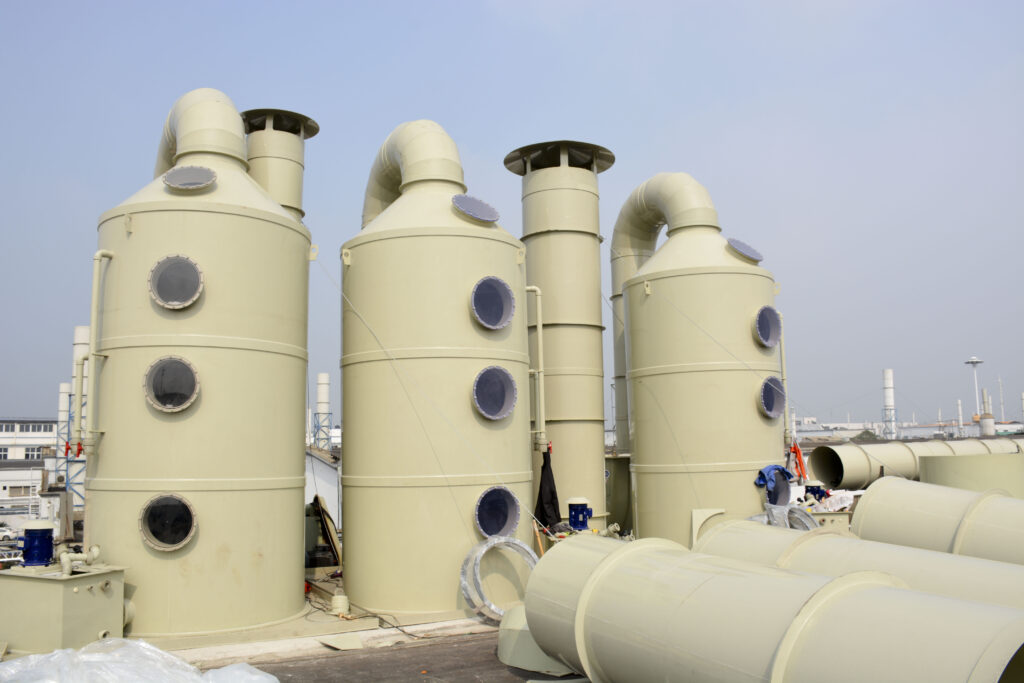
How Does a Wet Dust Collector Work? Types and Limits
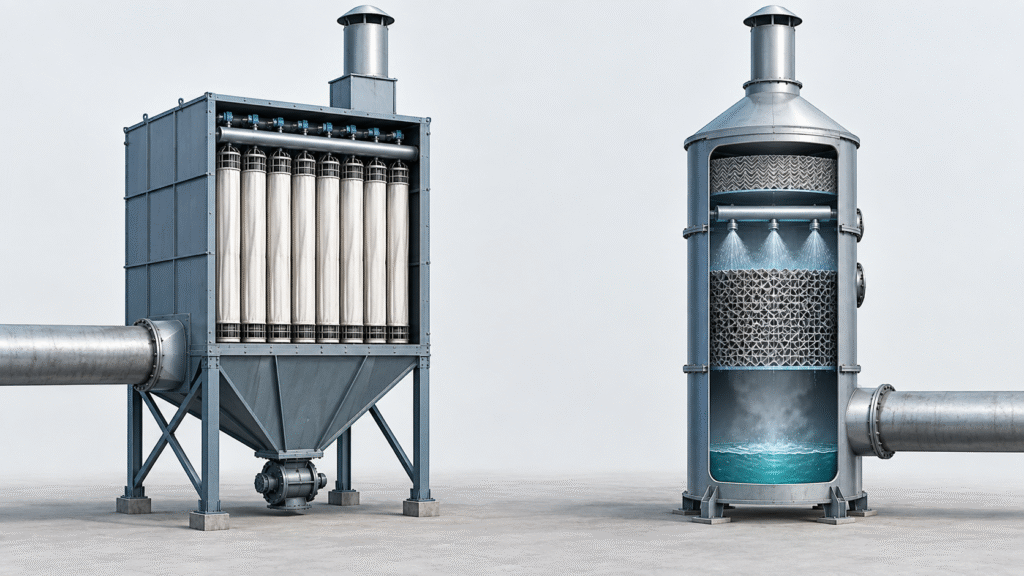
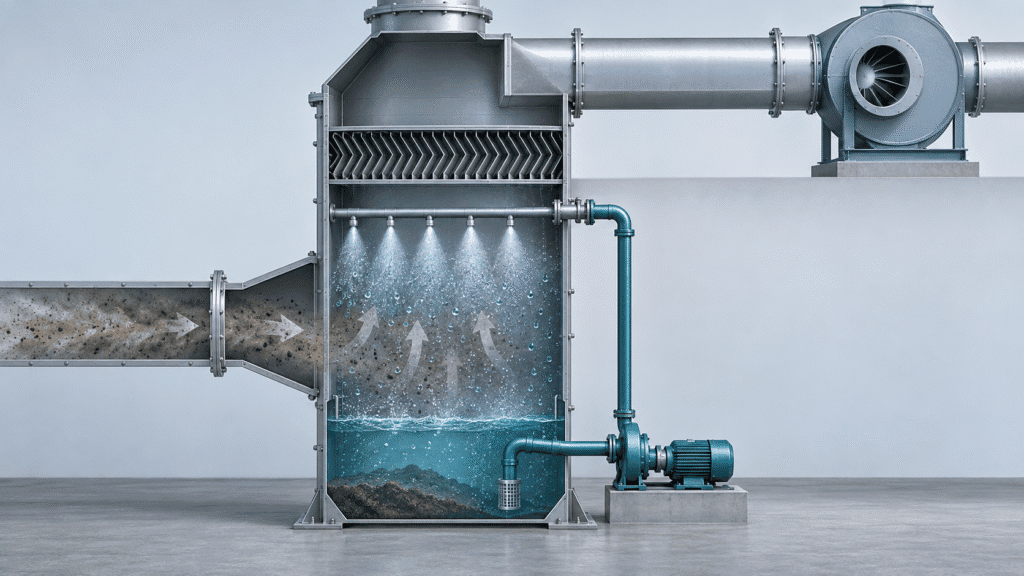
How does a wet dust collector work? Follow the capture mechanisms by particle size, the five wet collector designs for dust, and where wet collection fails.
Compare types of wet scrubbers by capture mechanism, dust limits, pressure drop and space. Use five inputs to eliminate options before you request a quote.
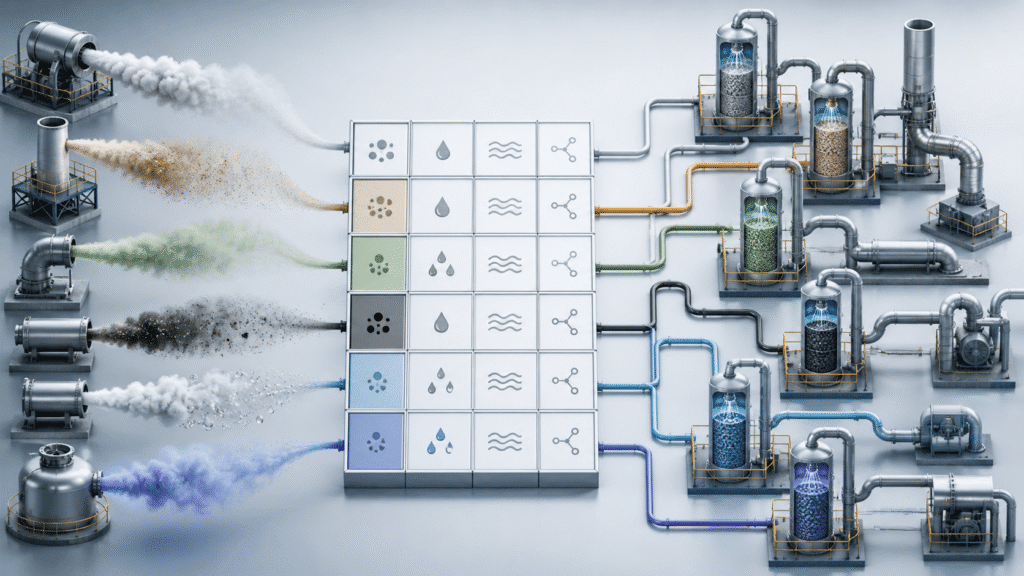
Engineering hub that routes H2S, SO2, HF, HCl, chlorine and ammonia loads to the right scrubber chemistry, materials and safety boundary – via one pollutant decision matrix, three screening questions, and a worked three-stream routing example.
Route semiconductor, glass, plastics extrusion, and automotive exhaust to the right abatement device with a process-by-process matrix.
Use a six-stage decision matrix to identify where your wet scrubber project stands, open the right guide, and prepare the data your supplier needs.
HF scrubber selection guide for engineers: how HF enters the gas stream, which wetted-zone materials survive the service, when wet vs dry is the right route, and how to handle fluoride-bearing wastewater under the applicable state NPDES permit.
Cyanide electroplating exhaust is a segregation problem before it is an airflow problem. This guide covers why acid and cyanide lines cannot share an exhaust system, what OSHA 1910.94(d) requires for open surface tanks, and the ten design inputs a qualified engineer needs to sign your segregation and exhaust basis.
Automotive manufacturing exhaust is six pollution problems wearing one label. This guide routes paint, pretreatment, welding, machining, battery, and plastics exhaust by pollutant form to a wet scrubber, filter, oxidizer, or carbon adsorber—with a verdict that is allowed to be not a scrubber.
A wet scrubber fits plastics extrusion exhaust when soluble acid gases or capturable particulate dominate, and it does not when poorly soluble VOC or condensable-heavy streams are the load. This guide walks the fit test — source characterization, pollutant form, five criteria, decision matrix — and ends with a source characterization data sheet to send to EHS and your vendor.
A scrubber room is more than the tower footprint: the input list covers envelope and clearances, access, drainage and containment, ventilation, chemical storage, utilities, lifting and code review. This guide builds the Facilities Input Data Sheet your designer, contractor and scrubber supplier confirm before design.
Incinerator exhaust is not boiler flue gas: SO2 arrives with HCl, fine particulate, and metals at temperatures that require a quench stage. This guide maps furnace type and feed to your acid load, matches your unit to the applicable NSPS or permit limit, and builds the design input sheet — liquid-to-gas ratio, pH, pressure drop, materials, monitoring — that a vendor needs to quote an SO2 scrubber for incinerator exhaust.
Wet scrubber rebuilds and retrofits are a shell-life decision, not an age decision. This guide walks a facility owner from the first degradation signals through a nine-point asset inspection to a repair/rebuild/replace decision matrix, then turns the branch into a supplier-ready scope definition with design inputs and acceptance criteria — without promising fixed service lives or guaranteed savings.
Glass furnace exhaust carries solid and condensable particulate, sulfur and halogen acid gases, and trace metal HAPs, and it is not always a wet scrubbing problem. This guide routes the stream between multi-stage wet scrubbing, dry sorbent injection, and filtration against EPA’s AP-42 factors and the NSPS and NESHAP limits, then sizes the multi-stage train of quench, venturi, packed tower, and demister from eight inputs a supplier needs, with a worked example for a container glass furnace.
A packed bed scrubber for semiconductor acid-gas exhaust is a counter-current wet scrubber that absorbs HCl, HF and other acids from etch, wet-clean and CVD tool exhaust. This guide covers which of the four fab stream classes belong on a packed-bed scrubber, how the tower captures acid gas and when it fits, HCl versus HF design differences, normal-versus-peak design basis, tower parameters, material and temperature boundaries, demisting, redundancy, monitoring, and a worked example that ends in a 12-field design input sheet you can hand to a supplier.
Wastewater tank vents and leachate exhaust can carry H2S above safe odor and exposure levels, so treatment starts with quantification, not equipment choice. This guide covers where vent gas comes from, how to estimate flow and H2S peaks, when a caustic wet scrubber, impregnated activated carbon, biological, or liquid-redox system fits, the six design inputs a vendor needs, a worked 150-cfm example, and inlet/outlet monitoring for acceptance.
Run a wet scrubber installation in five phases: site readiness, receiving, piping and instrumentation, leak testing, and commissioning — with a check item and an acceptance action at every step. This checklist covers foundation and utility verification, incoming inspection, P&ID instrument verification against EPA monitoring indicators, leak testing before energizing, pre-start checks, and commissioning acceptance against design criteria, with a ten-week worked example.
PP welding guide: hot gas welding step-by-step, extrusion welding, rod selection, temperature settings, common defects. Factory-direct PP welding rod and equipment. Get a quote.
PP tank design guide: chemical storage tanks for acid, alkali, and corrosive liquids. Rectangular vs cylindrical, wall thickness, welding, inspection. Get a quote.
PP plastic sheet guide: properties, thickness options (3-30mm), industrial applications, welding compatibility. Factory-direct PP sheet in custom sizes. Get a quote.
FRP anti-corrosion fan selection guide: centrifugal vs axial, sizing for corrosive exhaust, PP vs FRP fan comparison, installation tips. Factory-direct. Get a quote.
PP duct cost guide: prices by diameter, installation costs, 10-year TCO comparison vs steel and FRP. Factory-direct PP ductwork pricing. Get a quote.
Step-by-step PP duct installation guide: hot gas welding, support spacing, expansion joints, leak testing, and common mistakes. Factory-direct PP ductwork. Get a quote.
PP duct vs steel duct comparison: corrosion resistance, 10-year TCO, installation costs. PP ductwork saves 40% on lifetime costs vs SS304 in corrosive exhaust. Get a quote.
Scrubber efficiency calculation guide: NTU, HTU, L/G ratio, removal rate formulas with worked examples. Packed bed design parameters and pressure drop. Get a quote.
Electroplating ventilation system design guide: exhaust hood sizing, zoned duct layout, fan selection, and scrubber integration. PP construction, NFPA compliance, heat recovery. Get a quote.
Pharmaceutical exhaust treatment guide: wet scrubbers for solvent VOCs, acid gases, and dust from FBD, tablet coating, and reactor vents. PP construction, GMP compliance. Get a quote.
Semiconductor exhaust treatment guide: wet scrubbers for HF, HCl, NH₃ from CVD and etch processes. PP construction for HF resistance, PFC abatement, silane dust filtration. Get a quote.
Chemical plant exhaust treatment guide: packed bed, venturi, and spray tower scrubbers for HCl, H₂S, SO₂ plus carbon adsorption for VOCs. PP construction, batch reactor turndown. Get a quote.
NH3 scrubber design guide: acid (H₂SO₄) vs water scrubbing for ammonia removal. PP construction, ammonium sulfate recovery, sizing, dry vs wet comparison. Get a quote.
Chlorine gas scrubber design for emergency and continuous Cl₂ removal. Caustic NaOH chemistry, PP construction, sizing for water treatment and chemical plants. Get a quote.
SO2 scrubber design guide for industrial boilers and kilns. Compare wet limestone, NaOH, and seawater FGD methods. PP construction, 10-year TCO. Get a quote.
Electroplating acid scrubber design for HCl pickling, chrome mist, H₂SO₄ anodizing & cyanide exhaust. Zoned treatment, PP construction, global compliance. Get a quote.
H2S scrubber design guide: compare wet caustic, biological, and dry methods for hydrogen sulfide removal. PP construction, multi-stage sizing, 10-year TCO. Get a free system design.
Complete guide to polypropylene duct system design for industrial exhaust. Covers PP duct types, sizing calculations, welding methods, material comparison, and 10-year TCO analysis.
Activated carbon adsorption captures VOCs through physical adsorption — not chemical reaction, not combustion. Exhaust gas passes through a packed
The purchase price tells you almost nothing about what a carbon adsorption box actually costs. A PP carbon box may
A portable carbon filter box is a self-contained activated carbon adsorption unit designed for small exhaust volumes — typically 100–2,000
Three fundamentally different technologies compete for the same job — removing volatile organic compounds from industrial exhaust. Activated carbon adsorbs,
Standard carbon adsorption boxes are designed for clean factory environments — controlled exhaust from paint booths, chemical process vents, and
Carbon replacement is the largest recurring operating cost for any activated carbon adsorption system. For a mid-sized industrial installation treating
A carbon bed does not fail suddenly — it deteriorates predictably. The outlet VOC concentration rises along an S-shaped curve
Carbon adsorption boxes are not off-the-shelf products. They are fabricated to order — the material is cut, welded, and assembled
Choosing a carbon box manufacturer is not like ordering standard equipment from a catalog. The carbon adsorption box that handles
Electronics manufacturing generates a uniquely aggressive exhaust profile. PCB etching baths release HCl, HF, and HNO₃ mists alongside volatile organic
Activated carbon adsorption and wet scrubbing are the two most widely deployed industrial exhaust treatment technologies — yet they operate
The carbon media inside your filter determines everything: how much VOC mass you adsorb, how hard your fan works, how
Laboratory and pharmaceutical facilities generate exhaust that is chemically diverse, intermittently loaded, and subject to strict emission and workplace safety
Chemical plants and petrochemical facilities present the most demanding application for carbon adsorption: complex VOC mixtures, corrosive acid gases, fluctuating
Paint spraying and coating operations generate a specific and challenging exhaust profile: VOCs from solvent evaporation mixed with sticky overspray
A single carbon bed handles straightforward VOC streams — toluene, xylene, MEK — with predictable efficiency. But throw in paint