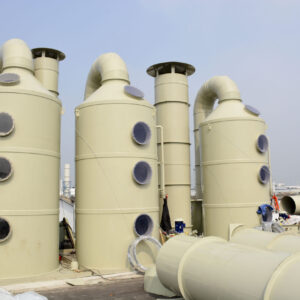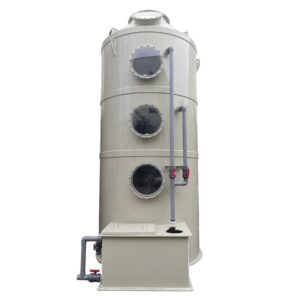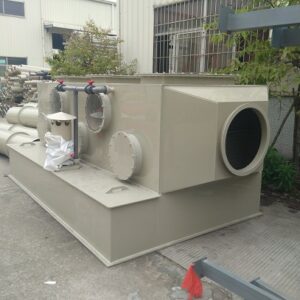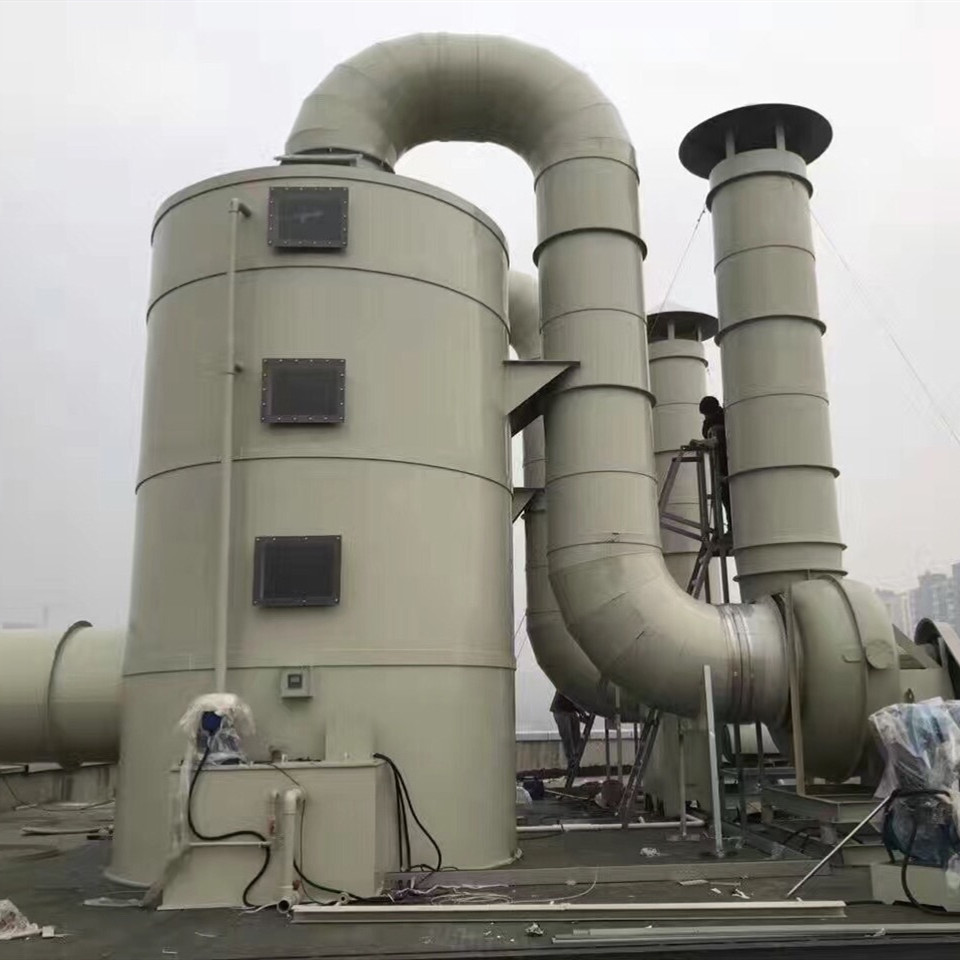
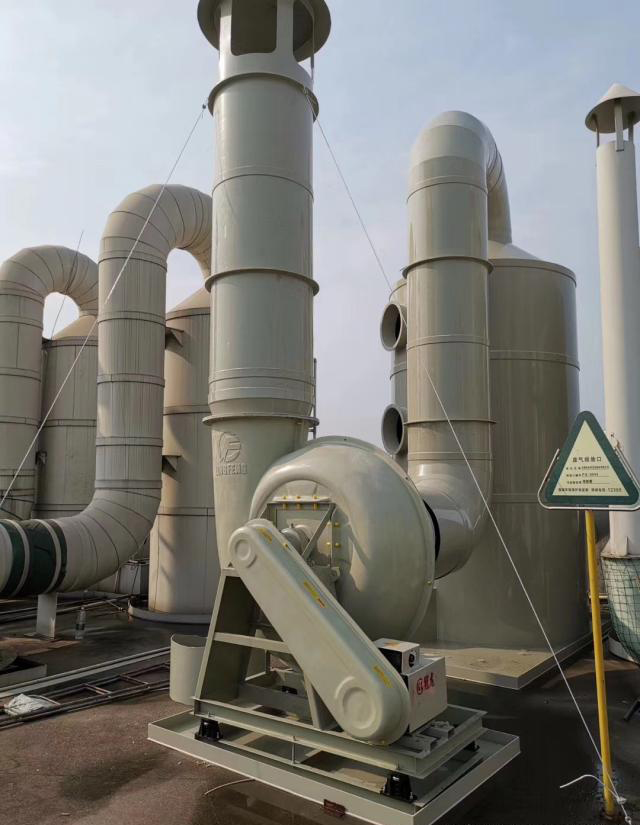
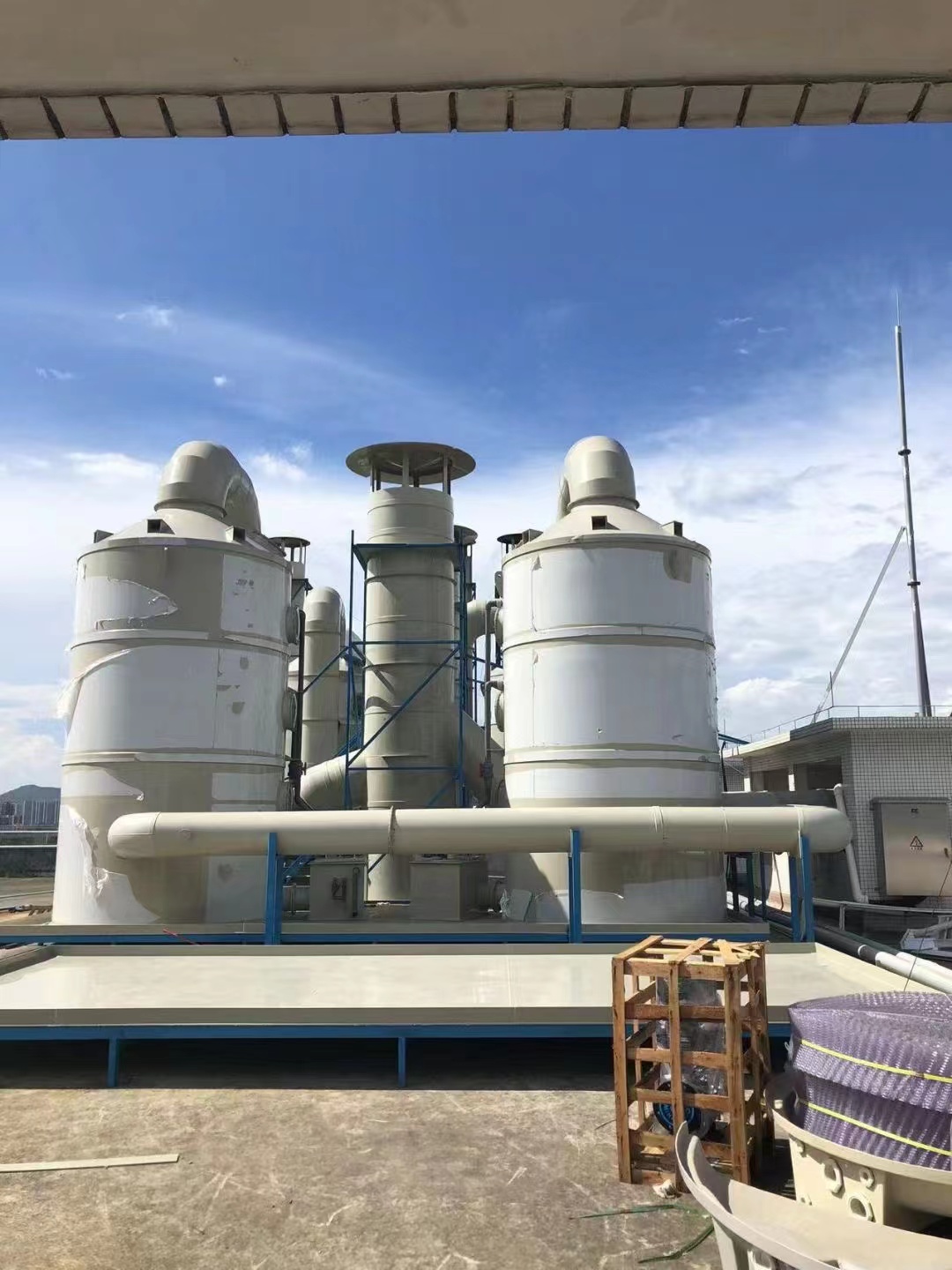
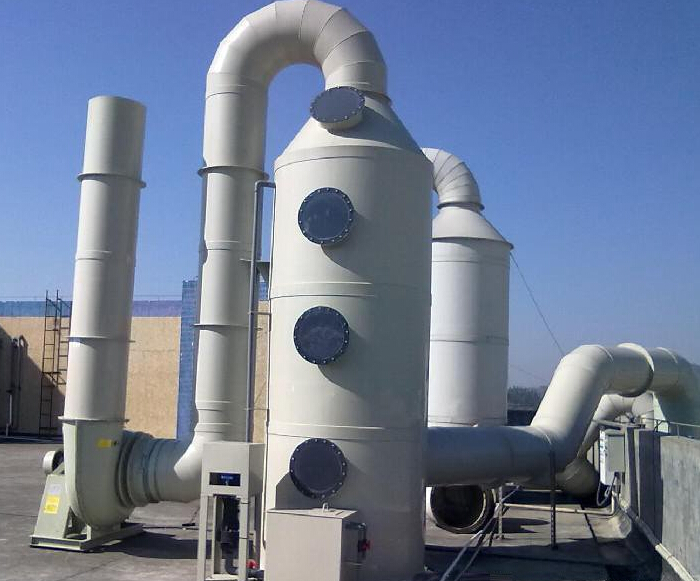
Product Overview
Datasheet and Project Review
An engineering datasheet with dimensional drawing, specification confirmation, and system integration notes can be prepared once the project configuration is confirmed.
To request a quotation, provide: gas composition and concentration, flow rate (m³/h) and temperature, material preference, and delivery location.
Industrial wet flue gas desulfurization (FGD) scrubber for SO2, SO3, and acid gas removal from boiler and furnace exhaust. Handles coal-fired, biomass, oil-fired, and waste-to-energy boilers from 1 ton to over 100 tons steam output. Includes integrated quench section for hot flue gas (up to 250 C inlet), packed bed absorption with alkaline scrubbing medium, and high-efficiency demisting. Designed to meet EU, US EPA, and local SO2 emission limits.
| Target pollutants | SO2, SO3, acid aerosols, particulates (co-removal); also HCl, HF if present in flue gas |
| Fuel types | Coal, biomass, oil, natural gas, waste-to-energy, biogas combustion |
| Scrubbing medium | NaOH, Na2CO3, Ca(OH)2 slurry (lime), or seawater — per site economics |
| Efficiency | over 95% SO2 removal; discharge meets EU and US EPA MATS limits |
| Boiler size | 1 – 100+ tons steam/hour; custom-sized to flue gas flow rate and SO2 loading |
| Lead time | 20-35 days standard; large multi-tower systems 35-60 days |
| Warranty | 12 months structure; SO2 removal performance guaranteed at specified inlet conditions |
Why Flue Gas Desulfurization Is Different
A boiler exhaust scrubber faces conditions that a room-temperature acid fume scrubber never sees: 180-250 C inlet gas, fly ash particulate loading of 500-5000 mg/Nm3, continuously varying SO2 concentration as fuel quality and boiler load change, and the risk of acid dewpoint corrosion if the gas temperature drops below the sulfuric acid condensation point. The quench section upstream of the packed bed handles the temperature gap — rapidly cooling flue gas from 250 C to under 80 C in under 0.5 seconds using high-volume recirculated water sprays. Get the quench wrong and you get wet-dry interface corrosion, thermal shock cracking in the PP shell, or incomplete cooling that sends hot gas into packing rated for 80 C. We design the quench for your specific flue gas conditions with a safety margin verified by computational fluid dynamics.
Read: Coal vs Biomass Power Plant Scrubber
Why Xicheng
16 years, 2600+ systems shipped worldwide. FGD scrubbers for industrial boilers is a specialized discipline — different from the general chemical scrubbers that make up most of the market. We’ve delivered over 200 boiler FGD systems:
- Quench that actually quenches. The quench is the most failure-prone section of any FGD scrubber. Undersized quench: incomplete cooling, packing damage, thermal warping. Oversized quench: excessive water consumption, pump energy waste, unnecessary blowdown volume. We design the quench for your specific flue gas conditions — temperature, moisture content, acid dewpoint — with a spray nozzle array that achieves complete evaporation before the gas reaches the packing.
- Fly ash management. For fly ash loading over 200 mg/Nm3, we include a pre-scrubber venturi or cyclone stage that removes 70-85 percent of particulates before they reach the packing. For very high ash loads (over 2000 mg/Nm3), we add a wet electrostatic precipitator upstream. The goal: keep your packing clean and your pressure drop stable between annual shutdowns.
- Fuel-flexible chemistry. Coal SO2 loading is predictable. Biomass isn’t — agricultural residue, wood chips, and palm kernel shells all have different sulfur contents. We size the chemical dosing system for the worst-case fuel scenario and include an automated pH-trim loop that adjusts reagent feed rate in real time.
Send your boiler specs and fuel analysis to xicheng023@outlook.com. We’ll size the quench and absorption sections for your specific flue gas conditions.
Core Advantages
- High Purification Efficiency: Delivers high dust removal and desulfurization efficiency. Effectively removes various industrial organic and inorganic waste gases, including HCL, HF, NH3, H2SO4, CrO3, HCN, NAOH, H2S, and HCHO.
- Durable and Premium Material: Manufactured using new PP material, offering excellent anti-corrosion and wear-resistant properties, ensuring a long service life and high cost-performance.
- Compact Design and Low Consumption: Features a simple structure that occupies minimal space. Operates stably with low energy consumption.
- Easy Installation and Operation: Improved with a floating packing layer, it is highly practical, easy to install, and simple to operate, making it ideal for acid-base waste gas treatment.
- Flexible Customization and After-Sales Service: Supports personalized customization; sizes and specifications can be adjusted according to customer needs and drawings. Comes with a 1-year warranty, professional installation guidance, and comprehensive overseas after-sales support.
Key Specifications
| Model No. | XC-1 |
| Material | New PP (Polypropylene) Material |
| Function | Waste Gas Treatment (Chemical Treatment) |
| Purifying Technology | HEPA |
| Automation | Automatic |
| Service Life | 8-10 Years |
| Color | Beige / Dark Grey |
| Environmental Temperature | Normal Temperature |
| Brand / Origin | Xicheng / China |
Certifications and Compliance
- CE Certified – Wet Scrubber, Exhaust Fan, Air Valve
- RoHS Compliant – Adsorption Tower materials
- ISO 9001 – Quality Management System
- ISO 14001 – Environmental Management System
- SGS Tested – PP Sheet, FR-PP Flame Retardant Sheet, PP Pipe, FR-PP Flame Retardant Pipe, PVC Sheet
- Design Compliance – Systems designed to meet EU Industrial Emissions Directive (2010/75/EU) including BAT conclusions for large combustion plants, US EPA MATS, and US EPA Boiler MACT.
Model Selection Table
Standard model range — all dimensions in millimeters. Custom sizes outside this range available on request.
| Air Volume (m3/h) | Diameter (mm) | Thickness (mm) | Drain Outlet | Water Tank (mm) | Inlet/Outlet Pipe | Pump (kW) | Air Resistance (Pa) |
|---|---|---|---|---|---|---|---|
| 3,000 | 800 | 8 | DN32 | 600x700xH700 | 315 | 0.75 | 500 |
| 5,000 | 1,000 | 8 | DN40 | 600x800xH700 | 400 | 1.5 | 500 |
| 8,000 | 1,200 | 8 | DN40 | 600x1000xH700 | 500 | 2.2 | 500 |
| 10,000 | 1,500 | 10 | DN40 | 700x1000xH700 | 550 | 2.2 | 500 |
| 12,000 | 1,600 | 10 | DN50 | 700x1000xH700 | 600 | 3.75 | 500 |
| 15,000 | 1,800 | 10 | DN50 | 700x1200xH700 | 650 | 3.75 | 500 |
| 20,000 | 2,000 | 10 | DN50 | 700x1200xH700 | 750 | 5.5 | 500 |
| 25,000 | 2,200 | 10 | DN50 | 700x1200xH700 | 950 | 5.5 | 600 |
| 30,000 | 2,500 | 12 | DN65 | 700x1200xH700 | 1,000 | 5.5 | 600 |
| 35,000 | 2,700 | 12 | DN65 | 1000x700xH700 | 1,100 | 7.5 | 600 |
| 40,000 | 2,900 | 12 | DN65 | 1000x700xH700 | 1,200 | 7.5 | 600 |
| 45,000 | 3,000 | 12 | DN65 | 1000x700xH700 | 1,250 | 7.5 | 600 |
Custom sizes: Up to 500,000 Nm3/h flue gas flow. Contact our engineers — xicheng023@outlook.com.
Technical Specifications
| Flue gas flow | 2,000 – 500,000 Nm3/h (single tower); parallel for larger boilers |
| Inlet temperature | Up to 250 C (with quench); higher with pre-cooler |
| Outlet temperature | Under 60 C (saturated); reheat option for plume suppression |
| Material | PP with FRP overwrap (standard); FRP (high-temp); 316L SS (combined high-SO2 + high-Cl) |
| Quench section | High-volume recirculated water spray; under 0.5 seconds contact; 250 C to under 80 C |
| Packing media | PP Pall rings 50 mm (standard; larger size resists fouling); structured packing (max efficiency) |
| Liquid-to-gas ratio | 3-8 L/Nm3 (SO2 concentration-dependent) |
| SO2 removal | over 95% single-stage; over 98% dual-alkali or two-stage |
| Particulate removal | over 70% (packed bed alone); over 95% (with venturi pre-scrubber); over 99% (with upstream WESP) |
| Pressure drop | 800 – 2500 Pa (quench + packing + demister) |
| Chemical dosing | Automated pH-trim loop with SO2 inlet feed-forward control |
| Design standard | GB/T 13931-2017; CE certified. See US EPA Boiler MACT for industrial boiler emission requirements. |
Scrubbing Chemistry Options
| Reagent | Cost per ton SO2 | Byproduct | Best for |
|---|---|---|---|
| NaOH (sodium hydroxide) | Higher | Na2SO4 / Na2SO3 solution | Small-medium boilers (under 30 tons); simple operation; no scaling risk |
| Ca(OH)2 (lime slurry) | Lowest | CaSO4 (gypsum) — can be dewatered | Large boilers (over 30 tons); lowest chemical cost |
| Na2CO3 (soda ash) | Medium | Na2SO4 solution | Medium boilers; lower hazard than NaOH |
| Seawater (once-through) | Negligible | Natural sulfate returned to sea | Coastal power plants with seawater cooling |
Selection Notes
Good Fit Conditions
This product is suitable when the application matches the design specifications listed in the technical table above. Confirm gas composition, airflow, temperature, and material compatibility before ordering.
When to Review with Engineering
- Gas temperature exceeds the material limit for standard construction
- Particulate or sticky components are present in the exhaust stream
- Mixed pollutants require multi-stage or dual-reagent treatment
- Site constraints limit available footprint, headroom, or utility connections
How to Order
- You send – Boiler type and fuel, steam output (tons/hour), flue gas flow rate (Nm3/h), fuel sulfur content, inlet SO2 concentration, emission limit, site altitude, water quality
- We analyze – Flue gas composition from fuel analysis, quench water requirement, SO2 mass loading, chemical consumption estimate, wastewater volume
- We design – Quench and absorber sizing, packing selection, reagent option comparison with lifetime cost estimate, P&ID with control philosophy
- You approve – Technical proposal with SO2 removal guarantee at your specified fuel and operating conditions, 3D layout, and pricing
- We build – 20-35 days standard. Quench nozzle spray pattern test, hydrostatic test, chemical dosing bench test
- We ship – Large vessels may require open-top or flat-rack containers. Installation drawings, commissioning procedure with quench performance verification included.
Contact our engineers at xicheng023@outlook.com or WhatsApp +86 18927456906 — proposal within 24 hours.
Complete Your System
- Industrial Spray Scrubber Tower – For non-combustion acid gas treatment
- Packed Bed Wet Scrubber – Maximum SO2 removal with structured packing
- PP Exhaust Duct and Fittings – Corrosion-resistant flue gas ductwork
- PP/FRP Centrifugal Fan – Induced-draft fan sized for FGD system
- Activated Carbon Adsorption Tower – Mercury and dioxin polishing for WTE
Global Shipping
Best Fit Applications
Not Recommended / Engineering Limits
- High-chloride flue gas: If gas contains HCl above NEEDS_HUMAN_INPUT ppm, a pre-scrubber is needed to avoid chloride buildup.
- High particulate (>NEEDS_HUMAN_INPUT mg/Nm³): Install cyclone or baghouse upstream.
- Zero-liquid-discharge: FGD produces continuous blowdown. A crystallizer or spray dryer is required if no discharge allowed.
This SO₂/FGD scrubber is designed for:
- Target gas: SO₂ and SO₃ from combustion or process exhaust
- Inlet concentration: 500–8000 ppm SO₂
- Airflow: 5,000–50,000 m³/h per train
- Removal efficiency: 95–99%+ with caustic or lime absorption
- Best industries: Boiler exhaust, chemical processing, mineral processing, waste-to-energy
We ship worldwide with documented export experience across Southeast Asia, South Asia, Middle East, Africa, Europe, Americas, and Oceania. FGD scrubbers for larger boilers may require break-bulk or flat-rack shipping due to vessel diameter. We handle all logistics planning, inland transport coordination, and export documentation.
FAQ
Why PP for FGD? What about rubber-lined steel?
Rubber-lined carbon steel is traditional for large power-plant FGD, but for industrial boilers (1-50 tons) PP is 30-50 percent lower capital cost. A PP vessel is homogeneous — no lining to fail from pinhole defects. FRP is an alternative for higher temperatures; we build both and recommend based on your conditions. Read: PP vs FRP Wet Scrubber.
What about wastewater from the FGD system?
All wet FGD systems produce wastewater blowdown containing dissolved salts, trace metals, and suspended solids from fly ash — typically 0.5-2 m3 per ton of SO2 removed. Treatment requirements depend on your site discharge permit. We can include a basic wastewater treatment package or interface with your existing treatment plant.
Can you guarantee SO2 removal at varying boiler loads?
Yes. We design for your specified operating envelope: minimum to maximum load and SO2 inlet. The automated pH-trim loop with SO2 feed-forward control adjusts chemical dosing in real time. Performance guarantee covers the specified operating range.
Power Plant Scrubber Cost Analysis
Learn More on Our Blog
FGD and Combustion
- Coal vs Biomass Power Plant Scrubber
- Power Plant Scrubber Cost Analysis
- Gas Scrubber Types (H2S, Acid, Fuel Gas)
Design and Engineering
- How to Size a PP Wet Scrubber
- Acid Scrubber System Design Engineering
- PP vs FRP Wet Scrubber Comparison
Cost and Maintenance
Contact the Xicheng Engineering Team Today.
Send us your project specifications. Our engineers will prepare a product configuration, system integration proposal, and quotation within 24 hours.
🎯 Manufacturing Head Office: No. 34 Zhenxing Road (Shengtaian Heavy Industrial Park B), Loucun, Guangming New District, Shenzhen, Guangdong, China
☎️ Direct Hotline / WhatsApp: +86 189 2745 6906
📬 Engineering Mailbox: xicheng023@outlook.com