

Product Overview
What This Chlorine Scrubber Is
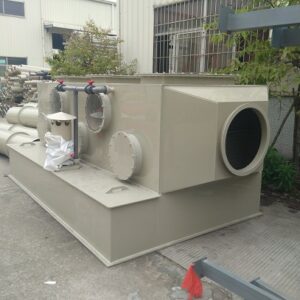
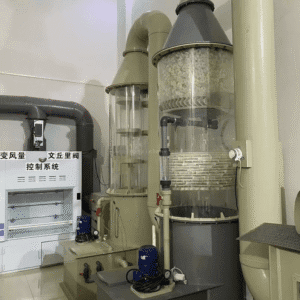
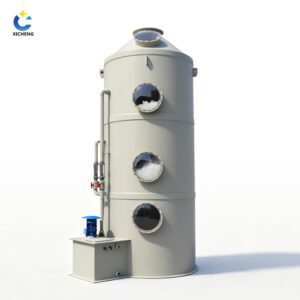
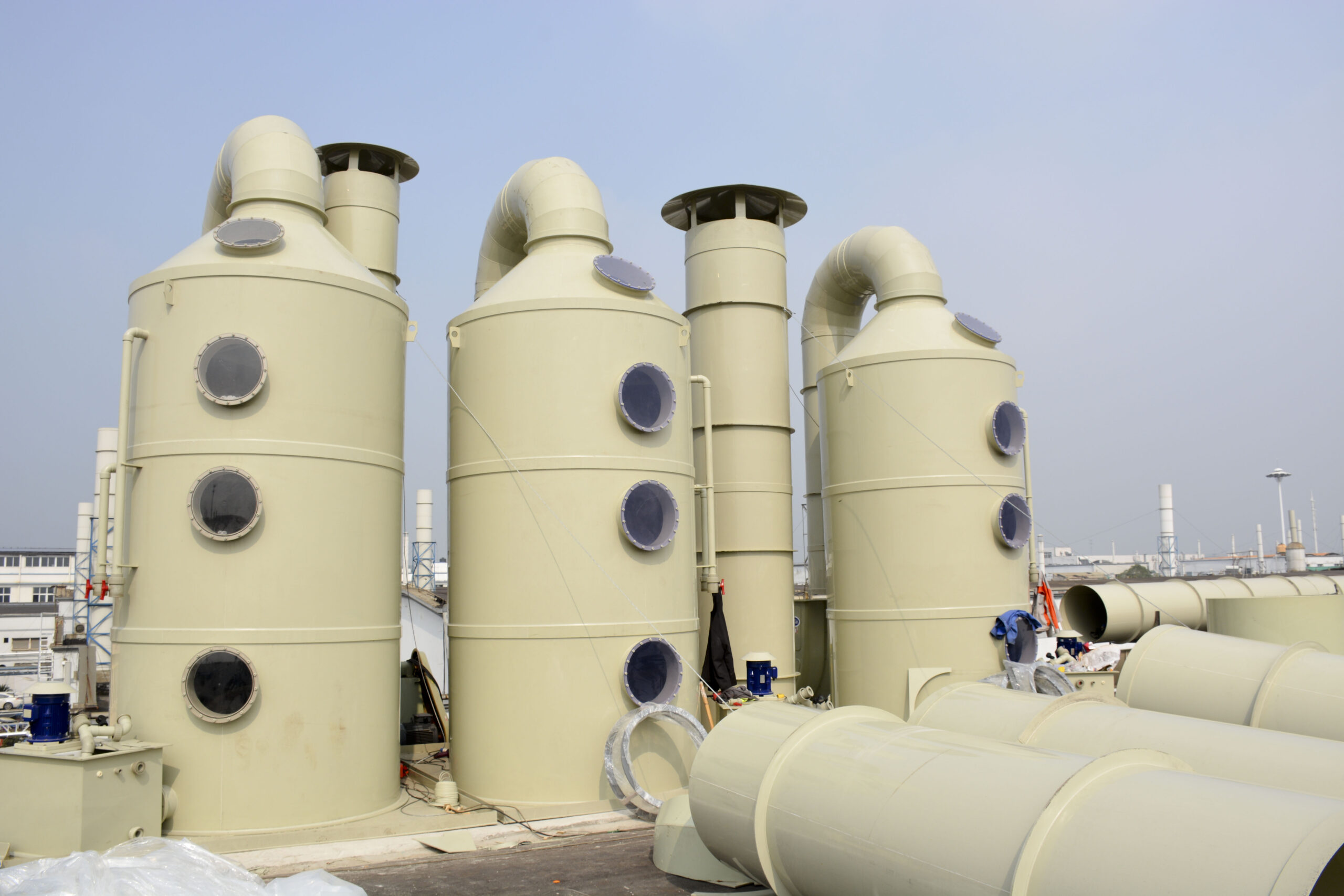
A chlorine gas scrubber is a packed bed wet scrubbing system designed to remove chlorine (Cl₂) gas from industrial exhaust and emergency vent streams. Chlorine is a highly reactive oxidizing gas that requires specialized absorption chemistry — typically sodium hydroxide (NaOH) — to convert Cl₂ to sodium hypochlorite (NaOCl) and sodium chloride (NaCl). The gas enters at the bottom and flows upward through packing while caustic solution flows downward, absorbing and neutralizing chlorine before discharge.
XICHENG EP chlorine scrubbers are built from oxidation-stabilized polypropylene (PP) to withstand the aggressive oxidizing environment. Standard configurations handle inlet concentrations up to NEEDS_HUMAN_INPUT ppm with removal efficiency exceeding 95% at design conditions. Units are available for both continuous process exhaust and emergency scrubber duty.
System Boundary
The chlorine scrubber supply includes the tower vessel, packing media, liquid distribution system, and mist eliminator. Not included unless specified: recirculation pump, caustic storage tank, ORP (oxidation-reduction potential) control panel, exhaust fan, ductwork, and emergency dump system components.
How Buyers Should Evaluate Fit
- Is chlorine the primary contaminant? Cl₂ requires NaOH/ORP-controlled scrubbing. Other gases may need different chemistry.
- Is the gas temperature controlled? Dry chlorine above 50 °C accelerates PP degradation. A quench section may be required.
- Is this for emergency or continuous duty? Emergency scrubbers operate only during chlorine release events; continuous scrubbers run 24/7.
Water Treatment Chlorination Rooms
Water treatment facilities using chlorine gas for disinfection must contain any chlorine release from cylinder storage, vaporizer, or injection areas. Emergency scrubbers for these applications are designed for rapid startup within seconds of a leak detection alarm, with sufficient caustic inventory to handle full cylinder release events.
Chemical Manufacturing
PVC production, phosgene synthesis, and other chlorination processes generate consistent Cl₂ vent streams requiring continuous scrubbing. Our continuous-duty chlorine scrubbers are designed for 24/7 operation with automatic ORP-controlled caustic feed and heat rejection systems.
Key Features
Oxidation-Stabilized PP Construction
Chlorine gas is a strong oxidizer. Standard PP grades degrade faster in Cl₂ service. XICHENG EP uses oxidation-stabilized PP that resists attack by chlorine and hypochlorite, extending service life in continuous and intermittent Cl₂ scrubbing applications.
ORP-Controlled Caustic Dosing
The Cl₂ + NaOH reaction is self-indicating via oxidation-reduction potential (ORP). An ORP controller automatically modulates caustic feed to match chlorine load, preventing excess caustic consumption while ensuring complete absorption.
Emergency Duty Design Option
Emergency chlorine scrubbers are designed for intermittent high-concentration events with rapid caustic recirculation startup, heat rejection capacity, and fail-safe operation on loss of power.
Technical Specifications
| Parameter | Specification |
|---|---|
| Product Type | Chlorine gas wet scrubber |
| Material | Oxidation-stabilized PP (standard) |
| Optional Material | FRP, PVC, PVDF (for high-temp) |
| Removal Efficiency | >95% at design conditions |
| Inlet Cl₂ Concentration | NEEDS_HUMAN_INPUT ppm (project-based) |
| Operating Temperature (PP) | Up to 50 °C continuous (Cl₂ service) |
| Absorption Chemistry | NaOH solution (pH 10–12) |
| Reaction Product | NaOCl (sodium hypochlorite) + NaCl |
| Control Method | ORP controller (optional) |
| Application | Continuous process exhaust / emergency scrubber |
Project-specific values confirmed during quotation.
Chlorine Absorption Chemistry
NaOH Reaction Path
Chlorine reacts with sodium hydroxide in two stages: Cl₂ + 2NaOH → NaOCl + NaCl + H₂O. The reaction is exothermic (approximately −105 kJ/mol Cl₂). At elevated temperature, NaOCl can further decompose to NaCl + O₂, reducing available oxidant and creating gas bubbles in the recirculation liquid. ORP control at 600–700 mV (vs Ag/AgCl) indicates optimal caustic dosing.
pH and Temperature Control
Maintain recirculating liquid pH at 10–12 for efficient Cl₂ absorption. Below pH 9, hypochlorite converts to Cl₂ gas and re-enters the vapor phase. Above 50 °C, NaOCl decomposition accelerates, reducing scrubbing efficiency and creating oxygen gas that can cause cavitation in the recirculation pump.
Byproducts and Blowdown
The scrubbing produces sodium hypochlorite (NaOCl) — a common industrial bleach — and sodium chloride. The blowdown can be used as a dilute bleach solution for wastewater treatment if local regulations permit, or neutralized with reducing agent before discharge.
Available Sizes and Model Selection
Size Reference (Project-Based)
| Airflow (m³/h) | Tower Diameter (mm) | Packing Depth (mm) | Recirculation (m³/h) |
|---|---|---|---|
| 500–2,000 | 500–800 | 800–1,200 | 5–15 |
| 2,000–8,000 | 800–1,200 | 1,000–1,500 | 15–40 |
| 8,000–20,000 | 1,200–1,800 | 1,200–1,800 | 40–100 |
| 20,000–40,000 | 1,800–2,400 | 1,500–2,000 | 80–200 |
Custom and Emergency Duty Design
Emergency scrubbers require larger liquid holdup and heat rejection capacity. Specify if the unit is for emergency-only, continuous, or combined duty.
Applications
Water and Wastewater Disinfection
Chlorine gas is used for disinfection in municipal water treatment. Scrubbers treat cylinder storage room exhaust and process vents.
Chemical Processing
PVC production, chlorinated solvents, isocyanates, and other chlorination processes generate Cl₂ vent streams requiring continuous scrubbing.
Pulp and Paper Bleaching
Chlorine dioxide and elemental chlorine used in pulp bleaching require scrubbers for chlorine gas containment.
Emergency Chlorine Containment
Facilities storing or using chlorine in bulk quantities (water treatment, chemical plants) are required to have emergency scrubber systems to handle cylinder or pipeline rupture events.
Selection Notes
When a Chlorine Scrubber Is a Good Fit
- Primary contaminant is chlorine gas (Cl₂) at measurable concentration
- Gas temperature is below 50 °C for PP construction
- Operation is continuous or emergency-batch with proper heat rejection
- Caustic supply and ORP control can be maintained
When Other Solutions May Be Needed
- Dry chlorine above 50 °C: Accelerates PP degradation. Use FRP, PVDF, or quench section upstream.
- Very high concentration (>NEEDS_HUMAN_INPUT ppm): The exothermic reaction may overheat the tower. A staged or cooled design is needed.
- Mixed gas streams (Cl₂ + organics): Hypochlorite can react with organics to form chlorinated byproducts. Review chemistry before design.
Quotation Requirements
Gas composition and Cl₂ concentration, gas flow rate and temperature, continuous or emergency duty, preferred material (PP, FRP, PVDF), and delivery location.
Request a Quote for Chlorine Scrubber →
Why Xicheng
XICHENG EP has delivered 2,600+ wet scrubber systems to 60+ countries since 2008. Our chlorine scrubbers are engineered with oxidation-stabilized PP, ORP control integration, and project-specific design. Each unit is supported by CE, ISO 9001, ISO 14001, and SGS certification. We provide custom engineering, factory-direct pricing, and global shipping with installation support.
Global Shipping and Support
We ship to all major industrial regions worldwide including North America, Europe, Southeast Asia, the Middle East, and Africa. Each scrubber is securely crated for export and shipped via sea, air, or land according to project schedule. On-site installation supervision and commissioning support are available on request.
Complete Your System
A complete chlorine scrubbing system may include: chlorine gas scrubber tower, caustic storage tank and dosing system, ORP control panel, recirculation pump with piping, exhaust fan and ductwork, chlorine gas detector and alarm, and emergency dump system. These components are selected based on project requirements and are not automatically included with the scrubber supply.
Datasheet and Quotation Information
An engineering datasheet with dimensional drawing can be prepared once configuration is confirmed.
To request a quotation: gas composition and SO2 concentration, flow rate and temperature, absorbent preference.
Frequently Asked Questions
What is the difference between a chlorine scrubber and an acid gas scrubber?
Chlorine is an oxidizing gas, not just an acid gas. It requires NaOH absorption with ORP control, whereas acid gas scrubbers for HCl or HF typically use pH-controlled caustic dosing. Chlorine also generates significant heat during absorption, requiring attention to temperature control.
Can a chlorine scrubber handle other gases?
Cl₂ scrubbers using NaOH can also absorb HCl, SO₂, and H₂S to varying degrees. However, if Cl₂ is not the primary contaminant, a multi-purpose chemical scrubber is more appropriate.
What materials are suitable for chlorine scrubbing?
Oxidation-stabilized PP is the standard. FRP with vinyl ester resin is suitable up to 120 °C. PVC is acceptable for low-temperature pipework. Stainless steel is NOT recommended — chlorine and hypochlorite cause rapid pitting and stress corrosion cracking.
How is blowdown handled?
The blowdown contains sodium hypochlorite (NaOCl) and sodium chloride. NaOCl decomposes naturally over time. If discharge limits apply, neutralize with sodium bisulfite or thiosulfate before disposal.
What is the recommended caustic concentration for Cl₂ scrubbing?
Typical NaOH concentration is 10–20 wt% in the recirculation tank. Higher concentrations increase reaction rate but also increase viscosity and pumping cost. The ORP controller adjusts caustic feed to maintain optimal dosing regardless of fluctuating Cl₂ load.
How often should the packing be replaced in chlorine service?
Packing lifespan in Cl₂ service is typically 3–5 years, shorter than in acid gas service due to the oxidizing environment. Annual inspection of packing condition is recommended. Polypropylene packing shows visible degradation (discoloration, embrittlement) before mechanical failure, providing visual warning.
Engineering guide: Review emergency and continuous chlorine scrubber design before defining the duty case, reagent controls, and standby requirements.
Frequently Asked Questions
Can a chlorine scrubber handle chlorine dioxide?
Chlorine dioxide (ClO₂) has different chemistry than Cl₂. It requires specific absorption conditions and is not effectively removed by standard chlorine scrubbers. Contact our engineering team with your specific gas composition.
What is the lifespan of a PP chlorine scrubber?
With oxidation-stabilized PP and proper operating conditions (temperature below 50 °C, controlled pH), a chlorine scrubber typically lasts 5–10 years. The oxidizing environment reduces PP lifespan compared to acid gas service. Regular inspection of wall thickness is recommended after 3 years.
Is an emergency chlorine scrubber different from a continuous scrubber?
Yes. Emergency scrubbers are designed for intermittent high-concentration events with rapid startup, larger liquid holdup for heat absorption, and fail-safe operation. Continuous scrubbers are optimized for steady-state lower concentrations with automatic chemical feed. Some installations require combined-duty designs.
What ORP setpoint is used for chlorine scrubbing?
Typical ORP setpoint for Cl₂ + NaOH absorption is 600–700 mV (vs Ag/AgCl reference). Below 600 mV, caustic is overdosed. Above 750 mV, free chlorine may break through. The optimal setpoint is confirmed during commissioning.
Certifications and Compliance
- CE (Pressure Equipment Directive 2014/68/EU)
- ISO 9001:2015 Quality Management
- ISO 14001:2015 Environmental Management
- SGS Product Compliance Verification
- RoHS Directive 2011/65/EU
Contact the Xicheng Engineering Team Today.
Send us your chlorine gas composition and concentration, gas flow rate, temperature, and preferred material. Our engineers will prepare a chlorine-specific scrubber configuration and quotation within 24 hours.
🎯 Manufacturing Head Office: No. 34 Zhenxing Road (Shengtaian Heavy Industrial Park B), Loucun, Guangming New District, Shenzhen, Guangdong, China
☎️ Direct Hotline / WhatsApp: +86 189 2745 6906
📬 Engineering Mailbox: xicheng023@outlook.com