
Activated Carbon Adsorption Equipment
Showing all 6 resultsSorted by latest
-
 Activated Carbon Adsorption Equipment
Activated Carbon Air Filter for H₂S Removal | Industrial Odor Control System
$899.00 Add to cart -
Activated Carbon Adsorption Equipment
Industrial Activated Carbon Adsorption Tower | Waste Gas Treatment Equipment
$599.00 Add to cart -
Activated Carbon Adsorption Equipment
Activated Carbon Bed System | Packed Bed Flue Gas Treatment Equipment
$899.00 Add to cart -
Activated Carbon Adsorption Equipment
PP Activated Carbon Tower | Industrial Carbon Adsorption Column
$999.00 Add to cart -
Activated Carbon Adsorption Equipment
PP Activated Carbon Tower | Industrial Carbon Adsorption Column
$599.00 Add to cart -
Activated Carbon Adsorption Equipment
Industrial Activated Carbon Filter | Carbon Air Filtration System
$599.00 Ali entrance
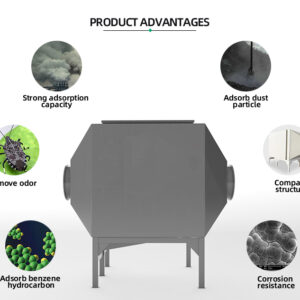


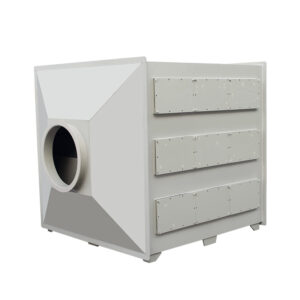
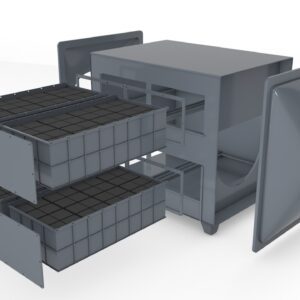

Industrial Activated Carbon Adsorption Equipment for VOC & Odor Control
Activated carbon adsorption removes 90-99% of VOCs, odors, and solvent vapors from industrial exhaust through physical adsorption onto activated carbon’s porous surface (500-1,500 m2/g specific surface area). According to EPA technical guidance, carbon adsorption is the best available control technology (BACT) for many VOC emission sources where recovery or thermal oxidation is not economical. XICHENG EP manufactures complete PP-housed carbon adsorption systems for corrosive exhaust environments where standard steel housings fail.
| Configuration | Best For | Airflow Range |
|---|---|---|
| Vertical Adsorption Tower | High-concentration VOCs, solvent recovery | 1,000-50,000 m3/h |
| Horizontal Carbon Box | Moderate VOC loads, space-constrained | 500-30,000 m3/h |
| Single-Stage | Single pollutant, moderate concentration | 500-50,000 m3/h |
| Multi-Stage | Mixed VOCs, high concentration, critical compliance | 1,000-30,000 m3/h |
PP housing vs steel vs FRP for carbon systems
PP-housed carbon systems handle corrosive exhaust where steel corrodes within months. PP provides zero-corrosion service life of 15-20 years in acid-gas environments. FRP offers higher temperature resistance but costs 40-60% more. PP systems are 30-40% lighter than steel equivalents, reducing structural support requirements. See our PP vs Stainless Steel comparison.
When to choose carbon adsorption over wet scrubbing or thermal oxidation
Carbon adsorption is optimal for VOC concentrations below 1,000 ppm where recovery value exists or thermal oxidation fuel cost is prohibitive. Wet scrubbing suits water-soluble gases (acids, NH3). Thermal oxidation suits high-concentration VOCs above 25% LEL. For mixed pollutant streams, multi-stage systems combining wet scrubbing + carbon adsorption achieve the highest overall removal efficiency. See our technology comparison and three-way comparison.
Frequently Asked Questions
How often does activated carbon need replacement?
Typical service life is 6-18 months depending on VOC concentration, airflow, temperature, and humidity. Breakthrough testing determines exact replacement timing. See our breakthrough testing guide.
Can spent carbon be regenerated?
Yes, for most organic VOCs. Thermal regeneration at 800-900 C restores 90-95% of adsorption capacity. On-site regeneration is not economical for small systems; off-site reactivation services are available.
What VOCs can activated carbon remove?
Effective for most organic solvents: toluene, xylene, MEK, acetone, IPA, ethyl acetate, hexane, and chlorinated solvents. Not effective for methanol, formaldehyde, or low-molecular-weight aldehydes. For specific chemical compatibility, contact our engineering team.