
Product Overview
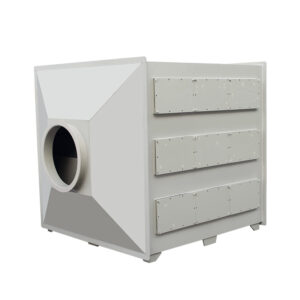
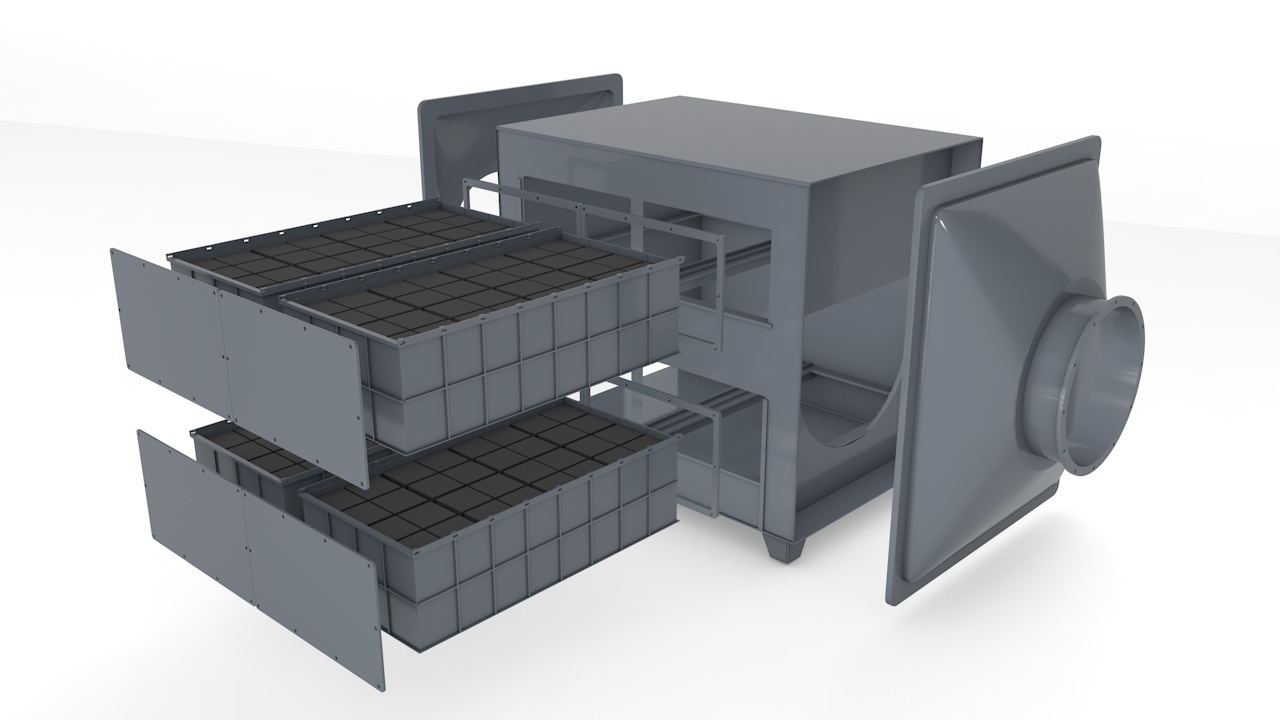
PP (polypropylene) activated carbon tower for industrial exhaust gas adsorption — a corrosion-resistant, lightweight alternative to stainless steel and FRP carbon vessels. Virgin PP construction provides inherent chemical resistance to acids, alkalis, and solvent-laden exhaust without the cost and weight penalty of exotic alloys. Designed as a vertical adsorption column with modular carbon tray inserts: gas enters from the side or bottom, passes through multiple activated carbon layers, and exits clean at the opposite end. Suited for chemical processing, electroplating, laboratory, pharmaceutical, and general industrial exhaust where both the pollutant and the environment demand corrosion-resistant equipment.
| Application | Corrosive exhaust gas adsorption: acid gas pre-cleaned streams, solvent vapors, VOC and odor removal in chemical environments |
| Material | Virgin PP (Polypropylene) — standard construction; PP plus UV stabilizer for outdoor installation; SS304/316L internals available for high-temperature zones |
| Structure | Vertical tower/column with multi-layer carbon tray inserts; single-side or double-side inlet configurations |
| Carbon media | Cylindrical activated carbon, diameter 4 mm; granular, pellet, honeycomb, and impregnated types available |
| Efficiency | 90%-95% for VOCs and odorous compounds; higher with multi-tower series arrangement |
| Air volume | 1,500 – 60,000 m3/h single tower; multi-tower parallel for larger systems |
| Lead time | 15-25 days |
| Warranty | 12 months PP tower structure; carbon media replaced per operating schedule |
Why PP Construction for Carbon Adsorption Towers
Material selection determines the service life and total cost of ownership of a carbon adsorption tower. While stainless steel offers high strength and temperature tolerance, and FRP offers excellent corrosion performance, PP occupies a practical middle ground that suits the majority of industrial carbon adsorption applications:
- Inherent corrosion resistance. PP is resistant to most acids (HCl, H2SO4, HNO3 at moderate concentrations), alkalis (NaOH, KOH), salt solutions, and organic solvents at ambient to moderate temperatures. Unlike SS304/316L, PP does not suffer pitting corrosion, stress corrosion cracking, or crevice corrosion in chloride-containing environments — critical for plants handling HCl, chlorinated solvents, or marine-atmosphere locations. This corrosion resistance extends the equipment service life to 8-10 years with minimal maintenance, consistent with US EPA NESHAP requirements for continuous emission control equipment reliability.
- Lightweight, lower installed cost. PP at 8-12 mm thickness weighs roughly 1/5 of an equivalent stainless steel vessel. Lighter weight means smaller support structures, easier rigging and installation, lower freight cost, and simpler on-site handling — particularly valuable for rooftop installations, mezzanine-level equipment platforms, and export shipments to remote sites.
- No painting, no coating maintenance. Carbon steel requires periodic repainting and coating repair to prevent rust — especially in chemical environments where atmospheric corrosion accelerates coating failure. PP is solid color throughout (beige or dark grey), never needs painting, and cannot rust. The surface is smooth and non-porous, resisting chemical staining and making cleaning straightforward.
- Compatible with multi-material design. For exhaust streams with elevated temperature zones or high solvent concentrations that challenge PP, we build hybrid towers: PP main structure with SS316L internals (support grids, fasteners) where local strength or temperature tolerance is needed. This gets you the corrosion resistance of PP where it matters with the mechanical properties of steel where it’s required.
Why Xicheng
16 years, 2600+ systems shipped worldwide. PP fabrication quality varies enormously between manufacturers. Poor welding, inadequate material thickness, and shortcut engineering produce towers that distort under vacuum, leak at seams, or collapse under negative pressure within months of installation:
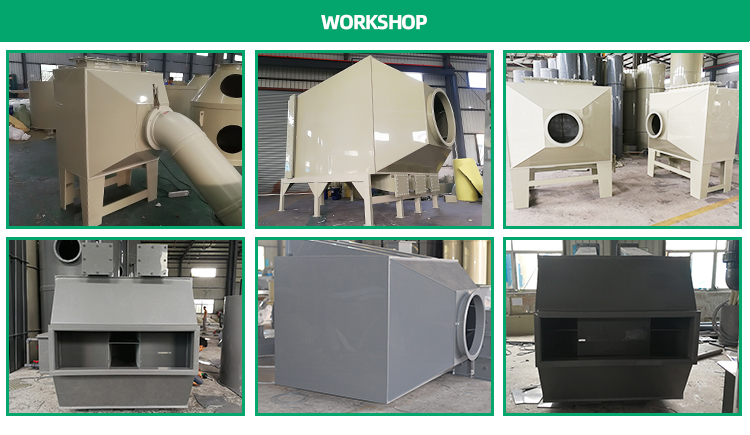
- PP fabrication expertise. We manufacture PP equipment in-house — welding, forming, and assembly are done by our own technicians using hot-gas extrusion welding and butt-welding techniques that produce seams as strong as the parent material. Material traceability back to raw resin batch ensures you’re getting virgin PP, not regrind or recycled material that embrittles prematurely.
- Industry-tested applications. Our PP carbon towers operate in chemical plants (solvent and process vent treatment), electroplating and surface finishing facilities (acid-pre-cleaned exhaust with residual VOCs), pharmaceutical manufacturing (API and solvent emissions), electronics and semiconductor fabs (cleanroom exhaust with organic solvent vapors), laboratories and R&D facilities (fume hood exhaust polishing), and wastewater treatment (H2S and odor control from covered treatment units).
- Structural engineering, not guesswork. PP loses mechanical strength at elevated temperature — roughly 50% reduction in tensile strength at 60degC vs 20degC. We account for this in the structural design with appropriate safety factors, wall thickness, and external rib reinforcement where needed. Every tower is designed for its actual operating temperature, not a generic worst-case.
- Tower + carbon as a matched system. The tower geometry, carbon type, and operating conditions are interdependent. We don’t just fabricate a box and fill it with whatever carbon is in stock — we engineer the tower dimensions around the carbon’s working capacity, residence time requirement, and your pollutant profile. The same tower can be configured with different carbon types depending on whether you’re removing VOCs, odors, or specific chemical species.
Send your exhaust conditions to xicheng023@outlook.com. We’ll specify the right PP grade, tower configuration, carbon type, and provide a complete proposal with structural drawings.
Core Advantages
- High Purification Efficiency: Delivers 90%-95% VOC and odor removal. Effectively treats various industrial organic waste gases.
- Durable and Premium Material: New PP material offering excellent anti-corrosion and chemical-resistant properties.
- Compact Design and Low Consumption: Simple drawer structure, minimal footprint, no chemical reagent consumption.
- Easy Installation and Operation: Modular drawer design for easy carbon replacement, simple to operate and maintain.
- Flexible Customization and After-Sales: Custom sizing to air volume, 1-year warranty, overseas support.
Key Specifications
| Model No. | XC-2 |
| Material | Virgin PP (Polypropylene) |
| Function | Corrosive Exhaust Gas Adsorption |
| Purifying Technology | Activated Carbon Adsorption |
| Construction | PP hot-gas extrusion welded, external rib reinforced |
| Purify Efficiency | 90%-95% |
| Activated Carbon Type | Cylindrical, diameter 4 mm (granular/pellet/honeycomb available) |
| Service Life | 8-10 Years (PP structure); carbon media replacement per usage |
| Color | Beige / Dark Grey |
| Brand / Origin | Xicheng / China |
Certifications and Compliance
- CE Certified – PP Carbon Tower, Exhaust Fan, Air Valve
- RoHS Compliant – PP Tower materials
- ISO 9001 – Quality Management System
- ISO 14001 – Environmental Management System
- SGS Tested – PP Sheet (tensile strength, chemical resistance, UV stability), PP Pipe, PVC Sheet
- Design Compliance – Towers designed to meet EU Industrial Emissions Directive (2010/75/EU) and US EPA NESHAP for VOC and HAP emission control
Model Selection Table
Standard PP activated carbon tower range — all dimensions in millimeters.
| Air Volume (m3/h) | Type | Specification (mm) | Activated Carbon (kg) | Thickness (mm) | Through Area (m2) |
|---|---|---|---|---|---|
| 1,500-2,500 | 2 Layers 1 Side | 1050 x 870 x 1000 | 100 | 10 | 0.64 |
| 2,500-3,500 | 3 Layers 1 Side | 1150 x 870 x 1700 | 125 | 10 | 0.96 |
| 3,500-5,000 | 2 Layers 1 Side | 1550 x 870 x 1000 | 175 | 10 | 1.28 |
| 5,000-7,000 | 3 Layers 1 Side | 1600 x 870 x 1700 | 275 | 10 | 1.92 |
| 7,000-10,000 | 3 Layers 1 Side | 2150 x 870 x 1700 | 400 | 10 | 2.88 |
| 10,000-14,000 | 3 Layers 2 Sides | 1600 x 1730 x 1700 | 525 | 10 | 3.84 |
| 14,000-18,000 | 4 Layers 2 Sides | 1800 x 1730 x 2000 | 700 | 10 | 5.12 |
| 18,000-22,000 | 3 Layers 2 Sides | 2150 x 1730 x 1700 | 775 | 10 | 5.76 |
| 22,000-28,000 | 3 Layers 2 Sides | 2650 x 1730 x 1700 | 1,050 | 10 | 7.68 |
| 28,000-35,000 | 4 Layers 2 Sides | 2900 x 1730 x 2000 | 1,400 | 12 | 10.24 |
| 35,000-45,000 | 4 Layers 2 Sides | 3500 x 1730 x 2400 | 1,725 | 12 | 12.80 |
| 45,000-55,000 | 4 Layers 2 Sides | 4000 x 1730 x 2400 | 2,075 | 12 | 15.36 |
| 55,000-60,000 | 5 Layers 2 Sides | 4000 x 1730 x 2900 | 2,600 | 12 | 19.20 |
Custom configurations: Up to 120,000 m3/h with multi-tower arrangement. Contact xicheng023@outlook.com for tower sizing.
How to Order
- You send – Exhaust gas composition, pollutant concentrations, air volume, operating temperature, ambient conditions
- We analyze – Chemical compatibility with PP, pollutant adsorption characteristics, carbon type selection
- We design – Tower dimensions, tray configuration, carbon charge, structural reinforcement, pressure drop
- You approve – Engineering proposal with tower drawings, carbon specification, media life estimate, and pricing
- We build – 15-25 days. PP fabricated and welded in-house, carbon loaded, flow tested before shipment
- We ship – Tower installation drawings, PP handling and welding repair guidelines, carbon replacement manual included.
Contact xicheng023@outlook.com or WhatsApp +86 18927456906 — proposal within 24 hours.
Complete Your System
- Wet Scrubber Overview – Wet scrubber upstream, PP carbon tower downstream for VOCs
- Activated Carbon Bed System – Deep-bed carbon system for high-load applications
- PP Spray Scrubber Tower – Same PP construction, complementary scrubbing technology
- PP/FRP Centrifugal Fan – Corrosion-resistant fan matched to tower pressure drop
Global Shipping
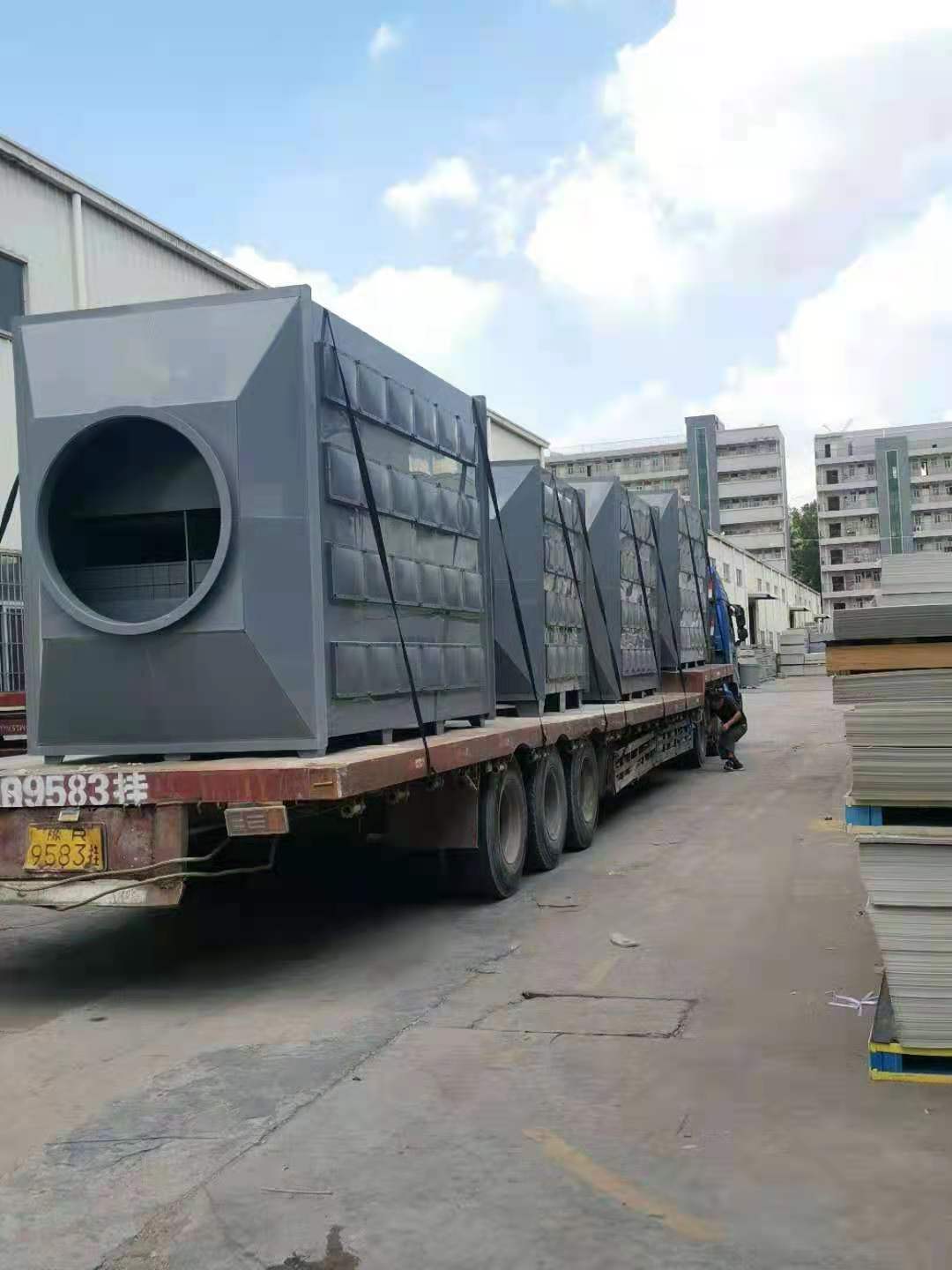
We ship PP carbon towers worldwide across Southeast Asia, South Asia, Middle East, Africa, Europe, Americas, and Oceania. Standard sea freight; PP’s light weight reduces freight cost vs steel equipment. Full export documentation included.
FAQ
Why choose PP over stainless steel for a carbon adsorption tower?
PP provides equivalent or better corrosion resistance than SS316L in chloride-containing and acid-gas environments, at roughly 1/3 the material cost and 1/5 the weight. PP never rusts, never needs painting, and resists pitting and crevice corrosion that plague stainless in HCl and chlorinated solvent service. Stainless steel is preferred when exhaust temperature exceeds 80degC continuously, when mechanical impact resistance is critical, or when local fire codes require non-combustible construction. Read: PP Activated Carbon Box vs Stainless FRP.
What temperature can a PP carbon tower handle?
Virgin PP is rated for continuous operation up to 80degC. Between 80-100degC, mechanical strength decreases significantly and we recommend either de-rating the design with additional wall thickness and external reinforcement, or switching to FRP or SS construction. For exhaust above 100degC, we typically design a quench or dilution air stage ahead of the carbon tower to bring temperature within PP’s operating range.
Is PP compatible with all the solvents and chemicals in my exhaust?
PP is resistant to most inorganic acids, alkalis, and salt solutions, and has good compatibility with many organic solvents at ambient temperature. However, strong oxidizing agents (concentrated HNO3, H2O2 over 30%, halogens) and some chlorinated solvents at elevated temperature can attack PP. Send us your complete exhaust composition and we’ll verify chemical compatibility before specifying PP — if PP isn’t right, we’ll recommend FRP or SS316L instead. Read: Electronics Semiconductor Carbon Filtration.