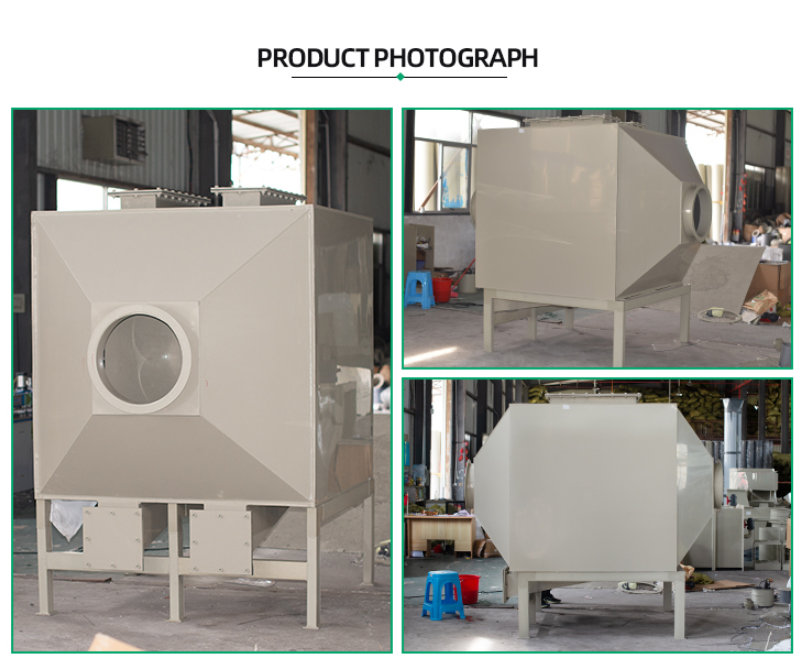

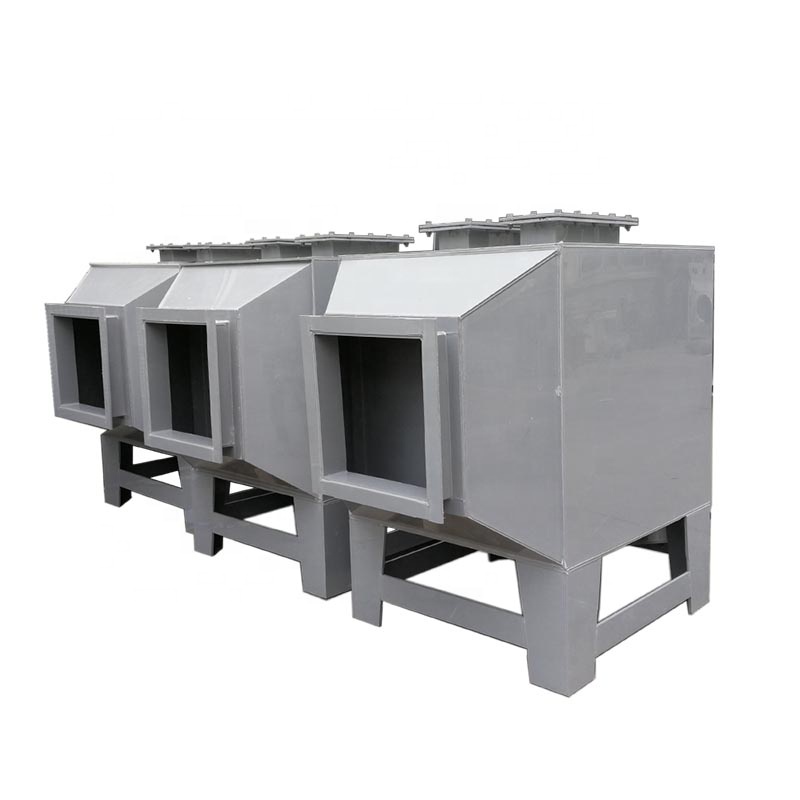
Product Overview
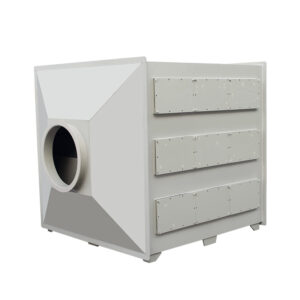
Activated carbon bed system for industrial flue gas treatment and large-volume exhaust purification. Unlike thin-panel carbon filters, a packed bed configuration provides deep carbon layers — typically 500 mm to 1200 mm bed depth — giving exhaust gases extended residence time through the adsorption media. Designed for applications where high pollutant loading, stringent outlet concentrations, or continuous operation demands a robust, high-capacity carbon adsorption solution: petrochemical flue gas, chemical process exhaust, steel mill sinter plant off-gas, and central waste gas treatment systems.
| Application | Flue gas treatment, high-load VOC exhaust, continuous-operation carbon adsorption with deep-bed configuration |
| Material | Virgin PP (standard to 80degC); SS304/316L (high-temperature flue gas); FRP (corrosive chemical exhaust) |
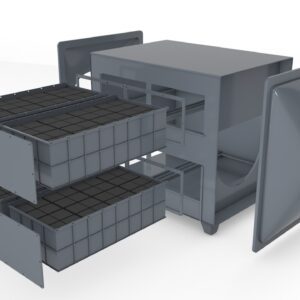
| Bed configuration | Multi-layer packed bed, 2-5 layers, single or double-sided inlet; bed depth 500-1200 mm |
| Carbon charge | 100-2,600 kg per unit (cylindrical activated carbon, diameter 4 mm); granular and pellet options available |
| Efficiency | 90%-95% VOC and odor removal; higher with multi-bed series configuration |
| Air volume | 1,500 – 60,000 m3/h single unit; modular multi-unit design for 120,000+ m3/h |
| Lead time | 15-25 days |
| Warranty | 12 months bed structure; carbon media replacement interval based on pollution loading |
Why Packed Bed Design Matters
Activated carbon adsorption is a mass transfer process — pollutants must diffuse from the gas stream to the carbon surface and then into the internal pore structure. A thin carbon panel provides limited contact time and saturates quickly. A deep packed bed extends the mass transfer zone, increases the carbon’s working capacity, and delivers consistent outlet concentrations over a longer service life:
- Extended residence time. Empty-bed contact time (EBCT) determines removal performance. A 500 mm bed at 0.5 m/s face velocity provides approximately 1.0 second of contact — sufficient for most VOC applications. Deeper beds (800-1200 mm) provide 1.6-2.4 seconds for high-concentration or difficult-to-adsorb compounds. Our standard models are sized for 0.1-0.5 second EBCT as specified in US EPA VOC control technical guidance.
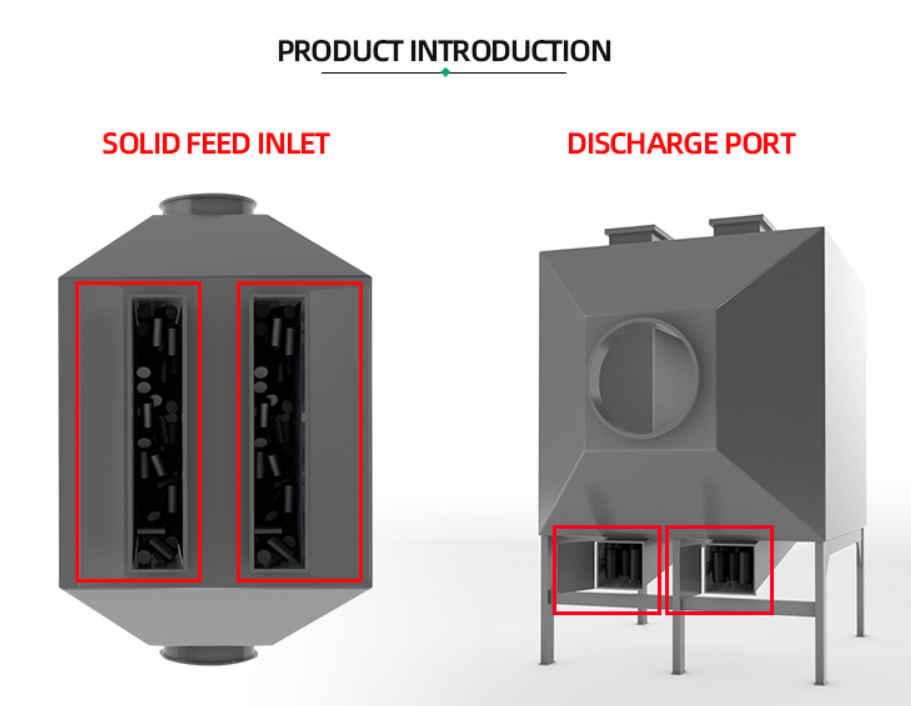
- Multi-layer configuration. Single-layer beds are simplest but offer limited carbon volume. Two-layer and three-layer configurations multiply carbon charge without increasing footprint — each layer adds bed depth while maintaining the same face area. For large air volumes, two-sided configurations (inlet through center, outlets on both sides) double the throughput area per unit footprint.
- Thermal management for flue gas. Flue gas streams can enter at 60-120degC after heat recovery. At elevated temperatures, carbon’s adsorption capacity decreases — typically 30-50% lower at 80degC vs 25degC. Our bed sizing compensates for temperature effects using adsorption isotherm data, and we specify materials (SS316L, high-temp PP) rated for your actual operating temperature.
- Pressure drop optimization. Deep beds increase pressure drop, which increases fan power. We balance bed depth against acceptable pressure drop — typically 200-500 Pa for a standard bed at design flow — and select the optimal layer configuration for your system’s fan capacity. Honeycomb carbon media is available where pressure drop must be minimized.
Why Xicheng
16 years, 2600+ systems shipped worldwide. Packed bed carbon systems are custom-engineered equipment — off-the-shelf designs rarely match real operating conditions. We build each bed to your specific pollutant profile, concentration, and emission target:
- Application-specific bed design. Our carbon bed systems serve diverse industries: petrochemical refineries (BTEX and hydrocarbon vapor from process vents and tank farms), chemical manufacturing (chlorinated solvents, styrene, acrylonitrile from reactor vents), pharmaceutical plants (trace API and solvent emissions from synthesis and drying), steel and metallurgical facilities (VOC and PAH from sinter plant off-gas), coating and painting operations (continuous VOC load from spray booths and curing ovens), and municipal/industrial wastewater treatment (H2S and odor control at large air volumes).
- Bed geometry engineered, not estimated. We calculate carbon bed dimensions from your inlet concentration (mg/Nm3), target outlet concentration, carbon working capacity at operating temperature, and required service life between change-outs. The 13-model spec table below covers common industrial ranges; every dimension can be adjusted.
- Flow uniformity across the bed face. Uneven flow creates localized saturation — gas takes the path of least resistance, satuates a small section of carbon, then breaks through while the rest of the bed remains underutilized. Our inlet plenum and perforated distribution plate design achieves over 85% flow uniformity across the bed face, confirmed by CFD modeling on larger units.
- Change-out designed for uptime. Our drawer-and-tray system allows carbon replacement layer by layer. Operators slide out saturated drawers, insert pre-loaded replacements, and return to service in hours. No confined-space entry, no bulk carbon handling inside the vessel, and no extended production downtime.
Send your exhaust analysis and flow data to xicheng023@outlook.com. We’ll calculate bed dimensions, carbon life, pressure drop, and provide a complete engineering proposal.
Core Advantages
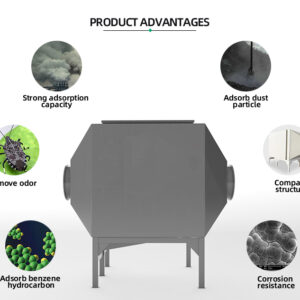
- High Purification Efficiency: Delivers 90%-95% VOC and odor removal. Effectively treats various industrial organic waste gases.
- Durable and Premium Material: New PP material offering excellent anti-corrosion and chemical-resistant properties.
- Compact Design and Low Consumption: Simple drawer structure, minimal footprint, no chemical reagent consumption.
- Easy Installation and Operation: Modular drawer design for easy carbon replacement, simple to operate and maintain.
- Flexible Customization and After-Sales: Custom sizing to air volume, 1-year warranty, overseas support.
Key Specifications
| Model No. | XC-2 |
| Material | New PP (Polypropylene) |
| Function | Flue Gas Treatment and VOC Removal |
| Purifying Technology | Activated Carbon Packed Bed Adsorption |
| Purify Efficiency | 90%-95% |
| Activated Carbon Type | Cylindrical, diameter 4 mm (granular/pellet/honeycomb available) |
| Service Life | 8-10 Years (bed structure); carbon media replacement per usage |
| Color | Beige / Dark Grey |
| Brand / Origin | Xicheng / China |
Certifications and Compliance
- CE Certified – Carbon Bed System, Exhaust Fan, Air Valve
- RoHS Compliant – Bed System materials
- ISO 9001 – Quality Management System
- ISO 14001 – Environmental Management System
- SGS Tested – PP Sheet, FR-PP, PP Pipe, PVC Sheet
- Design Compliance – Systems designed to meet EU Industrial Emissions Directive (2010/75/EU) and US EPA NESHAP for VOC and HAP emission control
Model Selection Table
Standard activated carbon bed system range — all dimensions in millimeters.
| Air Volume (m3/h) | Type | Specification (mm) | Activated Carbon (kg) | Thickness (mm) | Through Area (m2) |
|---|---|---|---|---|---|
| 1,500-2,500 | 2 Layers 1 Side | 1050 x 870 x 1000 | 100 | 10 | 0.64 |
| 2,500-3,500 | 3 Layers 1 Side | 1150 x 870 x 1700 | 125 | 10 | 0.96 |
| 3,500-5,000 | 2 Layers 1 Side | 1550 x 870 x 1000 | 175 | 10 | 1.28 |
| 5,000-7,000 | 3 Layers 1 Side | 1600 x 870 x 1700 | 275 | 10 | 1.92 |
| 7,000-10,000 | 3 Layers 1 Side | 2150 x 870 x 1700 | 400 | 10 | 2.88 |
| 10,000-14,000 | 3 Layers 2 Sides | 1600 x 1730 x 1700 | 525 | 10 | 3.84 |
| 14,000-18,000 | 4 Layers 2 Sides | 1800 x 1730 x 2000 | 700 | 10 | 5.12 |
| 18,000-22,000 | 3 Layers 2 Sides | 2150 x 1730 x 1700 | 775 | 10 | 5.76 |
| 22,000-28,000 | 3 Layers 2 Sides | 2650 x 1730 x 1700 | 1,050 | 10 | 7.68 |
| 28,000-35,000 | 4 Layers 2 Sides | 2900 x 1730 x 2000 | 1,400 | 12 | 10.24 |
| 35,000-45,000 | 4 Layers 2 Sides | 3500 x 1730 x 2400 | 1,725 | 12 | 12.80 |
| 45,000-55,000 | 4 Layers 2 Sides | 4000 x 1730 x 2400 | 2,075 | 12 | 15.36 |
| 55,000-60,000 | 5 Layers 2 Sides | 4000 x 1730 x 2900 | 2,600 | 12 | 19.20 |
Custom configurations: Up to 120,000 m3/h with multi-unit parallel arrangement. Contact xicheng023@outlook.com for engineering sizing.
How to Order
- You send – Exhaust gas composition, pollutant concentrations, air volume, temperature, humidity, target outlet limits
- We analyze – Pollutant profile and adsorption isotherms to select carbon type and estimate working capacity
- We design – Bed dimensions, layer configuration, pressure drop, carbon charge, and expected service life
- You approve – Engineering proposal with bed drawings, carbon specification, media life curve, and pricing
- We build – 15-25 days. Vessel fabricated, bed layers assembled, flow distribution verified before shipment
- We ship – Installation drawings, bed loading procedure, carbon handling and replacement manual included.
Contact xicheng023@outlook.com or WhatsApp +86 18927456906 — engineering proposal within 24 hours.
Complete Your System
- Wet Scrubber Overview – Multi-stage: scrubber for acid gases + carbon bed for VOCs
- PP Activated Carbon Tower – PP-specific tower-type carbon system
- Packed Bed Wet Scrubber – Counterpart packed bed scrubber for gas absorption
- PP Exhaust Duct – Corrosion-resistant ductwork for your treatment train
Global Shipping
We ship carbon bed systems worldwide across Southeast Asia, South Asia, Middle East, Africa, Europe, Americas, and Oceania. Standard sea freight with full export documentation; air freight for smaller units. Modular bed design allows flat-pack shipping to reduce freight cost.
FAQ
What is the difference between a carbon bed system and a panel carbon filter?
A carbon bed uses deep packed layers (500-1200 mm bed depth) for extended gas-carbon contact time and high carbon loading capacity. A panel filter uses thin carbon elements (50-150 mm) designed for lighter-duty polishing applications. Bed systems handle higher pollutant concentrations and provide longer service life between change-outs — they are the right choice for primary VOC control, while panel filters are typically used for final polishing stages. Read: Single Stage vs Multi Stage Carbon Filtration.
How does bed depth affect carbon utilization?
In a deep bed, the pollutant concentration decreases progressively as gas moves through each layer — forming what engineers call the mass transfer zone (MTZ). A bed deep enough to contain the entire MTZ achieves full carbon utilization: the leading edge of the bed reaches saturation while the trailing edge still has fresh carbon capacity. If the bed is too shallow, the MTZ extends past the carbon and breakthrough occurs before the upstream carbon is fully saturated. Our designs ensure bed depth exceeds MTZ length for your specific conditions.
Can the carbon bed system handle flue gas at elevated temperatures?
Yes, with proper material selection and capacity derating. Standard PP is suitable up to 80degC continuous. For flue gas at 80-150degC, we specify SS304 or SS316L construction. Carbon adsorption capacity decreases with temperature — typically 30-50% at 80degC vs 25degC — so we increase bed size and carbon charge accordingly, using temperature-corrected adsorption isotherm data for your specific pollutants. Read: Activated Carbon Box VOCs Removal Guide.