
Key Takeaways
- Wet scrubber rebuilds and retrofits are a shell-life decision, not an age decision. The remaining structural life of the vessel—read from wall-thickness and corrosion data, not from the equipment tag year—sets the ceiling on what a rebuild can achieve.
- Three questions decide the branch. Is the shell structurally sound? Can the performance gap be closed by renewing internals? Do the emission limits stay unchanged? Each is answered from measured field data, not from assumptions.
- Field data drive the decision. Pressure-drop drift, packing settlement, wall loss, and mist-eliminator fouling map to repair, rebuild, and replace thresholds in a decision matrix; no fixed service life can substitute for that data.
- Repair is a real third option. A leaking nozzle, a failed gasket, or a worn pump seal does not justify a full rebuild, and a localized shell patch can extend service where damage is confined.
- The deliverable is a scope definition. Inspection findings become a work scope a supplier can quote, with design inputs and acceptance criteria attached—not just a request for a price.
- The final call belongs to field measurement and a qualified engineer. This guide gives the framework and the thresholds; it does not promise fixed service lives or guaranteed savings.
A wet scrubber with rising pressure drop, drifting pH, and declining removal efficiency forces a decision that many owners start from the wrong place: the age of the equipment and a contractor’s price list. The right starting point is the shell. Wet scrubber rebuilds and retrofits are economically justified by the remaining life of the vessel and its internals, not by how many years the tower has run. This guide is an inspection-based decision framework. It walks you from the first degradation signals, through a nine-point asset inspection that produces comparable field data, to a decision matrix that separates repair, rebuild, and replacement—then shows how to turn that decision into a scope a supplier can quote. By the end you will hold the thresholds, the data sheet, and the caveats that keep the call honest.
First, Decide Whether the Scrubber Needs a Major Intervention
Not every scrubber with poor performance needs a rebuild. Before any capital decision, measure the degradation signals against the commissioning baseline and decide whether the pattern is a sustained asset problem or a fixable operating issue. This first pass separates the towers that need a full inspection from the ones that need a pump rebuild or a calibration.
Pressure-drop drift versus the commissioning baseline
Pressure drop is the most reliable early signal because it is continuous, measurable in inches of water column (in. w.c.), and independent of stack sampling. Compare current readings at the same gas flow against the commissioning baseline, not against an absolute number. A sustained drift of roughly 20% or more above baseline at design flow warrants an internal inspection; a drift that grows to 40–50% typically indicates fouled packing, a collapsed support, a blocked distributor, or a saturated mist eliminator—each of which shows up differently in the nine-point check.
Short-term spikes that return to baseline are a different class of problem. Surge from liquid carryover, fan stall, or a partially blocked duct tends to move with operating conditions and clears with the cause, so it belongs in the operating-troubleshooting path, not in a rebuild decision.
Efficiency and reagent-consumption signals
Removal efficiency and reagent use tell you whether the absorption capacity has fallen. A rise in outlet concentration, or a measurable increase in caustic consumption per mole of acid removed, points to lost effective area in the packed bed, a distributor that is no longer wetting the media evenly, or nozzles worn past their design spray pattern. A pH control loop that must swing further to hold its setpoint is often the first quantitative sign of that loss.
These signals should be read together with the baseline. A scrubber designed for 500 ppm inlet hydrochloric acid that now consumes reagent out of proportion to its load, at the same time the outlet reading drifts upward, is losing contact area somewhere between the top of the packed bed and the stack.
When a diagnostic run, not a rebuild decision, comes first
A share of apparent degradation is instrumentation and rotating-equipment error. A pH probe reading 0.5 to 1.0 unit off because of fouling, a recirculation pump losing head to cavitation or a worn impeller, or a reagent pump that cannot keep up will all produce the same outward symptoms as a fouled tower. Confirm the instruments and the pumps before committing to an inspection outage, because a diagnostic run costs hours, while a full inspection and a capital request cost weeks and budget.
The operating-diagnosis path for those cases is covered separately in the common wet scrubber problems guide. If the diagnostic run confirms the instruments and pumps are sound and the drift persists, the decision moves to a full inspection.
Decision point: after this module you can state whether the drift is sustained and quantified against the commissioning baseline, and therefore whether the tower enters the nine-point inspection or stays in the operating-diagnosis path.
The Asset Inspection Checklist: Nine Areas and the Data to Record
When the inspection is justified, the job is to collect comparable, time-stamped data across nine areas of the asset. Each area produces a number or a condition—wall thickness, bed height, differential pressure across a section, spray flow—that feeds the decision matrix. The same symptom-to-record-to-evaluation sequence frames EPA’s Wet Scrubber Inspection and Evaluation Manual, the field reference this checklist condenses for a packed-bed tower. The checklist below is the field instrument list for that job.
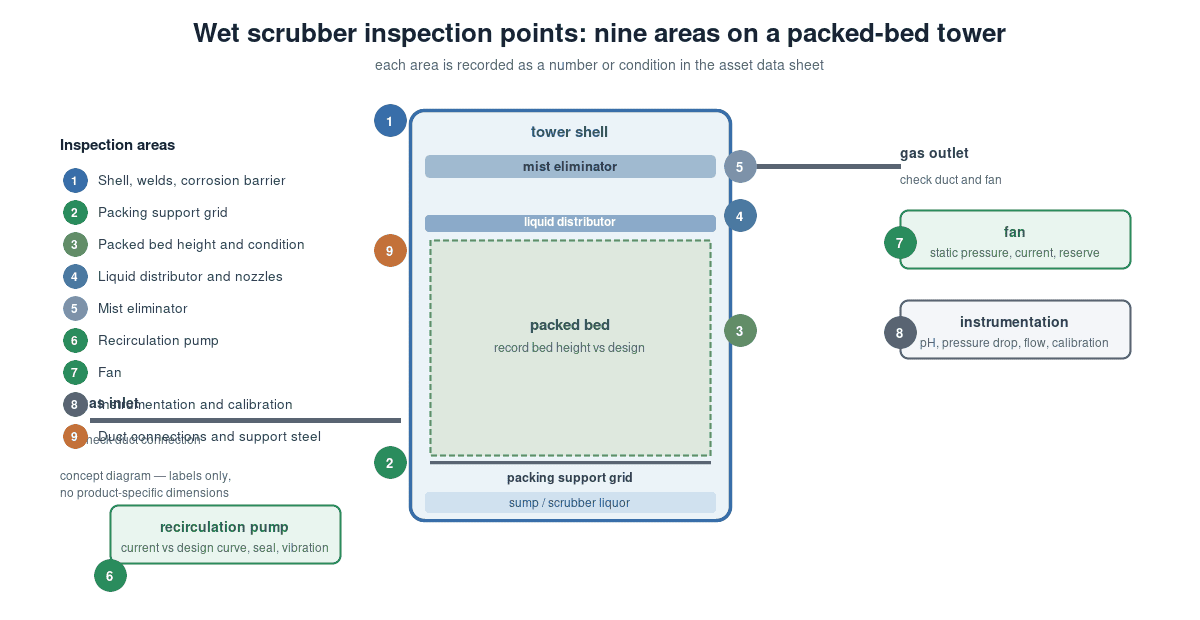
*Nine inspection areas on a packed-bed scrubber; each is recorded as a number or condition that the decision matrix can compare.*
Shell, welds, and corrosion barriers
Record minimum wall thickness by ultrasonic testing at marked grid points on the shell, the head, and the nozzle necks, with the location and date for each reading. Note blistering, cracking, or delamination of the corrosion barrier and any area where the original thickness has fallen. Welds get their own pass: surface cracks, pinholes, and repairs in the shell seams matter because a failure here leaks process gas, not just liquor.
The inspection method and the acceptable limits depend on the material, which the next section covers. For every material, the output is the same: a wall-thickness map and a weld-condition log that let an engineer estimate remaining structural life.
Packing support, bed height, and settlement
Measure bed height from a fixed reference at several points across the tower diameter, and compare it to the design bed depth. Settlement of 10% or more of the design bed height indicates media loss—through breakage, dissolution, or migration through a failed support—and it directly cuts the number of transfer units the bed provides. Check the support grid or plate for sag, corrosion, and missing or shifted sections, because a support failure can dump the entire bed into the lower sump.
Record the packing condition: fouling scale, broken media, and fines accumulation in the lower bed. Each is a different rebuild work item, and each has a different repair-versus-replace consequence in the matrix.
Liquid distributor and mist eliminator
Confirm that the distributor covers the bed area and delivers uniform flow. Photograph the spray pattern during a short run if possible, measure nozzle flow against design, and inspect the distributor arms for blocked orifices, scale, and missing nozzles. Non-uniform wetting creates dry channels that collapse local absorption efficiency while the tower continues to look normal from outside.
For the mist eliminator, measure the pressure drop across it and inspect for fouling, broken vanes or mesh, and carryover deposits on the downstream duct. A clean mesh pad typically contributes on the order of 0.5–1 in. w.c. at design flow; when the same instrument reads roughly double that at the same gas flow, the pad is fouled and moves to the rebuild list. A mesh pad that has lost half its open area to scale can push a tower’s total pressure drop well past the fan’s reserve, and a damaged vane pack re-entrains liquor directly into the stack.
Recirculation pump, fan, and instrumentation
Record pump current against the nameplate and the design curve, seal condition, and any vibration or cavitation noise. A pump running above design current at the same flow is typically losing hydraulic efficiency from a worn impeller, which cuts the liquid-to-gas ratio the bed receives. Log the fan’s static pressure, current, and damper position, because the fan’s remaining capacity sets how much pressure drop a rebuild can add before the fan becomes the limiting item.
Verify the instruments the decision depends on: pH probe slope and calibration, the differential-pressure transmitters across the tower and the mist eliminator, and the flow elements for gas and liquor. A decision matrix is only as good as the numbers it is fed.
Duct connections and support steel
Inspect the inlet and outlet duct connections for corrosion at the flanges and the joint between duct and tower, where condensate and wet-deposited salts concentrate. Check the support steel, the vessel skirts or legs, and the anchor bolts for corrosion loss, because a tower that is rebuilt gains weight when internals are renewed, and the supports have to carry that load through its next service interval.
What to record per area
Every reading goes into a single data sheet with the same fields: area, measurement point, value with units, date, instrument used, and operator. The table below is the record format; the same sheet becomes the input to the decision matrix and, later, the reference baseline for the rebuilt asset.
| Inspection area | Primary data fields | Recording frequency |
|---|---|---|
| Shell, welds, corrosion barrier | Wall thickness (in./mm) by grid point; weld condition; barrier defects | Every outage; thickness mapped at 2–3 ft intervals |
| Packing and support | Bed height from fixed reference; support condition; media fouling | Each inspection |
| Distributor and mist eliminator | Nozzle flow vs design (gpm); spray coverage; mist-eliminator ΔP (in. w.c.) | Each inspection |
| Pump, fan, instruments | Pump current (A); fan static pressure and current; pH/ΔP calibration | Baseline and each inspection |
| Duct connections, support steel | Flange/joint condition; support corrosion; anchor torque | Each inspection |
Decision point: after this module you can now assemble a completed nine-area data sheet for the tower, with every field comparable to its commissioning baseline, and determine whether the dataset is complete enough for the decision matrix later in this guide.
Material Dictates the Check Method and the Life Expectancy
The shell material determines which inspection method is valid, which defects matter, and what repair routes exist at all. A vessel shell is a fiber-reinforced plastic (FRP), a polypropylene (PP) or other thermoplastic, or a stainless steel (SS316L is common on halide service), and the check that is authoritative for one material is meaningless or even destructive for another. Reading the shell correctly is the difference between a rebuild that extends life for years and a rebuild that fails within one operating season.
FRP: spark test, tap test, and ASME RTP-1 repair context
FRP shells are inspected with two techniques that do not transfer to metal. A high-voltage spark test checks the corrosion barrier at roughly 10–15 kV, locating pinholes and voids in the resin-rich inner layer; a tap test with a light hammer finds delamination and weak bond areas by the change in acoustic response. FRP repair and fabrication practice is governed by ASME RTP-1, the code for reinforced thermoset plastic corrosion-resistant equipment, which is the reference a qualified shop uses for shell repair and for the qualified-operator requirement behind any laminate work.
The life signal for FRP is the corrosion barrier. Once the barrier is breached, the load-bearing laminate sees chemical attack, and wall thickness falls from inside, not from the outer surface, so ultrasonic thickness alone understates the damage. Where the barrier is intact and the laminate is sound, a repair is credible; where damage has spread over a large area, the shell cost dominates and replacement should be priced.
PP: UV embrittlement, chemical softening, and DVS 2207 welding
Polypropylene scrubbers fail by UV embrittlement, chemical softening, and weld deterioration, not by the pinhole corrosion an FRP barrier sees. Check for surface crazing and chalkiness on areas exposed to light, for softening and creep on shell walls in contact with hot liquor, and for weld-line cracking at the seams. Thermoplastic welds are executed and tested under the DVS 2207 series for heated-tool welding of thermoplastics, which covers the joint geometry and welding parameters that make a PP seam trustworthy.
A PP shell that has embrittled or softened has few repair routes, because patching an embrittled substrate rarely holds. PP towers are commonly rated for continuous service near 180°F (82°C) and are sensitive to hot solvent exposure, so a shell that has seen sustained overtemperature is usually a replacement candidate, not a rebuild candidate.
SS316L: chloride stress-corrosion cracking at welds
Stainless shells in wet scrubber service fail primarily by chloride stress-corrosion cracking (SCC) at welds, not by uniform corrosion. Chloride SCC is a real risk for 316L in chloride-bearing scrubbing liquor once temperatures exceed roughly 140°F (60°C), and it appears as branching cracks in the weld heat-affected zone that are easy to miss in a visual pass. Dye-penetrant testing on the welds, and ultrasonic thickness on the base metal, are the appropriate checks; a straight visual inspection can pass a shell that is hours of service from a through-wall crack.
Cracked welds in 316L are repairable only where the cracking is localized and the metallurgy is confirmed. Widespread SCC means the base metal is sensitized or the service conditions are outside the material’s envelope, and replacement—or a material upgrade in the rebuild—becomes the defensible decision.
Decision point: after this module you can select the correct inspection method for the shell material, interpret what it found, and state whether the shell itself is a repair, a rebuild, or a replacement candidate before any internals work is quoted.
Wet Scrubber Rebuilds and Retrofits: The Repair, Rebuild, or Replace Matrix
This is the point where the data sheet meets a decision. The matrix below maps measured conditions to the three scopes, with thresholds expressed as engineering guidance, not absolute rules—the final call is made by a qualified engineer on your asset. Wet scrubber rebuilds and retrofits live in the middle column: the shell is sound, and renewing the internals restores performance. Repair is the left column, replacement the right.
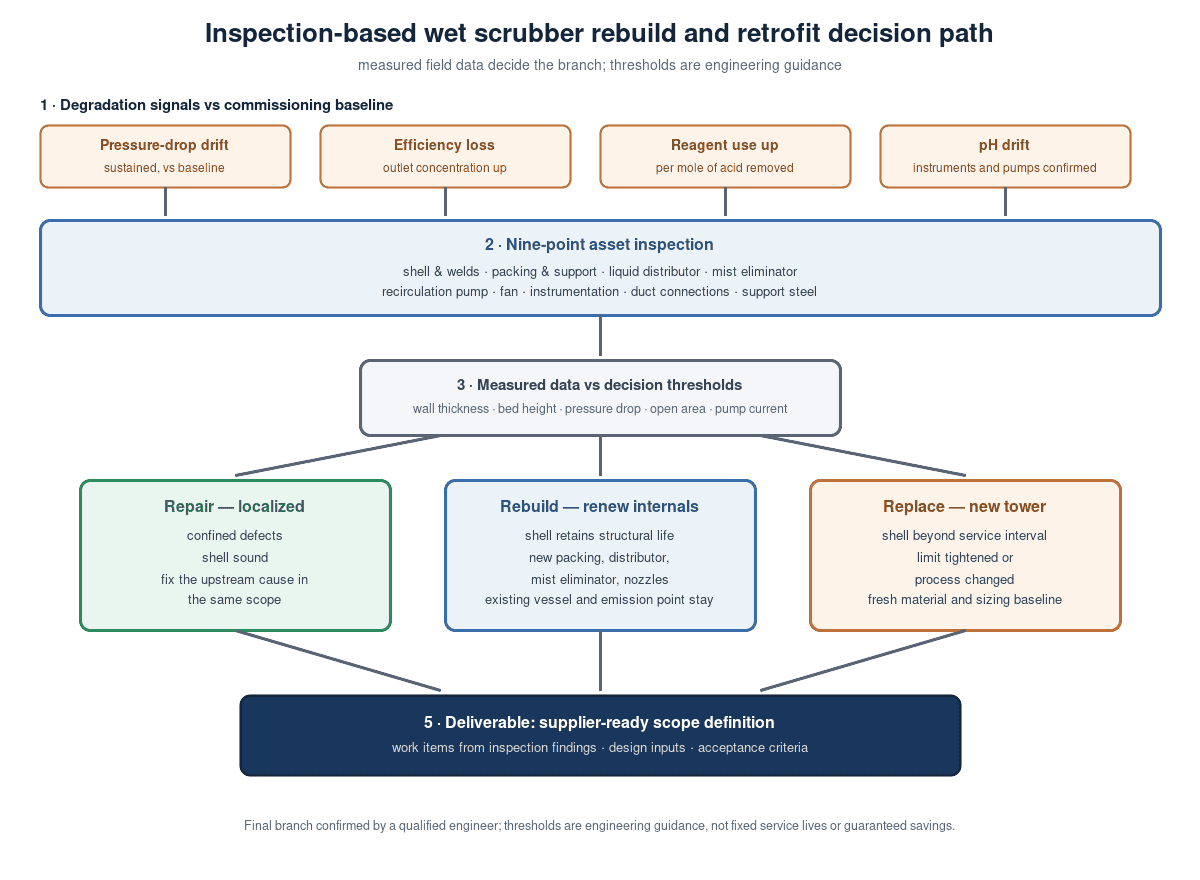
*Read left to right: the inspection data place the tower in one of three scopes, and each scope produces a different supplier deliverable.*
Reading the data against decision thresholds
The decision matrix uses four inputs from the inspection sheet: shell condition, packing and support condition, mist eliminator and distributor condition, and rotating-equipment condition. Each maps to a scope. The thresholds below are engineering rules of thumb for a typical FRP or PP packed tower; a qualified engineer confirms them for your service.
| Condition measured | Repair (localized) | Rebuild (renew internals) | Replace (new tower) |
|---|---|---|---|
| Shell minimum wall thickness vs original | Local thinning to about 70–85%, no through-wall defect | ≥85% retained, barrier intact | Below about 70%, through-wall, or widespread SCC/embrittlement |
| Packing bed height vs design | Loss <10%, localized fouling | Loss 10–30% or uniform fouling; support sound | Support failed and bed dumped |
| Mist eliminator | One panel fouled; <30% open-area loss | Open-area loss >50% or broken vanes/mesh | — |
| Distributor / nozzles | Blocked orifices, a few nozzles | Many nozzles worn, spray coverage poor | — |
| Pump, fan, instruments | Seal, impeller, probe, calibration | Replacement in scope of rebuild | Fan reserve below required ΔP |
| Emission limit | Unchanged and met | Unchanged and met | Tightened limit or new pollutant |
The columns are not rigid. A tower with a sound shell and a failed support lands in rebuild even if the packing loss is under 10%, because the support must be renewed to carry a new bed. What the matrix fixes is the decision sequence: shell first, then internals, then rotating equipment, then the emission limit.
When repair is the right scope
Repair is the right scope when the problem is confined and the fix does not change the tower’s fundamental condition. A leaking nozzle flange, a failed gasket, a worn pump seal, a blocked distributor orifice, or a single fouled mist-eliminator panel are repair work items. A localized shell patch is also repair when the corrosion is limited in area and the surrounding laminate or metal is sound; ASME RTP-1 practice covers that path for FRP.
Repair is also the right call when the operating cause is still in play. Replacing a distributor that failed from a plugged chemical feed does nothing if the feed system is not fixed first—so the repair scope should always include the upstream cause that created the damage.
When rebuild is the right scope
A rebuild means renewing the internals inside a shell that still has structural life. This is the classic wet scrubber rebuild: new packing, a renewed or reconditioned distributor, new mist eliminator media, reconditioned nozzles, and any pump or instrument replacements, carried out in the existing vessel. The economics of this route exist because the shell—typically the single largest cost component—stays in place.
The rebuild scope must be defined by the inspection findings, not by a menu. A bed that lost 15% of its height from media breakage is a different job from a bed that is fouled but full, and the distributor work differs from the mist-eliminator work. Renewing internals is what rebuilds and retrofits are for, and it is where most sound-shell towers belong after a decade of acid service.
When replacement is the safer decision
Replacement is the right call when the shell cannot carry the next service interval. A wall below the matrix threshold, through-wall leakage, widespread SCC on 316L, or a PP shell that has embrittled are structural limits, not internal-part problems. Replacement is also the defensible call when the emission limit has tightened or the process changed—a new pollutant, a higher load, or a lower outlet limit that the existing tower geometry cannot meet even with new internals.
Replacement buys a clean baseline: new materials matched to the current chemistry, a bed sized to the current load, and a fresh performance guarantee. It also inherits the permitting question covered in the compliance section later in this guide, because a new vessel can change the stack configuration and the emission profile that the permit records.
Worked example: one degraded packed-bed scrubber through the chain
The following example is illustrative and marked as such; it is not a specific XICHENG case. A packed-bed scrubber on hydrochloric acid service runs at 18,000 CFM with a design inlet of 500 ppm HCl. The commissioning baseline is a total pressure drop of 4.5 in. w.c. at design flow, a scrubber-liquor pH of 9.5, a packed bed depth of 48 in., and a shell wall of 0.375 in. at the recorded grid points.
The nine-point inspection returns: pressure drop at 7.8 in. w.c. (about 73% above baseline), scrubber pH holding near 8.2 with reagent use up, bed height at 41 in. against a design of 48 in. (about 15% settlement), one distributor arm blocked and three nozzles worn, mist-eliminator open area roughly half gone, and minimum shell wall thickness at 0.28 in. on a localized panel (about 25% below original) with the rest of the shell at or above 0.35 in. and no through-wall defects. Pump current runs 12% above nameplate at the same flow.
Reading the matrix: the shell retains more than 85% of its original thickness across most of the tower and the localized 25% loss is confined to one repairable panel, so the shell is a repair-and-rebuild candidate, not a replacement. The packing loss, the distributor damage, and the mist-eliminator condition all fall in the rebuild column. The answer is a rebuild: renew the packing bed, rebuild the distributor with new nozzles, replace the mist eliminator, patch the localized shell panel, and recondition the pump impeller. The new scope definition then flows into the supplier-scope section that follows, with an acceptance target that restores pressure drop toward the 4.5 in. w.c. baseline at design flow.
Decision point: after this module you can decide the repair, rebuild, or replace branch for the tower from the inspection data, with the shell condition read first and the emission limit checked last, and you can explain the reasoning behind that choice to the budget holder.
Turn the Decision into a Scope Definition the Supplier Can Quote
The decision branch is not a deliverable; the scope definition is. A supplier can price a rebuild only when each inspection finding is translated into a work item with a location, an extent, and a design input attached. This section produces that document, whether the tower is a fume scrubber rebuild in halide service or a nitric acid scrubber whose absorption chemistry is being renewed.
Scope definition checklist: inspection finding to work item
Work through the inspection sheet line by line and state, for each finding, what will be done, where, and to what extent. A fouled lower bed becomes “replace packing in the lower 12 in. of the 41 in. bed, remove and dispose of scale and broken media.” A worn distributor arm becomes “replace the affected distributor arm and all nozzles on that arm.” A localized shell panel becomes “grind, dry, and patch the shell panel at grid point G-07 per ASME RTP-1 qualified-operator procedure, followed by spark test.” Vague scope items are the reason rebuilds come back over budget.
The scope should also state what stays. Existing nozzles that measured at design flow, an impeller with acceptable wear, and a fan with reserve are kept, and the scope says so explicitly so the supplier does not price replacement by default.
Design inputs the supplier needs
The supplier prices and designs the work from a fixed set of process inputs, and missing one of them produces a quote that does not match the operating reality. Provide the current and design gas flow (CFM at operating temperature), the pollutant species and concentration at the inlet, the inlet temperature and moisture content, the scrubber liquor chemistry and pH setpoint, the liquid-to-gas ratio the tower was designed for (commonly 10–30 gpm per 1,000 cfm for a packed bed), the shell material and thickness data, the vessel dimensions and nozzle locations, the available electrical supply, and the current instrumentation list.
Two inputs deserve special care because they change the rebuild design. The first is the changed operating condition: if the process now runs at a higher flow or a different pollutant mix than the original design, the rebuild has to be designed to the current condition, not to the nameplate. The second is the oxidation chemistry on a nitric acid scrubber: NOx absorption depends on oxidant addition and residence time, so a rebuild of that chemistry renews the oxidant feed and the bed depth together, not the packing alone.
Performance acceptance criteria for the delivered work
A rebuild contract without acceptance criteria is a rebuild without a definition of done. State the targets the supplier must meet after commissioning: total pressure drop back toward the baseline at design flow (for example, within 10% of the original 4.5 in. w.c. in the worked example), the outlet concentration at or below the permit limit with the specified inlet load, pH control that holds its setpoint under the design load, uniform spray coverage confirmed by a distribution test, and no leaks at the reworked joints verified by the applicable check—spark test on FRP, DVS 2207 weld inspection on PP, dye-penetrant on 316L welds.
The acceptance test is the record of the rebuild, and it should be written into the scope before the quote, not negotiated after the work. It also becomes the commissioning baseline for the next inspection cycle.
Decision point: after this module you can now hand over a supplier-ready scope document — inspection findings translated into work items, process inputs attached, and acceptance criteria defined — which is the input the budget and the contractor conversation both start from.
Permitting and Compliance Boundaries for Rebuild versus Replace
The rebuild-versus-replace decision has a compliance dimension that runs in parallel with the engineering one. Rebuilding inside an existing, permitted vessel tends to keep the permit intact, while replacing the vessel—or changing what it emits—can reopen the permitting and testing cycle. The engineering call and the regulatory call should be made together, because a rebuild that is right on paper can fail on a compliance review.
When existing permits stay valid after a rebuild
A rebuild that keeps the vessel, the stack, the emission point, and the controlled pollutants unchanged is typically an equipment-renewal activity under the existing permit, not a new source. Renewing packing, distributor, mist eliminator, and rotating equipment does not change the emission profile the permit records, so the existing emission limits, the monitoring requirements, and the stack test history carry over. A stack test is typically three separate runs of about 60 min each at the permitted operating rate, and a rebuild of that kind does not repeat it. Operators still confirm the classification with their permitting authority and their environmental staff, because state definitions of modification differ.
The practical consequence is that a rebuild preserves the compliance investment already made: the permitted emission point stays, the stack test record stays, and the facility avoids a new-source review cycle. That is a scheduling and cost advantage that belongs in the decision matrix as a tie-breaker when engineering is close between rebuild and replace.
What changes trigger re-permitting or a new stack test
A replacement tower, a moved emission point, a materially different stack, or a change in the controlled pollutants or their limits can trigger a new permit review and a new stack test. Tightened limits from a permit revision — for example, an outlet limit cut from 50 ppm to 10 ppm for the controlled pollutant — or a process change that introduces a pollutant the existing tower never controlled, both push the decision toward a more capable system—and both change the compliance boundary even when the vessel itself is reusable.
The compliance check belongs before the quote, not after it. Confirm which of these apply to the planned scope, and get the classification in writing from the responsible authority, so the rebuild or replacement decision is made with its true cost. The table below summarizes the boundary cases.
| Planned change in the scope | Typical permitting consequence |
|---|---|
| Renew packing, distributor, mist eliminator, nozzles in the existing vessel | Permit intact; limits, monitoring, and stack-test history carry over |
| Replace pump, fan, or instruments to restore design performance | Permit intact; no new review expected |
| Replace the tower at the same location with a similar stack | Permit review; often an administrative revision, not a new-source review |
| Move the emission point or change the stack materially | New review and a new stack test typically required |
| Add a pollutant or accept a tightened limit | New review; existing limits may no longer apply |
Decision point: after this module you can state whether the planned scope keeps the existing permit and stack-test record intact or triggers a new review, and you have that classification confirmed before the supplier scope is finalized.
Frequently Asked Questions
Can I replace only the packing?
Yes, where the shell and the rest of the internals are sound. Packing replacement is the most common single rebuild work item because the bed is the part that fouls, breaks down, and settles first. Replace the packing alone when the bed is the measured problem—loss of height, fouling, or media breakdown—and the distributor, mist eliminator, and shell are within their thresholds. If the distributor is also damaged, replace or recondition it in the same outage, because new media under a failing distributor reproduces the same dry channels.
Can a PP scrubber be rebuilt?
Yes, once the shell passes its material-specific checks. A PP tower can be rebuilt—new packing, a reconditioned distributor, fresh mist-eliminator media, and reconditioned nozzles, all welded under DVS 2207 practice—when the shell is free of UV embrittlement, chemical softening, and weld-line cracking. What is different about PP is the timing: the shell decision comes before any internals work is quoted, because an embrittled or softened PP shell has no credible repair route and forces replacement regardless of what the internals need.
How is a rebuild verified after handover?
By the acceptance criteria written into the scope before the quote. Verification is a joint commissioning run, usually the plant engineer and the supplier together: pressure drop inside the agreed band at design flow, outlet concentration at or below the permit limit, pH holding its setpoint, spray coverage confirmed by a distribution test, and leak checks passed on every reworked joint. Keep the signed commissioning record as the new baseline—the next inspection compares against the rebuilt state, and that record is also the document a future buyer or insurer will ask for.
Decision point: after this module you can place the three most common scenarios—packing-only wear, a PP shell in question, and a finished rebuild—into the correct branch, and you know which verification record the delivered work must carry before it is signed off.
The Decision Path for Wet Scrubber Rebuilds and Retrofits
The decision path is short enough to carry: confirm the shell, confirm the internals, confirm the emission limit, and let the inspection data place the tower in its branch. Wet scrubber rebuilds and retrofits follow that order, and the branch then determines the deliverable—a repair scope, a rebuild scope, or a replacement specification.
Summary decision rules
A tower belongs in the repair branch when the damage is localized and the upstream cause is being fixed in the same scope. It belongs in the rebuild branch when the shell retains its structural life and the internals—packing, distributor, mist eliminator, nozzles—are the degraded parts. In numbers, that means a shell retaining at least 85% of its original thickness, a bed-height loss in the 10–30% range, and a pressure-drop drift the fan reserve can still carry. It belongs in the replacement branch when the shell cannot carry the next service interval — a wall retained below about 70%, through-wall leakage, or widespread SCC — the emission limit has tightened beyond the tower’s geometry, or the process changed. In every branch, the final call is confirmed by a qualified engineer and, for the shell in particular, by an inspector qualified for the material.
Carry three numbers out of the inspection as the minimum decision set: the wall-thickness minimum against the original, the bed-height loss against design, and the pressure-drop drift against baseline. In the worked example, those three read a 25% local wall loss on an otherwise sound shell, a 15% bed settlement, and a 73% pressure-drop drift — each inside the rebuild column, which is where the tower landed. Those three, plus the emission-limit check, decide more towers than any other combination.
Where a rebuild or replacement leads
A rebuild extends the life of the existing vessel and its permitted emission point; a replacement starts fresh with material and sizing matched to the current process. Both paths lead to the same equipment family—a packed-bed tower designed for your flow, load, and chemistry. For the rebuild or the new tower itself, see the packed-bed scrubber page, and for acid-fume applications that include halide or nitrogen-oxide chemistry, the industrial acid fume scrubber range. The broader lifecycle context for the asset—from the installation checklist that produced your commissioning baseline to the basics of what scrubbers do—sits elsewhere in this blog, because the decision you have just made is one stage in the asset’s full life.
Decision point: after this module you can now decide the branch classification for your tower from the three-number decision set — wall thickness, bed height, pressure-drop drift — and leave with the scope document and the permitting classification that make wet scrubber rebuilds and retrofits actionable with a supplier.
When the rebuild-or-replace branch is decided, the wet scrubber lifecycle decision map places that decision in the full project sequence.


