Available Types
- Couplings and connectors (socket, threaded, flanged)
- Reducers (concentric and eccentric)
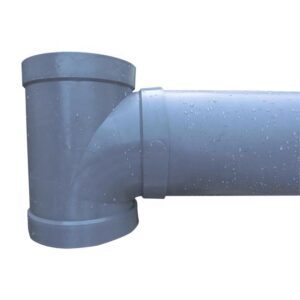
- Tees (equal and reducing)
- Elbows (45° and 90°)
- Dampers (butterfly and gate)
- End caps and cleanouts
Material Options
- PP: Most common for acid exhaust. -10 °C to 80 °C. UV stabilization available for outdoor use.
- PVC: Lower cost, lower temperature limit. -5 °C to 55 °C. Not for continuous UV exposure.
- FR-PP: Higher temperature rating (up to 100 °C). For special chemical resistance requirements.
The Components That Complete the System
Straight duct is the backbone of a ventilation system. Fittings make it work. Elbows change direction. Tees create branches. Reducers transition sizes. Flanges provide serviceable connections. End caps terminate runs. Together, fittings typically account for 20-30% of the total duct system cost — but 80% of the pressure drop. Getting the fittings right matters more than getting the straight duct right, because each fitting multiplies the system’s flow resistance. A poorly selected elbow adds as much pressure drop as 10-20 meters of straight duct.
All round air duct fittings — elbows, tees, reducers, connections, flanges, end caps — are available in PP, PVC, and FR-PP to match your duct material. For detailed specifications on each fitting type, see their individual product pages linked below.
Round Duct Fittings Overview
| Fitting Type | Function | Product Page |
|---|---|---|
| 45 Degree Elbow | Gentle direction change — lowest pressure drop option | 45 Degree Duct Elbow |
| 90 Degree Elbow | Sharp turn for tight spaces and equipment connections | 90 Degree Duct Elbow |
| Connection Elbow | Flanged or socket elbow for equipment interfaces | Air Duct Connection Elbow |
| 3-Way Tee | Branch connection for splitting or combining flow | 3-Way Duct Tee Fitting |
| Equal Tee | Same-diameter tee for balanced distribution | Equal Tee Connection |
| Concentric Reducer | Centerline-aligned diameter transition | Concentric Duct Reducer |
| Variable Diameter Fitting | Non-standard equipment-to-duct transition | Variable Diameter Fitting |
| Flanges & Connections | Flange kits, socket couplings, gaskets, fasteners | Air Duct Connection Flanges |
| End Caps | Blind termination for duct ends — permanent or removable | See Air Duct Connection Flanges |
Material Selection for Fittings: Match Your Duct
The fundamental rule of fittings: the fitting material must match the duct material. Mixing materials creates galvanic or chemical compatibility problems at the welded or flanged joint. A PP elbow welded to a PVC duct won’t fuse properly — the materials have different melt temperatures and the weld will fail. A FR-PP flange bolted to a PP flange with the wrong gasket will leak when the system reaches operating temperature and the two materials expand at different rates:
- PP fittings with PP duct. Standard for most industrial ventilation. Chemical resistant, weld-compatible, -10 to 80degC. All standard injection-molded fittings are available in PP.
- PVC fittings with PVC duct. For outdoor and UV-exposed installations. Higher rigidity, lower cost. Weld-compatible only with PVC duct.
- FR-PP fittings with FR-PP duct. For fire-rated and high-temperature systems. Only compatible with FR-PP duct — cannot be welded to PP or PVC. Flanged connections with PTFE gaskets are used where a FR-PP section must connect to a PP or PVC section (at the temperature transition point).
Sizing Fittings: Don’t Oversize the Bend, Undersize the Branch
Common fitting sizing errors:
- Elbow diameter must match duct diameter. A DN315 elbow on a DN315 duct run. Obvious but frequently wrong on site when the specified elbow isn’t available and a different size is substituted. An undersized elbow creates a velocity increase and higher pressure drop; an oversized elbow requires transition pieces at both ends.
- Tee branch diameter should match the branch flow, not the main. A DN400 header with a DN150 branch drop to a fume hood is correct — the DN150 branch carries ~1,000 m3/h and the DN400 main carries ~5,000 m3/h. A DN400 equal tee with a DN400 branch carrying only 20% of the main flow wastes money on an oversized branch fitting.
- Reducer taper length should match the available space and flow velocity. Higher velocities need longer tapers (shallower angle) to prevent flow separation. A reducer crammed into a short space at high velocity will separate and create far more pressure drop than the straight duct it replaces.
For connection components — flanges, gaskets, fasteners, socket couplings, and end caps — see our Air Duct Connections & Flanges and Plastic Air Duct Connections pages.
Send your fitting schedule to xicheng023@outlook.com. We’ll verify sizing, material compatibility, and provide a complete quotation. WhatsApp: +86 18927456906.
Selection Guide
To select the correct fitting for your duct system, follow these steps:
- Determine the duct material (PP, PVC, FR-PP) matching your pipe specification.
- Confirm the connection type: butt fusion for permanent, flanged for serviceable, or socket for small diameters.
- Measure the outside diameter of your duct to confirm DN size.
- For transitions between materials, specify a flanged adapter — PP-to-PVC or PP-to-metal.
Contact our technical sales team with your duct diameter and application details for a complete fitting list.