

Specifications
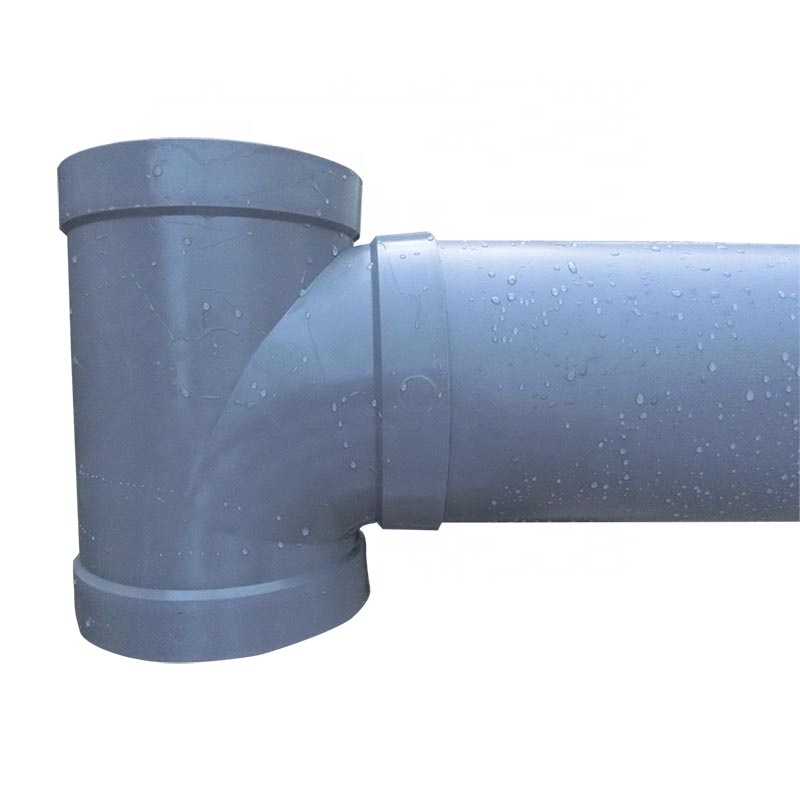
- Type: Equal tee (same diameter on all three branches)
- Material: PP (polypropylene)
- Connection: Butt weld or flanged
- Size range: DN 50–400 mm
- Angle: 90° branch
Typical Applications
- Branch connections in main exhaust duct runs
- Distributing exhaust from multiple sources into a common header
Equal Diameter, Equal Flow — In Theory
An equal tee — all three ports the same diameter — is the simplest tee configuration and the most commonly specified. It splits one flow into two equal branches, or combines two equal branch flows into one main. The symmetry is elegant: DN200 in, two DN200 out. But flow through a tee is never perfectly symmetrical. The branch port at 90 degrees to the run sees different flow conditions than the straight-through run port. In a splitting configuration, the branch takes a portion of the flow; the remainder continues straight. The split ratio depends on downstream resistance in each leg, not the tee geometry.
Our equal tees are injection-molded as one piece in PP, PVC, and FR-PP — the branch intersection is continuous material with no weld, no saddle reinforcement, and consistent wall thickness at the crotch (the internal intersection point where all three flow paths meet). For full specifications, see our PP Duct Tee main page.
Equal Tee Applications
| Application | Configuration | Why Equal Tee |
|---|---|---|
| Distribution header | One main in → two equal branches out. Each branch feeds a zone or piece of equipment with similar airflow. | Equal diameter maintains consistent velocity in all legs — no acceleration or deceleration at the split. |
| Collection manifold | Two equal branch flows in → one main out. Both branches serve similar equipment with similar exhaust rates. | Symmetrical combining — both inlet flows enter at the same velocity, minimizing mixing turbulence. |
| Clean-out access tee | Flanged equal tee in the main duct run with a blind flange on the branch port. Branch port provides full-diameter access. | Equal diameter means the access port is the same size as the duct — full-bore inspection and cleaning access. |
| Future expansion point | Flanged equal tee with blind flange installed now; branch connection added when system expands. | Equal diameter ensures the future branch can carry the same flow as the existing main. |
Equal Tee vs Wye: The Flow Decision
An equal tee makes a 90-degree branch connection. A wye (lateral) fitting makes a 45-degree branch connection. The difference in pressure drop between the two is significant — and the choice depends on how flow moves through the fitting:
- For splitting flow (one in, two out): An equal tee is acceptable. The incoming flow divides at the branch intersection — some continues straight, some turns 90 degrees into the branch. The branch flow experiences higher pressure drop than the straight-through flow, which may create flow imbalance between the two downstream legs if they have different downstream resistance. The equal tee is the standard choice for distribution headers where space constraints prevent a wye.
- For combining flow (two in, one out): A wye is strongly preferred over an equal tee. When the branch flow enters the main at 90 degrees, it must make a sharp turn to align with the main flow direction — creating turbulence and velocity profile distortion that persists for several diameters downstream. A wye at 45 degrees produces a gentler merge with lower pressure drop. Use an equal tee for combining only when space prevents a wye or when the branch flow is small (under 30% of total).
- For access tees (blind flange): Equal tee is correct — the branch port orientation is about access, not flow. 90-degree branch provides perpendicular access to the main run.
For tee flow configurations in detail, see our 3-Way Duct Tee Fitting page.
Installation and Pressure Balance
In a distribution header with multiple equal tees in series, the first tee (closest to the fan or source) sees the highest pressure. The last tee sees the lowest — because pressure drops continuously along the header as flow is extracted at each branch. If all branches are the same diameter and have similar downstream duct runs, the branch closest to the source will flow more air than the branch furthest away — because higher pressure drives more flow through the same resistance. The solution is either: balancing dampers in each branch to equalize resistance, or reducing tee sizes along the header (larger branches near the source where more total flow remains in the header). We can calculate the pressure profile along your header and recommend the right approach.
Send your header layout to xicheng023@outlook.com. We’ll specify tee configurations and provide a complete quotation. WhatsApp: +86 18927456906.
Installation Guide
- Branch orientation: Standard tee has 90° branch. Can be rotated to any angle before welding.
- Support: All three branches must be independently supported. Add hangers within 500 mm of each connection.
- Flow distribution: For equal tees, flow splits approximately 50/50 under equal downstream resistance. For controlled distribution, add balancing dampers.