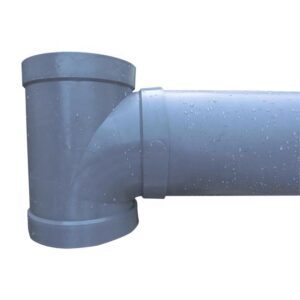
Specifications
- Type: 3-way branch/tee fitting
- Material: PP (polypropylene)
- Branch angle: 90° standard
- Connection: Butt weld or flanged
- Size range: DN 50–400 mm
The Most Complex Standard Fitting
A tee is the only standard fitting where three flow paths intersect at one point. Flow enters from one, two, or potentially all three ports — depending on whether the tee is splitting flow (one inlet, two outlets) or combining flow (two inlets, one outlet). The flow dynamics at the intersection determine the system pressure drop, noise, and — in exhaust systems carrying particulate — whether solids drop out at the tee or stay entrained. Specifying a tee based on diameter alone, without considering the flow configuration, is the most common fitting selection error in industrial ductwork.
Our 3-way tees are injection-molded as one continuous piece — the branch intersection, the highest-stress zone in a tee, has no welds. The run and branch are formed in a single mold cycle with consistent wall thickness at the intersection. For full product data, see our PP Duct Tee main page.
Tee Flow Configurations: Same Fitting, Different Behavior
The same tee performs differently depending on how flow passes through it. Understanding your configuration determines whether a tee is the right fitting or whether a wye (lateral) would perform better:
| Configuration | Flow Pattern | Pressure Drop | When to Use |
|---|---|---|---|
| Splitting (diverge) | One inlet → two outlets. Flow divides at the branch intersection. | Moderate. Flow separation at the branch entry creates turbulence in both downstream legs. | Distribution headers: one main feeding multiple branch lines. HVAC supply duct take-offs. Exhaust collection manifold (reverse flow — two inlets, one outlet). |
| Combining (converge) | Two inlets → one outlet. Two flows merge at the intersection. | Higher — especially when branch flow is a large fraction of main flow. The merging streams create turbulence and momentum exchange. | Multiple hoods combining into a single zone header. Two scrubber outlets feeding a common stack. Process exhaust manifold. |
| Branch injection | Small branch flow entering a large main flow. Branch flow << main flow. | Lowest. The small branch stream is entrained by the main flow with minimal disturbance. | Individual fume hood drop (DN150) entering a main exhaust header (DN400). Instrument vent line entering process exhaust. |
When the branch flow is more than 30% of the total combined flow, a 45deg lateral (wye) fitting provides lower pressure drop than a 90deg tee. The shallower entry angle reduces the momentum exchange between the merging streams. Contact us with your flow data for a recommendation.
Equal vs Reducing Tees
- Equal tee. All three ports are the same diameter. For symmetrical splitting (one DN250 into two DN250 branches) or combining (two equal branches into one main of the same diameter). The simplest configuration and the most common in distribution headers and collection manifolds. See our Equal Tee Connection page.
- Reducing tee. The branch port is smaller than the run ports. For branching off a smaller line from a larger main — DN150 branch from a DN400 header is the standard fume hood drop configuration. The reducing branch minimizes flow disturbance in the main because the smaller take-off represents a minor flow area change.
Tee Orientation and Installation
How a tee is installed — branch up, branch down, or branch horizontal — affects both flow performance and maintenance:
- Branch up (from horizontal run). For exhaust take-offs from an overhead main header. Condensation or particulate in the main flow may fall into the branch if velocity is too low. Ensure transport velocity is maintained in the main at all operating conditions.
- Branch down (from horizontal run). For supply air drops or exhaust connections where the equipment is below the duct. Condensation drains into the branch — provide a low-point drain if the exhaust carries moisture.
- Branch horizontal (from vertical run). For riser take-offs at each floor. Flow disturbance from the tee can affect pressure balance between floors in a multi-story riser — balancing dampers may be needed at each branch take-off.
For tee flange connections and gaskets, see Air Duct Connections & Flanges. For elbows at the branch connection, see PP Duct Elbow.
Send your duct layout with branch points to xicheng023@outlook.com. We’ll specify tee type, size, and connection method. WhatsApp: +86 18927456906.
Installation Guide
- Balanced flow: The branch connection creates turbulence. A straight duct length of 5× diameter after the tee is recommended for stable flow measurement.
- Reinforcement: For DN 300 and above, add gusset plates or external stiffening rings at the branch junction.
- Support: All three branches require individual supports.
The branch connection in a 3-way tee creates localized turbulence at the junction. For systems with precise flow balancing requirements, specify a tee with an integrated butterfly damper on the branch or install a separate balancing damper within 1 m of the tee branch.