
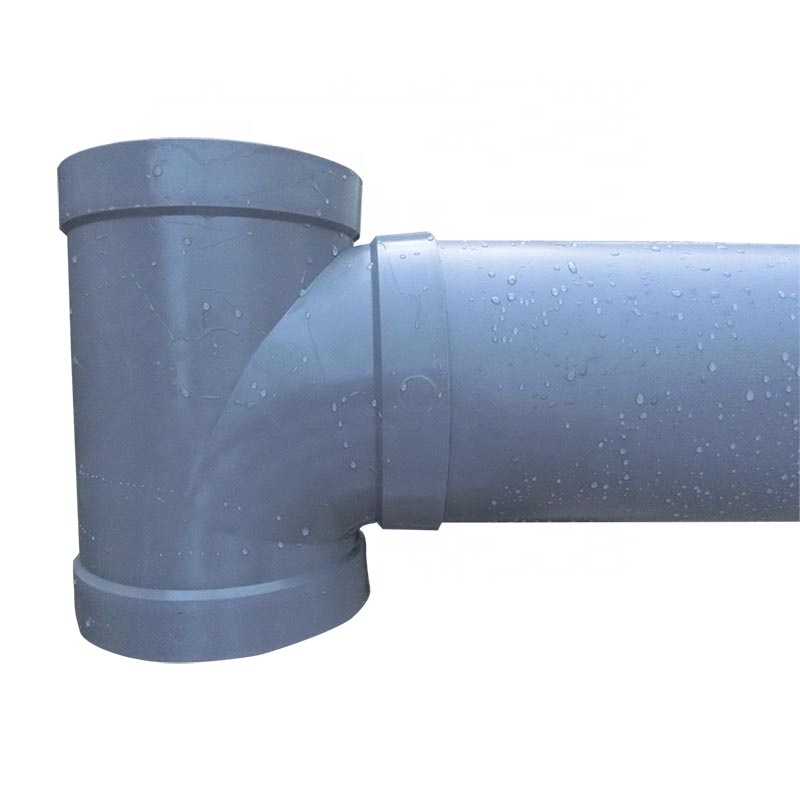


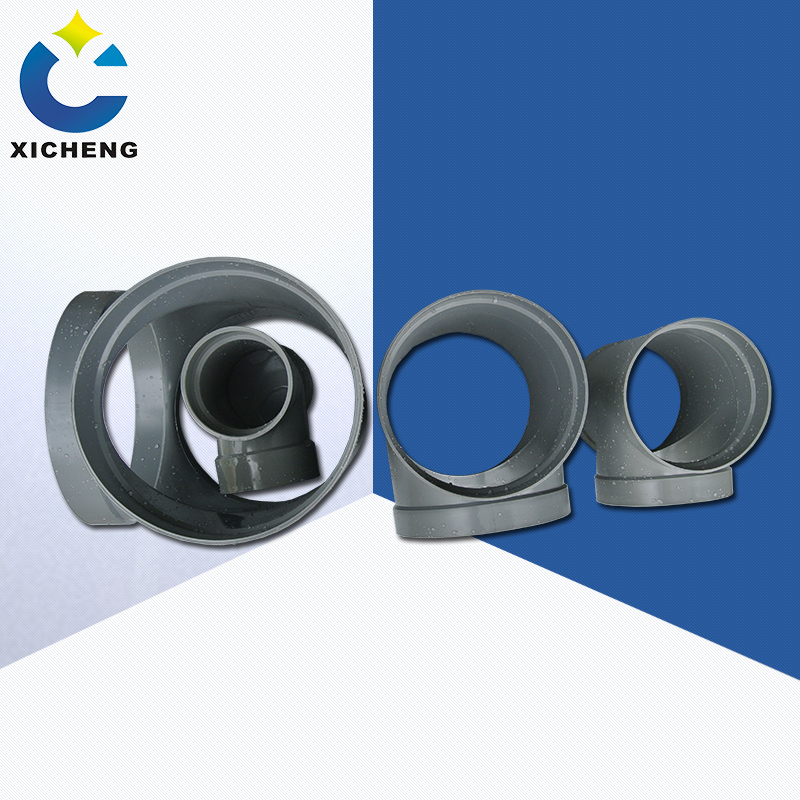
Specifications
- Type: Injection molded PP duct tee
- Material: PP (polypropylene)
- Configuration: Equal or reducing tee
- Connection: Butt weld or flanged
- Size range: DN 50–400 mm
- Temperature: -10 °C to 80 °C
Product Overview
PP duct tee fitting manufactured by one-piece injection molding — 3-way branch connections for industrial ventilation, exhaust distribution, and process piping manifolds. Equal tees (all three ports same diameter) for splitting flow evenly between two branches or combining two streams into one main. Available in PP, PVC, and FR-PP materials for diameters from 15 mm to 500 mm. Unlike fabricated tees assembled from cut-and-welded pipe segments, injection-molded tees are one continuous piece — the branch intersection, the highest-stress zone in a tee, has no welds.
| Application | Duct branching and flow distribution, exhaust manifold connections, combining multiple branch ducts into main header, process piping tees |
| Material | PP (standard corrosion), PVC (rigid/UV), FR-PP (flame retardant / 60 °C) |
| Type | Equal tee (all three ports same diameter standard); reducing tee (branch smaller than run) available custom |
| Diameter range | 15 mm to 500 mm (injection molded); larger sizes fabricated |
| Wall thickness | 2.5 mm to 8 mm depending on diameter |
| Connection | Butt-weld ends (standard); flanged ends (optional) |
| Color | Beige / Dark Grey / White |
| Lead time | 5-15 days standard; 15-20 days custom |
Why Injection-Molded Tees Handle Stress Better
A tee fitting carries three loads simultaneously: internal pressure or vacuum, bending moment from connected pipe spans, and thermal expansion forces from all three directions. The intersection where the branch meets the run is the most highly stressed point in any piping system — fabricated tees put a weld exactly there:
- No weld at the branch intersection. A fabricated tee is made by cutting a hole in the run pipe, welding a branch stub over it, and reinforcing with a saddle or collar. Three welds (branch-to-run, plus two end connections) in the highest-stress zone. An injection-molded tee forms all three ports and the central intersection as one continuous piece — the material flows through the intersection with no joints, no seams, no stress risers.
- Smooth internal flow transition. The branch-to-run intersection in a fabricated tee has an abrupt 90deg internal edge where the drilled hole meets the branch stub — creating turbulence and a localized high-pressure-drop zone. Injection-molded tees can incorporate a radiused transition at the intersection, reducing turbulence and pressure loss compared to a sharp-edged fabricated tee.
- Consistent wall thickness at the crotch. The crotch area (where branch and run intersect internally) is complex geometry that fabricated tees handle with overlapping welds and reinforcement pads. Injection molding fills this geometry precisely and consistently — wall thickness at the crotch matches the design specification, confirmed by the mold cavity geometry. This is critical for exhaust systems operating under negative pressure, supporting EU Industrial Emissions Directive requirements for leak-tight industrial ductwork.
Why Xicheng
16 years, 2600+ systems shipped worldwide. Tees are the most complex standard fitting to manufacture — three ports, a central intersection, and complex internal geometry. Getting them right matters for system reliability:
- Equal and reducing tees from one source. Equal tees for symmetrical branching — all three ports same diameter, used for distribution headers and collection manifolds. Reducing tees for branch lines smaller than the main — the branch port is one or two sizes down from the run, used for individual hood drops off a main exhaust trunk. Both types in PP, PVC, and FR-PP.
- Designed for your flow configuration. A tee used as a flow splitter (one inlet, two outlets) has different flow characteristics than the same tee used as a flow combiner (two inlets, one outlet). We can advise on orientation and whether a 45deg lateral (wye) fitting might provide lower pressure drop than a 90deg tee for your specific application.
- Flanged tees for access and clean-out. Tees are natural access points — installing a flanged tee with a blind flange on the branch port creates a clean-out access for duct inspection and maintenance. We supply flanged tees with matching blind flanges and gaskets.
Send your duct layout showing branch points to xicheng023@outlook.com. We’ll specify tee types, sizes, and provide a complete fittings schedule.
Core Advantages
- One-Piece Injection Molded Intersection: The branch-to-run junction — the highest-stress zone in any tee — is solid continuous material with no welds, no saddle, no reinforcement pads.
- Equal and Reducing Tees: Standard equal tees for symmetrical branching; reducing tees for branch lines smaller than the main header — both from the same manufacturer.
- Smooth Internal Radius at Intersection: Radiused transition at the branch entry reduces turbulence and pressure drop vs sharp-edged fabricated tees.
- Three Materials: PP for general corrosion, PVC for rigid UV-stable, FR-PP for fire-rated and 60 °C applications.
- Flanged Tees for Access: Flanged branch port with blind flange creates built-in clean-out access points for duct inspection.
Key Specifications
| Material | PP / PVC / FR-PP — virgin resin, injection molded |
| Type | Equal tee standard; reducing tee available |
| Diameter Range | 15 mm – 500 mm (injection molded); larger sizes fabricated |
| Wall Thickness | 2.5 – 8 mm |
| Connection Type | Butt-weld (standard); flanged (optional) |
| Operating Temperature | PP: -10 to 80degC | PVC: 0 to 60degC | FR-PP: up to 60 °C |
| Service Life | 10-15 Years |
| Brand / Origin | Xicheng / China |
Certifications and Compliance
- CE Certified – PP Tee, Duct, Fittings
- RoHS Compliant – All materials
- ISO 9001 – Quality Management System
- ISO 14001 – Environmental Management System
- SGS Tested – PP material properties, weld integrity
- Design Compliance – Fittings designed to meet EU Industrial Emissions Directive (2010/75/EU) for leak-tight industrial exhaust ductwork
How to Order
- You send – Run diameter, branch diameter, material preference, connection type, quantity
- We confirm – Equal or reducing tee configuration, material availability, lead time, pricing
- We produce – 5-15 days. Injection molded, dimensional inspection before shipment
Contact xicheng023@outlook.com or WhatsApp +86 18927456906 — quotation within 24 hours.
Complete Your System
- PP Industrial Pipe – Straight pipe sections
- PP Duct Elbow – 45deg and 90deg elbows for direction change
- PP Duct Reducer – Diameter transition fittings
- PP Square Duct – Rectangular duct for space-constrained routes
FAQ
Equal tee or reducing tee — which do I need?
Equal tee: all three ports are the same diameter. Use when branching flow equally (splitting one main into two equal branches) or combining two equal branch flows into one main. Reducing tee: the branch port is smaller than the run ports. Use when a smaller branch line connects to a larger main — for example, an individual fume hood drop (200 mm) connecting to a main laboratory exhaust header (500 mm). We produce both types.
Can I use a tee as a clean-out access point?
Yes — this is a common design practice. Install a flanged tee with the branch port oriented for access (typically upward or to the side at service height). Fit a blind flange with gasket on the branch port. For duct inspection or cleaning, remove the blind flange for access. This is more cost-effective than a dedicated clean-out fitting and provides full-diameter access to the main run.
Is a 45deg lateral better than a 90deg tee?
For combining two flows into one, a 45deg lateral (wye) fitting provides lower pressure drop than a 90deg tee because the branch flow enters at a shallower angle with less turbulence. Use a wye when both inlet flows are significant. Use a 90deg tee when the branch flow is small relative to the main (less than 30% of total flow) or when space constraints prevent a wye fitting.


