

Specifications
- Material: PP (polypropylene) homopolymer or copolymer
- Size range: DN 15 mm (½”) to DN 1000 mm (40″)
- Wall thickness: SDR 33, SDR 26, SDR 17, SDR 11, SDR 7.4
- Pressure rating: PN 4 to PN 16 depending on SDR and temperature
- Temperature: -10 °C to 80 °C continuous; up to 100 °C short-term
- Color: Natural (translucent white) or grey
- Length: Standard 4 m or 6 m; custom lengths available
- Standard: ISO 15494, DVS 2205, DIN 8077/8078
Typical Applications
- Bulk transport of corrosive liquids and gases in chemical processing
- PP ductwork for exhaust ventilation in fume hoods and scrubber systems
- Compressed air and vacuum lines in clean environments
- Food processing fluid lines (PP complies with food contact regulations)
Product Overview
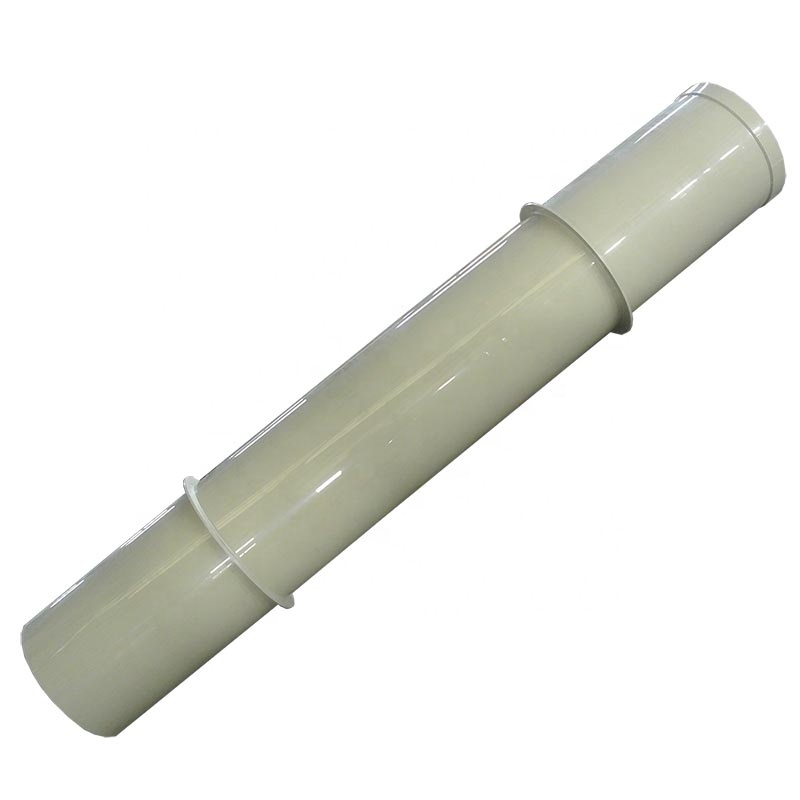
PP industrial pipe manufactured by one-piece injection molding — producing seamless pipe from 15 mm to 1,000 mm diameter with no weld joints, no longitudinal seams, and uniform wall thickness throughout. Designed for corrosive fluid transport, chemical process piping, industrial water lines, and exhaust gas ducting where leak-tight integrity and chemical resistance are critical. Available in three material grades: PP (polypropylene — standard corrosion resistance), PVC (polyvinyl chloride — higher rigidity, UV stable), and FR-PP (flame-retardant polypropylene — flame-retardant (FR) grade available on request).
| Application | Corrosive fluid transport, chemical process piping, industrial water supply, exhaust gas ducting, drainage systems |
| Material | PP (standard), PVC (rigid / UV-stable), FR-PP (flame retardant / high-temp 60 °C) — all virgin resin, injection molded |
| Diameter range | 15 mm to 1,000 mm — one-piece injection molding; above 1,000 mm to 1,500 mm — welded fabrication from PP/PVC sheet |
| Wall thickness | 2.5 mm to 8 mm depending on diameter; custom thickness available |
| Standard length | 3-4 meter sections |
| Color | Beige / Dark Grey / White |
| Lead time | 10-20 days standard; 15-25 days custom production |
Why Injection-Molded Pipe Over Fabricated
Most large-diameter plastic pipe is fabricated by rolling sheet material and welding a longitudinal seam. This seam is the pipe’s weakest point — a potential leak path, a stress concentration, and a corrosion initiation site. Our injection molding process produces pipe as a single continuous piece:
- Zero weld seams, zero leak paths. Welded pipe has a seam running the full length of every section — vulnerable to cracking under thermal cycling, vibration, and negative pressure. Injection-molded pipe is one solid piece from end to end, with identical mechanical properties at every point on the circumference.
- Uniform wall thickness, predictable strength. Sheet-rolled pipe inevitably has thickness variation — thinner where the sheet was stretched during rolling, thicker near the weld. Injection molding delivers precise, repeatable wall thickness controlled by the mold cavity. No weak spots, no surprises during pressure testing.
- Up to 1,000 mm in a single piece. Most suppliers top out at 400-600 mm for seamless pipe. Our large-format molding capability produces up to 1,000 mm as a single injection-molded piece. For diameters above 1,000 mm up to 1,500 mm, we fabricate from PP/PVC sheet by rolling and hot-gas extrusion welding — a proven method for large-diameter piping with full penetration welds and quality inspection. This supports EU Industrial Emissions Directive requirements for leak-tight industrial ductwork and US EPA NESHAP standards for chemical process exhaust conveyance systems.
Why Xicheng
16 years, 2600+ systems shipped worldwide. Industrial pipe quality depends on three things: raw material (virgin vs regrind), manufacturing process (molded vs extruded vs welded), and dimensional accuracy (wall thickness consistency). Shortcuts on any of these produce pipe that leaks at joints, embrittles after 3 years, or collapses under vacuum:
- In-house injection molding from 15 mm to 1,000 mm. We own and operate the molding equipment — no outsourced production, no third-party pipe with unknown material provenance. Every diameter from small-bore (15-200 mm) for instrumentation and branch lines, to medium-bore (200-500 mm) for process mains, to large-bore (500-1,000 mm) for main exhaust trunks is produced under the same quality system.
- Three materials, one manufacturer. PP for standard corrosive service (acids, alkalis, salts, most organics, -10 to 80degC). PVC for applications requiring higher rigidity or outdoor UV exposure. FR-PP for fire-rated systems and high-temperature exhaust up to 60 °C. All virgin resin with traceable batch certification — no regrind, no recycled content.
- Installed across demanding industries. Chemical processing plants (corrosive fluid lines, process vents), electroplating and surface finishing (acid handling, rinse water, exhaust ductwork), pharmaceutical manufacturing (WFI water loops, solvent waste, cleanroom utilities), electronics and semiconductor fabs (process chemical drain, exhaust ducting), laboratories and research facilities (fume hood exhaust, chemical waste drainage), and general industrial plants (compressed air condensate, cooling water, chemical dosing lines).
- Pipe + fittings + support — one source. Matching elbows, tees, reducers, flanges, and connectors from the same material batch. No compatibility issues between pipe and fittings from different suppliers. Complete system warranty.
Send your pipe specifications to xicheng023@outlook.com. We’ll confirm diameter capability, material recommendation, and lead time.
Core Advantages
- Pressure-Tight Injection Molding to 1,000 mm: One-piece seamless pipe handles internal pressure and vacuum without weld seam failure risk — critical for chemical transfer and process piping.
- Chemical Compatibility by Application: PP for broad acid/alkali/solvent resistance, PVC for rigid UV-stable outdoor lines, FR-PP for 60 °C high-temperature or fire-rated systems — material matched to fluid, not one-size-fits-all.
- Small-Bore to Large-Bore, One Manufacturer: 15 mm instrumentation lines to 1,000 mm main process headers — consistent material quality, no multi-supplier compatibility issues.
- Virgin Resin Traceability: Every batch traceable to resin lot with material certification on request — no regrind, no recycled content compromising chemical resistance or mechanical strength.
- Pipe + Fittings + Flanges, One Source: Matching elbows, tees, reducers, and flanges from the same production batch — guaranteed dimensional and material compatibility.
Key Specifications
| Material | PP (Polypropylene) / PVC (Polyvinyl Chloride) / FR-PP (flame-retardant polypropylene) — virgin resin |
| Manufacturing Process | One-piece injection molding — seamless, no welds |
| Diameter Range | 15 mm – 1,000 mm (injection molded); 1,000 mm – 1,500 mm (sheet fabricated) |
| Wall Thickness | 2.5 – 8 mm (diameter-dependent; custom thickness available) |
| Standard Length | 3 – 4 meters per section |
| Operating Temperature | PP: -10 to 80degC | PVC: 0 to 60degC | FR-PP: up to 60 °C |
| Chemical Resistance | Acids, alkalis, salt solutions, most organic solvents (PP/PVC); broad chemical resistance (FR-PP) |
| Service Life | 10-15 Years |
| Brand / Origin | Xicheng / China |
Certifications and Compliance
- CE Certified – PP Pipe, PVC Pipe, Fittings
- RoHS Compliant – All materials
- ISO 9001 – Quality Management System
- ISO 14001 – Environmental Management System
- SGS Tested – PP Pipe (mechanical properties, chemical resistance), FR-PP (flame retardancy, thermal stability)
- Design Compliance – Piping systems designed to meet EU Industrial Emissions Directive (2010/75/EU) for leak-tight industrial exhaust ductwork
How to Order
- You send – Required diameter(s), wall thickness, lengths, quantity, application, chemical exposure conditions, operating temperature
- We recommend – Material grade (PP/PVC/FR-PP), wall thickness specification, connection method, support spacing
- You approve – Technical proposal with material certs, dimensional drawings, and pricing
- We produce – 10-25 days. Injection molded to spec, dimensional inspection, material certification provided
- We ship – Bundled and protected. Installation drawings, welding guidelines, and thermal expansion compensation data included.
Contact xicheng023@outlook.com or WhatsApp +86 18927456906 — quotation within 24 hours.
Complete Your System
- PP Round Duct – Round ventilation duct for air and exhaust systems
- PP Square Duct – Square and rectangular duct for ventilation
- PP Duct Elbow – 45deg and 90deg elbows, injection molded
- PP Duct Tee – Tee fittings for pipe branching
Installation Guide
- Butt fusion: Use a PP butt fusion machine. Facing, heating (210 °C), fusion, and cooling phases per DVS 2208. Fusion cycle time 10–40 minutes depending on diameter.
- Hanger spacing: DN 50: every 1.0 m; DN 100: every 1.5 m; DN 200: every 2.0 m; DN 400+: every 2.5 m.
- Thermal expansion: PP expands 0.15 mm/m/°C. For a 20 m pipe run with 50 °C temperature change, allow 150 mm axial movement at expansion loops or bellows.
- Chemical resistance: PP resists most acids, alkalis, and solvents at room temperature. Check chemical resistance tables for elevated temperature and specific solvent exposure.
Pressure Rating Table
- SDR 33: PN 4 bar at 20 °C, max 60 °C
- SDR 17: PN 8 bar at 20 °C, max 80 °C
- SDR 11: PN 12 bar at 20 °C, max 80 °C
- SDR 7.4: PN 16 bar at 20 °C, max 80 °C
FAQ
What is the difference between injection-molded pipe and extruded pipe?
Extruded pipe is pushed continuously through a die — efficient for small diameters but limited in wall thickness control and maximum diameter (typically under 400 mm). Injection-molded pipe is produced as individual pieces in a closed mold — allowing precise wall thickness control, larger diameters (up to 1,000 mm), and superior dimensional accuracy. For industrial applications where pipe integrity is critical, injection molding is the preferred process.
Which material should I choose — PP, PVC, or FR-PP?
PP is the standard choice for most industrial applications — excellent chemical resistance across acids, alkalis, and solvents, good temperature range (-10 to 80degC), and best overall value. PVC offers higher rigidity and better UV resistance for outdoor installations but has a lower maximum temperature (60degC). FR-PP is specified when flame retardancy is required by building codes or when the application involves continuous exposure to temperatures above 80degC — it is rated to 60 °C.
What connection methods are available?
Butt welding (hot-gas extrusion) for permanent, leak-tight joints — recommended for exhaust ductwork and pressure piping. Flange connections for sections that require periodic disassembly for maintenance access or equipment change-out. Socket coupling for small-bore pipe (under 200 mm) where quick assembly is needed. We supply matching flanges, gaskets, and fasteners in compatible materials.