Specifications
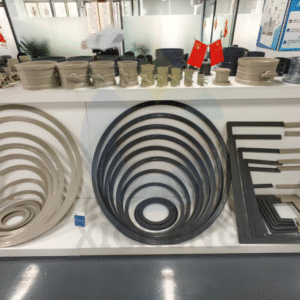
- Type: PP and PVC couplings, connectors, and transition pieces
- Material: PP, PVC, FR-PP
- Connection: Socket, threaded, or flanged
- Size range: DN 50–400 mm
- Temperature: PP: -10 °C to 80 °C; PVC: -5 °C to 55 °C
Every Duct System Starts and Ends with a Connection
Straight duct sections don’t connect themselves. The joint between two sections — or between a duct and a piece of equipment — is where most systems eventually leak. Choose the right connection method for each location, and the system stays tight for its design life. Choose wrong, and you’ll be chasing leaks from the day of commissioning.
Connection methods range from permanent (butt-welded) to fully demountable (flanged with gasket). The right choice depends on three factors: will this joint ever need to be opened, what pressure does it operate under, and what chemical compatibility is required for the sealing element. For flange kits including gaskets and fasteners, see our Air Duct Connection Flanges page. For the complete connection system overview, see Air Duct Connections & Flanges.
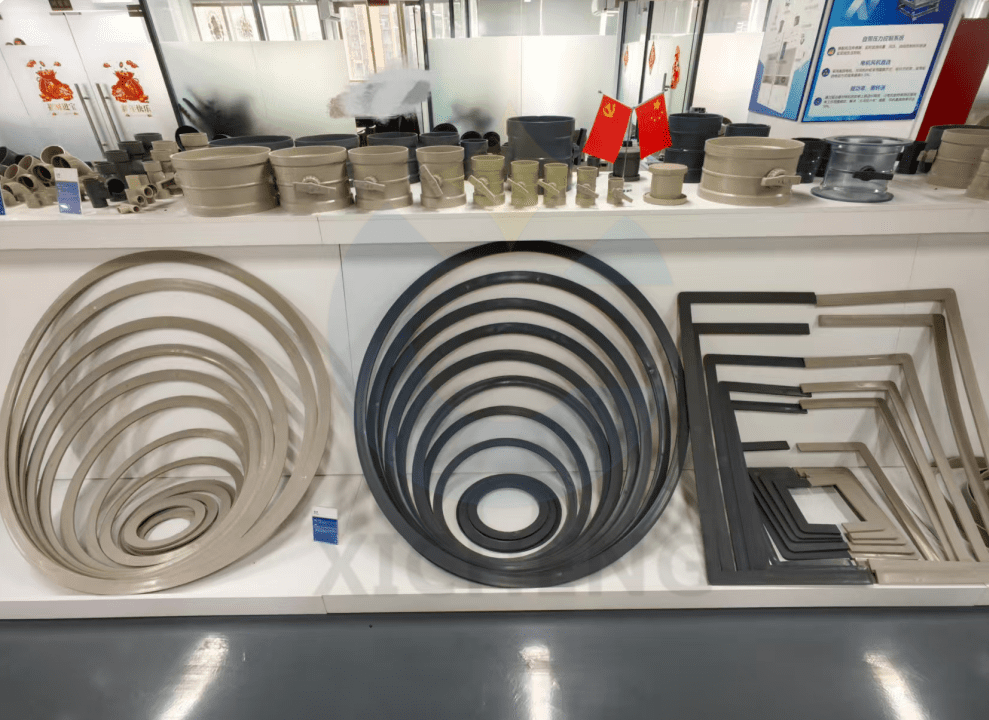
Connection Methods Compared
| Method | Joint Type | Pressure Range | Diameters | Best For |
|---|---|---|---|---|
| Butt welding | Permanent — duct ends fused by hot-gas extrusion welding. Joint strength equals parent material. | Full vacuum to 2 bar positive | All diameters | Long straight runs, critical exhaust, any joint that should never need to be opened. The standard for industrial exhaust ductwork. |
| Socket coupling | Semi-permanent — duct end slips into socket fitting with integral EPDM or FKM sealing ring. Can be disassembled with effort. | -200 Pa to 0.5 bar | DN15-DN200 | Small-diameter branch connections, lab bench exhaust, instrument lines. Fast assembly, no welding equipment required. |
| Flanged connection | Demountable — flanges welded to duct ends, bolted together with gasket between. Fully serviceable. | Full vacuum to 1 bar (gasket-dependent) | All diameters | Equipment connections, access points, future expansion tie-ins, any joint requiring periodic disassembly. |
| Compression fitting | Demountable — threaded nut compresses ferrule onto pipe OD. No welding. | Up to 10 bar (ferrule-dependent) | DN15-DN50 | Instrumentation, chemical dosing lines, compressed air. Pressure-rated connection for small-bore pipe. |
Butt Welding: The Standard for Industrial Exhaust
Hot-gas extrusion butt welding is the most common joint method for PP industrial ductwork — and when done correctly, the most reliable. A handheld extrusion welder feeds PP welding rod through a heated barrel, depositing molten PP into the joint between two duct ends. The key variables: welding temperature (220-280degC for PP), welding speed, and rod material (must match the duct material grade). A properly executed butt weld has tensile strength equal to or greater than the parent PP sheet or pipe wall. The weld should be full-penetration through the wall thickness, with a smooth internal bead profile that doesn’t create a flow obstruction.
For field installations, butt welding requires a qualified technician with PP welding experience and the correct equipment. We can provide welding procedure specifications for your local installer, or supply pre-welded duct sections with flanged connections at the field joint locations — the factory-made welds are performed under controlled conditions with ultrasonic inspection available for critical applications.
Socket Couplings: Fast Assembly for Small Lines
Socket couplings use an integral elastomeric sealing ring inside a molded PP socket. The pipe end is simply pushed into the socket — the ring compresses against the pipe OD to create a seal. No welding, no bolts, no tools beyond a chamfering tool to bevel the pipe end. The joint can accommodate slight angular misalignment and thermal expansion/contraction movement — the sealing ring maintains contact as the pipe moves within the socket.
Limitations: socket couplings are not rated for deep negative pressure (the seal relies on compression, and vacuum tends to pull the ring away from the pipe surface). They are not recommended for hazardous chemical exhaust where a seal failure would create a personnel exposure risk. And they cannot be used above DN200 — the sealing force required for larger diameters exceeds what a simple push-fit ring can provide.
Compression Fittings for Instrument and Chemical Lines
At DN15-DN50, where PP pipe is used for chemical dosing, instrument air, and sampling lines, compression fittings provide a pressure-rated, demountable connection without welding. A threaded nut compresses a PTFE or EPDM ferrule onto the pipe OD, creating a mechanical seal. These fittings are rated to 10 bar at ambient temperature — suitable for pressurized liquid chemical lines that small-diameter process pipe often carries.
For gasket selection, bolt torque specifications, and flange face machining standards, see our Air Duct Connection Flanges page.
Send your connection requirements to xicheng023@outlook.com. We’ll specify the right connection method for each joint in your system. WhatsApp: +86 18927456906.
Connection Method Guide
Choosing the right connection method depends on duct diameter, operating temperature, and maintenance access requirements:
- Butt fusion: Strongest joint. For permanent connections DN 200+. Requires fusion welding machine.
- Socket fusion: Faster installation. For DN 50–200. Good for field joints.
- Flanged: Allows disassembly. Required at equipment connections, expansion joints, and inspection points. Use PP backing flanges with loose stub ends.
- Threaded: For small diameters DN 15–50 only. PTFE tape sealant recommended.