Specifications
- Type: Concentric and eccentric reducers
- Material: PP (polypropylene)
- Size transitions: Standard reductions per DVS 2204
- Connection: Butt weld or flanged
- Wall thickness: SDR 17, SDR 11, or custom
Product Overview
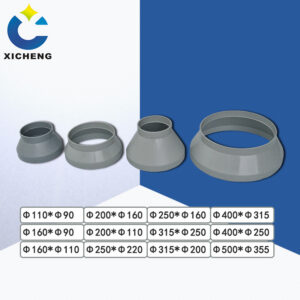
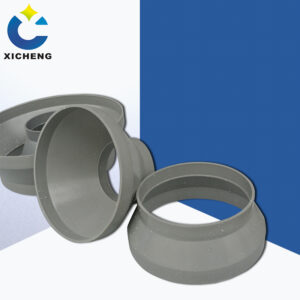
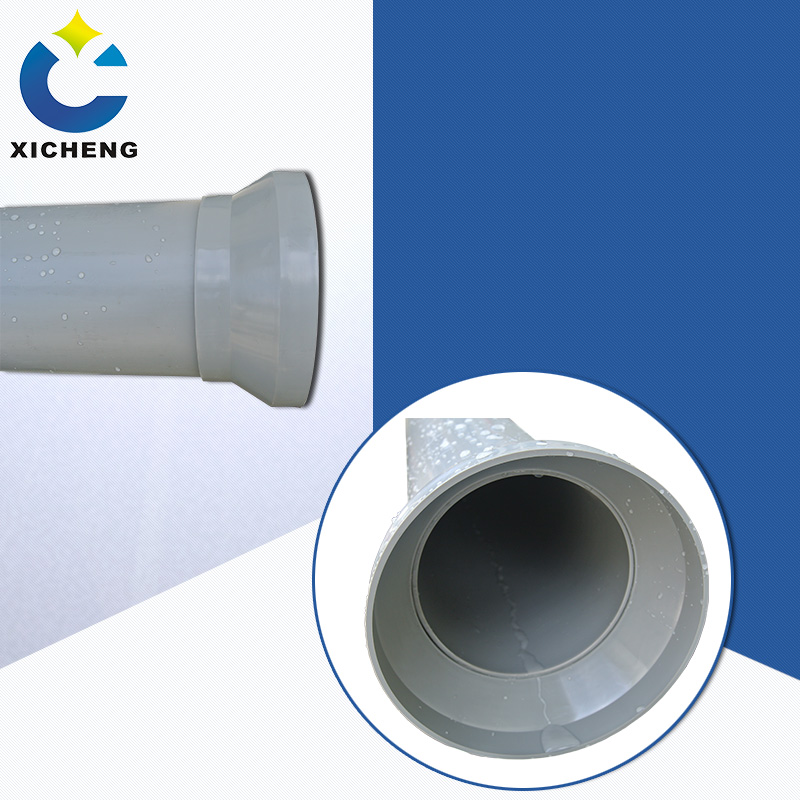
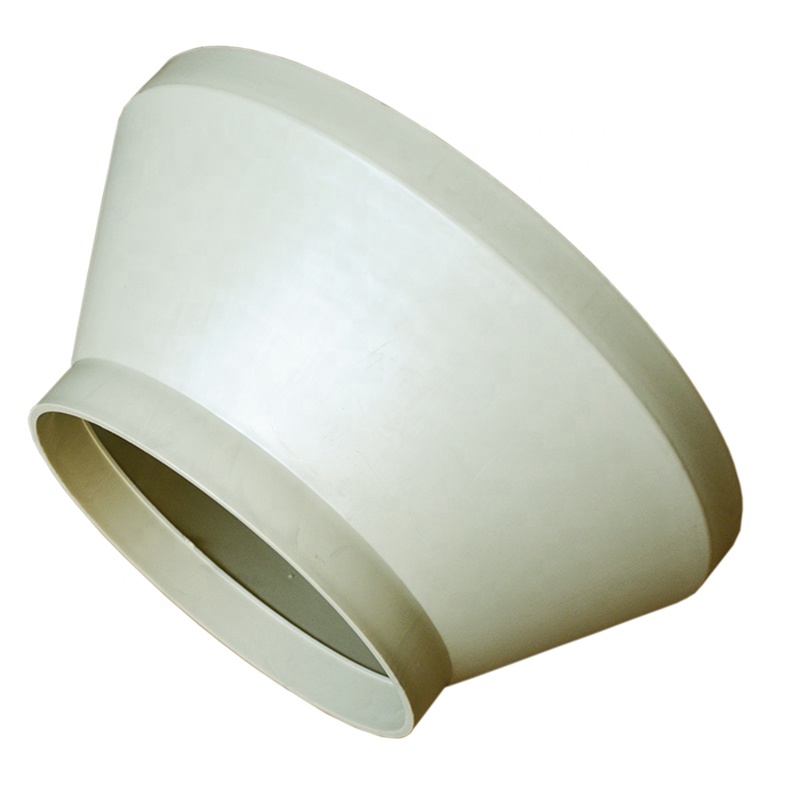
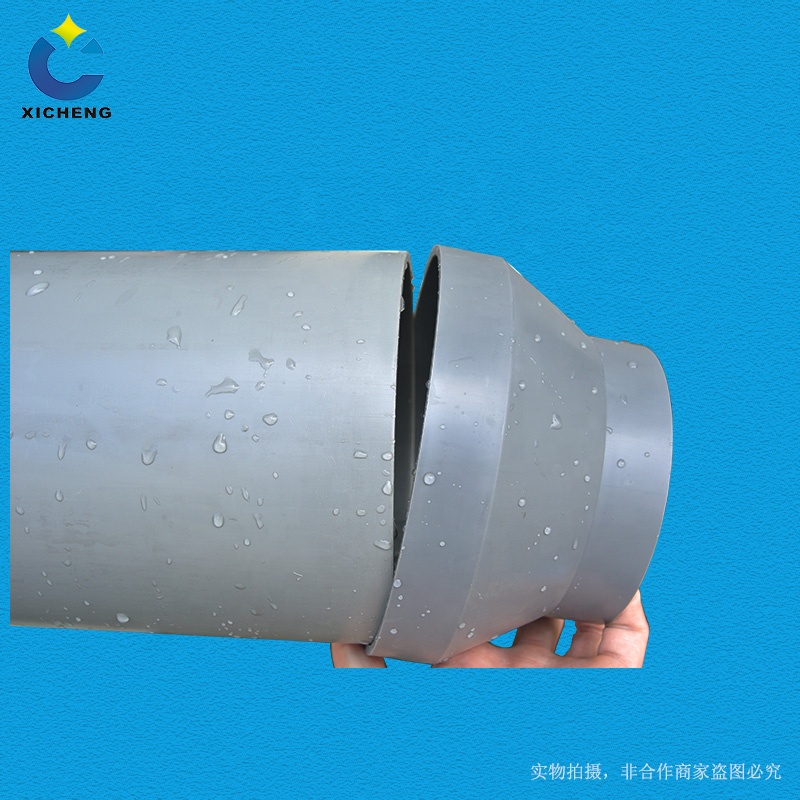
PP duct reducer for diameter transition in industrial ventilation, exhaust, and process piping — connecting different-diameter pipe or duct sections smoothly without abrupt step changes that create turbulence. Concentric reducers (centerline-aligned) for vertical and in-line transitions where maintaining the same centerline is important. Eccentric reducers (flat on one side) for horizontal runs where maintaining a flat bottom prevents liquid pooling. Injection molded up to 500 mm, with larger sizes fabricated from PP/PVC/FR-PP sheet. Variable-diameter fittings available for equipment connections with non-standard port sizes.
| Application | Diameter transition between different-size pipes/ducts, fan inlet/outlet connections, equipment port adaptation, scrubber inlet/outlet transitions |
| Material | PP (standard corrosion), PVC (rigid/UV), FR-PP (flame retardant / 60 °C) |
| Type | Concentric (centerline-aligned) standard; eccentric (flat-bottom) available; variable-diameter for non-standard equipment ports |
| Diameter range | 15 mm to 500 mm (injection molded); larger sizes fabricated |
| Wall thickness | 2.5 mm to 8 mm |
| Connection | Butt-weld ends (standard); flanged ends (optional) |
| Color | Beige / Dark Grey / White |
| Lead time | 5-15 days standard; 15-20 days custom |
Why a Proper Reducer Matters
A diameter change that’s too abrupt creates flow separation, turbulence, and a permanent pressure drop penalty. A properly designed reducer manages the transition gradually, minimizing energy loss and preventing flow-induced vibration:
- Concentric vs eccentric — choose the right type. Concentric reducers keep the centerline of both pipe sections aligned — correct for vertical runs, pump suction/discharge, and any installation where centerline alignment matters. Eccentric reducers keep one side flat (typically the bottom) — correct for horizontal runs where liquid could pool in the dead zone of a concentric reducer, causing corrosion or solids accumulation over time.
- Smooth taper angle — no step changes. An abrupt diameter change (butt-welding a small pipe directly to a larger one) creates a 90deg face at the step that generates severe turbulence. A fabricated reducer with a proper taper angle (typically 15-30deg included angle) transitions flow smoothly from one diameter to the next with minimal pressure drop and no vibration-inducing flow separation.
- Matching reducer to flow direction. Reducing flow (large to small): the taper accelerates the flow smoothly — used at fan inlets, equipment connections, and where the downstream system has lower air volume requirements. Expanding flow (small to large): the taper decelerates the flow, recovering some velocity pressure as static pressure — used at fan outlets and where the duct size increases to handle additional branch flow downstream. Understanding the flow direction is critical to selecting the right reducer orientation, and proper sizing is essential for EU Industrial Emissions Directive compliance in industrial exhaust systems where leakage at transitions is a concern.
Why Xicheng
16 years, 2600+ systems shipped worldwide. Reducers handle the transition between different pipe sizes — often at equipment connections where vibration, thermal movement, and mechanical loads concentrate:
- Injection molded to 500 mm for standard reductions. Common size transitions (e.g., 315 mm to 250 mm, 400 mm to 315 mm) are produced as one-piece injection moldings — the taper and both end diameters are formed in a single mold cycle. No welds at the diameter transition — the taper is continuous material.
- Variable-diameter fittings for equipment connections. Fan inlets and outlets, scrubber flanges, and equipment ports often have non-standard diameters that don’t match standard pipe sizes. We produce variable-diameter fittings — one end matches the equipment port dimension, the other end matches the standard pipe OD — eliminating the need for adapters and gasketed step rings.
- Eccentric reducers for horizontal exhaust lines. In horizontal exhaust ducting carrying humid or condensing gas streams, an eccentric reducer installed flat-side-down prevents liquid from pooling in the dead zone of a concentric reducer — reducing corrosion risk and eliminating a potential leak path at the low point.
Send your duct schedule showing diameter changes to xicheng023@outlook.com. We’ll specify reducer types, sizes, and provide a complete fittings schedule.
Core Advantages
- One-Piece Injection Molded Taper: The diameter transition is continuous material with no weld at the taper — smooth internal surface, no turbulence-generating steps.
- Concentric and Eccentric Options: Centerline-aligned for vertical and in-line use; flat-bottom for horizontal runs where liquid pooling must be avoided.
- Variable-Diameter Capability: One end matches standard pipe OD, the other matches your specific equipment port — no field adapters needed.
- Three Materials: PP for general corrosion, PVC for rigid UV-stable, FR-PP for fire-rated and 60 °C applications.
- Flanged or Weld-End: Connection type matched to your installation method and maintenance access requirements.
Key Specifications
| Material | PP / PVC / FR-PP — virgin resin, injection molded or fabricated |
| Type | Concentric standard; eccentric available; variable-diameter custom |
| Diameter Range | 15 mm – 500 mm (injection molded); larger sizes fabricated |
| Wall Thickness | 2.5 – 8 mm |
| Connection Type | Butt-weld (standard); flanged (optional) |
| Operating Temperature | PP: -10 to 80degC | PVC: 0 to 60degC | FR-PP: up to 60 °C |
| Service Life | 10-15 Years |
| Brand / Origin | Xicheng / China |
Certifications and Compliance
- CE Certified – PP Reducer, Duct, Fittings
- RoHS Compliant – All materials
- ISO 9001 – Quality Management System
- ISO 14001 – Environmental Management System
- SGS Tested – PP material properties, dimensional accuracy
- Design Compliance – Fittings designed to meet EU Industrial Emissions Directive (2010/75/EU) for leak-tight industrial exhaust ductwork
How to Order
- You send – Large-end diameter, small-end diameter, material preference, reducer type (concentric/eccentric), flow direction, connection type
- We confirm – Taper angle, reducer length, material availability, lead time, pricing
- We produce – 5-15 days. Injection molded or fabricated, dimensional inspection before shipment
Contact xicheng023@outlook.com or WhatsApp +86 18927456906 — quotation within 24 hours.
Complete Your System
- PP Industrial Pipe – Straight pipe sections
- PP Duct Elbow – 45deg and 90deg elbows for direction change
- PP Duct Tee – Tee fittings for duct branching
- PP Square Duct – Rectangular duct for space-constrained routes
Installation Guide
- Butt fusion: Prepare both ends with a facing tool to ensure parallel surfaces. Heating temperature 210 °C. Fusion pressure 0.3–0.5 MPa.
- Support: The reducer changes the duct diameter, so support spacing changes at the transition. Add a hanger or support within 300 mm of each reducer.
FAQ
Concentric or eccentric reducer — which should I specify?
Concentric: both ends share the same centerline. Use for vertical pipe runs, pump suction/discharge, and any installation where maintaining centerline alignment matters. Eccentric: one side is flat (typically the bottom). Use for horizontal runs where the gas stream contains moisture or condensable vapors — the flat bottom prevents liquid pooling in the reducer. Also used where the duct must maintain a constant bottom elevation for support spacing.
What is the standard taper angle for a reducer?
For ventilation and low-pressure exhaust systems, a 15-30deg included angle (7.5-15deg half-angle) is typical — steep enough to keep the reducer length manageable, gradual enough to avoid flow separation. For higher-velocity systems or critical pressure-drop applications, a shallower angle (10-15deg included) provides smoother flow transition at the cost of a longer fitting. We can adjust the taper angle to your specific installation and performance requirements.
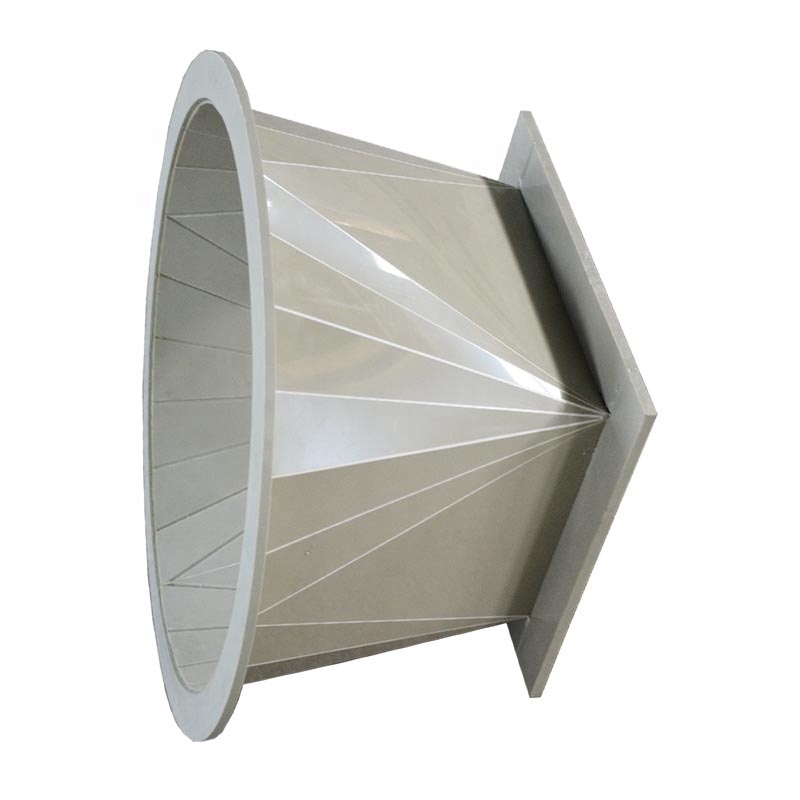
Do you produce square-to-round reducers?
Yes — square-to-round transition pieces for connecting rectangular duct to round duct, fan inlets/outlets, and equipment connections. These are fabricated from PP/PVC/FR-PP sheet with full-penetration welding. The transition length is designed to manage flow expansion or contraction without separation. Specify the rectangular dimensions, round diameter, and flow direction when ordering.