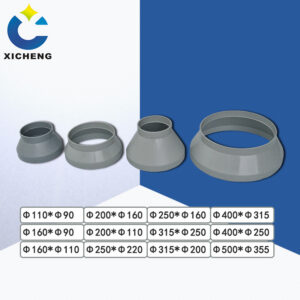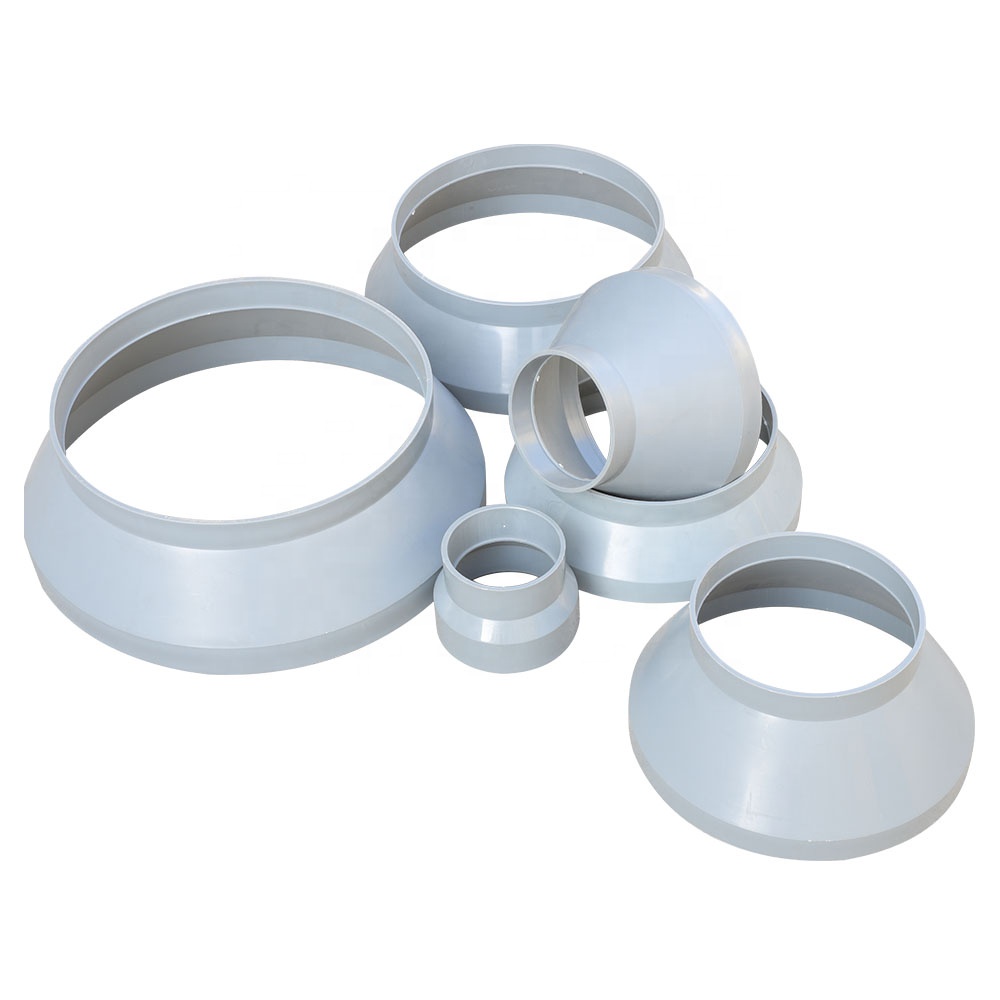


Specifications
- Type: Concentric reducer (centerline-aligned)
- Material: PP (polypropylene)
- Connection: Butt weld or flanged
- Size range: DN 80 → 50 mm up to DN 600 → 400 mm
- Length: Per DVS 2204 standard
Typical Applications
- Transition between different duct diameters in ventilation systems
- Connection from scrubber outlet to main duct header
- Balancing airflow velocity by changing cross-section
The Smooth Transition Between Sizes
A concentric reducer transitions between two different pipe diameters while keeping their centerlines aligned. The result is a smooth taper — symmetric around the centerline — that accelerates or decelerates the flow depending on direction. This is the standard reducer for vertical pipe runs, pump suction and discharge, in-line transitions where centerline alignment matters, and any installation where an eccentric reducer’s flat-side orientation would be wrong for the installation orientation.
Our concentric reducers are injection-molded as one piece in PP, PVC, and FR-PP for standard size transitions — the taper and both end diameters are formed in a single mold cycle. No weld at the diameter change, uniform wall thickness through the taper. For full specifications see our PP Duct Reducer main page.
Concentric vs Eccentric: The Simple Rule
The decision between concentric and eccentric is rarely about cost — both are similarly priced at the same diameters. It’s about installation orientation and what happens when flow stops:
- Concentric: use for vertical runs. Gravity works with the centerline symmetry — any condensation or liquid drains equally around the circumference. There’s no flat bottom for liquid to pool on and no dead zone where solids can accumulate. Vertical reducers in exhaust stacks, risers, and drop legs should always be concentric.
- Concentric: use for in-line horizontal transitions when the gas is dry. If the gas stream contains no condensable vapors and no particulate that could settle out, concentric is fine for horizontal runs. The centerline stays aligned, supports are simpler, and the reducer looks right.
- Eccentric: use for horizontal runs with moisture or particulate. If the gas can condense or carries solids, an eccentric reducer installed flat-side-down prevents pooling. The flat bottom provides a continuous drainage path. See our Variable Diameter Fitting page for eccentric options.
Sizing the Taper: Angle and Length
The taper angle determines how abruptly the diameter changes — and how much pressure drop the reducer contributes to the system:
| Taper Angle (included) | Reducer Length (DN400→DN315) | Pressure Drop | Best For |
|---|---|---|---|
| 15deg | ~320 mm | Lowest | High-velocity systems, critical pressure drop applications, fan inlet connections |
| 20deg | ~240 mm | Low | Standard recommendation — good balance of length and performance |
| 30deg | ~160 mm | Moderate | Space-constrained installations where a longer reducer won’t fit |
| 45deg+ | ~100 mm | High | Avoid unless space absolutely prevents a longer taper. Abrupt diameter change creates flow separation. |
The default recommendation is 20-30deg included angle. Steeper than 30deg risks flow separation at the taper wall — the flow detaches from the wall surface, creating a recirculation zone that effectively reduces the cross-sectional area and increases the real pressure drop beyond what the smooth-taper calculation predicts.
Flow Direction: Reducing vs Expanding
The same reducer performs differently depending on flow direction:
- Reducing flow (large → small). Flow accelerates as the cross-section decreases. The velocity increase is smooth if the taper angle is under 30deg. Used at: fan inlets (large duct → smaller fan nozzle), equipment connections where the downstream pipe is smaller, and zone header diameter reductions after branch take-offs.
- Expanding flow (small → large). Flow decelerates as the cross-section increases — converting velocity pressure to static pressure (pressure recovery). This is more sensitive to taper angle: too steep and the flow separates from the wall, eliminating the pressure recovery. Expanding reducers should use shallower angles (15-20deg) than reducing reducers. Used at: fan outlets (smaller fan discharge → larger duct), scrubber outlet connections, and where duct diameter increases ahead of a branch take-off.
For standard diameter transitions that match common pipe sizes, an injection-molded reducer from our catalog is the most cost-effective solution. For non-standard equipment connections, see our Variable Diameter Fitting page.
Send your diameter schedule to xicheng023@outlook.com. We’ll specify reducer type, taper angle, and provide a quotation. WhatsApp: +86 18927456906.
Installation Guide
- Orientation: Install with the reducer oriented in the direction of airflow (converging for higher velocity, diverging for lower).
- Transition length: Minimum transition length = 2 × (D1 – D2) for gradual taper. Shorter reducers increase turbulence and pressure drop.
- Support: Support both the larger and smaller diameter sides independently to prevent stress on the reducer joint.
Common Size Transitions
- DN 200 → DN 150 (8″→6″): Transition length 150 mm
- DN 300 → DN 200 (12″→8″): Transition length 200 mm
- DN 400 → DN 300 (16″→12″): Transition length 250 mm
Concentric reducers keep the duct centerline aligned, which is critical for straight duct runs where headroom clearance is limited. For applications where condensate drainage is needed, specify an eccentric reducer (flat side at bottom) to prevent liquid pooling at the transition.