
Specifications
- Type: Custom transition fitting for non-standard duct diameters
- Material: PP (polypropylene)
- Size range: Custom diameter transitions up to DN 600
- Lead time: Typically 5–10 working days for custom sizes
- Minimum order: 1 piece
When Standard Sizes Don’t Match
Equipment manufacturers do not design their fan outlet flanges, scrubber nozzles, or damper housings to match standard pipe diameters. A fan might have a 580 × 420 mm discharge flange. A scrubber inlet might be DN530 — not DN500 or DN600. A legacy duct from a 1970s plant might be an imperial-equivalent diameter that no current standard matches. Standard reducers connect standard sizes; variable-diameter fittings bridge the gap between your equipment and your duct system.
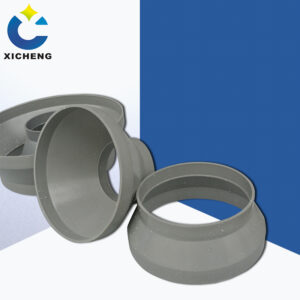
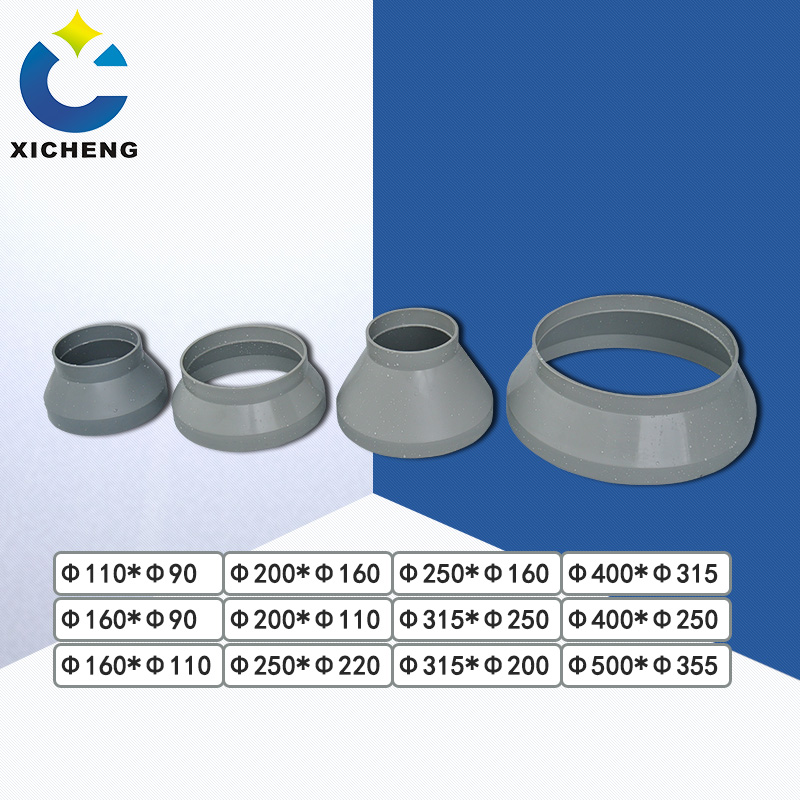
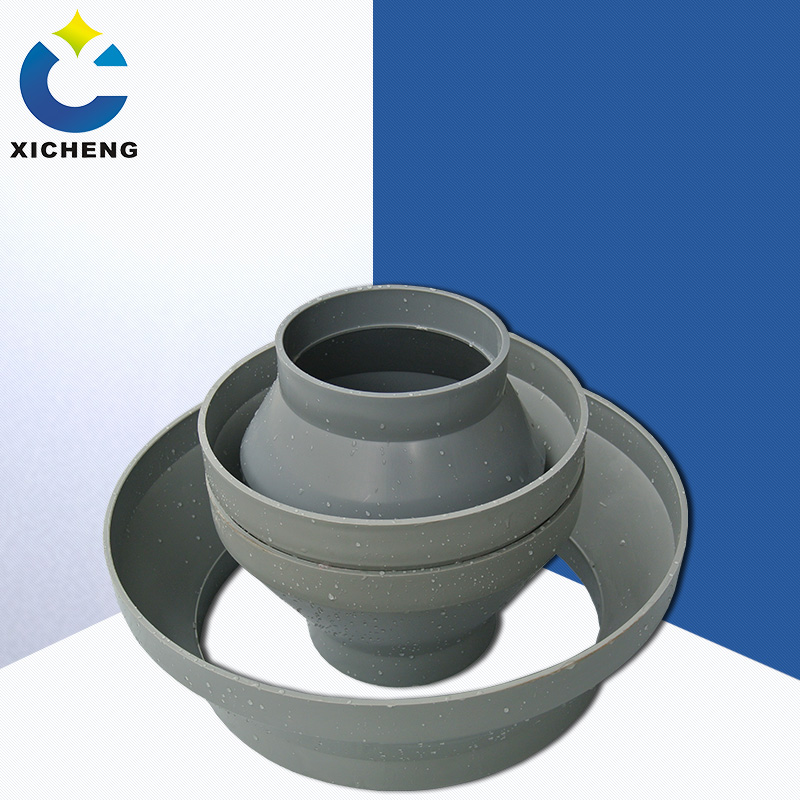
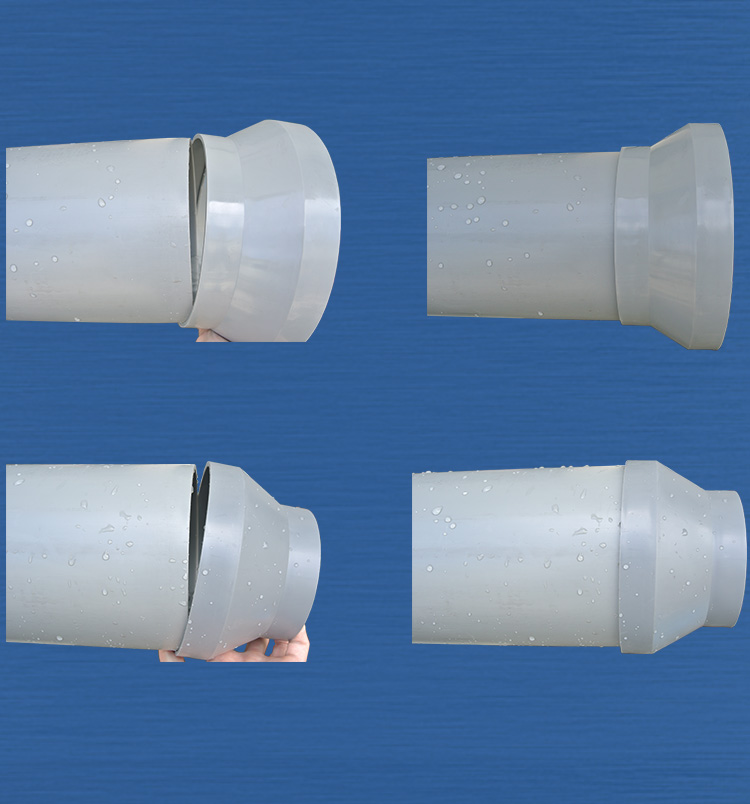
Our variable-diameter fittings are fabricated to your specific dimensions — one end matches the equipment port, the other matches the standard duct OD. Any diameter combination, any taper angle, concentric or eccentric configuration. For standard size-to-size transitions, see our Concentric Duct Reducer or PP Duct Reducer main page.
Custom Diameter, Custom Configuration
| Configuration | When Specified | Example |
|---|---|---|
| Non-standard to standard | Equipment port dimension doesn’t match any standard DN size | Fan discharge 580 × 420 mm rectangular to DN500 round duct. One end matches the exact fan flange dimensions; the other matches standard DN500. |
| Non-standard to non-standard | Both ends are equipment-dictated, neither matches a standard size | Scrubber outlet 530 mm round to damper inlet 485 mm round. Both dimensions are equipment-specific. |
| Variable diameter (adjustable range) | The exact equipment dimension is uncertain or the fitting must accommodate tolerance | Field connection where the existing duct diameter was measured but may vary slightly — fitting produced with a tolerance band at one end. |
| Eccentric variable-diameter | Flat-bottom transition for horizontal runs with moisture or limited vertical clearance | Condensing exhaust main reducing from DN600 to DN400 — flat bottom prevents liquid pooling in the reducer. |
The Fabrication Difference
Variable-diameter fittings are fabricated from PP/PVC/FR-PP sheet rather than injection-molded — the mold for every possible diameter combination would be infinite. Fabrication quality determines whether the fitting performs as well as a molded reducer:
- Developed blank calculation. The taper from one diameter to another is a truncated cone (for round) or a truncated pyramid (for rectangular). The sheet metal equivalent is a developed blank — a flat pattern that, when rolled or bent and welded, forms the 3D shape. The accuracy of the blank calculation determines whether the inlet and outlet diameters are correct and whether the taper is truly conical. We calculate developed blanks from your specified dimensions using CAD; the blank is CNC-cut from PP/PVC/FR-PP sheet for dimensional accuracy.
- Longitudinal weld at the taper seam. The seam where the developed blank edges meet runs along the taper — not a straight line but a curve following the conical geometry. This weld must have full penetration through the sheet thickness and a smooth internal profile to avoid creating a turbulence-generating ridge at the seam. We ultrasonic-test critical-service reducer seams.
- Flange welding at both ends. Flanges are welded to the inlet and outlet diameters after the taper is formed. The flange faces are machined flat after welding to ensure uniform gasket compression. For rectangular-to-round transitions, one flange is rectangular, the other is round — the fabrication includes the cross-section change within the taper.
When to Order Variable-Diameter vs Standard
Variable-diameter fittings are custom-fabricated per order. They cost more and take longer than standard injection-molded reducers — but they solve the problem of non-matching dimensions that standard fittings cannot. The decision rule: if both your diameters match standard DN sizes, order an injection-molded standard reducer. If either diameter is non-standard, order a variable-diameter fitting. Don’t adapt non-standard equipment to a standard reducer with gasketed step rings and field modifications — the reducer costs less than the field labor and leak risk.
For complete reducer specifications, see PP Duct Reducer. For flange kits and gaskets, see Air Duct Connections & Flanges.
Send your equipment dimensions and duct schedule to xicheng023@outlook.com. We’ll design the transition and provide a quotation. WhatsApp: +86 18927456906.
Custom Sizing Guide
- Lead time: 5–10 working days for custom sizes. Rush orders available.
- How to order: Provide existing diameter (A), required diameter (B), and available installation length (L).
- Draft angle: Maximum 15° included angle for butt fusion compatibility. Steeper angles require flanged connection.
- Wall thickness: Matched to the larger diameter pipe SDR rating.
To order a variable diameter fitting, provide your existing duct diameter (A), required connection diameter (B), available fitting length (L), wall thickness / SDR rating, and connection type (butt weld, flanged, or socket). We manufacture to your exact dimensions with a tolerance of ±2 mm.