Specifications
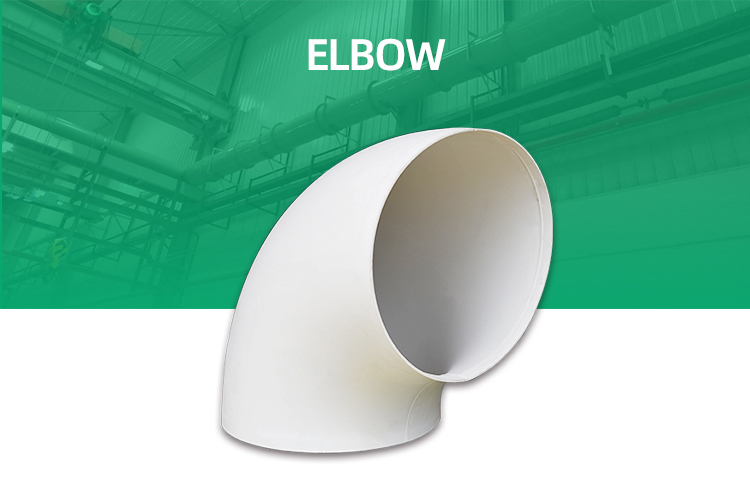
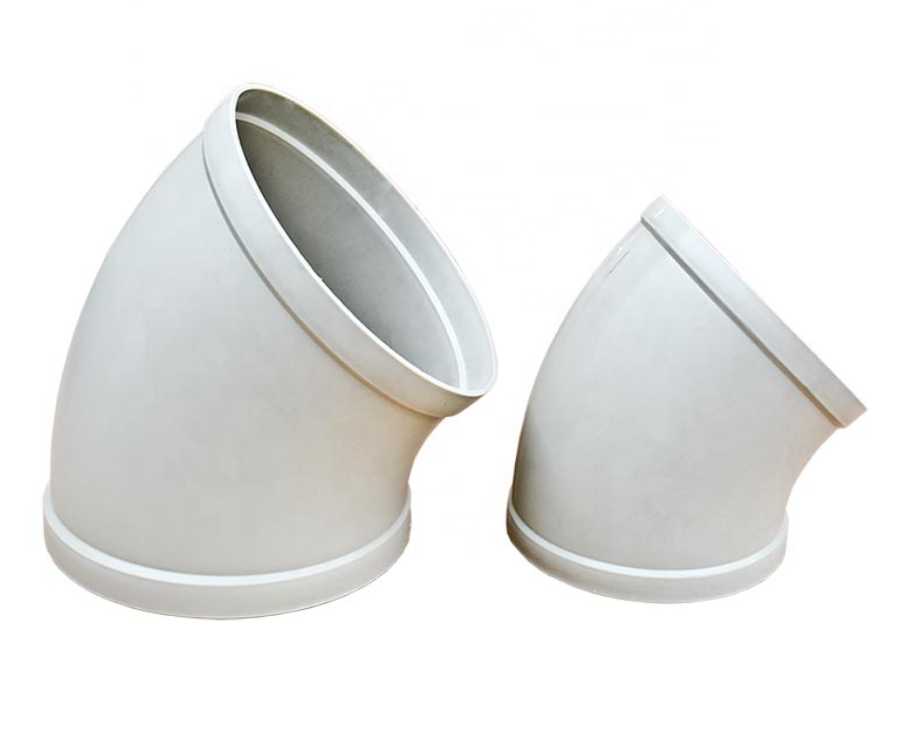
- Angle: 45°
- Material: PP (polypropylene), UV-stabilized
- Connection: Socket weld / butt weld / flanged
- Size range: DN 50–600 mm (2″–24″)
- Temperature: -10 °C to 80 °C continuous
- Pressure: Up to 0.4 MPa at 20 °C
Typical Applications
- Gentle direction changes in exhaust duct systems where 90° is too sharp
- Transition between duct runs at roof level or mezzanine clearance
- Low pressure drop alternative to 90° elbows
Half the Angle, Half the Pressure Drop
A 45-degree elbow has roughly 50-60% of the pressure drop of an equivalent-diameter 90-degree elbow — not because of a simple linear relationship, but because the gentler turn produces less flow separation at the inner radius. In a 90-degree bend, the airflow must make a full right-angle turn, creating a separation zone on the inner wall that reduces the effective flow area and increases velocity through the remaining cross-section. In a 45-degree bend, the separation zone is smaller, the effective flow area is larger, and the velocity increase — the source of the pressure drop — is less severe.
Two 45-degree elbows with a short straight section between them achieve the same 90-degree direction change with 30-40% lower combined pressure drop than a single 90. The straight section between the two 45s allows the flow profile to re-stabilize before the second turn — eliminating the compounded separation that occurs in a single sharp 90. For complete product data, see our PP Duct Elbow main page.
45-Degree Applications: Where the Gentle Turn Wins
| Application | Why 45deg Works Better |
|---|---|
| Gradual elevation change | Duct rising or dropping 30-60 cm over a short distance — a 45deg elbow provides the elevation change without the sharp pressure drop penalty of a 90 |
| Obstacle avoidance with straight offset | Two 45s with a straight section create an offset that routes around a beam, pipe rack, or cable tray with lower pressure drop than two 90s |
| Branch line entering main header at shallow angle | A 45deg lateral (wye) entry into the main header produces lower pressure drop and less turbulence than a 90deg tee entry — particularly important when the branch flow is a significant fraction of the main flow |
| Fan discharge with limited straight run | Fan discharge flow is non-uniform and turbulent. A 45deg elbow placed after the minimum required straight run (typically 2-3 duct diameters) causes less additional turbulence than a 90 in the same position |
| Vertical stack direction change | Stack discharge turning from vertical riser to horizontal outlet — 45deg elbow reduces exit velocity loss compared to a 90deg cap or gooseneck |
Integral Molding: The 45-Degree Advantage
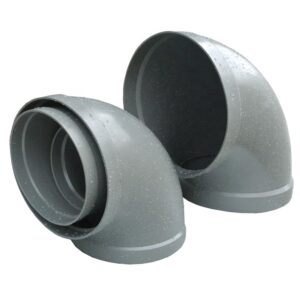
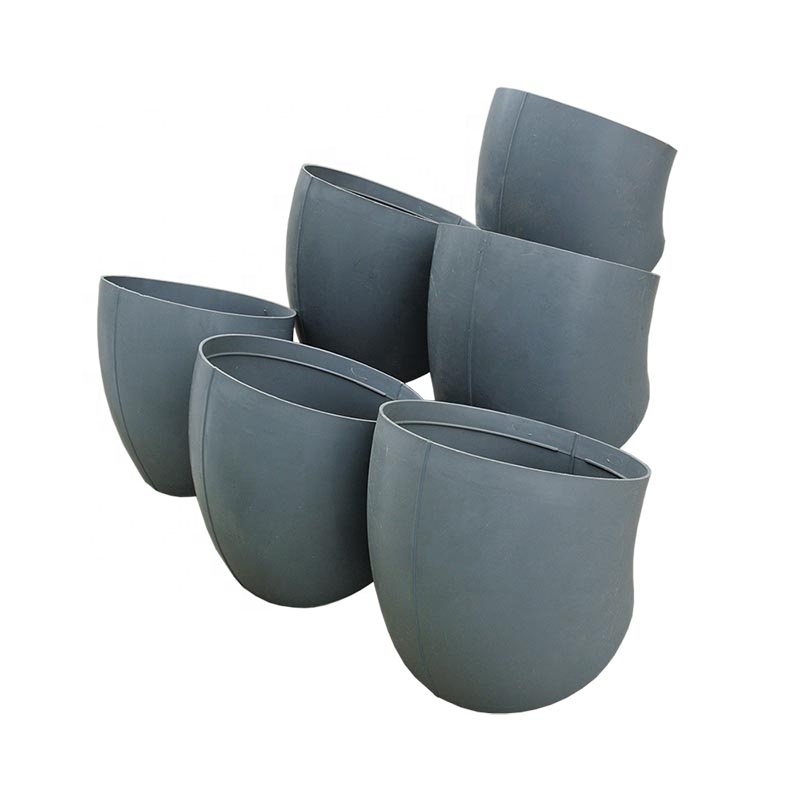
Fabricated 45-degree elbows are simpler to make than fabricated 90s — the shallower angle requires fewer miter segments. But the same vulnerabilities apply: welds at the tangent points, step changes at miter joints, and potential for wall thinning at the bend if formed by bending rather than segmenting. Injection-molded 45s eliminate all of these:
- One continuous piece from inlet to outlet. The 45-degree bend is formed in the mold — no segments, no welds, no joints. The internal surface is smooth throughout the bend arc. The pressure drop coefficient approaches the theoretical minimum for a smooth 45-degree bend.
- Consistent wall thickness. The mold cavity controls wall thickness at every point — the outer radius, inner radius, and both tangent ends have identical design thickness. No thinning from bending, no thickening from compression at the inner radius.
- Matched material and diameter. Same PP, PVC, or FR-PP material as your straight duct. Same OD tolerance for direct butt-weld connection. No adapters, no transition pieces.
When NOT to Use 45s
45-degree elbows are aerodynamically better — but they’re not always the right choice:
- Space doesn’t permit. Two 45s with a straight section require more length than one 90. When the available straight run is too short to fit the 45-degree offset, the 90 is the only option.
- One 45 plus one 90 is worse than two 90s. Mixing angles in a compound turn creates asymmetric flow that can be worse than consistent 90s. If you can’t use two 45s for the full direction change, stick with matched 90s.
- Vertical stack terminations. A 90-degree gooseneck or cap provides better rain protection at the top of a vertical exhaust stack than a 45-degree termination.
For 90-degree elbows where space is tight, see our 90 Degree Duct Elbow page. For connection elbows at equipment interfaces, see Air Duct Connection Elbow.
Send your duct layout to xicheng023@outlook.com. We’ll calculate system pressure drop and recommend the optimal elbow configuration. WhatsApp: +86 18927456906.
Installation Guide
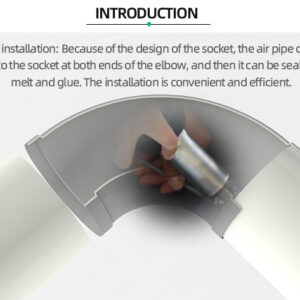
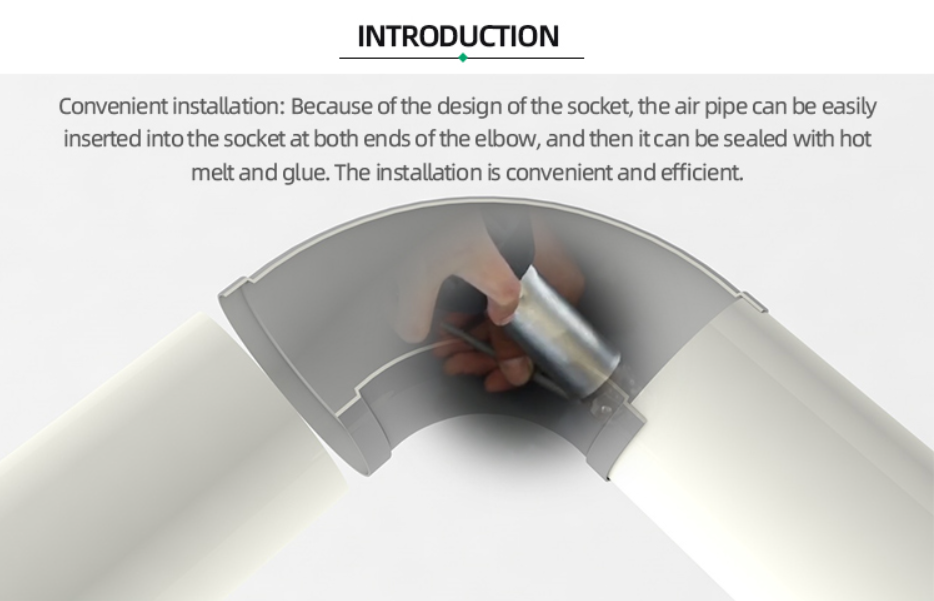
45° elbows are installed using the same fusion methods as 90° elbows. The longer sweep reduces turbulence and is preferred for high-velocity duct runs.
- Orientation: Can be installed in any rotation. The longer radius reduces stress on downstream joints.
- Support spacing: PP duct runs with 45° elbows require hangers every 2–3 m for DN 200 and below, every 1.5–2 m for larger diameters.
- Thermal expansion: PP expands 0.15 mm/m/°C. Allow 10–15 mm axial clearance per 10 m of duct run at expansion joints.