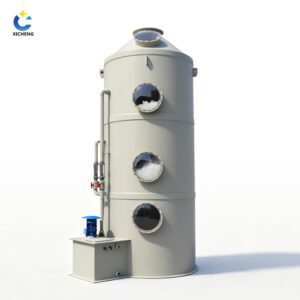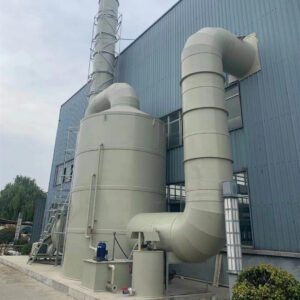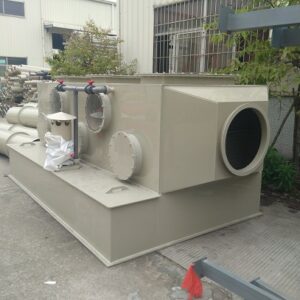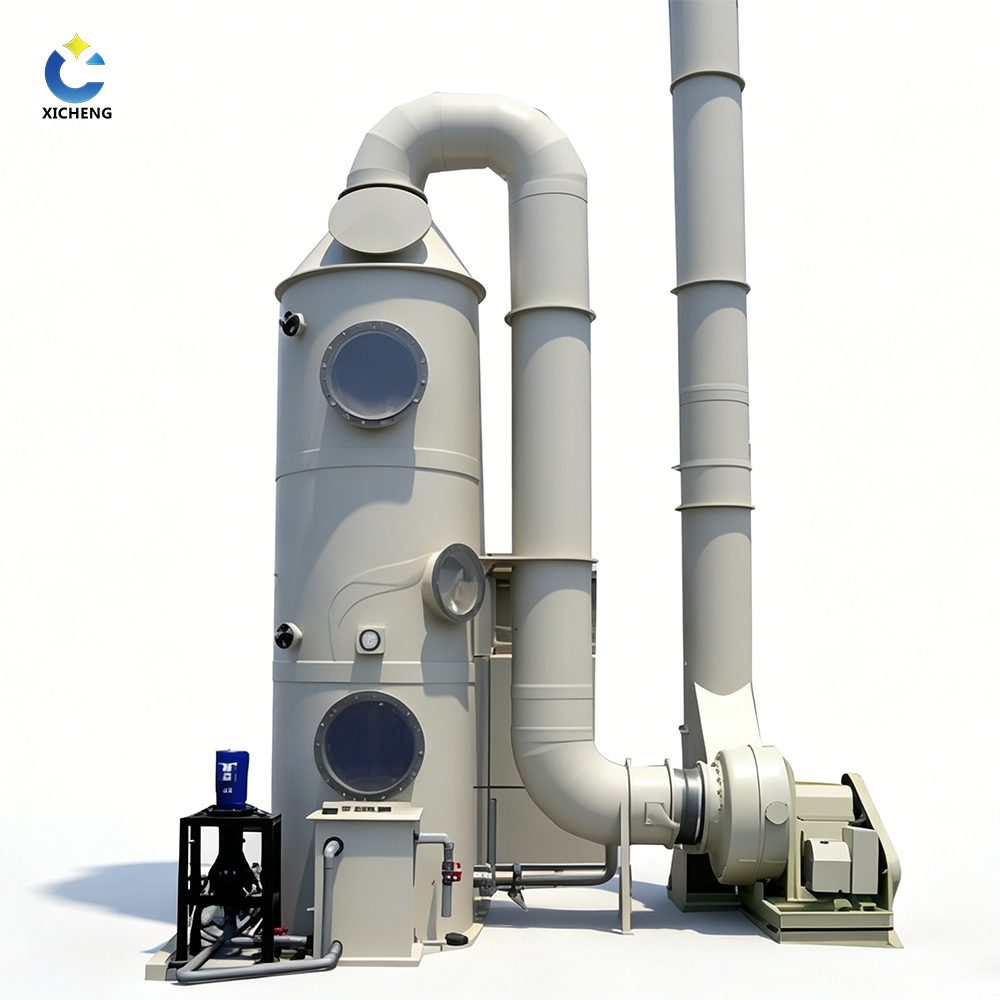

Who Needs This Counter-Current Acid Fume Scrubber System?
If your industrial facility generates acid mist exhaust from processes such as metal surface treatment, chemical reactions, or laboratory work — and you require a durable, efficient, and compliant treatment solution — this packed bed acid fume scrubber system is precisely designed for your needs. For a broader overview of the technologies available, see our guide on different gas scrubber types (H₂S, Acid & Fuel Gas).
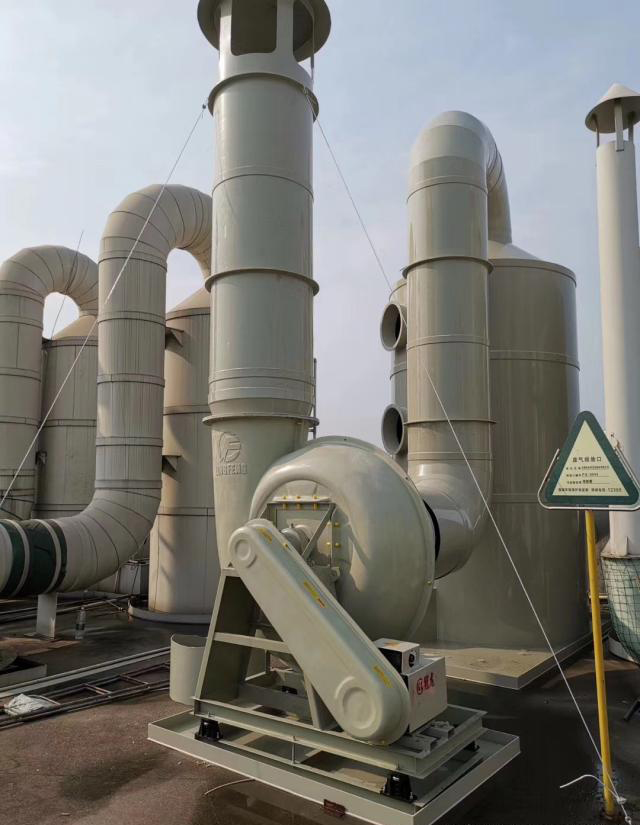
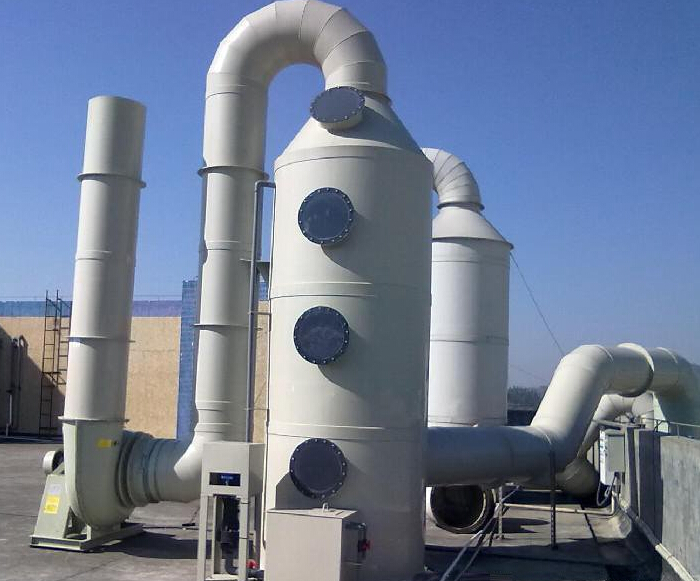
This system employs a vertical counter-current packed bed configuration, where acid-laden gases flow upward and are contacted by a descending scrubbing liquid. This counter-flow design is known for providing the best scrubbing efficiency of vapors in a compact footprint, making it the most common design found in most industries.This principle is applied in demanding environments such as modern steel pickle lines, where scrubbers efficiently capture hydrochloric acid fumes. CECO Environmental’s Pickle Line Scrubbers use a similar counter-current packed bed system to neutralize acid fumes from this process.
Typical operating scenarios include:
- Metal finishing and pickling lines generating HCl, HNO₃, or H₂SO₄ mists.
- Electroplating operations producing chromic acid (CrO₃) fumes.
- Laboratory fume hood exhaust containing a mixture of volatile acids.
- Chemical processing plants with mixed acid gas streams.
- Battery manufacturing and other processes emitting sulfuric acid mist.
This system is built for versatility and durability, handling air volumes from small pilot lines (50 m³/h) all the way up to large factory-wide installations (215,000+ m³/h). Its modular design allows for single or multi-stage configurations to meet specific outlet emission targets. For applications focused purely on acid mist treatment with a simpler setup, see our standalone acid fume scrubber. For dedicated high-concentration HCl streams, explore our hydrochloric acid scrubber. It’s important to note that this scrubber is not designed for high-temperature exhaust (>70°C) or streams with heavy particulate loading that require pre-filtration.
Why Engineers Choose Our Acid Fume Scrubber System
1. Optimized Counter-Current Flow for Maximum Absorption
The vertical, packed bed design ensures that contaminated gas moving upward continuously meets the freshest scrubbing solution cascading downward. This creates a powerful concentration gradient that drives rapid pollutant transfer and neutralization. According to the U.S. EPA, wet scrubbers used for this type of pollutant control are often referred to as absorbers and have removal efficiencies in excess of 90 percent.
2. High-Efficiency Polyhedral Packing Media
As detailed in our product specifications, the system utilizes a new type of multi-faceted hollow ball as packing media. These PP polyhedral hollow balls provide a large specific surface area for gas-liquid contact while maintaining low flow resistance. Greater contact area between the gas and liquid phases directly translates to more efficient mass transfer and pollutant removal, all within a compact tower size.
3. Complete, Automated System for Stable and Low-Maintenance Operation
This is a complete, integrated system. It includes the scrubber body, circulation pump, piping, and, crucially, an automated dosing system with an online pH detector, dosing metering pump, and a mixing barrel. This automation continuously monitors the scrubbing liquid’s pH and precisely controls chemical injection, ensuring consistent performance, reducing chemical waste, and enabling stable, low-maintenance operation — a significant advantage over manually operated systems.
4. Durable, Corrosion-Resistant PP Construction
The entire scrubber body is constructed from PP polypropylene. It provides excellent resistance to a wide range of acids, alkalis, and solvents, offering long-lasting and reliable performance. When properly maintained, PP scrubbers can provide a service life of over 8 years, far outlasting metallic alternatives. For a deep dive into how this material choice ensures long-term reliability, read our feature on acid fume scrubbers, corrosion & compliance.
Field case (Electronics factory, Taiwan): 12,000 m³/h system for HCl and HNO₃ removal. Single-stage configuration with NaOH scrubbing. Result: outlet acid mist concentration well below local standards. Operational since 2020 with routine maintenance.
Technical Specifications
| Air Volume (m³/h) | Tower Size (mm) | Shell THK (mm) | Inlet/Outlet Size (mm) | Pump Power (kW) | Wind Resist. (Pa) | Recommended Application |
|---|---|---|---|---|---|---|
| 50 – 4,000 | 800 | 8 | 315 | 0.75 | 500 | Lab fume hood |
| 4,000 – 5,500 | 1000 | 8 | 400 | 1.5 | 500 | Small workshop / pilot line |
| 5,500 – 8,000 | 1200 | 8 | 500 | 1.5 | 500 | Medium production line |
| 8,000 – 12,000 | 1500 | 8 | 600 | 2.2 | 500 | Large workshop / pickling line |
| 12,000 – 17,000 | 1800 | 10 | 650 | 3.0 | 500 | Anodizing facility |
| 17,000 – 21,000 | 2000 | 10 | 700 | 4.0 | 500 | Metal finishing plant |
| 21,000 – 25,000 | 2200 | 10 | 750 | 4.0 | 600 | Centralized scrubbing system |
| 25,000 – 32,000 | 2500 | 12 | 800 | 5.5 | 600 | Semiconductor facility |
| 32,000 – 40,000 | 2800 | 12 | 900 | 7.5 | 600 | Chemical processing plant |
| 40,000 – Plus | 3000 | 12 | 1000 | 7.5 | 600 | Multi-line factory-wide system |
Standard configuration includes: Tower body, PP polyhedral ball packing, packed bed support grille, liquid distribution spray system with PP spiral nozzles, mist eliminator, integrated water tank with level control, and an automated pH monitoring and dosing system.
Customization: Non-standard sizes, multi-stage configurations, and remote monitoring capabilities are available upon request. Please contact our engineering team.
Frequently Asked Questions
Q1: What acid gases can this system treat?
This system is engineered for water-soluble acid gases, including hydrochloric acid (HCl), nitric acid (HNO₃), sulfuric acid (H₂SO₄), hydrofluoric acid (HF), and chromic acid (CrO₃) mists. The scrubbing liquid chemistry must be matched to the specific pollutant for effective neutralization.
Q2: What removal efficiency can I expect?
Under standard design conditions with proper chemical dosing, a single-stage vertical counter-current scrubber like this one can achieve over 95% removal for highly soluble gases like HCl. By adding a second scrubbing stage, removal efficiencies can be increased to well over 99%. The exact efficiency depends on factors like pollutant solubility, concentration, and liquid-to-gas ratio. Monroe Environmental is one example of an industry leader whose packed bed scrubbers are capable of 99.99% removal efficiency. XICHENG’s specific guaranteed performance will be provided based on your detailed process parameters during the project quotation stage.
Q3: How does the integrated dosing system work?
The system includes an “automatic dosing system” with a pH online detector, metering pump, and mixing barrel. It continuously monitors the pH of the scrubbing liquid, and when it falls outside the optimal range (indicating NaOH depletion), the pump automatically injects fresh alkaline solution from the mixing barrel. This maintains consistent neutralization performance, prevents chemical overdosing, and significantly reduces operator workload.
Q4: How do I select the correct model size?
The first step is to determine your total exhaust air volume in m³/h. Match this volume to the nearest model range in our Technical Specifications table. For example, an air volume of 6,000 m³/h would fall in the 5500-8000 range, corresponding to the 1200mm tower. If your acid mist concentration is unusually high, or if you require >99% removal, a multi-stage system or a larger model may be necessary. Our engineering team can provide a detailed sizing verification if you share your process data.
Q5: What are the installation requirements?
Our product page outlines a clear installation method. The basic steps are: 1) Secure the unit on a level, corrosion-resistant foundation. 2) Connect the front exhaust duct to the acid mist inlet. 3) Install the anticorrosive centrifugal fan at the rear, configured for induced-draft (negative pressure) operation to prevent leaks. 4) Install the chimney after the fan. 5) Connect the automated dosing system to the water tank. 6) Install the electrical control panel to manage the pump, fan, and dosing system. It is essential to ensure adequate clearance for inspection and maintenance.
Q6: What regular maintenance is needed?
A well-designed maintenance schedule prevents corrosion, scaling, and unexpected downtime. We recommend:
Weekly: Check spray nozzle patterns and verify pH probe calibration.
Monthly: Test and replace the scrubbing liquid as needed; inspect the dosing pump.
Quarterly: Inspect the mist eliminator for scaling or damage.
Annually: Perform a full packing inspection and replace any degraded media (typical service life is 3-5 years).
PP construction eliminates the need for constant corrosion monitoring, a major advantage over metal scrubbers. For a complete, tiered maintenance checklist, refer to our Acid Scrubber Maintenance Guide.
Q7: What are the most common operating issues?
Low removal efficiency: Usually caused by depleted scrubbing liquid concentration or blocked spray nozzles.
High pressure drop: Indicates solids accumulation or scaling in the packing.
Liquid carryover: A sign of a damaged or saturated mist eliminator.
Pump cavitation or noise: Check for leaks in the suction line or a clogged strainer. Because the scrubber body is made of PP, you avoid the shell corrosion and pinhole leaks that are common failure points in metallic scrubbers.
Q8: What is the expected service life of this equipment?
With proper maintenance, the PP polypropylene housing can last 8–12 years in normal corrosive acid gas environments. The internal packing media will typically need replacement every 3–5 years, depending on the acid type, concentration, and operating hours. This significantly exceeds the service life of unlined metallic scrubbers, which can fail in 2-4 years under similar conditions. To learn how we tackle these challenges, read our guide on Acid Fume Scrubbers: Corrosion & Compliance Solved.
Q9: How do we handle the wastewater?
The neutralized scrubbing solution will contain dissolved salts (e.g., NaCl from the HCl + NaOH reaction). You must have, or plan for, a wastewater treatment system. Before discharge, the solution should be neutralized to a pH of 6-9 and cleared of any solids. Always verify compliance with your local wastewater regulations. For a more detailed discussion on this topic, please see our guide on scrubber water treatment.
Q10: What is the standard lead time?
Standard models typically ship within 15–25 working days from our factory in China. Custom configurations, including multi-stage systems or non-standard sizes, may require a longer production time. We ship via sea freight (FOB/CIF) to major ports worldwide.


About the Author & Our Expertise
Product specifications reviewed by: Corbin Deng, Process Engineer, XICHENG EP LTD — 12+ years in industrial waste gas treatment and scrubbing system design.
About XICHENG EP LTD
XICHENG EP LTD specializes in the design and fabrication of PP polypropylene waste gas treatment equipment. We serve the chemical, electroplating, metal finishing, pharmaceutical, and laboratory industries across more than 30 countries. With an annual production capacity of over 2,000 scrubber units, our team combines deep material science expertise with practical, field-proven engineering to deliver reliable, cost-effective pollution control solutions.
Verified Installations & Compliance
- Metal finishing facility, Vietnam — 8,000 m³/h HCl scrubber in continuous operation since 2019 with zero unplanned downtime.
- Chemical laboratory, Singapore — 3,000 m³/h scrubber treating mixed acid exhaust, consistently achieving <5 ppm outlet concentration.
- Electronics factory, Taiwan — 12,000 m³/h system for HCl and HNO₃ removal, validated by a third-party stack test.
Certifications: ISO 9001:2015 (Quality Management) | ISO 14001 (Environmental Management). Material certificates and inspection reports are available upon request.
All photos on this page are of actual XICHENG manufacturing, packing, and installation sites, taken in 2021–2026.