

Who Needs This Packed Tower Wet Scrubber?
Datasheet and Project Review
An engineering datasheet with dimensional drawing, specification confirmation, and system integration notes can be prepared once the project configuration is confirmed.
To request a quotation, provide: gas composition and concentration, flow rate (m³/h) and temperature, material preference, and delivery location.
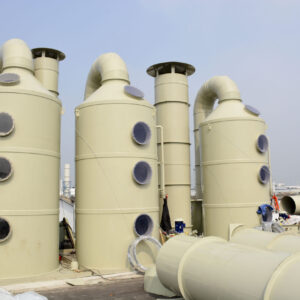
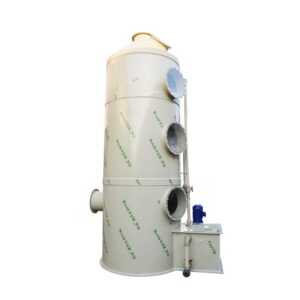
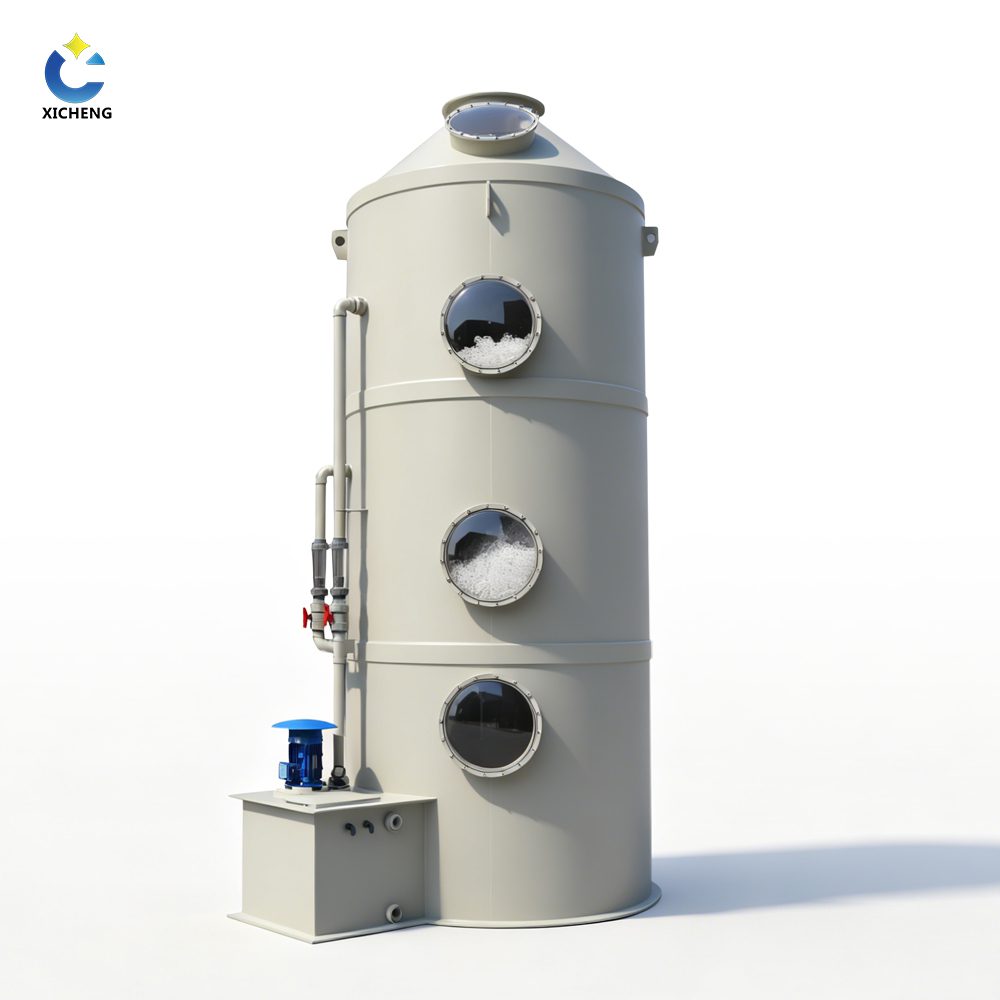
Many industrial facilities generate exhaust streams containing both acidic gases and particulate matter, requiring separate treatment systems that increase capital and operating costs. Our PP packed tower wet scrubber is specifically engineered for simultaneous removal of gases and dust in a single compact unit, following EPA wet scrubber dust control standards.
Metallurgical Sintering & Smelting: Treats exhaust from iron and steel sintering plants, copper smelters, and aluminum foundries, which contain high concentrations of SO₂, HCl, and metal oxide particulates.
Building Materials & Cement Kilns: Removes dust, SO₂, and NOₓ from cement kilns, brick kilns, and glass manufacturing processes, eliminating both air pollution and equipment corrosion.
Chemical Granulation & Drying: Handles mixed exhaust from chemical granulation, spray drying, and fertilizer production, which contains both acid gases and fine product dust.
Mining & Mineral Processing: Treats dust and acid fumes from ore crushing, grinding, and leaching operations, protecting workers and complying with environmental regulations.
Waste Incineration Facilities: Removes acid gases (HCl, SO₂) and fly ash from municipal solid waste and hazardous waste incinerators, meeting strict emission standards.
Not Recommended For: Dust particles smaller than 0.5 μm (requires venturi scrubber), high-temperature exhaust above 82°C without pre-cooling, and pure dust streams with no gaseous pollutants (use dry dust collectors).
Why Choose Our PP Packed Tower Scrubber
1. Simultaneous 99% Gas + 95% Dust Removal
Unlike general spray towers that only achieve 60-70% dust removal efficiency, our packed tower design uses high-surface-area packing to create intimate gas-liquid contact, achieving 99% removal of acidic gases and 95% removal of particulate matter ≥0.5 μm.
This eliminates the need for separate dust collectors and gas scrubbers, reducing capital costs by 40% and operating costs by 30% compared to two separate systems.
2. High-Efficiency Mass Transfer with 230 m²/m³ Packing
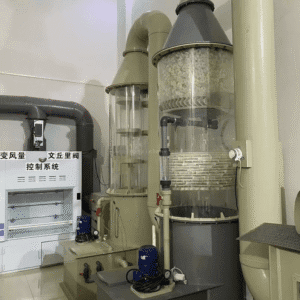
Our scrubbers use high-quality polypropylene multi-faceted hollow ball packing with a specific surface area of 230 m²/m³. This provides maximum gas-liquid contact area, ensuring complete absorption of pollutants with a gas residence time of ≥2 seconds.
The random packing design also creates turbulent flow conditions, enhancing mass transfer efficiency and reducing the required tower height compared to other scrubber types.
3. Anti-Clogging Design with Automatic Backwashing
Packing clogging is the most common problem with packed towers handling dusty exhaust. Our system features large-orifice spray nozzles, open-structure packing, and an automatic backwashing system that flushes accumulated dust from the packing bed.
This extends the time between maintenance cleanings from 1-2 months to 6-8 months, reducing maintenance downtime by 75%.
4. Low Energy Consumption: ≤600 Pa System Resistance
Our optimized packed tower design has a system resistance of only 500-600 Pa, which is 20% lower than swirl towers and 50% lower than venturi scrubbers. This reduces fan power consumption and operating costs significantly.
For a 20,000 m³/h system, this translates to annual energy savings of approximately 12,000 kWh, worth $1,440 at current industrial electricity prices.
5. All-PP Construction for 15+ Year Corrosion Resistance
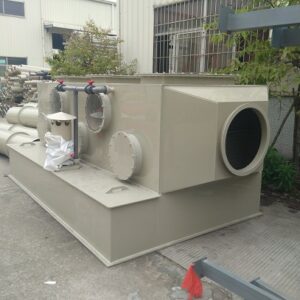
Constructed entirely from homogeneous polypropylene (PP) with seamless welding, our scrubber is inherently resistant to both acidic gases and abrasive dust particles. Unlike steel or FRP systems, PP does not suffer from corrosion or delamination.
This delivers a 15+ year service life with zero shell repairs, compared to 3-5 years for metallic alternatives. The system pairs seamlessly with our anti-corrosion centrifugal fan for optimal performance.
Technical Specifications
| Air Volume (m³/h) | Tower Diameter (mm) | Wall Thickness (mm) | Packing Type | Specific Surface Area (m²/m³) | Dust Removal Efficiency | Gas Removal Efficiency | System Resistance (Pa) |
|---|---|---|---|---|---|---|---|
| 3,000 | 800 | 8 | Multi-faceted hollow ball | 230 | 92%+ | 99%+ | 500 |
| 5,000 | 1,000 | 8 | Multi-faceted hollow ball | 230 | 93%+ | 99%+ | 500 |
| 8,000 | 1,200 | 8 | Multi-faceted hollow ball | 230 | 94%+ | 99%+ | 500 |
| 10,000 | 1,500 | 10 | Multi-faceted hollow ball | 230 | 94%+ | 99%+ | 500 |
| 12,000 | 1,600 | 10 | Multi-faceted hollow ball | 230 | 95%+ | 99%+ | 500 |
| 15,000 | 1,800 | 10 | Multi-faceted hollow ball | 230 | 95%+ | 99%+ | 500 |
| 20,000 | 2,000 | 10 | Multi-faceted hollow ball | 230 | 95%+ | 99%+ | 500 |
| 25,000 | 2,200 | 10 | Multi-faceted hollow ball | 230 | 95%+ | 99%+ | 600 |
| 30,000-45,000 | 2,500-3,000 | 12 | Multi-faceted hollow ball | 230 | 95%+ | 99%+ | 600 |
Note: All specifications based on design wind speed 1.8m/s. For high-dust applications, add a pre-filter stage. Custom packing types (Pall rings, Raschig rings) available upon request.
Selection Notes
Good Fit Conditions
This product is suitable when the application matches the design specifications listed in the technical table above. Confirm gas composition, airflow, temperature, and material compatibility before ordering.
When to Review with Engineering
- Gas temperature exceeds the material limit for standard construction
- Particulate or sticky components are present in the exhaust stream
- Mixed pollutants require multi-stage or dual-reagent treatment
- Site constraints limit available footprint, headroom, or utility connections
Frequently Asked Questions
Q1: What is the difference between a packed tower and a spray tower?
A spray tower uses only nozzles to create liquid droplets, while a packed tower uses a bed of packing material to increase gas-liquid contact area. This makes packed towers 30-40% more efficient at removing both gases and dust, especially for fine particulates.
Spray towers are simpler and less prone to clogging but have lower efficiency. Packed towers are preferred for applications requiring high removal efficiency and simultaneous gas and dust treatment. Learn more in our packed tower vs spray tower comparison guide.
Q2: How does a packed tower remove dust particles?
Dust particles are removed through three mechanisms: impaction (particles collide with packing surfaces), interception (particles follow gas streamlines and touch packing), and diffusion (fine particles diffuse into liquid film).
The high surface area of the packing provides numerous collision points, making packed towers highly effective at removing particles ≥0.5 μm. For smaller particles, we recommend adding a venturi pre-scrubber stage.
Q3: What type of packing should I choose?
We recommend multi-faceted hollow ball packing for most applications due to its high surface area, low pressure drop, and excellent anti-clogging properties. For high-dust applications, we may recommend Pall rings or Raschig rings.
Our engineers will select the optimal packing type and size based on your specific exhaust characteristics and performance requirements.
Q4: How do you prevent packing clogging?
We prevent packing clogging through three design features: large-orifice anti-clog nozzles, open-structure packing with high void fraction, and an automatic backwashing system that flushes the packing bed with high-pressure water on a scheduled basis.
For extremely high-dust applications, we also recommend adding a pre-filter stage to remove large particles before they enter the packed tower.
Q5: How often does the packing need to be replaced?
With proper maintenance and regular backwashing, PP packing can last 5-8 years. The packing should be inspected annually for signs of wear, damage, or excessive fouling.
Our packed tower anti-clogging maintenance checklist provides detailed instructions for packing inspection and replacement.
Q6: How do I size a packed tower scrubber?
Packed tower sizing depends on four main factors: total exhaust air volume, types and concentrations of pollutants, dust particle size distribution, and required outlet emission limits.
Our engineers can provide a detailed sizing calculation based on your specific operating conditions. You can also refer to our packed tower sizing calculation guide for more information.
Q7: What is the gas-liquid ratio for a packed tower?
The optimal gas-liquid ratio (L/G) for a packed tower scrubber is typically 1.5-3.0 L/m³, depending on the pollutant concentration and solubility. Higher concentrations require higher L/G ratios to ensure complete absorption.
Our automatic control system adjusts the liquid flow rate based on inlet pollutant concentration, optimizing the L/G ratio for maximum efficiency and minimum water consumption.
Q8: How do I handle the wastewater from a packed tower?
The wastewater from a packed tower contains dissolved salts and suspended dust particles. It is typically treated by sedimentation to remove solids, followed by neutralization to adjust pH before discharge.
For high-volume applications, the clarified water can be recycled back to the scrubber, reducing water consumption by up to 80%. Our engineers will help you develop a wastewater management plan that meets local regulations.
Q9: Can I add additional treatment stages to my packed tower?
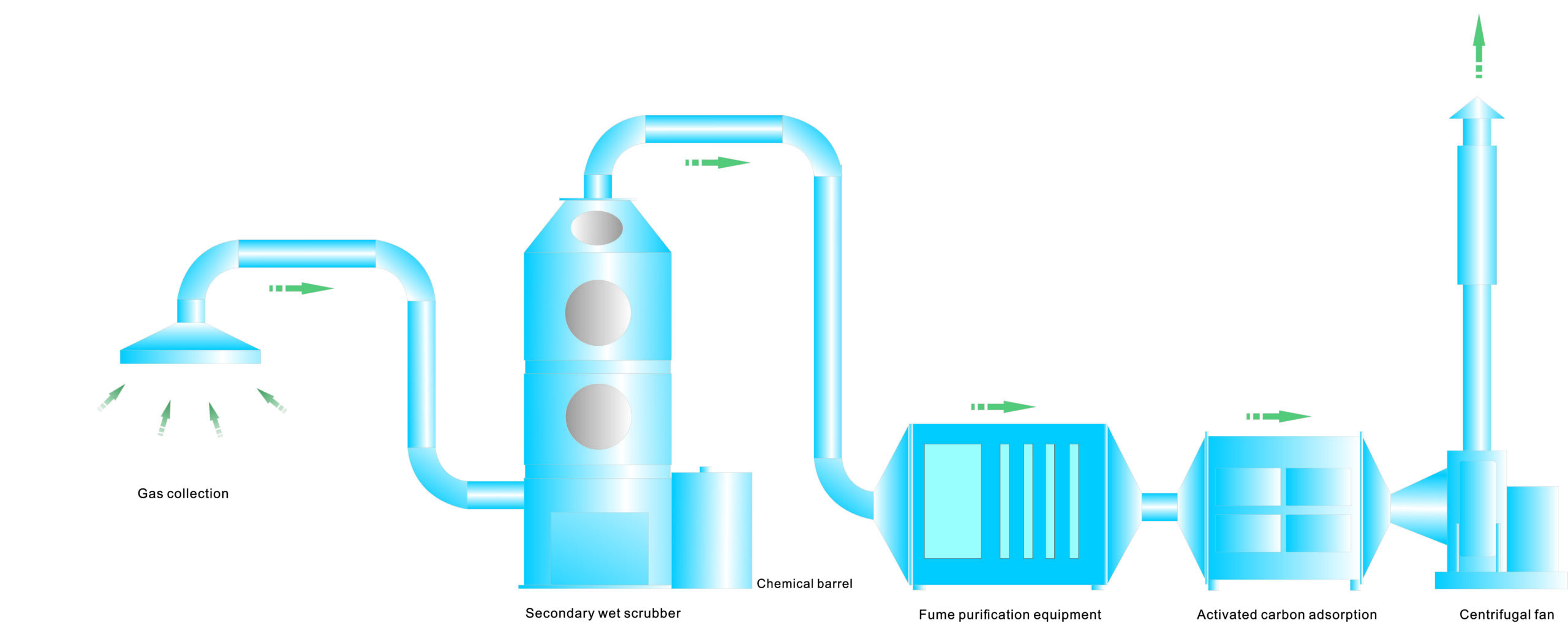
Yes, our modular design allows for easy addition of treatment stages. For facilities requiring higher removal efficiency, we can add a second packed bed stage or an activated carbon polishing stage for final treatment.
For facilities with both SO₂ and NOₓ emissions, we can also integrate an oxidation stage to convert NO to NO₂ for improved removal efficiency.
Q10: When should I choose a packed tower over a dry dust collector?
Choose a packed tower if your exhaust contains both gaseous pollutants and dust particles. Dry dust collectors (baghouses, cyclones) can only remove dust and cannot treat gases.
Packed towers also offer the additional benefits of gas cooling, humidity control, and lower fire and explosion risks compared to dry collectors. For pure dust streams with no gaseous pollutants, a dry collector may be more cost-effective.
About the Author & Our Expertise
Best Fit Applications
Not Recommended / Engineering Limits
- Fine dust (<5 micron): Packing will blind rapidly. Use a venturi scrubber or wet ESP for fine particulate.
- Sticky/tarry particulate: Tars and polymers will foul packing irreversibly. Pre-treatment required.
- Very high dust loading (>NEEDS_HUMAN_INPUT mg/Nm³): A cyclone or baghouse upstream is necessary.
This packed tower scrubber handles simultaneous gas and dust removal:
- Target gases: Soluble acid gases + moderate particulate loading
- Airflow: 3,000–45,000 m³/h
- Particulate size: >5 microns (finer particles require a mist eliminator or wet ESP downstream)
- Removal efficiency: >99% gas, >95% particulate at design conditions
- Best industries: Chemical processing, metal finishing, incineration exhaust
Written by Corbin Deng, Process Engineer
12 years of experience in industrial gas and dust treatment systems design
XICHENG EP LTD is a leading manufacturer of industrial air pollution control equipment based in Shenzhen, China. With 16 years of specialized experience in packed tower technology, we have delivered over 300 systems for simultaneous gas and dust treatment to customers in more than 30 countries worldwide.
Our team of experienced engineers provides complete turnkey solutions, from initial system design and manufacturing to installation, commissioning, and after-sales support. We are committed to delivering high-quality, reliable equipment that helps our customers meet their environmental compliance goals.
Recent Packed Tower Installation References
- Jiangsu Metallurgical Plant: 25,000 m³/h packed tower for sintering plant exhaust
- Guangdong Building Materials Factory: 18,000 m³/h system for cement kiln exhaust
- Shandong Chemical Plant: 12,000 m³/h packed tower for granulation process exhaust
Certifications
- ISO 9001:2015 Quality Management System
- CE Marking for European Union
- China Environmental Protection Product Certification
Contact the Xicheng Engineering Team Today.
Send us your project specifications. Our engineers will prepare a product configuration, system integration proposal, and quotation within 24 hours.
🎯 Manufacturing Head Office: No. 34 Zhenxing Road (Shengtaian Heavy Industrial Park B), Loucun, Guangming New District, Shenzhen, Guangdong, China
☎️ Direct Hotline / WhatsApp: +86 189 2745 6906
📬 Engineering Mailbox: xicheng023@outlook.com