
Product Overview
Datasheet and Project Review
An engineering datasheet with dimensional drawing, specification confirmation, and system integration notes can be prepared once the project configuration is confirmed.
To request a quotation, provide: gas composition and concentration, flow rate (m³/h) and temperature, material preference, and delivery location.
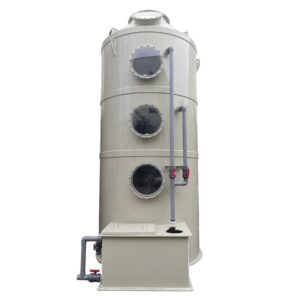
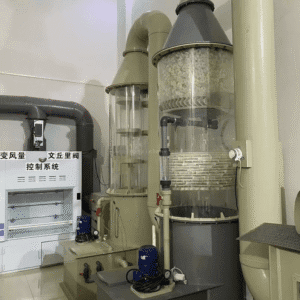
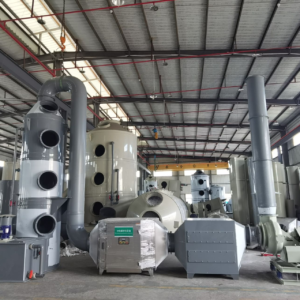
Dedicated ammonia (NH3) gas scrubber using sulfuric acid (H2SO4) scrubbing chemistry for high-efficiency NH3 removal from industrial exhaust. Reaction: 2NH3 + H2SO4 → (NH4)2SO4 — producing ammonium sulfate, a water-soluble fertilizer compound that stays in solution and is removed via controlled blowdown. Removal efficiency over 99%, discharge under 5 PPM NH3. Designed for fertilizer production, ammonia refrigeration, chemical processing, and livestock operations where NH3 emissions must be tightly controlled for both regulatory compliance and odor management.
| Target gas | Ammonia (NH3) — also co-removes amines and other alkaline nitrogen compounds |
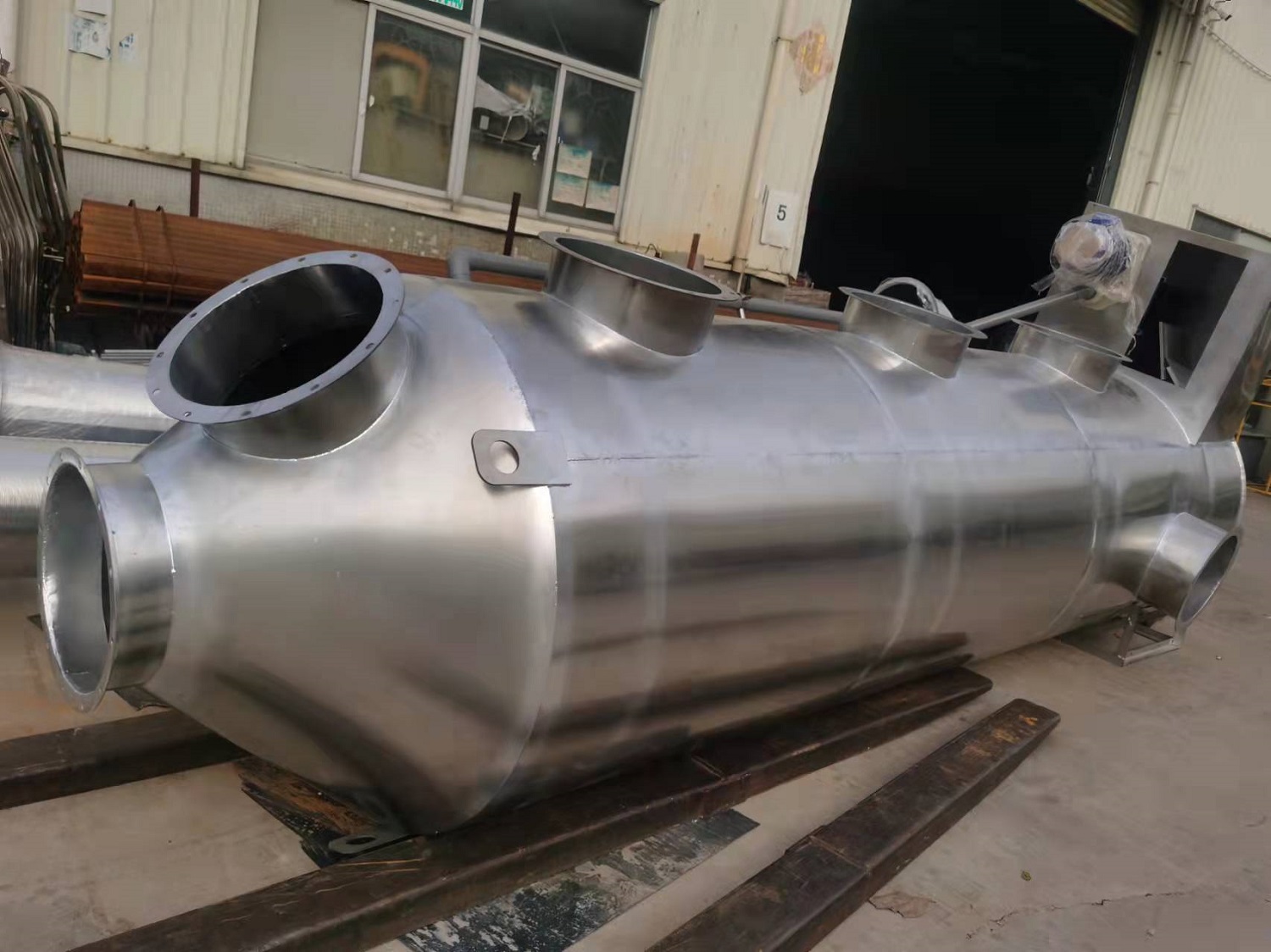
| Material | Virgin PP; FRP or SS316L for combined NH3 + high-temperature service |
| Scrubbing reagent | H2SO4 (sulfuric acid), 10-30% solution; automated pH-controlled dosing |
| Byproduct | (NH4)2SO4 (ammonium sulfate) — water-soluble fertilizer; can be recovered or discharged |
| Efficiency | over 99% single-stage; discharge under 5 PPM |
| Air volume | 100 – 120,000 m3/h single tower |
| Lead time | 15-25 days |
| Warranty | 12 months structure; NH3 removal guaranteed at specified conditions |
Ammonia is highly soluble in water (≈52 g/100 mL at 20 °C), but water absorption alone produces a dilute ammonium hydroxide solution that may not meet discharge limits without further treatment. Acid scrubbing with H₂SO₄ converts NH₃ to (NH₄)₂SO₄ — a stable, non-volatile salt that can be safely discharged or recovered as liquid fertilizer.
Key design considerations for ammonia scrubbing:
- pH control: Maintain recirculating liquid pH between 3–5 for efficient absorption. A pH controller with acid dosing pump automates chemical feed and prevents reagent waste.
- Temperature rise: NH₃ + H₂SO₄ reaction is exothermic (≈85 kJ/mol). For high inlet concentrations (>NEEDS_HUMAN_INPUT ppm), a heat exchanger or quench section may be needed to keep tower temperature within PP limits.
- Ammonium salt crystallization: (NH₄)₂SO₄ solubility decreases at lower temperature. In cold climates, insulate or heat-trace the recirculation loop to prevent salt deposition on packing.
- Mist elimination: A high-efficiency mist eliminator at the tower outlet captures entrained droplets containing ammonium salts, preventing stack emissions and plume formation.
Why Ammonia Needs a Dedicated Approach
NH3 is highly soluble in water — that’s the good news. The bad news: water-scrubbed NH3 simply transfers the ammonia from the gas phase to the liquid phase. The scrubbing water becomes ammonia-laden and must be treated or stripped, and NH3 can re-volatilize from the sump if pH rises above 9. A water-only scrubber might achieve 85-90% removal; the remaining 10-15% is often enough to fail a stack test or generate odor complaints from neighbors.
Acid scrubbing with H2SO4 solves this permanently: NH3 + H2SO4 → (NH4)2SO4 is irreversible under normal operating conditions. The ammonia is converted to ammonium sulfate — a stable, non-volatile salt that remains dissolved in the scrubbing liquor. No re-volatilization, no odor breakthrough, no pH-dependent efficiency swings. The byproduct (ammonium sulfate solution) can be concentrated and sold as liquid fertilizer, used directly for irrigation if the concentration is managed, or discharged to wastewater treatment — we size the blowdown system for your site’s disposal path.
For very large NH3 loads (urea plants, ammonia production facilities), the (NH4)2SO4 byproduct stream can be economically recovered via crystallization — converting an emission control cost center into a fertilizer revenue stream. Contact us for an economic analysis.
Why Xicheng
16 years, 2600+ systems shipped worldwide. Ammonia scrubbing with acid sounds straightforward — mix acid with ammonia, get ammonium sulfate. In practice, three things go wrong and we’ve designed them out:
- Acid mist carryover. Spraying H2SO4 solution generates acid mist droplets that must be captured before the gas exits. An undersized or missing demister sends sulfuric acid mist out the stack — replacing one emission problem with another. Our two-stage chevron + mesh pad demister captures acid mist droplets down to sub-micron range, with outlet acid mist under 10 mg/Nm3.
- Salt crystallization. (NH4)2SO4 has a solubility limit of about 750 g/L at 25 C. If the blowdown rate is too low or the sump temperature drops, crystals form in the packing, spray nozzles, and pump internals — progressively reducing efficiency and eventually seizing the recirculation pump. We calculate the blowdown rate to maintain dissolved solids below 60 percent of saturation at minimum operating temperature, with an automatic fresh-water makeup and conductivity-controlled blowdown.
- pH control lag. NH3 inlet concentration changes with process load. If acid dosing can’t keep up, pH rises above 7, NH3 absorption efficiency drops sharply, and breakthrough occurs. Our feed-forward pH control loop monitors inlet NH3 concentration (via gas sensor or inferred from process data) and adjusts acid dosing rate before the pH probe sees the change — not after the scrubber has already started losing efficiency.
Send your NH3 concentration and air volume to xicheng023@outlook.com. We’ll specify the acid consumption rate, byproduct volume, and disposal options.
Core Advantages
- High Purification Efficiency: Delivers high dust removal and desulfurization efficiency. Effectively removes various industrial waste gases.
- Durable and Premium Material: New PP material offering excellent anti-corrosion and wear-resistant properties.
- Compact Design and Low Consumption: Simple structure, minimal space, low energy consumption.
- Easy Installation and Operation: Floating packing layer, practical, simple to operate.
- Flexible Customization and After-Sales: Personalized sizing, 1-year warranty, overseas support.
Key Specifications
Beyond the basic NH₃ + H₂SO₄ → (NH₄)₂SO₄ reaction, several design parameters determine system performance:
- Liquid-to-gas ratio: Typical L/G for ammonia scrubbing is 3–6 L/m³ (higher than acid gas scrubbing at 1.5–3 L/m³) due to the need for complete gas-liquid contact and byproduct dissolution.
- Ammonium sulfate concentration: The recirculating liquid can be concentrated to 20–35% (NH₄)₂SO₄ before crystallization risk. At this concentration, the blowdown can be sold as liquid fertilizer, offsetting 30–50% of chemical operating cost.
- Temperature control: The neutralization reaction releases 85 kJ/mol. For inlet NH₃ exceeding 2000 ppm, a packed-bed heat exchanger or quench section maintains tower temperature below 60 °C (PP limit). Each 10 °C rise reduces NH₃ solubility by approximately 15%.
| Model No. | XC-1 |
| Material | New PP (Polypropylene) Material; H2SO4-compatible |
| Function | Ammonia Gas Removal (Chemical Absorption) |
| Purifying Technology | H2SO4 acid scrubbing with pH-controlled dosing |
| Automation | Automatic pH-controlled H2SO4 dosing with feed-forward loop |
| Service Life | 8-10 Years |
| Color | Beige / Dark Grey |
| Brand / Origin | Xicheng / China |
Certifications and Compliance
- CE Certified – Wet Scrubber, Exhaust Fan, Air Valve
- RoHS Compliant – Adsorption Tower materials
- ISO 9001 – Quality Management System
- ISO 14001 – Environmental Management System
- SGS Tested – PP Sheet, FR-PP, PP Pipe, PVC Sheet
- Design Compliance – Systems designed to meet EU Industrial Emissions Directive (2010/75/EU). NH3 emission limits per OSHA NH3 exposure standards.
Model Selection Table
Standard model range — all dimensions in millimeters.
| Air Volume (m3/h) | Diameter (mm) | Thickness (mm) | Drain Outlet | Water Tank (mm) | Inlet/Outlet Pipe | Pump (kW) | Air Resistance (Pa) |
|---|---|---|---|---|---|---|---|
| 3,000 | 800 | 8 | DN32 | 600x700xH700 | 315 | 0.75 | 500 |
| 5,000 | 1,000 | 8 | DN40 | 600x800xH700 | 400 | 1.5 | 500 |
| 8,000 | 1,200 | 8 | DN40 | 600x1000xH700 | 500 | 2.2 | 500 |
| 10,000 | 1,500 | 10 | DN40 | 700x1000xH700 | 550 | 2.2 | 500 |
| 12,000 | 1,600 | 10 | DN50 | 700x1000xH700 | 600 | 3.75 | 500 |
| 15,000 | 1,800 | 10 | DN50 | 700x1200xH700 | 650 | 3.75 | 500 |
| 20,000 | 2,000 | 10 | DN50 | 700x1200xH700 | 750 | 5.5 | 500 |
| 25,000 | 2,200 | 10 | DN50 | 700x1200xH700 | 950 | 5.5 | 600 |
| 30,000 | 2,500 | 12 | DN65 | 700x1200xH700 | 1,000 | 5.5 | 600 |
| 35,000 | 2,700 | 12 | DN65 | 1000x700xH700 | 1,100 | 7.5 | 600 |
| 40,000 | 2,900 | 12 | DN65 | 1000x700xH700 | 1,200 | 7.5 | 600 |
| 45,000 | 3,000 | 12 | DN65 | 1000x700xH700 | 1,250 | 7.5 | 600 |
Custom sizes: Up to 215,000 m3/h. Contact xicheng023@outlook.com.
Applications
| Industry | NH3 source |
|---|---|
| Fertilizer production | Urea prilling/granulation, ammonium nitrate neutralizer vents, ammonia storage tank breathing |
| Ammonia refrigeration | Cold storage ventilation, compressor room exhaust, safety relief valve discharge |
| Chemical manufacturing | Amine production, ammonia synthesis purge gas, chemical reactor vents |
| Livestock / poultry | Barn ventilation, manure processing exhaust, rendering plant odor control |
| Semiconductor | MOCVD process exhaust (NH3 used in III-V semiconductor manufacturing) |
| Wastewater treatment | Digester gas cleaning, sludge drying exhaust |
Selection Notes
Good Fit Conditions
This product is suitable when the application matches the design specifications listed in the technical table above. Confirm gas composition, airflow, temperature, and material compatibility before ordering.
When to Review with Engineering
- Gas temperature exceeds the material limit for standard construction
- Particulate or sticky components are present in the exhaust stream
- Mixed pollutants require multi-stage or dual-reagent treatment
- Site constraints limit available footprint, headroom, or utility connections
How to Order
- You send – NH3 inlet concentration (PPM or mg/Nm3), air volume, process description, local emission limit
- We calculate – H2SO4 consumption rate, (NH4)2SO4 production rate, blowdown volume, acid storage tank sizing
- We design – Tower size, packing selection, acid dosing and pH control system, demister specification
- You approve – Technical proposal with NH3 removal guarantee, chemical consumption estimate, and byproduct management plan
- We build – 15-25 days. Acid-compatible materials verified; pH control loop bench-tested
- We ship – Installation drawings, acid handling guidelines, commissioning procedure included.
Contact xicheng023@outlook.com or WhatsApp +86 18927456906 — proposal within 24 hours.
Complete Your System
- Wet Scrubber Overview – Compare all scrubber configurations
- Spray Scrubber Tower – For general acid gas treatment
- Chemical Wet Scrubber – For exhaust requiring custom reagent chemistry
- PP Exhaust Duct – Corrosion-resistant ductwork
Global Shipping
Best Fit Applications
Not Recommended / Engineering Limits
- Hot ammonia gas (>60 °C): PP construction softens. Use FRP or SS.
- High-concentration NH₃ (>NEEDS_HUMAN_INPUT ppm): Exothermic absorption may overheat the tower. A quench section or multi-stage design needed.
- Ammonium salt crystallization risk: If operating temperature drops below the salt saturation point, packing may plug. Insulate or heat-trace in cold climates.
This ammonia scrubber is designed for:
- Target gas: NH₃ (ammonia) at 50–5000 ppm inlet concentration
- Absorption: H₂SO₄ acid scrubbing (preferred) or water absorption
- Airflow: 1,000–40,000 m³/h per tower
- Removal efficiency: >99% with acid scrubbing, >95% with water
- Best industries: Fertilizer production, livestock, refrigeration, chemical synthesis, wastewater treatment
We ship worldwide. Sea freight standard; air freight for small units. Acid-resistant packaging and SDS included with chemical handling documentation.
FAQ
Why use H2SO4 instead of just water for NH3?
Water absorbs NH3 but doesn’t convert it — the ammonia stays as dissolved gas that can re-volatilize. H2SO4 chemically converts NH3 to ammonium sulfate, which is a stable, non-volatile salt. Water scrubbing achieves 85-90% removal; acid scrubbing achieves over 99% with no risk of NH3 breakthrough as sump conditions change.
What do I do with the ammonium sulfate byproduct?
(NH4)2SO4 is a common nitrogen-sulfur fertilizer. The liquid solution from the scrubber blowdown (typically 20-40% concentration) can be: (a) sold or given to local farms as liquid fertilizer, (b) evaporated and crystallized for dry fertilizer sale, or (c) discharged to wastewater treatment — ammonium sulfate is readily biodegradable and non-toxic. We’ll help you evaluate the economics of recovery vs disposal for your specific volume.
How much sulfuric acid does the scrubber consume?
Stoichiometrically: 1 kg of NH3 requires approximately 2.9 kg of concentrated H2SO4 (98%). In practice, we design for 10-15% excess acid to maintain pH below 3 for maximum removal efficiency. For a facility emitting 10 kg/hour of NH3, expect acid consumption of roughly 32-34 kg/hour of 98% H2SO4. We provide a detailed chemical consumption estimate with every proposal.
Gas Scrubber Operating Cost Guide
Learn More on Our Blog
- Gas Scrubber Selection (Multi-Stage)
- NH3 Scrubber Design and Ammonia Removal Guide
- Gas Scrubber Operating Cost
- Common Scrubber Problems
Contact the Xicheng Engineering Team Today.
Send us your project specifications. Our engineers will prepare a product configuration, system integration proposal, and quotation within 24 hours.
🎯 Manufacturing Head Office: No. 34 Zhenxing Road (Shengtaian Heavy Industrial Park B), Loucun, Guangming New District, Shenzhen, Guangdong, China
☎️ Direct Hotline / WhatsApp: +86 189 2745 6906
📬 Engineering Mailbox: xicheng023@outlook.com