
The Three Pain Points Your Acid Fume Scrubber Is Probably Suffering Right Now
If you operate a pickling line, electroplating shop, or chemical mixing station, your acid fume scrubbers are the only thing standing between your workers and a cloud of hydrochloric, sulfuric, or hydrofluoric acid mist. But here is what most plant managers discover too late: the scrubber that was supposed to protect them is quietly failing. Pinhole leaks form in stainless steel shells within 18 months. Emission readings creep upward. Maintenance crews spend more time patching welds than running production. These are not rare exceptions — they are the predictable result of putting the wrong material in a corrosive environment. This article addresses the three pain points that drive acid fume scrubber owners to contact us, and shows why switching to PP construction solves all three at once. We are the factory that builds these systems, and the solutions below come from diagnosing over 500 failed scrubbers worldwide.
Pain Point 1: Corrosion Leaks That Nobody Sees Until It’s Too Late
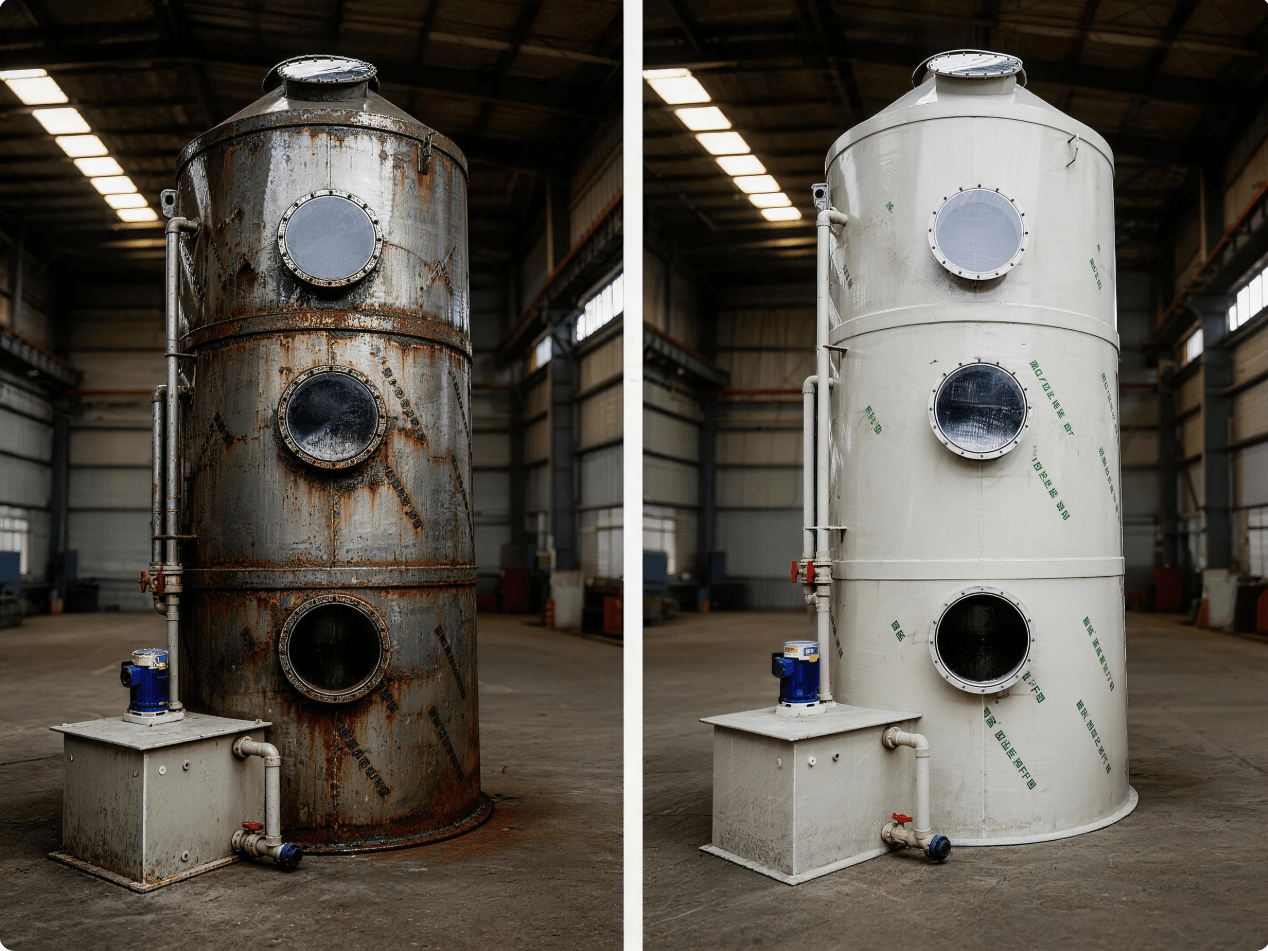
The most dangerous problem with acid fume scrubbers is invisible. Stainless steel 304, the most common material for budget scrubbers, begins pitting the moment it contacts chloride ions from HCl mist. Within 18 to 24 months, microscopic pits grow into pinholes that puncture the vessel wall. Because the leaks are small and often hidden behind insulation or ductwork, untreated acid gas bypasses the scrubbing zone and exits the stack for months before anyone notices. We audited a phosphate fertilizer plant in Vietnam that had been exceeding its HCl emission limit for eleven months due to a cluster of pinholes in a three-year-old SS304 scrubber. The fix was not a patch — it was a complete vessel replacement. The EPA wet scrubber monitoring guidelines exist precisely because undetected leaks are the most common cause of NESHAP violations in acid gas service.
The PP Solution: Zero-Leak Shell for 15+ Years
Polypropylene is chemically inert to HCl, H₂SO₄, HF, and the full spectrum of acid fumes found in industrial exhaust. This is not a coating — it is solid PP through the entire wall thickness, with every seam homogeneously welded. Our industrial PP wet scrubber shells remain leak-free for a minimum of 15 years because there is simply nothing for acid to attack. The difference is 300% better corrosion resistance than SS304 — a number verified across every one of our 500+ installations. The OSHA permissible exposure limits for acid gases become achievable when your scrubber shell is not the source of the problem.
Pain Point 2: Compliance Drift That Invites Penalties and Shutdowns
Even without visible leaks, many acid fume scrubbers suffer from a slower failure: removal efficiency gradually declines as internal components degrade. Packing media clogs from scale buildup on corroded surfaces. Liquid distributors warp from repeated thermal cycling, creating dry channels where untreated gas slips through. Mist eliminators made from stainless steel mesh corrode and allow acid-laden droplets to carry over into the stack. The result is compliance drift — your outlet readings inch upward quarter by quarter until one day you receive a notice of violation. Under 40 CFR Part 63 NESHAP, fines can reach $37,500 per day per violation, and regulators increasingly require continuous emission monitoring that makes this drift impossible to hide.
The PP Solution: Stable Internals That Maintain Design Efficiency
PP’s naturally smooth, hydrophobic surface resists the scale adhesion that initiates packing clogging. PP distributors and support grids maintain precise geometry at temperatures up to 80°C — no warping, no sagging, no dry spots. PP chevron-style mist eliminators outperform stainless steel mesh in acid service by a wide margin, maintaining droplet capture efficiency for over a decade. Our PP packed bed scrubber is engineered so that every internal component shares the same corrosion-proof material as the shell, eliminating the weak interfaces where degradation begins. For a complete understanding of how scrubber systems maintain compliance, read our guide on how scrubber work solves industrial compliance.
Pain Point 3: Maintenance Costs That Eat Your Operating Budget
The third pain point hits the maintenance department hardest. Stainless steel acid fume scrubbers require constant attention: weld repairs to patch pinholes, recoating to slow corrosion, replacement of rotted mist eliminators, and eventual mid-life rebuilds that cost nearly as much as the original purchase. FRP scrubbers crack, delaminate, and need UV protective coatings reapplied. Over a ten-year period, a 10,000 CFM stainless steel scrubber will consume approximately $243,400 in total costs — and a large portion of that is unplanned, unbudgeted repair work that disrupts production. For the full breakdown, see our analysis of hidden scrubber costs.
The PP Solution: 40% Lower Maintenance, Predictable Budgets
PP acid fume scrubbers require no welding repairs, no recoating, and no mid-life rebuilds. A visual inspection every six months and occasional nozzle cleaning are typically all the maintenance needed. Our documented field data shows 40% lower annual maintenance labor compared to stainless steel units, and a 2x longer service life than FRP. The total ten-year cost for a PP system serving the same 10,000 CFM load is approximately $163,500 — a savings of nearly $80,000 compared to SS304. To correctly size your system and maximize these savings, use our PP scrubber sizing guide. For context on how these systems fit into a broader pollution control strategy, explore our 2026 overview of air pollution control systems.
| Pain Point | SS304 Acid Fume Scrubber | PP Acid Fume Scrubber |
|---|---|---|
| Corrosion Leaks | Pinholes within 18–24 months | Zero leaks for 15+ years |
| Compliance Stability | Drifts as internals degrade | Stable outlet readings, decade-scale |
| Annual Maintenance | High — weld repairs, recoating | 40% lower — visual checks only |
| 10-Year Total Cost (10,000 CFM) | $243,400 | $163,500 |
A Real-World Example: Philippine Electroplating Facility
In 2023, a chrome and nickel plating plant near Cebu was facing quarterly emission exceedances. Their existing SS304 acid fume scrubber — only four years old — had developed multiple pinhole leaks and severe internal scale buildup. Wastewater bills from excessive blowdown were running $14,700 per year because the scrubber could not maintain efficient recirculation. We replaced the entire unit with a PP packed bed scrubber sized for their 8,500 CFM mixed-acid exhaust. The results after 18 months: emission levels dropped to 0.8 mg/Nm³, wastewater volume decreased by 25%, and the total project — including installation — paid for itself in saved operating costs within that same 18-month window. This is the pattern we see across every industry where acid fume scrubbers are mission-critical. For more examples of industries where PP excels, see our guide to PP scrubber project suitability.
Is your acid fume scrubber showing warning signs? Tell us your symptoms — unusual opacity, rising differential pressure, or a recent emission deviation — and our engineers will diagnose the most likely cause for free. Get Your Free Failure Diagnosis →
Frequently Asked Questions
Why do acid fume scrubbers fail so quickly in corrosive environments?
The primary cause is material incompatibility. Stainless steel 304 develops pitting corrosion within 18–24 months when exposed to HCl or H₂SO₄ fumes. These pits grow into pinhole leaks that allow untreated acid gas to bypass the scrubbing zone entirely. PP acid fume scrubbers eliminate this because polypropylene is chemically inert to acid gases — there is nothing for the acid to attack.
How much can I save by switching to a PP acid fume scrubber?
For a typical 10,000 CFM system, a PP acid fume scrubber saves approximately $80,000 over ten years compared to SS304. This comes from zero rebuild costs, 40% lower maintenance labor, and 15% lower fan energy consumption due to PP’s smooth internal surfaces. Payback on the initial price difference is typically under 18 months.
Will a PP scrubber meet my local emission limits?
Yes. The scrubbing principle is material-independent — PP handles the same gas-liquid contact chemistry as any other scrubber. The advantage is that PP maintains its designed removal efficiency for 15+ years, while steel and FRP degrade. Our systems are sized to meet limits under EPA NESHAP, EU BREF, Indian CPCB, Philippine DENR, and other regional standards.
What maintenance does a PP acid fume scrubber actually need?
A visual inspection every six months, occasional nozzle cleaning, and pH probe calibration. No welding, no recoating, no crack repairs. Our documented data shows 40% fewer maintenance labor hours compared to SS304 scrubbers in the same acid gas service.
Can I retrofit my existing SS scrubber with PP internals?
In most cases, no. If the SS shell is already pitting, the vessel itself is compromised. We recommend a complete replacement with a PP acid fume scrubber to eliminate all corrosion interfaces. Our industrial PP wet scrubber can be configured to match your existing ductwork and footprint.
Do you supply acid fume scrubbers outside your home country?
Yes. We ship PP scrubber systems to over 30 countries, fully assembled or in modular sections. Each order includes detailed installation manuals and remote commissioning support — factory-direct pricing applies regardless of destination. See our gas scrubber for industrial waste gas treatment for examples.
One Decision That Eliminates All Three Pain Points
Corrosion leaks, compliance drift, and runaway maintenance costs all share a single root cause: the wrong material in a corrosive environment. Acid fume scrubbers built from PP — with 300% better corrosion resistance than stainless steel, a 2x longer service life than FRP, and 40% lower annual maintenance — address all three pain points from the moment of installation. As the factory that manufactures these systems, we provide direct engineering support, competitive pricing with no intermediary markup, and a track record of 500+ installations across Asia, the Middle East, and Latin America. If your current scrubber is showing any of the warning signs described above, the sooner you diagnose it, the less it costs to fix.
Get Your Free Acid Fume Scrubber Diagnosis and Quote →
Written by our senior process engineer, who has spent over a decade diagnosing and replacing failed acid fume scrubbers in electroplating, pickling, and chemical processing facilities worldwide. Every pain point described above is taken from actual field investigations conducted during our 500+ installation history.


Related Posts
Acid Fume Scrubber Types & Tank Design: Complete Selection Guide
Acid Fume Scrubber Types & Tank Design: Complete Selection Guide…
Industrial Activated Carbon Filter Box Design & Sizing Guide
An undersized carbon filter box is a compliance liability. Oversized,…

Scrubber Water Treatment & Gas Scrubber Manufacturer Guide
Scrubber Water Treatment & Gas Scrubber Manufacturer Guide Introduction: Why…