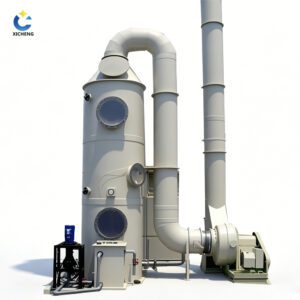
Product Overview
Datasheet and Project Review
An engineering datasheet with dimensional drawing, specification confirmation, and system integration notes can be prepared once the project configuration is confirmed.
To request a quotation, provide: gas composition and concentration, flow rate (m³/h) and temperature, material preference, and delivery location.
Wet dust collection combines particle capture with gas absorption in a single vessel. Unlike dry dust collectors (baghouses, cyclones) which can pose explosion risks for combustible dust and require periodic filter replacement, wet collectors use water or scrubbing liquid to capture and remove particulate.
- Capture mechanism: Particulate is wetted by spray nozzles or submerged gas distribution, agglomerating into larger droplets that settle or are removed by entrainment separation. Collection efficiency depends on particle size, density, and hydrophilicity.
- Combustible dust safety: Wet collection eliminates the fire and explosion hazard associated with dry dust collection for combustible materials (aluminum, magnesium, coal, sulfur). The water bath inherently suppresses ignition.
- Simultaneous gas removal: If the exhaust contains both particulate and soluble acid gases, the wet dust collector can achieve 85%+ particulate removal and 90%+ gas removal simultaneously, replacing two separate treatment stages.
- Sludge handling: Collected particulate reports to the sump as a slurry. A continuous or periodic blowdown with settling tank or filter press produces a disposable filter cake. Typical blowdown rate: NEEDS_HUMAN_INPUT % of recirculation flow.
Industrial wet dust collector combining water bath and spray scrubbing for particulate removal from process exhaust. Water bath captures coarse dust through inertial impaction; high-pressure spray nozzles remove fine particles in counter-current flow. Filtration efficiency over 85% for particles 5-20 microns. Also provides simultaneous gas cooling and water-soluble gas absorption — three functions in one unit. Compact footprint of approximately 4 m2, processing 5-7 m3 of dust-laden air per second.
| Application | Industrial dust: chemical powders, mineral dust, metal fines, food processing dust, wood dust |
| Material | 100% virgin PP; optional SS for abrasive dust or high-temperature |
| Mechanism | Water bath inertial impaction + counter-current spray scrubbing |
| Efficiency | over 85% for 5-20 micron particles; co-removal of water-soluble gases |
| Service life | 5-8 years (PP construction) |
| Water consumption | Approximately 1 ton/hour (recirculated with controlled blowdown) |
| Lead time | 10-20 days |
| Warranty | 12 months structure warranty |
Why Wet Dust Collection
Dry dust collectors — bag filters, cyclones, cartridge collectors — dominate the market. But they fail predictably in three scenarios where wet collection wins:
- Sticky or hygroscopic dust. Powders that absorb moisture from the air (fertilizer dust, some chemical powders, sugar dust) blind bag filters within hours. Wet collectors wash them away continuously — no blinding, no pressure drop spikes, no production stoppage to shake or replace bags.
- Explosive dust. Organic dusts — wood, grain, coal, aluminum, magnesium — are combustible. Dry collectors concentrate explosive dust inside a confined vessel with an ignition source (static discharge, mechanical spark). Wet collectors eliminate the explosion hazard by keeping dust suspended in water, where it cannot ignite. This is why wet collectors are often specified by fire codes for aluminum grinding and magnesium processing. Workplace dust exposure is regulated under OSHA 29 CFR 1910.1000 Air Contaminants which sets Permissible Exposure Limits for particulate matter including nuisance dust (15 mg/m³ total, 5 mg/m³ respirable), metal dusts, and chemical powders — wet collection provides reliable compliance for dusts that challenge dry filtration.
- Hot, humid exhaust. Processes like drying, calcining, or quenching produce exhaust that condenses in bag filters — turning dust into mud that sets like concrete on filter media. Wet collectors handle saturated gas without issue; the scrubbing water is already wet.
A wet dust collector also absorbs water-soluble gases (HCl, SO2, NH3) simultaneously with particulate removal — something no dry collector can do. For processes emitting both dust and acid gases, a single wet collector can replace a baghouse plus a separate scrubber.
Not suitable for: hydrophobic dust that repels water and floats on the sump surface, or sticky dust that accumulates on internal surfaces and requires manual cleaning.
Why Xicheng
16 years, 2600+ systems shipped worldwide. Wet dust collectors seem simpler than packed bed scrubbers — and in some ways they are. But the failure modes are different and equally consequential: sump sludge buildup reducing effective water volume until efficiency collapses, spray nozzle clogging from recirculated solids, water carryover into downstream ductwork causing corrosion puddles. Our design addresses each:
- Settling sump, not just a water tank. The sump includes a baffled settling zone where captured dust settles before water reaches the pump suction. A sloped bottom with drain valve allows sludge removal without system shutdown. Automatic blowdown with timed or turbidity-triggered control prevents sludge accumulation from reducing effective water volume — the most common wet collector failure mode.
- Filtration protects the nozzles. Recirculated water passes through a coarse strainer before reaching the spray pump — preventing captured particles from re-entering the spray system and clogging nozzles. The strainer is accessible from outside the vessel for cleaning without opening the unit.
- Demister as standard, not optional. Wet collectors inherently generate water droplets. Without proper demisting, outlet ductwork accumulates water pools that cause corrosion and, in cold climates, ice damage. A two-stage PP chevron demister is standard on every unit.
Tell us your dust type, particle size, and air volume: xicheng023@outlook.com. We’ll confirm suitability and size accordingly.
Core Advantages
- High Purification Efficiency: Delivers high dust removal efficiency. Effectively captures particulates while co-removing water-soluble industrial waste gases.
- Durable and Premium Material: Manufactured using new PP material, offering excellent anti-corrosion and wear-resistant properties, ensuring a long service life and high cost-performance.
- Compact Design and Low Consumption: Occupies approximately 4 m2 floor space. Operates stably with low water and energy consumption.
- Easy Installation and Operation: Simple structure with convenient maintenance access. Direct water bath absorption eliminates complex pretreatment requirements.
- Flexible Customization and After-Sales Service: Supports personalized customization; sizes and specifications can be adjusted according to customer needs and drawings. Comes with a 1-year warranty, professional installation guidance, and comprehensive overseas after-sales support.
Key Specifications
| Model No. | XC-1 |
| Material | 100% Virgin PP (Polypropylene) |
| Function | Dust Collection + Gas Absorption (combined) |
| Purifying Technology | Water bath impaction + counter-current spray scrubbing |
| Automation | Automatic blowdown control |
| Service Life | 5-8 Years |
| Footprint | Approximately 4 m2 |
| Color | Beige / Dark Grey |
| Brand / Origin | Xicheng / China |
Certifications and Compliance
- CE Certified – Wet Scrubber, Exhaust Fan, Air Valve
- RoHS Compliant – Adsorption Tower materials
- ISO 9001 – Quality Management System
- ISO 14001 – Environmental Management System
- SGS Tested – PP Sheet, FR-PP Flame Retardant Sheet, PP Pipe, FR-PP Flame Retardant Pipe, PVC Sheet
- Design Compliance – Systems designed to meet EU Industrial Emissions Directive (2010/75/EU) and applicable workplace dust exposure limits
Model Selection Table
| Air Volume (m3/h) | Diameter (mm) | Thickness (mm) | Drain Outlet | Water Tank (mm) | Inlet/Outlet Pipe | Pump (kW) | Air Resistance (Pa) |
|---|---|---|---|---|---|---|---|
| 3,000 | 800 | 8 | DN32 | 600x700xH700 | 315 | 0.75 | 500 |
| 5,000 | 1,000 | 8 | DN40 | 600x800xH700 | 400 | 1.5 | 500 |
| 8,000 | 1,200 | 8 | DN40 | 600x1000xH700 | 500 | 2.2 | 500 |
| 10,000 | 1,500 | 10 | DN40 | 700x1000xH700 | 550 | 2.2 | 500 |
| 12,000 | 1,600 | 10 | DN50 | 700x1000xH700 | 600 | 3.75 | 500 |
| 15,000 | 1,800 | 10 | DN50 | 700x1200xH700 | 650 | 3.75 | 500 |
| 20,000 | 2,000 | 10 | DN50 | 700x1200xH700 | 750 | 5.5 | 500 |
Custom sizes: Available up to 100,000 m3/h. Contact our engineers — xicheng023@outlook.com.
Wet vs Dry Dust Collection
| Factor | Wet Collector | Bag Filter | Cyclone |
|---|---|---|---|
| Efficiency (5-20 micron) | 85%+ | 99%+ | 50-80% |
| Sticky/hygroscopic dust | Handles well | Blinds filters | Handles well |
| Explosive dust | Safe (submerged) | Explosion risk | Explosion risk |
| Hot/humid gas | Handles well | Condensation blinds | Handles well |
| Gas absorption | Simultaneous | No | No |
| Water requirement | Yes (~1 ton/h) | None | None |
| Wastewater production | Yes (sludge) | Dry waste | Dry waste |
| Freeze protection | Required (outdoor) | Not required | Not required |
Selection Notes
Good Fit Conditions
This product is suitable when the application matches the design specifications listed in the technical table above. Confirm gas composition, airflow, temperature, and material compatibility before ordering.
When to Review with Engineering
- Gas temperature exceeds the material limit for standard construction
- Particulate or sticky components are present in the exhaust stream
- Mixed pollutants require multi-stage or dual-reagent treatment
- Site constraints limit available footprint, headroom, or utility connections
How to Order
- You send – Dust type and approximate particle size distribution, air volume (m3/h), process description (what generates the dust), site indoor/outdoor, local emission limits
- We assess suitability – We’ll confirm wet collection is appropriate for your dust type and recommend dry collection if it’s a better fit — we build both and have no stake in pushing one over the other
- We design – Water bath depth, spray nozzle configuration, sump volume, blowdown rate, pump selection, demister sizing
- You approve – Technical proposal with dust removal guarantee at your specified particle size distribution, 3D layout, and pricing
- We build – 10-20 days fabrication. Water bath spray test and quality inspection before shipment
- We ship – Installation drawings, commissioning procedure, and sludge management guidelines included.
Contact our engineers at xicheng023@outlook.com or WhatsApp +86 18927456906 — proposal within 24 hours.
Complete Your System
- Industrial Spray Scrubber Tower – For simultaneous acid gas treatment at higher efficiency
- Exhaust Purification System – Turnkey solution combining dust collection with multi-stage gas treatment
- PP Exhaust Duct and Fittings – Corrosion-resistant ductwork for dust-laden air transport
- PP/FRP Centrifugal Fan – High-pressure fan for wet collector system resistance
Global Shipping
Best Fit Applications
Not Recommended / Engineering Limits
- Sub-micron particulate: Standard wet scrubbers are ineffective below 5 microns. Use a venturi scrubber, wet ESP, or baghouse.
- Hydrophobic dust: Some powders resist wetting. A surfactant dosing system may be needed — confirm with a bench test.
- High gas temperature (>60 °C PP): Specify FRP or SS construction.
This wet dust collector is designed for:
- Target: Water-soluble dust and particulate, combustible dust (wet suppression)
- Particle size: >5 microns (sub-micron requires high-energy venturi or wet ESP)
- Airflow: 3,000–50,000 m³/h
- Removal efficiency: >85% for 5–20 micron particles
- Best industries: Metal grinding, chemical processing, pharmaceutical, food processing, mining
We ship worldwide with documented export experience across Southeast Asia, South Asia, Middle East, Africa, Europe, Americas, and Oceania. Sea freight standard; air freight for small units. For outdoor installations in cold climates, we include freeze protection guidelines and optional tank heating provisions in the shipping documentation.
FAQ
When should I choose a wet dust collector over a bag filter?
Choose wet collection when your dust is sticky, hygroscopic, explosive, or your exhaust gas is hot and humid. Also when you need simultaneous gas absorption — wet collectors remove water-soluble gases like HCl, SO2, NH3 alongside particulates. Choose a bag filter when you need the highest particle removal efficiency (over 99%), your dust is dry and free-flowing, and you want dry waste for simpler disposal.
What about the wastewater?
The wet collector produces a sludge-water mixture in the sump. The sump includes a settling zone and bottom drain for sludge removal. Wastewater volume is modest — approximately 1 ton/hour with recirculation, and blowdown is typically 5-15 percent of the recirculation rate depending on dust loading. Sludge disposal depends on the dust composition: inert mineral dust can often go to landfill; chemical dust may require treatment per local regulations.
Can this unit be installed outdoors?
Yes — with freeze protection. In climates where ambient temperature drops below 5 C, the water circulation system needs heat tracing on exposed pipes and a tank immersion heater for the sump during shutdown periods. We provide a cold-weather specification package; discuss during quoting if your site has freezing conditions.
What maintenance is required?
Weekly: check spray nozzle pattern through observation window, verify water level and blowdown operation. Monthly: clean pump suction strainer, check demister for scale buildup, verify sludge drain operation. Quarterly: drain and clean sump, inspect internal surfaces for scale or corrosion, recalibrate turbidity sensor if equipped. The simple design means fewer moving parts than a bag filter system — no compressed air pulse system, no filter cage replacement, no rotary valve.
Learn More on Our Blog
- Common Wet Scrubber Problems
- Scrubber Blowdown Management
- Scrubber Water Treatment
- Acid Scrubber Maintenance Guide
- Gas Scrubber Operating Cost
Contact the Xicheng Engineering Team Today.
Send us your project specifications. Our engineers will prepare a product configuration, system integration proposal, and quotation within 24 hours.
🎯 Manufacturing Head Office: No. 34 Zhenxing Road (Shengtaian Heavy Industrial Park B), Loucun, Guangming New District, Shenzhen, Guangdong, China
☎️ Direct Hotline / WhatsApp: +86 189 2745 6906
📬 Engineering Mailbox: xicheng023@outlook.com