
Product Overview
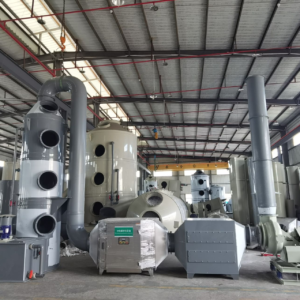
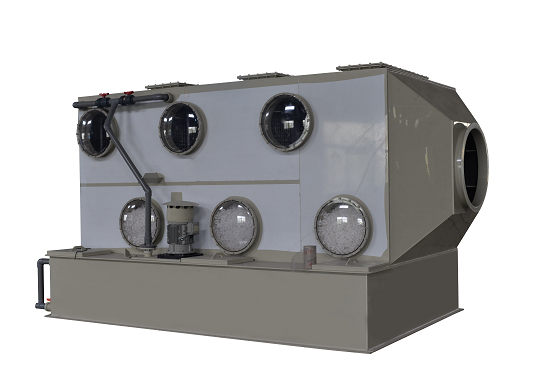
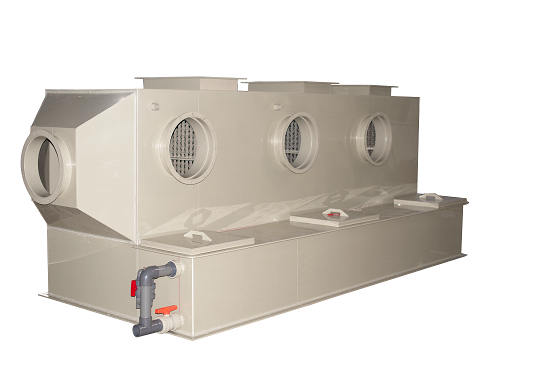
PP horizontal wet scrubber for acid gas and fume treatment in low-headroom installations. Same packed-bed absorption technology as vertical towers — arranged horizontally for sites where ceiling height is the limiting factor. Air volume 50-100000 m3/h, removal efficiency over 95%. Built-to-order from your gas composition and site constraints.
| Application | Acid gas scrubber (HCl, SO2, H2S, NH3, NOx, VOCs) for restricted-height sites |
| Material | Virgin PP, 8-20 mm wall; optional SS304/316 structural frame |
| Sizing | Custom to your air volume, gas load, and available ceiling height |
| Regions | Supplied globally: Southeast Asia, Middle East, Africa, Europe, North America, South Asia, Oceania |
| Lead time | Standard 15-30 days |
| Warranty | 12 months structure warranty |
Why a Horizontal Scrubber
Vertical towers need 3-8 meters of straight headroom. A horizontal scrubber does the same chemical work — packed bed absorption with counter-current or cross-flow gas-liquid contact — in a vessel that fits under a 2.5-meter ceiling. Common scenarios: basement mechanical rooms, retrofit projects with existing low-level ductwork, containerized skid-mounted systems, mezzanine or roof installations with weight distribution requirements.
Read our comparison: Vertical vs Horizontal Scrubber Selection 2026
Why Xicheng
16 years, 2600+ systems shipped worldwide. Horizontal scrubbers are inherently harder to design than vertical ones — you’re fighting gravity. Liquid distribution in a horizontal packed bed needs carefully engineered spray headers, not just a nozzle at the top. We’ve built over 300 horizontal units and solved the common failure modes: gas-liquid channeling eliminated via segmented packing trays with intermediate redistribution; structural sag prevented with SS frame or PP support rings for spans over 4 meters; side-mounted bolted access hatches every 1.5 meters for maintenance without duct disconnection.
Not sure whether you need horizontal or vertical? Send us your ceiling height and floor plan. We’ll tell you straight — horizontal only if you actually need it, because vertical is cheaper and easier to maintain when headroom is available. xicheng023@outlook.com
Core Advantages
- High Purification Efficiency: Delivers high dust removal and desulfurization efficiency. Effectively removes various industrial organic and inorganic waste gases, including HCL, HF, NH3, H2SO4, CrO3, HCN, NAOH, H2S, and HCHO.
- Durable and Premium Material: Manufactured using new PP material, offering excellent anti-corrosion and wear-resistant properties, ensuring a long service life and high cost-performance.
- Compact Design and Low Consumption: Features a simple structure that occupies minimal space — especially important in horizontal configurations where footprint efficiency is key. Operates stably with low energy consumption.
- Easy Installation and Operation: Improved with a floating packing layer, it is highly practical, easy to install, and simple to operate, making it ideal for acid-base waste gas treatment.
- Flexible Customization and After-Sales Service: Supports personalized customization; sizes and specifications can be adjusted according to customer needs and drawings. Comes with a 1-year warranty, professional installation guidance, and comprehensive overseas after-sales support.
Key Specifications
| Model No. | XC-1 |
| Material | New PP (Polypropylene) Material |
| Function | Waste Gas Treatment (Chemical Treatment) |
| Purifying Technology | HEPA |
| Automation | Automatic |
| Service Life | 8-10 Years |
| Color | Beige / Dark Grey |
| Environmental Temperature | Normal Temperature |
| Brand / Origin | Xicheng / China |
Certifications and Compliance
- CE Certified – Wet Scrubber, Exhaust Fan, Air Valve
- RoHS Compliant – Adsorption Tower materials
- ISO 9001 – Quality Management System
- ISO 14001 – Environmental Management System
- SGS Tested – PP Sheet, PPS Flame Retardant Sheet, PP Pipe, PPS Flame Retardant Pipe, PVC Sheet
- Design Compliance – Systems designed to meet EU Industrial Emissions Directive (2010/75/EU) and US EPA Chemical Manufacturing NESHAP per project requirements
Model Selection Table
Standard model range — all dimensions in millimeters. Custom sizes outside this range available on request.
| Air Volume (m3/h) | Diameter (mm) | Thickness (mm) | Drain Outlet | Water Tank (mm) | Inlet/Outlet Pipe | Pump (kW) | Air Resistance (Pa) |
|---|---|---|---|---|---|---|---|
| 3,000 | 800 | 8 | DN32 | 600x700xH700 | 315 | 0.75 | 500 |
| 5,000 | 1,000 | 8 | DN40 | 600x800xH700 | 400 | 1.5 | 500 |
| 8,000 | 1,200 | 8 | DN40 | 600x1000xH700 | 500 | 2.2 | 500 |
| 10,000 | 1,500 | 10 | DN40 | 700x1000xH700 | 550 | 2.2 | 500 |
| 12,000 | 1,600 | 10 | DN50 | 700x1000xH700 | 600 | 3.75 | 500 |
| 15,000 | 1,800 | 10 | DN50 | 700x1200xH700 | 650 | 3.75 | 500 |
| 20,000 | 2,000 | 10 | DN50 | 700x1200xH700 | 750 | 5.5 | 500 |
| 25,000 | 2,200 | 10 | DN50 | 700x1200xH700 | 950 | 5.5 | 600 |
| 30,000 | 2,500 | 12 | DN65 | 700x1200xH700 | 1,000 | 5.5 | 600 |
| 35,000 | 2,700 | 12 | DN65 | 1000x700xH700 | 1,100 | 7.5 | 600 |
| 40,000 | 2,900 | 12 | DN65 | 1000x700xH700 | 1,200 | 7.5 | 600 |
| 45,000 | 3,000 | 12 | DN65 | 1000x700xH700 | 1,250 | 7.5 | 600 |
Custom sizes: Up to 215,000 m3/h air volume. Contact our engineers for sizing beyond the standard model range — xicheng023@outlook.com.
Technical Specifications
| Air volume | 50 – 100,000 m3/h (single unit; parallel for higher flows) |
| Material | Virgin PP (0.92 g/cm3); SS304/316 frame on request |
| Wall thickness | 8 – 20 mm (per size); PP + FRP overwrap for outdoor duty |
| Structure | Horizontal cylindrical or rectangular: inlet plenum – spray section – packing bed(s) – mist eliminator – outlet plenum |
| Flow configuration | Cross-flow (standard); counter-current with internal baffles (high-efficiency) |
| Packing media | PP Pall rings / structured packing / Tellerette rings; segmented trays with redistribution plates |
| Spray stages | 1-3 stages; each with dedicated spray header and liquid distributor |
| Recirculation pump | Chemical-duty PP/FRP centrifugal, 0.75-11 kW (per stage) |
| Demisting | PP chevron or mesh pad; outlet moisture under 75 mg/Nm3 |
| Max inlet temp | 60 C standard / 80 C reinforced |
| Purification efficiency | over 95% single-stage; over 99% multi-stage |
| Pressure drop | 400 – 800 Pa |
| Design standard | GB/T 13931-2017; CE certified. See US EPA Chemical Manufacturing NESHAP for applicable emission requirements. |
Gas Purification Rate
| Gas Name | Formula | Cleaning Agent | Removal Efficiency |
|---|---|---|---|
| Hydrochloric Acid | HCl | H2O | 90-95% |
| NaOH | 95-99% | ||
| Hydrofluoric Acid | HF | H2O | 90-95% |
| NaOH | 95-99% | ||
| Ammonia Gas | NH3 | H2O | 90-95% |
| H2SO4 | over 99% | ||
| Cyanic Acid | HCN | NaOH | 90-98% |
| Sulfur Dioxide | SO2 | NaOH | 95-99% |
| Chlorine | Cl2 | NaOH | 95-99% |
| Hydrogen Sulfide | H2S | NaOH | 95-99% |
| Sulfuric Acid | H2SO4 | H2O | 95-99% |
| Chromic Acid | CrO3 | H2O | 95-99% |
| Sodium Hydroxide | NaOH | H2O | 95-99% |
| Nitric Acid | HNO3 | H2O | 90-99% |
How to Order
- You send – Gas composition, air volume (m3/h), target emission standard, ceiling height, and floor plan sketch
- We evaluate – We’ll confirm whether horizontal is the right choice for your site, or recommend vertical if it fits — because we build both and have no stake in pushing one over the other
- We design – Scrubber diameter and length, packing tray configuration, spray header layout, pump selection, P&ID drawing
- You approve – Technical proposal with performance guarantee, 3D layout showing the unit in your space, and pricing
- We build – 15-30 days fabrication + hydrostatic test + quality inspection
- We ship – Horizontal units ship in open-top containers or flat-rack; installation drawings and rigging guide included
Contact our engineers at xicheng023@outlook.com or WhatsApp +86 18927456906 — proposal within 24 hours.
Complete Your System
- Industrial Spray Scrubber Tower – If site conditions allow, vertical may be the more cost-effective option
- PP Exhaust Duct and Fittings – Corrosion-resistant ductwork; horizontal scrubbers typically connect to low-level duct runs
- PP Centrifugal Fan/Blower – Matched fan sized to the scrubber’s pressure drop curve
- PP Electric Air Dampers – Automated airflow control for multi-source systems
Global Shipping
We ship worldwide with documented export experience across:
- Southeast Asia: Malaysia, Singapore, Indonesia, Philippines, Thailand, Vietnam, Myanmar, Cambodia
- South Asia: India, Pakistan, Bangladesh, Sri Lanka
- Middle East: UAE, Saudi Arabia, Qatar, Oman, Kuwait, Bahrain, Israel
- Africa: Kenya, Nigeria, South Africa, Egypt, Ethiopia, Tanzania, Ghana
- Europe: Germany, UK, France, Italy, Spain, Netherlands, Poland, Turkey, Russia
- Americas: USA, Canada, Mexico, Brazil, Chile, Colombia, Argentina
- Oceania: Australia, New Zealand
Horizontal scrubbers require special shipping consideration: vessels over 6 meters may need flat-rack containers or break-bulk shipping. We handle all logistics — sea freight standard, air freight for small units.
FAQ
When should I choose horizontal over vertical?
When your available ceiling height is under 3 meters. Also when ductwork is already at low level, or when the scrubber needs to fit inside an existing building without structural modifications. If you have the headroom, vertical is almost always the more cost-effective choice — we’ll tell you honestly.
Does a horizontal scrubber perform as well as a vertical one?
For most applications (target over 90-95%), the difference is negligible. For applications demanding over 98% removal, we add a second stage — a 2-stage horizontal scrubber equals or exceeds the performance of a single-stage vertical tower.
What is the largest horizontal scrubber you can build?
Single vessel up to 12 meters long, 100,000 m3/h capacity. For larger flows, we use parallel horizontal units or recommend vertical — whichever makes more engineering and economic sense for your site.
Gas Scrubber Operating Cost Guide
Acid Scrubber Maintenance Guide
Learn More on Our Blog
Sizing and Design
- Vertical vs Horizontal Scrubber Selection
- How to Size a PP Wet Scrubber
- Acid Scrubber System Design Engineering
- Scrubber Packing Media Selection