Product Overview
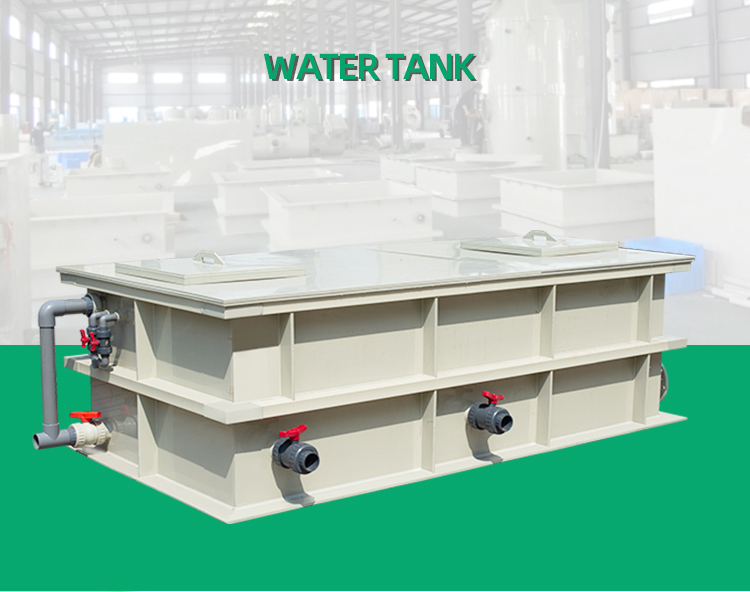
PP rectangular storage tank — the space-efficient alternative to cylindrical tanks for industrial liquid storage where floor space is constrained. A cylindrical tank wastes the corners of a rectangular room — a 2,000-liter cylindrical tank occupying a 1.5 m × 1.5 m footprint leaves four corner triangles (totaling approximately 0.6 m²) that cannot be used for anything else. A rectangular tank of the same capacity occupies the full rectangular footprint with no wasted space — and can be dimensioned to fit exactly into the available floor area, against walls, under mezzanines, or stacked in corners. Fabricated from virgin PP sheet by hot-gas extrusion welding, with capacity from 100 to 10,000 liters in any width × depth × height combination that suits your installation space.
| Application | Space-constrained liquid storage — chemical dosing day tanks, process intermediate holding, wastewater equalization, electroplating rinse water, water treatment chemical storage |
| Material | Virgin PP sheet — hot-gas welded. UV-stabilized for outdoor. PVC or FRP where PP is not chemically suitable |
| Capacity | 100-10,000 liters; custom to 50,000+ liters field-assembled |
| Dimensions | Any width × depth × height — optimized for your available floor space, not a catalog of fixed sizes |
| Wall thickness | 5-15 mm — engineered for liquid SG, tank height, and longest unsupported wall span |
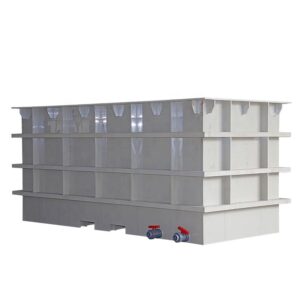
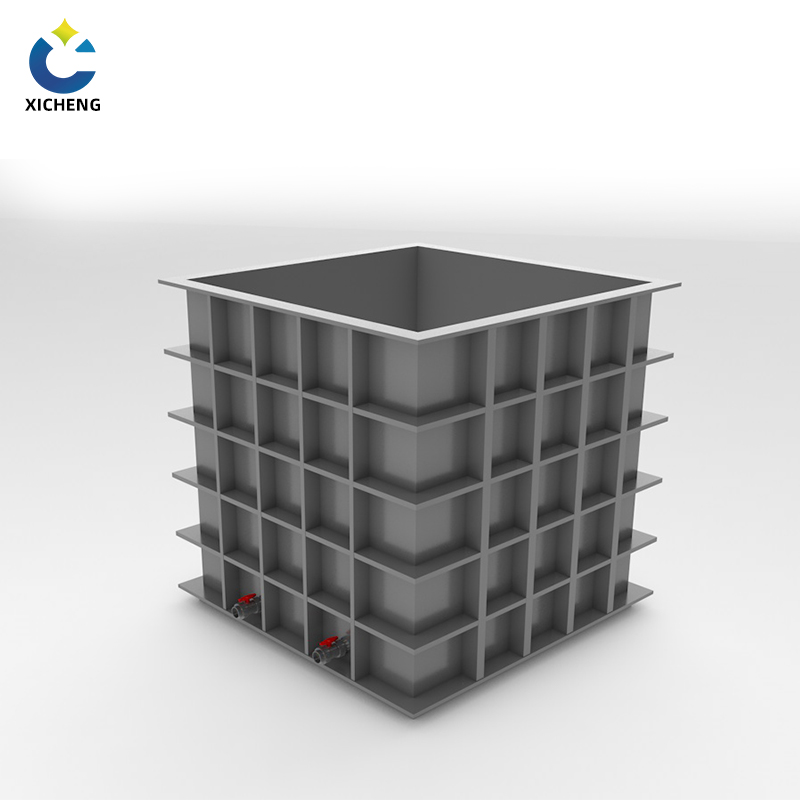
| Reinforcement | External PP rib stiffeners on walls exceeding 600 mm span — prevents wall bowing under hydrostatic pressure |
| Color | Beige / Dark Grey / White |
| Lead time | 10-20 days |
Why Rectangular: Space Efficiency vs Cylindrical Economy
Cylindrical tanks are the engineering default — the curved wall naturally resists hydrostatic pressure in pure tension (hoop stress), requiring the least material for a given volume and pressure. This is why most large storage tanks are cylindrical: material efficiency saves cost. But cylindrical efficiency assumes space is free — that the tank can occupy whatever circular footprint it needs with no constraints. In real industrial installations, space is bounded by walls, columns, equipment, and access clearances. The space efficiency of a rectangular tank — fitting exactly into the available rectangular area, using corners that a cylinder wastes — often outweighs the material efficiency advantage of a cylinder:
- Flat walls need stiffening — that’s the trade-off. A cylindrical tank wall resists hydrostatic pressure through hoop tension — the curved geometry converts liquid pressure into circumferential tensile stress in the tank wall, where PP is strong. A rectangular tank flat wall resists the same pressure through bending — the wall acts as a flat plate under a triangular distributed load (zero pressure at the top, maximum at the bottom). Without stiffening, a flat PP wall would bow outward unacceptably. External PP ribs welded vertically to the wall exterior divide the wall panel into narrower vertical strips — each strip spans between the tank bottom and the top rim as a narrower beam, dramatically reducing deflection. The ribs are external — they do not reduce the tank’s internal volume or create crevices inside the tank where debris could accumulate. This stiffening is the engineering cost of the rectangular form factor — it adds material and fabrication time compared to a cylinder, but the space savings in constrained installations justify it. Containment integrity principles align with US EPA SPCC Regulations for secondary containment and structural integrity of storage vessels in industrial service.
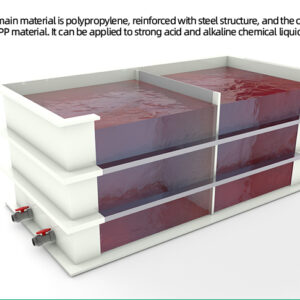
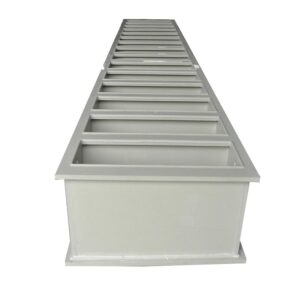
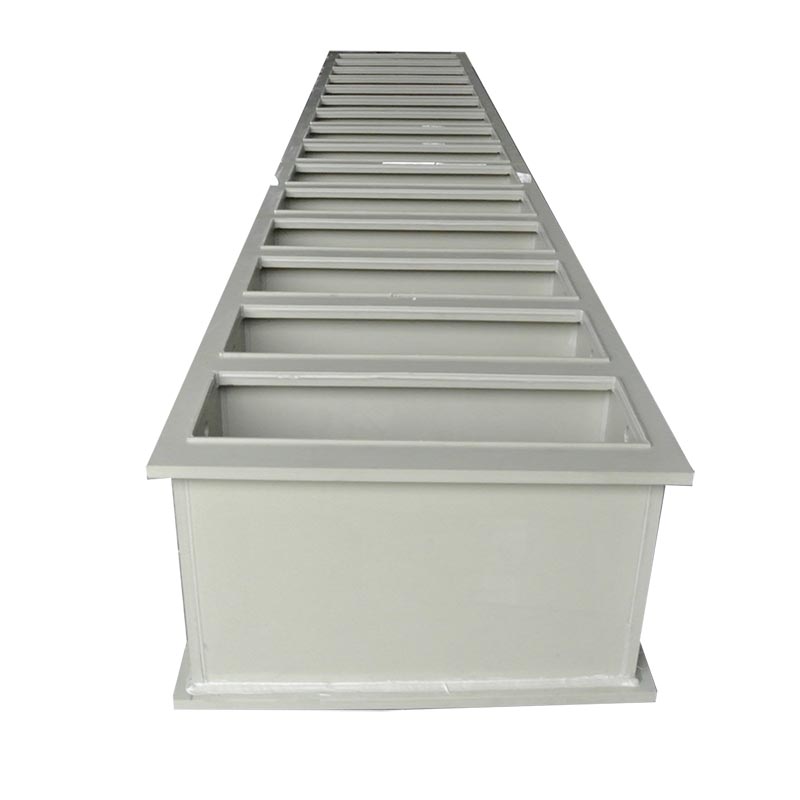
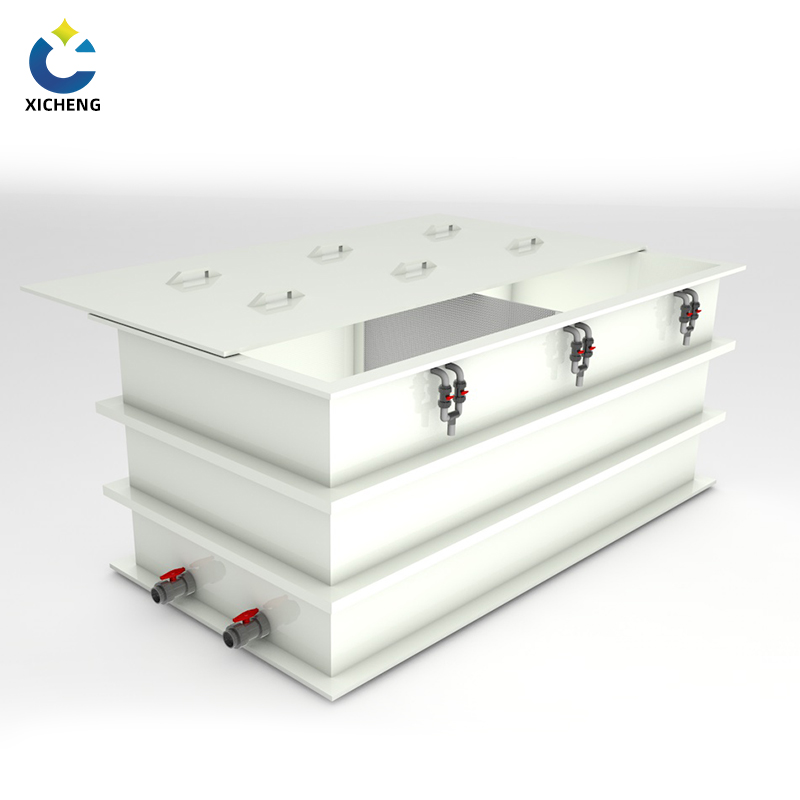
- Baffle walls — build them in, not add them later. Rectangular tanks can incorporate internal PP baffle walls during fabrication — dividing the tank into compartments, creating a serpentine flow path for increased liquid residence time, or providing structural support for the top cover. These baffles are welded into the tank during fabrication — not bolted in as afterthoughts that create crevices and leak paths. For chemical treatment tanks requiring multiple stages (neutralization, flocculation, settling), a single rectangular tank with internal baffles replaces three separate cylindrical tanks and the interconnecting pipework between them.
Why Xicheng
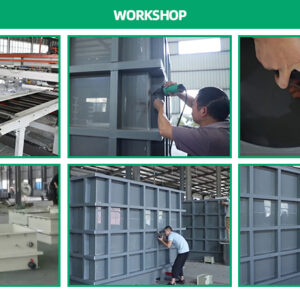
16 years, 2600+ systems shipped worldwide. Rectangular tank fabrication is more complex than cylindrical — flat walls require stiffening engineering, corner welds must handle stress concentration, and the tank must sit flat on its base without uneven support that would concentrate load on one wall:
- Rib spacing engineered, not guessed. How many ribs does a 1,200 mm wide × 1,000 mm tall tank wall need? It depends on the wall thickness, the liquid SG, and the acceptable deflection at the wall center. Our rib spacing calculation accounts for all three — ribs are placed where the engineering says they’re needed, not at a fixed spacing that might be adequate for water but inadequate for a denser liquid. For a wall holding 1,000 mm of sulfuric acid solution (SG 1.5 at 50% concentration), the hydrostatic pressure at the bottom is 14.7 kPa — 50% higher than water at the same fill height. Ribs that work for water may not work for acid.
- Corner welds — the highest-stress joints in the tank. The four vertical corner welds in a rectangular tank experience the combined loading of two adjacent walls — each wall pulls on the corner as it deflects outward under liquid pressure. The corner weld must be full-penetration through the sheet thickness with no voids — a partial weld will crack under this combined loading, and a crack at the corner propagates downward as the tank fills. Our corner welds are hot-gas extrusion welded with full penetration verified by visual inspection and, for critical tanks, dye penetrant testing.
- Flat base — requires flat support. A rectangular tank with an unevenly supported base will concentrate the total liquid weight on the high spots of the support surface — potentially overstressing the bottom sheet and causing a crack at the wall-to-base weld. Our tanks include a welded base frame or integral skid that distributes the tank weight evenly to the floor — the tank sits on its frame, not directly on the bottom sheet. This is standard on tanks above 1,000 liters or where the installation floor may not be perfectly level.
Send your available space dimensions and liquid requirements to xicheng023@outlook.com. We’ll design a tank that fits your space exactly. WhatsApp: +86 18927456906.
Core Advantages
- Fits Your Space, Not a Catalog Size: Any width × depth × height — optimized for your available floor area. No wasted corner space like cylindrical tanks.
- Externally Ribbed Flat Walls — No Internal Crevices: Stiffening ribs welded to the exterior — full internal volume usable, no debris-trapping crevices.
- Integral Baffle Walls for Multi-Stage Treatment: Divide one tank into compartments — replaces multiple separate tanks and interconnecting pipework.
- Engineered Rib Spacing Per Liquid: Calculated for your liquid density and fill height — not a one-size spacing that under-stiffens for dense liquids.
- Welded Base Frame for Even Support: Distributes tank weight — prevents point loading on the bottom sheet from uneven floors.
Key Specifications
| Material | Virgin PP sheet — hot-gas welded; PVC or FRP alternative |
| Capacity | 100-10,000 liters standard; larger field-assembled |
| Dimensions | Custom width × depth × height — engineered to your space |
| Wall Thickness | 5-15 mm — calculated for SG, height, and rib spacing |
| Wall Reinforcement | External PP ribs — spacing engineered per wall span and liquid load |
| Base | Welded PP frame or integral skid for even weight distribution |
| Baffles | Internal PP baffle walls — single tank, multiple compartments |
| Service Life | 10-15 Years |
| Brand / Origin | Xicheng / China |
Certifications and Compliance
- CE Certified – Rectangular Storage Tank
- RoHS Compliant – PP material
- ISO 9001 – Quality Management System
- ISO 14001 – Environmental Management System
- SGS Tested – PP sheet, weld integrity, hydrostatic testing
How to Order
- You send – Available floor space (width × depth), required capacity, liquid type and SG, operating temperature, fitting requirements
- We design – Tank dimensions, wall thickness, rib spacing and count, fitting placement, and pricing
- You approve – Tank drawing with all dimensions and fitting locations
- We fabricate – 10-20 days
Contact xicheng023@outlook.com or WhatsApp +86 18927456906 — design and quotation within 24 hours.
Complete Your System
- PP Water Storage Tank – Cylindrical water tanks
- PP Chemical & Acid Storage Tank – Chemical-resistant tanks
- PP Acid Pickling Tank – Pickling process tanks
- PP Industrial Pipe – Pipe for tank connections
FAQ
Rectangular or cylindrical — which tank shape should I choose?
Choose cylindrical when: space is not constrained, cost is the primary driver (less material, simpler fabrication), or the tank is outdoors with no space restrictions. Cylindrical tanks are more material-efficient for a given volume. Choose rectangular when: floor space is tight and the tank must fit against walls or in a corner, multiple tanks must be installed side-by-side (rectangular tanks pack together with no wasted interstitial space), or the tank requires internal baffles and compartments that are easier to fabricate in a rectangular shape.
How flat does the floor need to be for a rectangular tank?
Our tanks include a welded base frame that accommodates minor floor unevenness (up to 5 mm over the tank footprint). For floors with greater unevenness, a leveled concrete pad or steel support frame is recommended. The base frame distributes the tank’s filled weight evenly — the tank bottom is supported across its full area, not at discrete points. This is critical for tanks above 1,000 liters where the filled weight (1,000 kg for water at 1,000 liters, more for denser liquids) can exceed 10 tons for large units.
Can I add fittings after the tank is installed?
Yes — one advantage of fabricated PP over rotationally-molded tanks. Additional fittings can be welded in by a qualified PP welder with the tank drained and cleaned. However, it’s always more cost-effective to include all fittings in the original fabrication — field modifications cost more and may not match the quality of factory-welded fittings. Plan your fitting requirements at the design stage.