
Product Overview
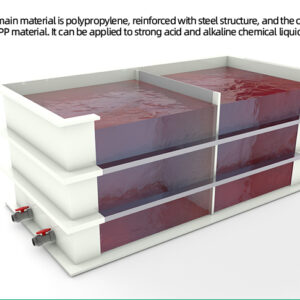
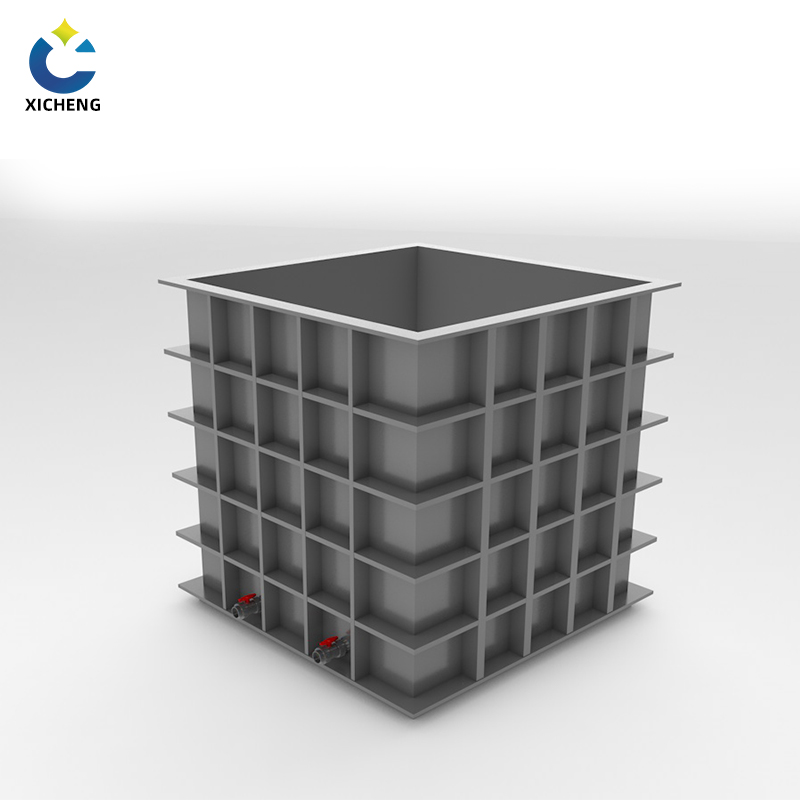
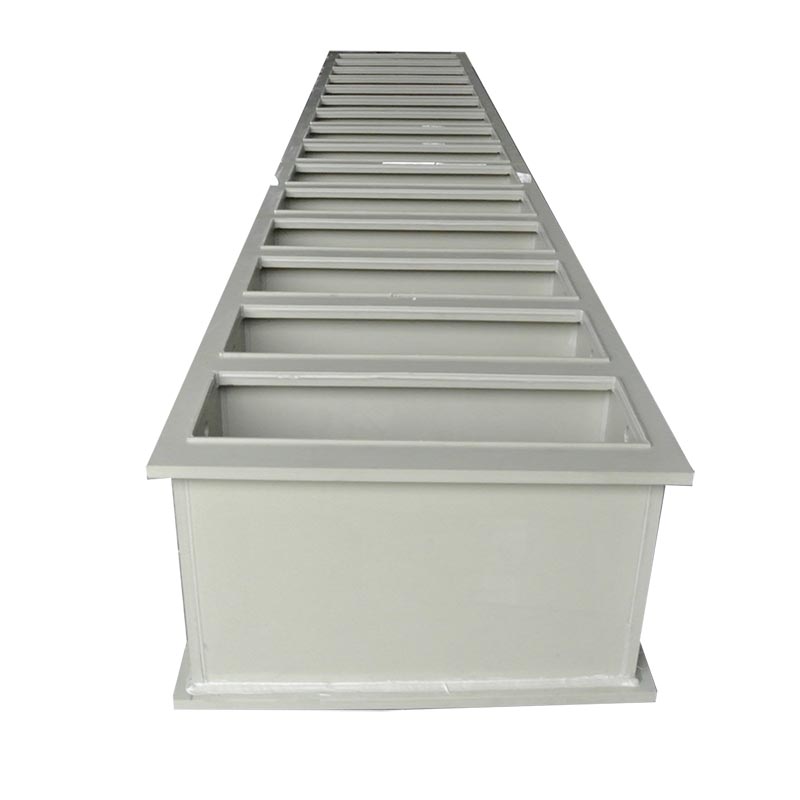
PP chemical and acid storage tank — engineered specifically for aggressive liquid chemicals where a standard water tank’s material and wall thickness would be inadequate. Unlike water storage tanks designed for specific gravity 1.0 (water) with general-purpose wall thickness, chemical storage tanks are engineered for the specific density, temperature, and corrosive characteristics of the stored liquid. Sulfuric acid at 98% concentration has SG 1.84 — nearly twice the hydrostatic load of water at the same fill height. Hydrochloric acid at 37% generates corrosive vapor in the tank headspace that attacks materials from above the liquid line. Sodium hypochlorite (bleach) decomposes over time, generating oxygen that pressurizes a sealed tank. Each chemical presents different engineering requirements — the tank design must account for all of them.
| Application | Bulk chemical storage — acids (HCl, H2SO4, HNO3, HF at moderate concentrations), alkalis (NaOH, KOH), oxidizing agents, corrosive salt solutions, water treatment chemicals |
| Material | Virgin PP (standard, ≤60degC liquid); FRP (≤120degC, higher strength); FR-PP available for specific chemical-temperature combinations |
| Capacity | 100-10,000 liters standard; custom to 50,000+ liters |
| Wall thickness | Calculated per chemical — liquid SG, temperature derating factor, and chemical compatibility verified before design |
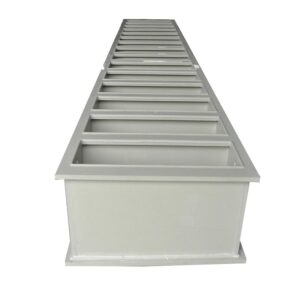
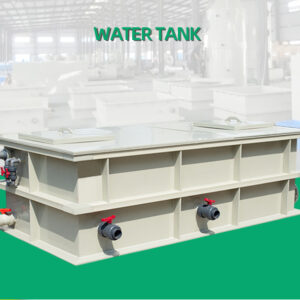
| Configuration | Cylindrical (vertical/horizontal) or rectangular; bunded (double-wall) for spill containment where required by local regulation |
| Lead time | 15-25 days |
Chemical Compatibility: The Tank Design Foundation
Every chemical tank design starts with a compatibility verification. The same PP that resists 37% HCl at 25degC may be attacked by 98% H2SO4 at 60degC — not because the PP fails, but because the combination of concentration, temperature, and chemical species exceeds PP’s chemical resistance envelope. Three factors interact:
- Chemical species and concentration. PP has excellent resistance to most mineral acids at moderate concentrations and temperatures: HCl (all concentrations to 37% at ≤60degC), H2SO4 (to 90% at ≤25degC, to 50% at ≤60degC), HNO3 (to 30% at ≤25degC), HF (to 60% at ≤25degC), NaOH (to 50% at ≤60degC), and most salt solutions. PP is NOT suitable for: concentrated oxidizing acids (fuming HNO3, H2SO4 above 90% at elevated temperature, oleum), strong oxidizers (H2O2 above 30%, perchloric acid), aromatic hydrocarbons, chlorinated solvents, or ketones. Each chemical at each concentration and temperature must be verified against established chemical resistance data — we do this before every chemical tank design.
- Temperature — the derating factor. PP’s mechanical strength decreases with increasing temperature. At 60degC, PP retains approximately 50% of its room-temperature tensile strength. A tank wall thickness calculated for 25degC service may be inadequate at 60degC — not because the chemical attacks the PP, but because the PP itself is mechanically weaker. Our wall thickness calculations apply the appropriate temperature derating factor for your specific operating temperature, with a safety factor that accounts for potential temperature excursions above normal operating conditions.
- Vapor space corrosion. The liquid-contact surfaces see one chemical environment. The vapor space above the liquid sees a different one — chemical vapors at potentially higher temperature and with condensation cycling as the tank breathes during filling and emptying. The tank roof and upper walls must resist vapor-phase corrosion that may be more aggressive than liquid-phase conditions. This is particularly important for HCl (vapor is HCl gas + water vapor, creating hydrochloric acid condensation on cool surfaces), HNO3 (NOx vapors in headspace), and sodium hypochlorite (oxygen generation from decomposition).
Why Xicheng
16 years, 2600+ systems shipped worldwide. Chemical tank fabrication requires both material expertise and welding quality — a chemically compatible material fabricated with poor welds is as dangerous as the wrong material with perfect welds:
- Chemical compatibility verified before design begins. We check every chemical in your tank against PP, PVC, FRP, and FR-PP chemical resistance databases — at your specified concentration and temperature. If PP is suitable, we proceed with design. If a specific chemical-temperature combination exceeds PP’s capability, we recommend the appropriate alternative (FRP for higher temperature, FR-PP for specific aggressive chemicals, or dual-material construction). We’d rather recommend a more expensive material than sell a tank that fails.
- Double-wall bunded construction for spill containment. Many jurisdictions require secondary containment for chemical storage tanks above a certain capacity or for specific chemical hazard classifications. Our double-wall (bunded) tanks integrate the primary tank and a secondary containment shell into a single fabricated unit — the outer shell captures 110% of the inner tank’s volume in the event of a leak. This integrated approach eliminates the need for a separate concrete bund or containment pit and simplifies site installation.
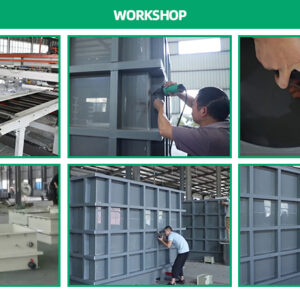
- Welded construction — no gasketed seams below the liquid line. Bolted tank construction uses gaskets at every panel joint — each gasket is a potential leak point that ages, hardens, and eventually fails. Our welded PP tanks have continuous fused seams — no gaskets in contact with stored liquid. The only gasketed connections are at the flanged fittings (inlet, outlet, drain) — and those gaskets are chemically compatible (EPDM, FKM, or PTFE) and accessible for replacement without draining the tank.
Send your chemical inventory — all chemicals, concentrations, and temperatures — to xicheng023@outlook.com. We’ll verify compatibility and design the tank. WhatsApp: +86 18927456906.
Core Advantages
- Chemical Compatibility Verified Per Order: Every chemical at its concentration and temperature checked against material resistance data before design — not a generic chemical-resistant claim.
- Wall Thickness Calculated for YOUR Chemical: Specific gravity, temperature derating, and safety factor applied per your liquid — not a one-size-fits-all standard.
- Double-Wall Bunded Option: Integrated secondary containment with 110% capacity — built-in spill protection without external bund construction.
- Welded Seams — No Gaskets Below Liquid Line: Continuous fused PP joints. Only flanged fittings have gaskets — and those are accessible for replacement.
- Material Alternatives When PP Is Not Enough: FRP for high temperature, FR-PP for aggressive chemistry — we recommend the right material, not just the material we stock.
Key Specifications
| Material | Virgin PP (standard); FRP (high temp); FR-PP (aggressive chemistry) — material verified per chemical |
| Capacity | 100-10,000 liters standard; custom to 50,000+ liters |
| Configuration | Cylindrical or rectangular; single-wall or double-wall bunded |
| Wall Thickness | Engineered per SG and temperature — chemical-specific calculation |
| Liquid Temperature | PP: ≤60degC continuous; FRP: ≤120degC |
| Liquid SG Range | 1.0-2.0 — verified per application |
| Fittings | Flanged inlet/outlet/drain/vent; level indication; inspection hatch |
| Service Life | 10-15 Years (chemically compatible service) |
| Brand / Origin | Xicheng / China |
Certifications and Compliance
- CE Certified – Chemical Storage Tank
- RoHS Compliant – PP material
- ISO 9001 – Quality Management System
- ISO 14001 – Environmental Management System
- SGS Tested – PP chemical resistance, weld integrity, hydrostatic pressure testing
- Design Compliance – Tanks designed to meet applicable chemical storage regulations and EU Industrial Emissions Directive (2010/75/EU) requirements for chemical containment
How to Order
- You send – Complete chemical list (species, concentration, temperature), required capacity, fitting requirements, bunded or single-wall
- We verify – Chemical compatibility with PP/FRP/FR-PP at your conditions. If PP is not suitable, we’ll recommend alternatives
- We design – Tank configuration, wall thickness (SG + temperature derated), fitting placement, and pricing
- You approve – Tank drawing, chemical compatibility report, and delivery schedule
- We fabricate – 15-25 days. Welds inspected, tank hydrostatically tested
Contact xicheng023@outlook.com or WhatsApp +86 18927456906 — chemical compatibility check and quotation within 24 hours.
Complete Your System
- PP Water Storage Tank – General water and non-aggressive liquid storage
- PP Acid Pickling Tank – Pickling process tanks for metal surface treatment
- PP Electroplating Tank – Electroplating and anodizing tanks
- PP Industrial Pipe – Chemical-rated pipe for tank connections
FAQ
How do I know if PP is compatible with my chemical?
Send us the complete list: chemical name, concentration (%), and operating temperature. We check against established PP chemical resistance databases. Most mineral acids at moderate concentration and temperature are compatible. Strong oxidizers, aromatic solvents, and chlorinated hydrocarbons are not. If PP is not suitable, we’ll tell you and recommend FRP or FR-PP. This compatibility check is done before every chemical tank order — it’s part of our standard design process, not an extra service.
Do I need a double-wall (bunded) tank?
It depends on your local regulations and the chemical hazard classification. Many jurisdictions require secondary containment for: tanks above a certain capacity (typically 1,000-5,000 liters, varying by location), chemicals classified as hazardous to the environment, or tanks installed in environmentally sensitive areas (above aquifers, near watercourses). Check your local environmental regulations. Our double-wall tanks provide integrated secondary containment that satisfies these requirements without external bund construction.
Can the tank handle chemical mixtures?
Chemical mixtures require special attention — the mixture may have different compatibility than any individual component. For example, a mixture of HCl and HNO3 (aqua regia, commonly used in metal digestion) is more aggressive than either acid alone because the combination generates free chlorine and nitrosyl chloride. Send us the complete mixture composition and we’ll verify compatibility. Do not assume that because PP resists each chemical individually, it will resist the mixture.