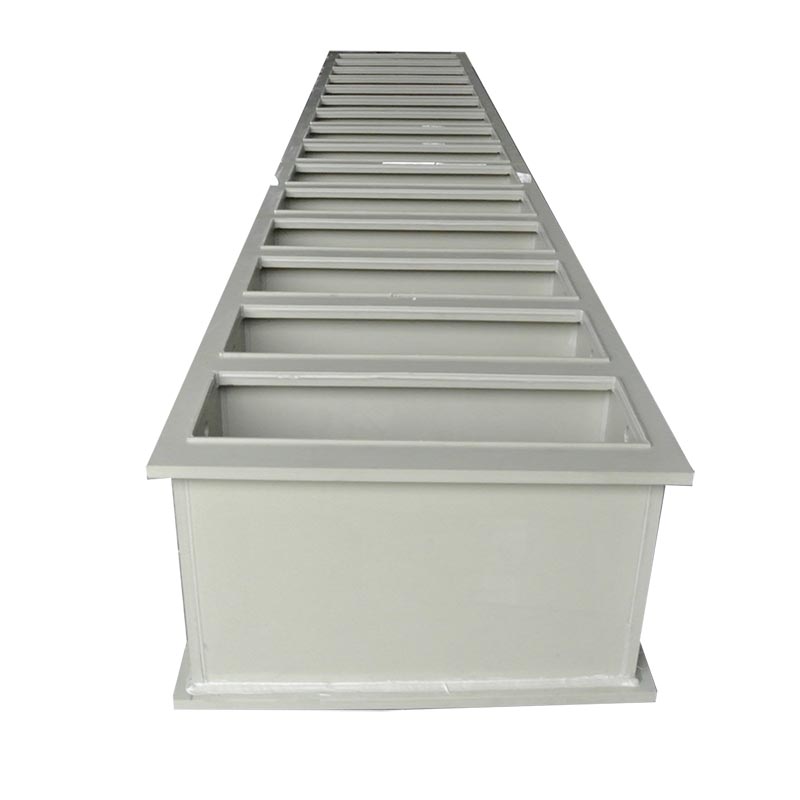


Product Overview
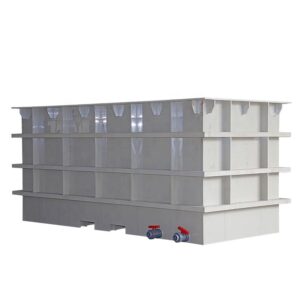
PP electroplating tank for industrial electroplating, anodizing, and electroless plating process lines — designed to contain plating solutions (acid copper, nickel sulfamate, chrome, zinc, tin, electroless nickel, and anodizing electrolytes) at controlled operating temperatures with resistance to both the chemical bath chemistry and the stray electrical currents inherent in electroplating operations. Unlike a general storage tank, an electroplating tank must accommodate: anode and cathode bus bars spanning the tank, work-piece fixturing and agitation systems, solution heating or cooling equipment, and continuous chemical attack from the plating electrolyte at process temperature. PP provides the broad chemical resistance and electrical insulation required for multi-process plating lines where different tanks in the same line contain different chemistries at different temperatures.
| Application | Electroplating process tanks — acid copper, nickel (Watts, sulfamate), chrome (hexavalent, trivalent), zinc (acid, alkaline), tin, electroless nickel, anodizing (sulfuric, chromic, hardcoat), electroforming |
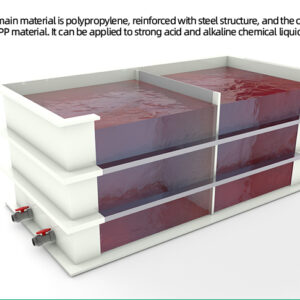
| Material | Virgin PP sheet — hot-gas welded. PP resists all common plating electrolytes at process temperature to 60degC |
| Capacity | 50-5,000 liters standard; larger custom. Sized for your workpiece dimensions, rack size, and production throughput |
| Temperature | PP: ≤60degC (acid copper, nickel, zinc, tin, anodizing). FRP or FR-PP for high-temp processes (hard chrome 50-60degC, some electroless nickel 85-95degC — above PP limit) |
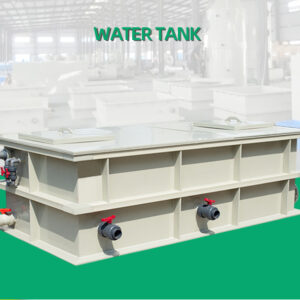
| Configuration | Open-top rectangular — anode/cathode bus bar supports, agitation manifold connections, heating/cooling coil interfaces |
| Key features | Reinforced top rim for bus bar support; internal weir for overflow to filtration; sloped bottom to drain |
| Lead time | 15-25 days |
Electroplating Tank Requirements: Beyond Chemical Storage
A plating tank is a process vessel, not a storage container. It contains a chemically aggressive solution at controlled temperature while workpieces hang from overhead bus bars, air or mechanical agitation mixes the bath, filtration continuously removes particulates, and DC current passes from anodes through the solution to the workpieces. Each function places demands on the tank beyond simple liquid containment:
- Bus bar support — electrical and mechanical load. Copper bus bars spanning the tank carry DC current (typically 100-1,000+ amps depending on tank size and process) to the anodes and workpieces. The bus bars are heavy (copper at 8.96 g/cm³) and must be supported without sagging into the bath. Our tanks include reinforced top rims with PP-insulated bus bar support blocks — the insulation prevents the copper bus bar from contacting the tank wall (which would create a short circuit path through any conductive contamination on the tank wall surface). The support blocks are replaceable — if bus bar corrosion damages a support, it’s replaced without modifying the tank.
- Solution agitation — air sparging or eductor circulation. Plating solutions require continuous agitation to maintain uniform temperature and concentration at the workpiece surface. Air sparging (compressed air injected through PP pipes at the tank bottom) is the simplest method — our tanks include integral PP sparge headers along the tank bottom with evenly spaced discharge holes. Mechanical agitation using submerged educators circulating solution through external pumps and filters provides higher flow rates for high-current-density processes — we include flanged connections for educator supply and return piping.
- Temperature control — heating AND cooling. Most plating processes operate at elevated temperature (nickel 50-60degC, chrome 45-55degC, copper 20-30degC). Some generate more heat from the plating current than they need — chrome plating at high current density actually requires cooling to maintain temperature within range. Our tanks accommodate: PTFE or PVDF immersion heating coils (chemical-resistant, electrically non-conductive), PP or PVDF cooling coils for heat-removal processes, or external heat exchanger circulation loops. The coil mounting brackets are welded into the tank during fabrication — not drilled and bolted as a field modification.
- Filtration overflow weir. Continuous filtration removes particulate and precipitated metal compounds from the plating solution. A weir — an internal baffle near the tank top that creates a separate compartment — allows solution to overflow from the main tank into the weir compartment, from which it’s pumped through a filter and returned to the tank. This surface-skimming action also removes oils and floating contaminants. Our tanks include an integral weir fabricated as part of the tank body — not a separate bolted-in insert that creates a dead zone and leak path behind it.
Why Xicheng
16 years, 2600+ systems shipped worldwide. Electroplating tanks operate in the harshest combined environment of any industrial tank application: aggressive chemistry + elevated temperature + electrical current + continuous production. A failure shuts down the plating line until the tank is replaced — and draining, decontaminating, and replacing a process tank can take days to weeks:
- Multi-process experience across plating chemistries. We’ve fabricated plating tanks for: acid copper (bright and semi-bright decorative, printed circuit board through-hole), nickel (Watts bath for decorative and engineering, sulfamate for electroforming), hexavalent and trivalent chrome (decorative and hard chrome), acid and alkaline zinc (rack and barrel), electroless nickel (high-phosphorus, mid-phosphorus), sulfuric acid anodizing (Type II and Type III hardcoat), and chromic acid anodizing. Each process has different temperature, agitation, and tank configuration requirements — we design accordingly.
- PP — electrically non-conductive, chemically resistant. Steel tanks in electroplating service require a non-conductive lining (PVC, PVDF, or rubber) to prevent the tank from becoming part of the electrical circuit — stray current through a steel tank wall causes rapid corrosion at the point where current leaves the tank. A solid PP tank is inherently non-conductive — no lining required, no stray current corrosion path, no risk of lining failure causing a short circuit that shuts down the plating rectifier. PP also provides chemical resistance to the plating solution — the same material provides both electrical insulation and chemical containment.
- Temperature limits — and when PP is not enough. PP handles most plating process temperatures: acid copper (20-30degC), most nickel (50-60degC), chrome (45-55degC), zinc (20-40degC), tin (20-30degC), anodizing (15-22degC for Type II, 0-5degC for Type III hardcoat). FRP handles higher temperatures: some electroless nickel formulations operate at 85-95degC — above PP’s 60degC continuous limit. If your process temperature exceeds PP’s capability, we’ll specify FRP instead. We track the temperature limits of each material and won’t sell PP into an application it can’t handle.
Send your plating process details to xicheng023@outlook.com. We’ll design the tank for your specific chemistry, temperature, and production configuration. WhatsApp: +86 18927456906.
Core Advantages
- PP — Chemical Resistant AND Electrically Non-Conductive: No lining needed, no stray current corrosion, no short-circuit risk. One material does both jobs.
- Built for Process, Not Just Storage: Bus bar supports, agitation headers, heating/cooling coil mounts, filtration weir — all integrated during fabrication.
- Replaceable Bus Bar Support Blocks: PP-insulated, field-replaceable — damaged support replaced without tank modification.
- Material Temperature Verification: PP for ≤60degC (most plating). FRP recommendation when your process temperature exceeds PP’s limit.
- Integral Overflow Weir for Filtration: Fabricted into the tank body — no bolted-in inserts, no hidden dead zones.
Key Specifications
| Material | Virgin PP sheet — hot-gas welded. FRP for high-temp processes |
| Plating Processes | Acid Cu, Ni (Watts/sulfamate), Cr (hex/trivalent), Zn (acid/alkaline), Sn, electroless Ni, anodizing |
| Capacity | 50-5,000 liters standard; larger custom |
| Temperature | PP: ≤60degC; FRP: ≤95degC |
| Configuration | Open-top rectangular; bus bar supports on top rim; integral weir; sloped bottom to drain |
| Agitation | Integral PP air sparge headers or educator circulation connections |
| Heating/Cooling | Coil mounting brackets — PTFE/PVDF immersion coils or external circulation |
| Service Life | 8-12 Years (chemistry and temperature dependent) |
| Brand / Origin | Xicheng / China |
Certifications and Compliance
- CE Certified – Electroplating Tank
- RoHS Compliant – PP material
- ISO 9001 – Quality Management System
- ISO 14001 – Environmental Management System
- SGS Tested – PP chemical resistance, weld integrity, electrical insulation properties
- Design Compliance – Tanks designed to meet EU Industrial Emissions Directive (2010/75/EU) surface treatment requirements
How to Order
- You send – Plating process and chemistry, operating temperature, workpiece dimensions and rack size, required bath volume, bus bar configuration, agitation and filtration requirements, heating/cooling needs
- We verify – PP compatibility with your plating chemistry at process temperature
- We design – Tank dimensions, reinforcement, bus bar support layout, agitation headers, weir, heating/cooling interfaces, and pricing
- You approve – Tank drawing, specification, and delivery schedule
- We fabricate – 15-25 days
Contact xicheng023@outlook.com or WhatsApp +86 18927456906 — design and quotation within 24 hours.
Complete Your System
- PP Acid Pickling Tank – Pre-plating pickling and surface activation
- PP Chemical & Acid Storage Tank – Bulk chemical storage for plating bath make-up
- Wet Scrubber System – Plating line exhaust scrubbing
- PP Round Duct – Corrosion-resistant exhaust ductwork
FAQ
Can PP tanks handle chrome plating solutions?
PP handles hexavalent chrome (CrO3 250-400 g/L + H2SO4 catalyst) at the standard operating temperature of 45-55degC — this is within PP’s chemical resistance and temperature envelope. PP also handles trivalent chrome solutions. The primary concern with chrome tanks is not the solution chemistry but the temperature control — chrome plating at high current density generates significant heat, and the tank must accommodate cooling coils to prevent the bath from exceeding PP’s temperature limit. We include cooling coil interfaces as standard on chrome tank designs.
Do I need different tanks for different plating processes on the same line?
Typically yes — each process step has its own dedicated tank. A typical decorative chrome plating line has: cleaning tank, acid pickling tank (separate from the cleaning tank — different chemistry), rinse tanks (multiple counter-flow stages), nickel plating tank, chrome plating tank, and final rinse tanks. A total of 8-12 tanks in the line. PP is suitable for all of these except possibly the nickel tank if your nickel process operates above 60degC — in which case FRP is required for the nickel tank specifically. We can fabricate all tanks for a complete plating line — each tank designed for its specific process chemistry and temperature.
How do you prevent the tank from becoming part of the electrical circuit?
PP is inherently non-conductive — unlike a steel tank that requires a lining to provide electrical isolation, PP itself is the insulator. The plating current flows from the anode bus bar → anodes → plating solution → workpieces → cathode bus bar → rectifier. The tank wall is not part of this circuit because PP does not conduct electricity. This is a fundamental advantage of PP over lined steel — if the lining on a steel tank develops a pinhole, current can flow from the solution through the pinhole to the steel wall, causing rapid corrosion at that point. PP has no such failure mode.