Product Overview
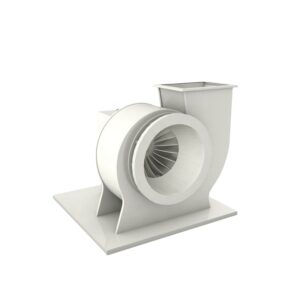
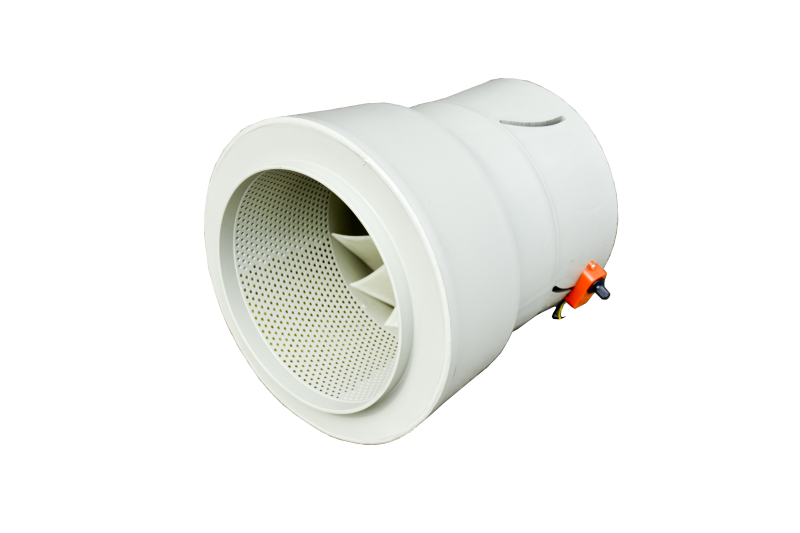
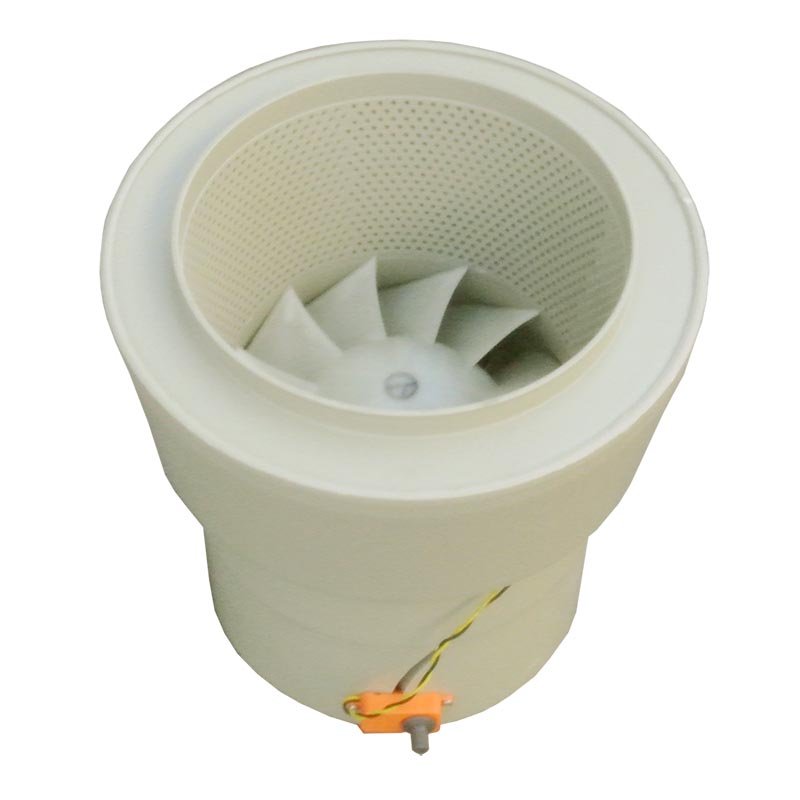
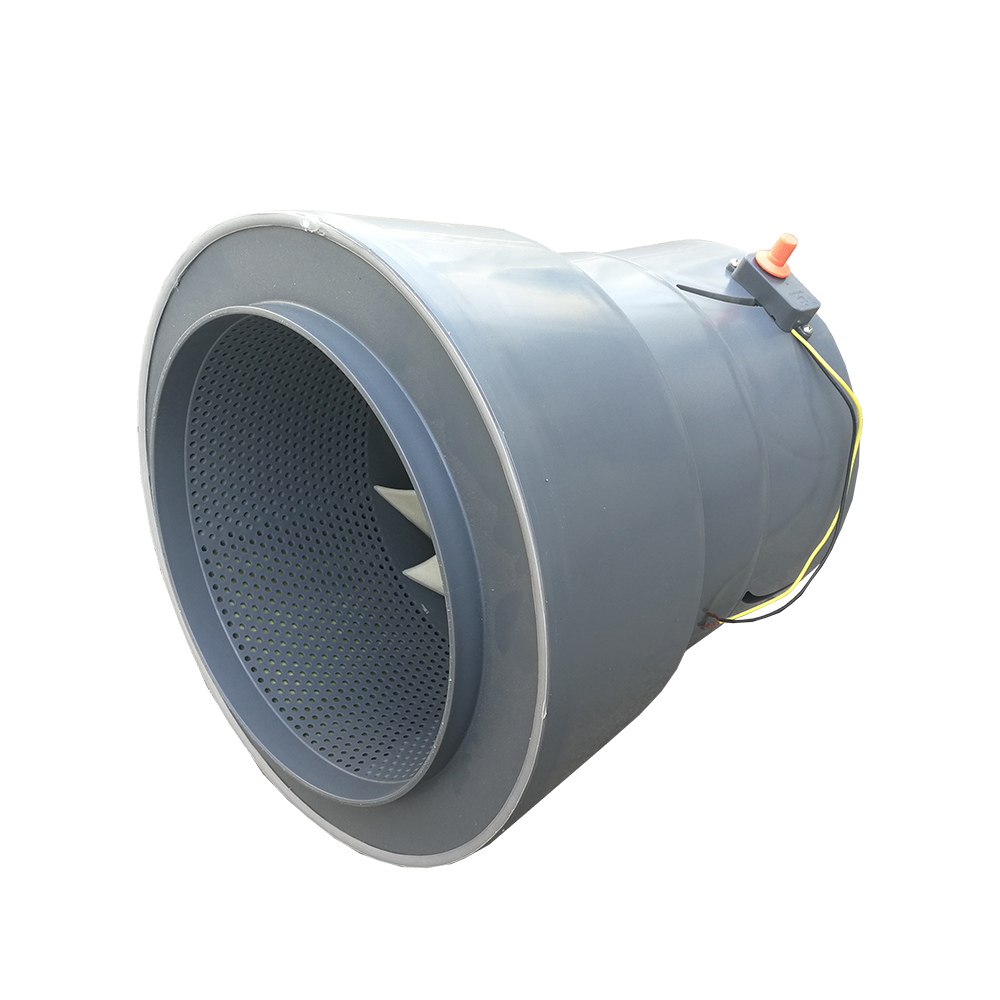
PP/FRP diagonal (mixed-flow) fan — combining the compact straight-through layout of an axial fan with the pressure-developing capability approaching that of a centrifugal fan. Air enters axially and exits at an angle — typically 45 degrees — providing a balance of volume and pressure that neither a pure axial nor a pure centrifugal fan can achieve in the same physical envelope. The diagonal impeller has a conical hub with blades that are three-dimensionally curved — a more complex shape than either axial blades or centrifugal backward-curved blades. This geometry accelerates the air both axially and radially in a single impeller stage, developing 300-800 Pa at volumes to 30,000 m³/h in a casing not much larger than an equivalent-diameter axial fan. For installations where space is constrained but system resistance exceeds axial fan capability, the diagonal fan is the engineering solution.
| Application | Intermediate-pressure ventilation — roof-mounted exhaust, ducted systems with moderate resistance, space-constrained mechanical rooms where a centrifugal volute won’t fit, retrofit replacing under-performing axial fans |
| Material | PP casing + PP impeller (≤60degC); FRP casing + FRP impeller (≤80degC) |
| Pressure range | 300-800 Pa — between axial (50-300 Pa) and centrifugal (500-2,500 Pa) |
| Air volume | 2,000-30,000 m³/h standard |
| Diameter range | DN250-DN800 standard; larger custom |
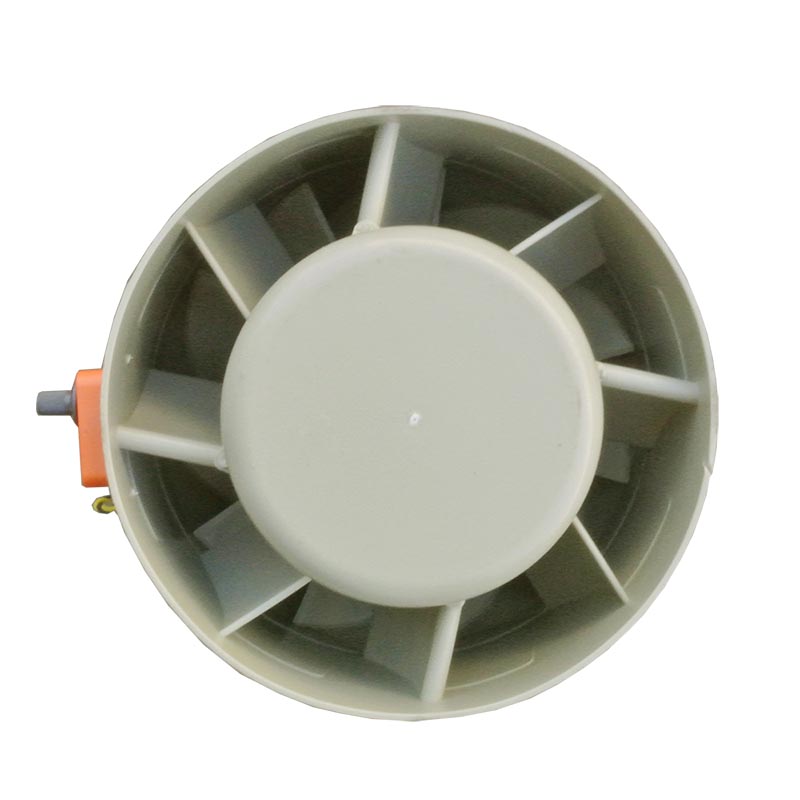
| Impeller | One-piece injection-molded PP conical hub with 3D-curved diagonal blades; G6.3 balanced |
| Flow path | Axial inlet → diagonal impeller → mixed-flow outlet (typically 45deg). Straight-through casing — no volute, compact footprint. |
| Lead time | 15-25 days |
Diagonal Flow: The Engineering Middle Ground
An axial fan moves air straight through at high volume but low pressure — when system resistance exceeds 200-300 Pa, the axial fan stalls. A centrifugal fan develops high pressure but requires a volute that makes the overall machine footprint significantly larger than the duct diameter — in a tight mechanical room, the volute takes space that doesn’t exist. The diagonal fan fills the gap between them:
- How it works — the geometry difference. In an axial fan, the blades are essentially rotating wings — they impart momentum to the air in the axial direction, with little radial component. In a centrifugal fan, the blades throw air radially outward by centrifugal force — high pressure but a 90-degree direction change and a large volute. In a diagonal fan, the impeller hub is conical (not cylindrical like an axial, not flat like a centrifugal backplate) and the blades curve in three dimensions. Air enters axially, is accelerated both axially and radially by the conical hub and 3D blade geometry, and exits at approximately 45 degrees — hence “diagonal” or “mixed” flow. The result: 300-800 Pa pressure development (2-3× an axial fan) in a straight-through casing not much larger than the duct diameter.
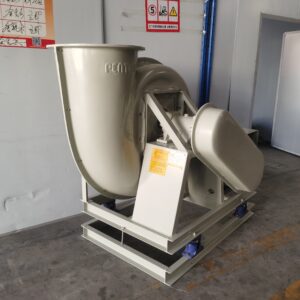
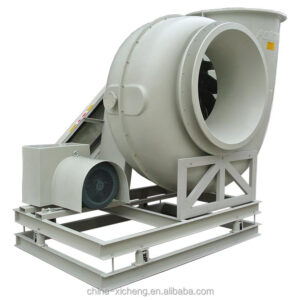
- No volute = smaller footprint. The centrifugal fan’s volute is essential for pressure recovery — but it makes the fan 2-3× wider than the duct diameter in one dimension. A diagonal fan fits in-line with the duct, like an axial fan — the casing is essentially a cylindrical tube with the motor and impeller inside. For a mechanical room where a centrifugal fan’s volute would interfere with adjacent equipment, pipe runs, or access clearance, the diagonal fan fits the same space as the duct itself.
- Efficiency — between axial and centrifugal. Axial fans achieve 70-80% static efficiency in their design range. Centrifugal fans (F4-72 profile) achieve 80-85%. Diagonal fans achieve 75-82% — better than axial, approaching centrifugal, in a package closer to axial size. The efficiency gap to centrifugal narrows at the upper end of the diagonal fan’s pressure range (600-800 Pa), making it a genuine alternative to a small centrifugal fan when space is the primary constraint.
Diagonal Fan Applications: Fill the Gap
| Application | Why Diagonal | Alternative (and why it’s worse) |
|---|---|---|
| Rooftop laboratory exhaust | 500 Pa system resistance from duct riser + scrubber. Roof space is limited — centrifugal volute requires more structural support. Diagonal fits the riser footprint. | Axial: insufficient pressure. Centrifugal: works but larger footprint on roof, heavier, more structural steel. |
| Underground parking ventilation (corrosive environment) | 300-400 Pa from duct friction. Diagonal provides pressure margin that axial lacks, in the duct’s own diameter for simple in-line installation. | Axial: marginal at 400 Pa — operating near stall, high noise. Centrifugal: oversized for the pressure requirement. |
| Retrofit replacing under-performing axial fan | Existing duct is sized for axial fan diameter. System resistance was underestimated — axial fan stalls. Diagonal fan fits the same duct diameter, same flange pattern, develops required pressure. No duct modification. | Centrifugal: requires duct modification (add 90-degree inlet transition, volute outlet adapter). More expensive than the fan alone. |
| Compact scrubber-fan package | Integrated treatment unit with fan mounted directly on scrubber outlet — diagonal fan’s compact footprint fits the package envelope. | Centrifugal: volute extends beyond package frame, complicates shipping and installation. |
Why Xicheng
16 years, 2600+ systems shipped worldwide. The diagonal impeller is the most complex fan impeller geometry to manufacture — the 3D blade curvature and conical hub require mold design sophistication beyond axial or centrifugal impellers. Getting it right means a fan that performs as designed; getting it wrong means a fan that under-performs and was expensive to produce:
- One-piece injection-molded diagonal impeller. The conical hub and 3D-curved blades are formed as a single injection-molded piece in reinforced PP. The mold is precision-machined to produce the exact 3D blade geometry that computational fluid dynamics (CFD) optimization predicted — every blade on every impeller is identical to the design geometry. Fabricated diagonal impellers (sheet metal or welded plastic) cannot reproduce the 3D blade curvature with sufficient accuracy — the performance penalty of approximated geometry typically costs 5-10 percentage points of efficiency.
- Guide vane diffuser for pressure recovery. The diagonal discharge flow — at approximately 45 degrees with both axial and radial velocity components — requires a diffuser section downstream of the impeller to convert the mixed-flow kinetic energy to static pressure. Our stationary guide vane ring straightens the flow while recovering pressure — without it, the 45-degree discharge swirl dissipates as turbulence in the downstream duct, losing the pressure energy that the impeller worked to create. The guide vane geometry is matched to the impeller’s discharge flow angle for maximum recovery.
- Diagonal fan for the right application — not sold where centrifugal is better. Diagonal fans are not a universal replacement for either axial or centrifugal. They are the correct choice in a specific performance band: 300-800 Pa at moderate volume. Below 300 Pa, an axial fan is simpler and cheaper. Above 800 Pa, a centrifugal fan is more efficient. We’ll tell you if your application falls outside the diagonal fan’s sweet spot and recommend the right machine — whether we sell it or not. For the full fan range: PP/FRP Axial Flow Fan for low pressure, PP Centrifugal Fan for standard duty, PP/FRP Centrifugal Blower for high pressure.
Send your system requirements to xicheng023@outlook.com. We’ll verify the diagonal fan is the correct machine for your application and provide a performance curve. WhatsApp: +86 18927456906.
Core Advantages
- Axial Compactness + Centrifugal Pressure: Fits in-line with duct like an axial fan, develops 300-800 Pa approaching centrifugal performance — in the same duct diameter.
- One-Piece 3D Injection-Molded Impeller: Conical hub with three-dimensionally curved blades — CFD-optimized geometry reproduced exactly in every impeller via precision mold.
- No Volute, No 90-Degree Turn: Straight-through casing eliminates the volute footprint, 90-degree duct transitions, and structural support complexity of centrifugal installations.
- Guide Vane Diffuser for Pressure Recovery: Stationary downstream vanes matched to impeller discharge angle — converts mixed-flow swirl to static pressure.
- Retrofit-Compatible with Axial Fan Ductwork: Same diameter, same flange pattern, same straight-through layout — replace an under-performing axial fan without duct modification.
Key Specifications
| Model No. | XC-5D |
| Material | PP casing + PP impeller (≤60degC); FRP casing + FRP impeller (≤80degC) |
| Type | Diagonal / mixed-flow — axial inlet, 45-degree discharge, in-line casing |
| Pressure Range | 300-800 Pa |
| Air Volume | 2,000-30,000 m³/h standard |
| Diameter Range | DN250-DN800 standard; larger custom |
| Impeller | One-piece injection-molded PP, conical hub, 3D-curved diagonal blades, G6.3 balanced |
| Diffuser | Stationary guide vane ring — pressure recovery from mixed-flow discharge |
| Drive | Direct drive (standard); belt drive for motor external to airstream |
| Motor Speed | 1,440 or 2,900 RPM |
| Gas Temperature | PP: ≤60degC; FRP: ≤80degC |
| Service Life | 8-10 Years |
| Brand / Origin | Xicheng / China |
Certifications and Compliance
- CE Certified – Diagonal Flow Fan
- RoHS Compliant – PP and FRP materials
- ISO 9001 – Quality Management System
- ISO 14001 – Environmental Management System
- SGS Tested – PP impeller, FRP properties, G6.3 balance, performance curve verification
- Design Compliance – Fan designed to meet EU Industrial Emissions Directive (2010/75/EU); impeller per ISO 1940 G6.3
How to Order
- You send – Air volume, system resistance, duct diameter, gas composition and temperature, space constraints (if any)
- We verify – Whether diagonal, axial, or centrifugal is the correct machine for your conditions
- We select – Fan diameter, impeller configuration, motor specification, diffuser arrangement
- You approve – Fan curve, motor specification, and pricing
- We build – 15-25 days. Impeller balanced, fan assembled, performance-tested
Contact xicheng023@outlook.com or WhatsApp +86 18927456906 — application review and fan selection within 24 hours.
Complete Your System
- PP/FRP Axial Flow Fan – Low-pressure, high-volume straight-through fan
- PP Centrifugal Fan – Standard centrifugal for ducted exhaust
- PP/FRP Centrifugal Blower – High-pressure blower for demanding systems
- PP Round Duct – Matching corrosion-resistant ductwork
FAQ
Diagonal, axial, or centrifugal — which fan type for my application?
Under 300 Pa system resistance: axial fan — simplest, most compact, lowest cost. 300-800 Pa: diagonal fan — fits the space of an axial, develops the pressure approaching a centrifugal. Above 800 Pa: centrifugal fan or blower — most efficient at higher pressures. Space-constrained installations in the 300-800 Pa range are the diagonal fan’s sweet spot. Send us your system details for a definitive recommendation.
Can a diagonal fan replace an existing axial fan without duct modification?
Yes — this is a common retrofit application. The diagonal fan’s casing diameter matches standard duct diameters (DN250-DN800), and the flange pattern can be matched to your existing duct flanges. The fan fits in the same axial length as the original axial fan (plus the diffuser section, typically 1-2 duct diameters). No 90-degree transitions, no enlarged footprint — the diagonal fan slots into the existing duct run. The motor electrical supply may need upgrading — the diagonal fan typically draws more power than an equivalent-diameter axial fan because it’s doing more pressure work.
Why is the impeller so complex to manufacture?
The three-dimensional blade curvature on a conical hub cannot be produced by bending flat sheet material — the geometry is doubly curved. An injection mold is the only production method that can reproduce this geometry accurately and consistently. The mold cost is higher than for an axial or centrifugal impeller mold, which is why diagonal fans are typically more expensive than axial fans of the same diameter. The performance benefit — axial compactness with centrifugal-like pressure — justifies the cost in the right applications.