
Product Overview
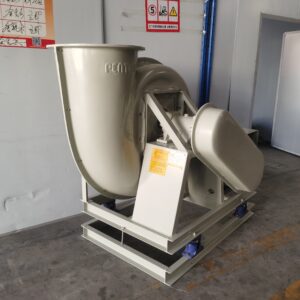
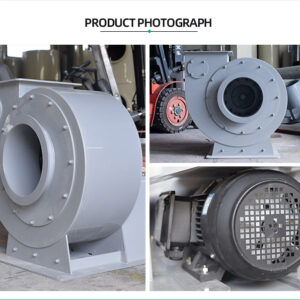
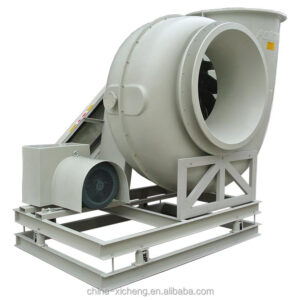
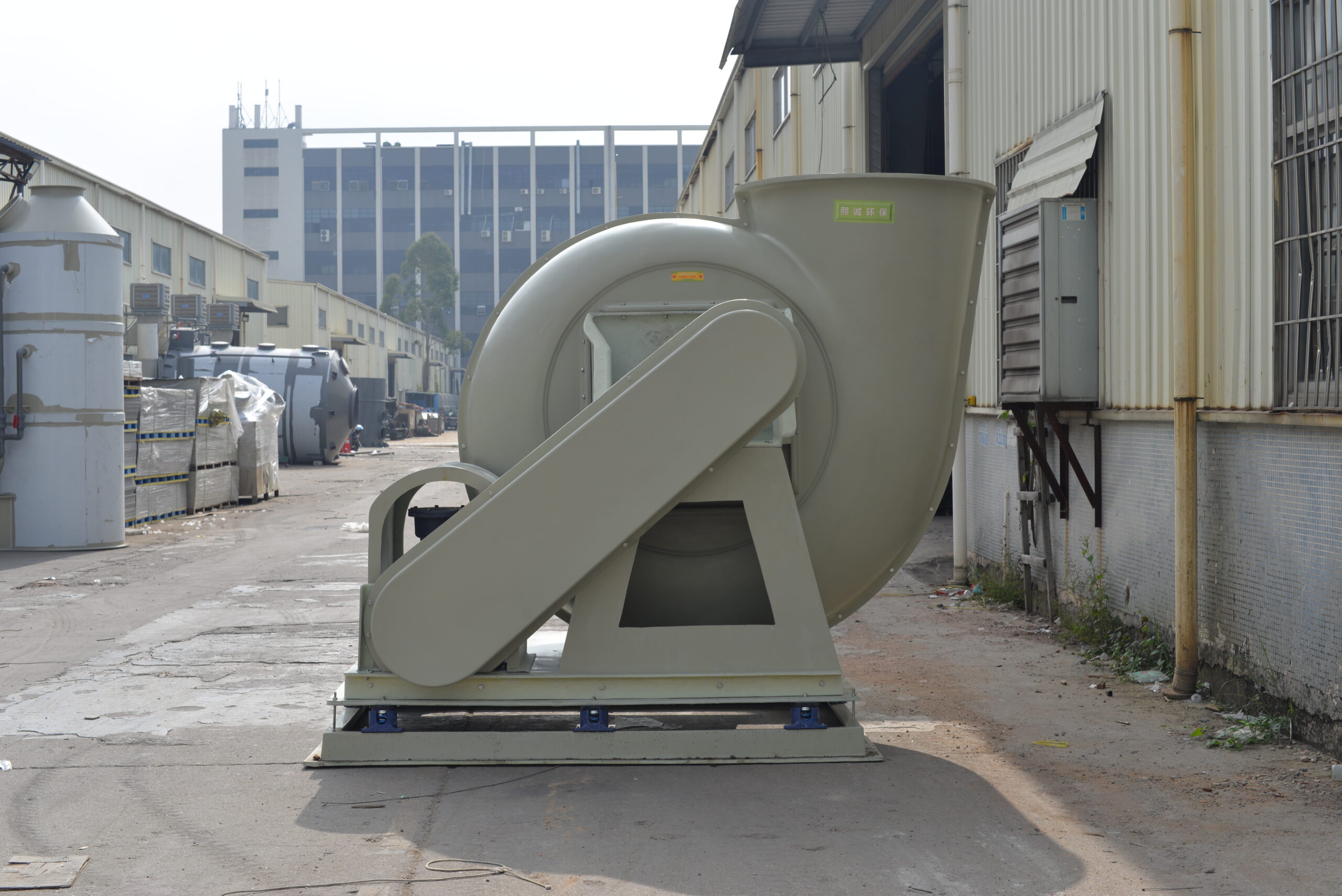
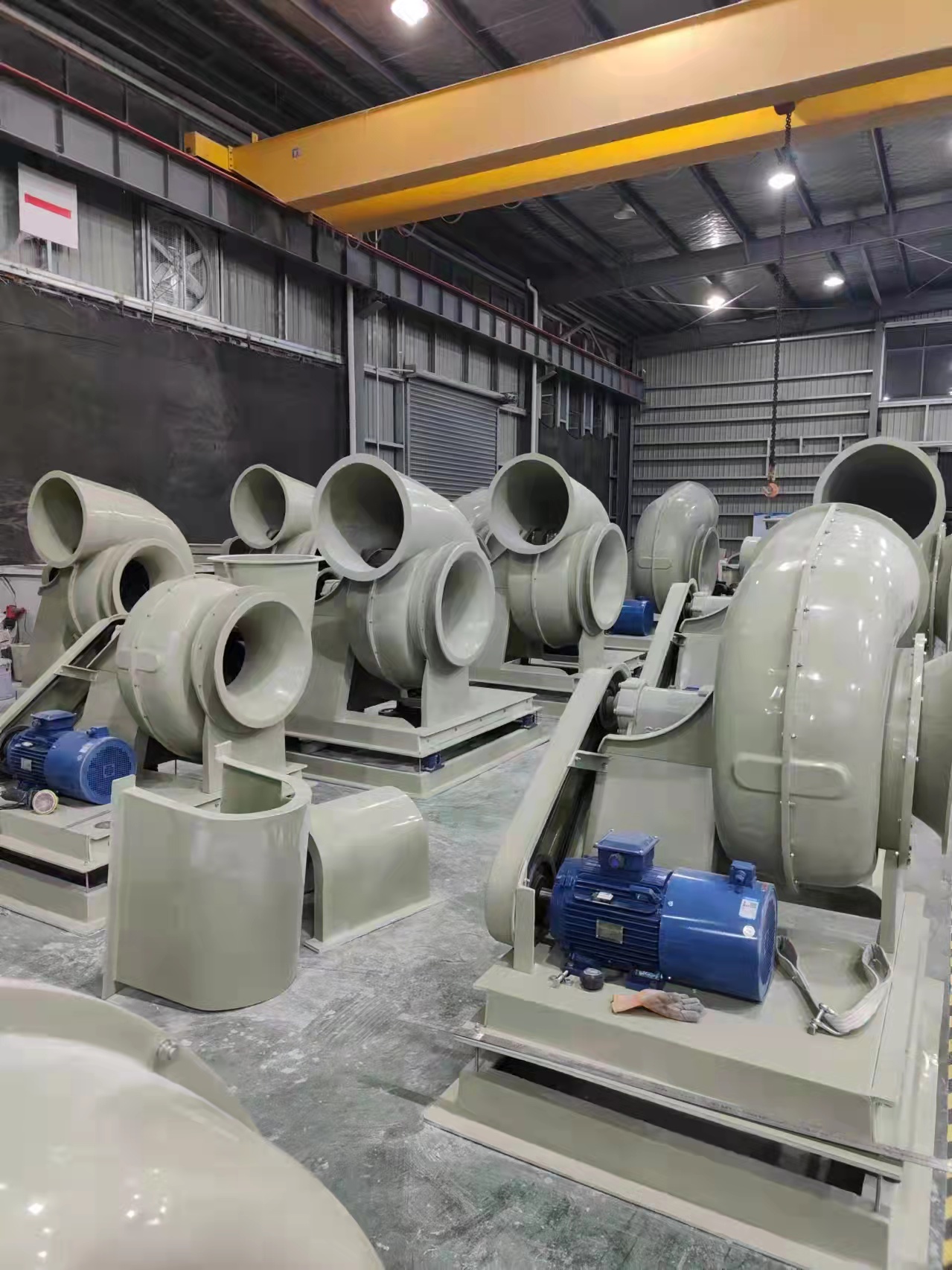
PP/FRP negative pressure fan with belt-driven configuration for industrial exhaust systems operating under sustained negative pressure — where the fan must pull air through ductwork, scrubbers, filters, and stacks against cumulative system resistance. The belt drive isolates the motor from the impeller shaft via pulleys and V-belts, providing two operational advantages over direct-drive fans: speed adjustment by pulley ratio change (not VFD) for commissioning fine-tuning, and motor isolation from the corrosive airstream (the motor sits outside the fan casing, connected only by belts). PP or FRP construction throughout the volute and impeller for full corrosion resistance. Standard models handle 2,000-8,000 m³/h against system pressures to 1,150 Pa, with custom configurations available to 80,000 m³/h.
| Application | Negative pressure industrial exhaust — pulling through scrubbers, long duct runs, multi-branch collection systems where system resistance exceeds direct-drive fan capability |
| Material | PP volute + PP impeller (≤60degC); FRP volute + FRP impeller (≤80degC, higher strength) |
| Drive type | Belt-driven — motor isolated from impeller shaft; pulley ratio adjustable for speed fine-tuning |
| Model range | XC-5 series — 1.5-11 kW, 2,000-8,000 m³/h standard; custom to 80,000 m³/h |
| Impeller | Reinforced PP injection-molded one-piece; ISO 1940 G6.3 balanced; F4-72 profile |
| Gas limits | PP: ≤60degC, ≤100 mg/m³; FRP: ≤80degC, ≤150 mg/m³ |
| Lead time | 15-25 days |
Direct Drive vs Belt Drive: Why Belt Drive Exists
Direct-drive fans (motor directly coupled to impeller shaft) are simpler, more compact, and have no belt maintenance. So why specify belt drive? Because it solves three problems that direct drive cannot:
- Speed adjustment without electronics. A direct-drive fan runs at motor speed — 1,440 or 2,900 RPM. If the system pressure drop calculation was slightly off (and it often is — duct friction estimates have uncertainty, filter loading changes resistance over time, future expansion may add branches), the fan delivers the wrong airflow. With a direct-drive fan, the fix is a VFD (adds cost, requires electrical work, introduces harmonics) or a damper (wastes energy by throttling). With a belt-driven fan, the fix is a pulley change — swap the motor pulley for a different diameter, fan speed changes proportionally, airflow adjusts. No electronics, no electrical contractor, no energy-wasting throttling.
- Motor isolation from the airstream. In a direct-drive fan, the motor shaft penetrates the fan casing — the shaft seal is the only barrier between the corrosive airstream and the motor bearings. In a belt-driven fan, the motor sits entirely outside the fan casing with no penetration — the impeller shaft has its own bearings in pillow blocks external to the casing, and the motor is connected only by belts. If the shaft seal on a direct-drive fan leaks, corrosive gas attacks the motor bearings directly. On a belt-driven fan, the motor is physically separated from the airstream — bearing contamination from seal leakage is not possible because there is no seal to leak past.
- Motor replacement without fan disassembly. If a direct-drive fan motor fails, the impeller must be removed from the shaft to replace the motor — significant downtime, potential for impeller damage during removal. If a belt-driven fan motor fails, the motor is unbolted from its baseplate and replaced — the impeller, shaft, bearings, and casing remain undisturbed. Motor replacement takes hours, not days. For facilities where fan downtime means production downtime, this maintainability difference alone justifies belt drive. System reliability requirements aligned with EU Industrial Emissions Directive standards favor maintainable fan configurations that minimize exhaust system outage duration.
Negative Pressure Operation: The Fan as System Anchor
In a negative pressure exhaust system, the fan sits at the end of the treatment train — after the capture hood, ductwork, dampers, scrubber, and any in-line equipment. It pulls air through the entire system. The fan must overcome the total pressure drop of everything upstream of it, while operating at an inlet pressure well below atmospheric. This creates specific engineering requirements:
- Inlet conditions affect performance. A fan’s catalog performance curve is measured at standard inlet conditions (open inlet, atmospheric pressure). When the fan inlet is connected to ductwork operating at negative pressure, the inlet air density is lower than standard — reducing the fan’s mass flow capacity at a given speed and pressure. Our fan selections compensate for inlet depression — the selected fan is slightly larger than the catalog curve would suggest for the same airflow at atmospheric inlet. This prevents the common field problem of a fan that “meets the spec on paper” but under-performs when connected to the actual system.
- Belt tension under continuous negative pressure. Negative pressure in the fan casing creates a slight axial load on the impeller shaft — pulling it toward the casing. This load transfers to the shaft bearings and, through the pulley, to belt tension. Belt tension that was correct at installation can change as the system reaches operating negative pressure. Our belt-driven negative pressure fans include bearing arrangements designed for this axial load, and belt tensioning procedures that account for operating-condition deflection.
- Startup against closed damper. Negative pressure fans should start against a closed inlet damper — the motor accelerates the impeller to speed with minimum load, then the damper opens gradually to the operating point. This reduces starting current, minimizes belt slippage during startup, and prevents the impeller from being back-driven by natural draft in the stack before the motor reaches speed.
Why Xicheng
16 years, 2600+ systems shipped worldwide. Belt-driven negative pressure fans operate at the intersection of mechanical drive engineering and corrosion-resistant design — getting either wrong means premature failure:
- Pillow block bearings external to the casing. The impeller shaft is supported by two pillow block bearings mounted on the fan baseplate — one on each side of the fan casing. Both bearings are external to the airstream, protected from corrosive gas, and accessible for lubrication and replacement without opening the fan casing. The bearings are sized for the combined radial load (impeller weight + belt tension) and axial load (negative pressure pull) at the fan’s operating speed.
- PP or FRP impeller — one-piece, no joints under centrifugal + negative pressure load. The impeller experiences centrifugal force from rotation pulling outward AND a net axial force from the pressure differential across it. In a fabricated impeller with welded or fastened blades, this combined loading works the joints — microscopic relative movement at each joint accumulates fatigue damage over millions of cycles. Our one-piece injection-molded impeller has no joints to work — the entire rotating assembly responds to the combined loading as a single continuous structure.
- Belt guard standard, belt tension documentation included. Every belt-driven fan ships with a belt guard (OSHA-compliant, full enclosure). Tensioning instructions, recommended tension gauge settings, and re-tensioning intervals are documented in the installation manual. Correct belt tension at commissioning and periodic re-tensioning during service prevent the belt slippage that causes premature pulley wear and reduced airflow.
Send your system pressure drop calculation and airflow requirements to xicheng023@outlook.com. We’ll select the fan, specify pulley ratio, and provide a performance curve. WhatsApp: +86 18927456906.
Core Advantages
- Belt Drive Enables Speed Adjustment Without Electronics: Pulley ratio change adjusts fan speed and airflow — no VFD, no electrical contractor, no throttling damper energy waste.
- Motor Physically Isolated from Corrosive Airstream: No shaft penetration into the fan casing, no seal to leak, no corrosive gas reaching motor bearings.
- Motor Replacement Without Impeller Removal: Failed motor replaced in hours — impeller, shaft, bearings, and casing remain undisturbed.
- One-Piece Injection-Molded Impeller, G6.3 Balanced: No blade joints, no fatigue accumulation under combined centrifugal and negative pressure loading.
- External Pillow Block Bearings — Serviceable Without Opening Casing: Lubrication and replacement accessible without system shutdown beyond fan isolation.
Key Specifications
| Model No. | XC-5B |
| Material | PP volute + PP impeller (≤60degC); FRP volute + FRP impeller (≤80degC) |
| Drive Type | Belt-driven — V-belt, pulley ratio adjustable |
| Bearing Type | External pillow block — serviceable without casing disassembly |
| Impeller | One-piece injection-molded PP, F4-72 profile, G6.3 balanced |
| Motor Power | 1.5 kW to 11 kW standard |
| Motor Speed | 1,440 RPM (belt reduction to impeller speed per pulley ratio) |
| Gas Temperature | PP: ≤60degC | FRP: ≤80degC |
| Particulate Limit | PP: ≤100 mg/m³ | FRP: ≤150 mg/m³ |
| Service Life | 8-10 Years (fan); belts replaced per maintenance schedule |
| Brand / Origin | Xicheng / China |
Certifications and Compliance
- CE Certified – Negative Pressure Fan Assembly
- RoHS Compliant – PP and FRP materials
- ISO 9001 – Quality Management System
- ISO 14001 – Environmental Management System
- SGS Tested – PP impeller bending strength, FRP mechanical properties, impeller balance G6.3
- Design Compliance – Fan designed to meet EU Industrial Emissions Directive (2010/75/EU); impeller balance per ISO 1940 G6.3; belt guard per OSHA 1910.219
How to Order
- You send – Air volume, total system pressure drop (including all upstream equipment), gas composition and temperature, particulate loading
- We select – Fan model, pulley ratio for required speed, motor specification, bearing arrangement
- You approve – Fan curve at operating inlet depression, drive specification, and pricing
- We build – 15-25 days. Impeller balanced, belts tensioned, fan run-tested
Contact xicheng023@outlook.com or WhatsApp +86 18927456906 — fan selection within 24 hours.
Complete Your System
- PP Centrifugal Fan – Direct-drive fan for standard exhaust applications
- Anti-Corrosion Centrifugal Fan – Enhanced chemical resistance for aggressive environments
- PP/FRP Centrifugal Blower – Higher pressure for demanding applications
- Wet Scrubber System – Complete exhaust treatment system
FAQ
Belt drive or direct drive — which should I choose?
Choose direct drive when: speed adjustment is not needed (or handled by VFD), motor access is not a maintenance concern, and the airstream is not so corrosive that shaft seal leakage would damage the motor. Direct drive is simpler, more compact, and has no belt maintenance. Choose belt drive when: you need speed adjustability without electronics (pulley change), you want motor isolation from corrosive airstream (no shaft penetration), or you need motor replacement without impeller removal (critical for production-dependent facilities).
How often do belts need to be replaced?
V-belts in continuous industrial fan service typically last 12-18 months before requiring replacement. Tension should be checked monthly for the first 3 months (new belts stretch and seat into pulley grooves), then quarterly. A properly tensioned belt set that is not overloaded will show gradual wear; sudden belt failure usually indicates incorrect tension, misaligned pulleys, or an overloaded fan. We ship every fan with belt tension specifications and a recommended re-tensioning schedule.
Can I retrofit a belt-driven negative pressure fan into an existing direct-drive installation?
Yes, if the existing duct connections and baseplate accommodate the larger footprint of a belt-driven fan (the motor sits beside the casing rather than directly coupled, requiring more width). Send us the existing fan’s dimensions, duct connection sizes, and current performance data. We’ll check if a belt-driven replacement fits the available space and meets the performance requirement. The transition typically requires new duct adapters at the fan inlet and outlet flanges.