Product Overview
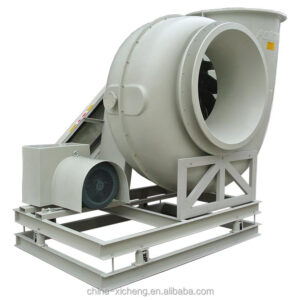
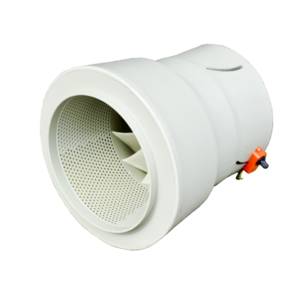
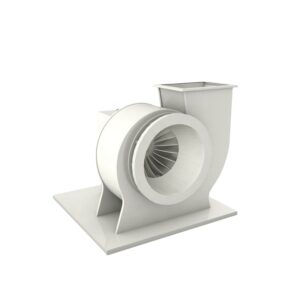
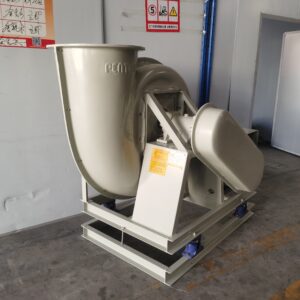
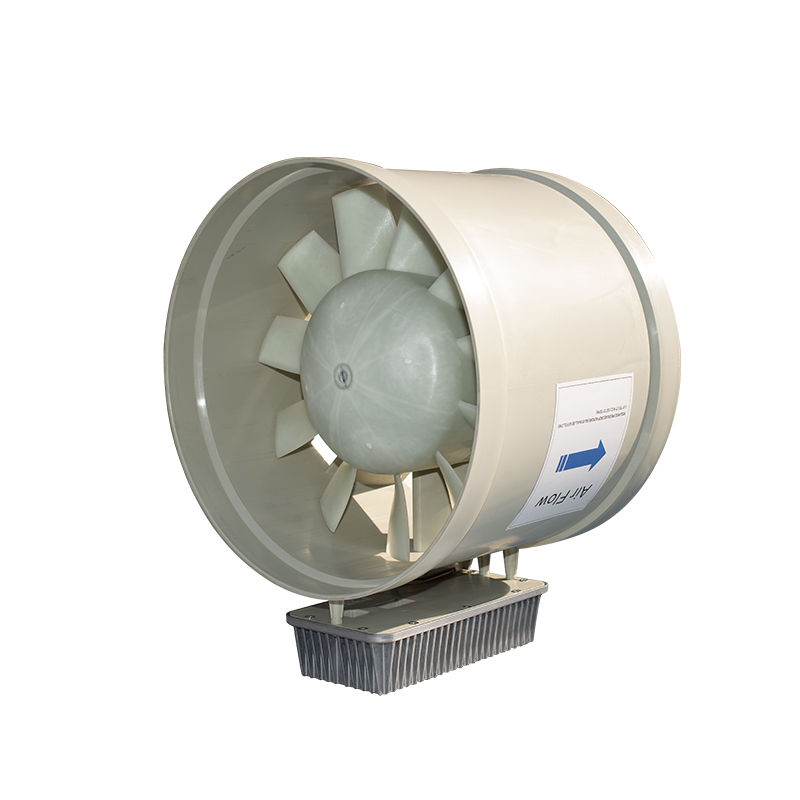
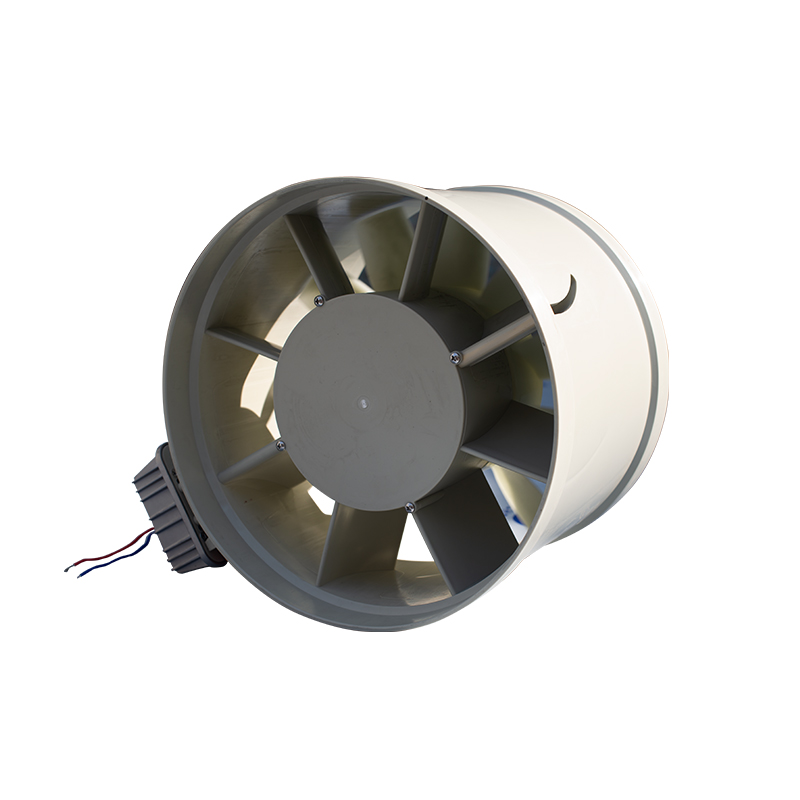
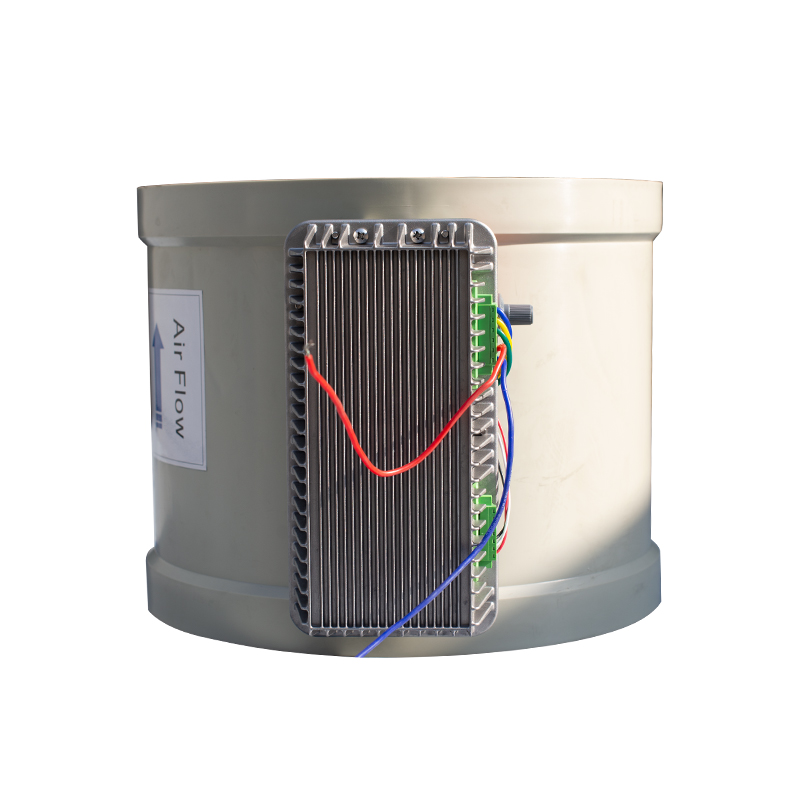
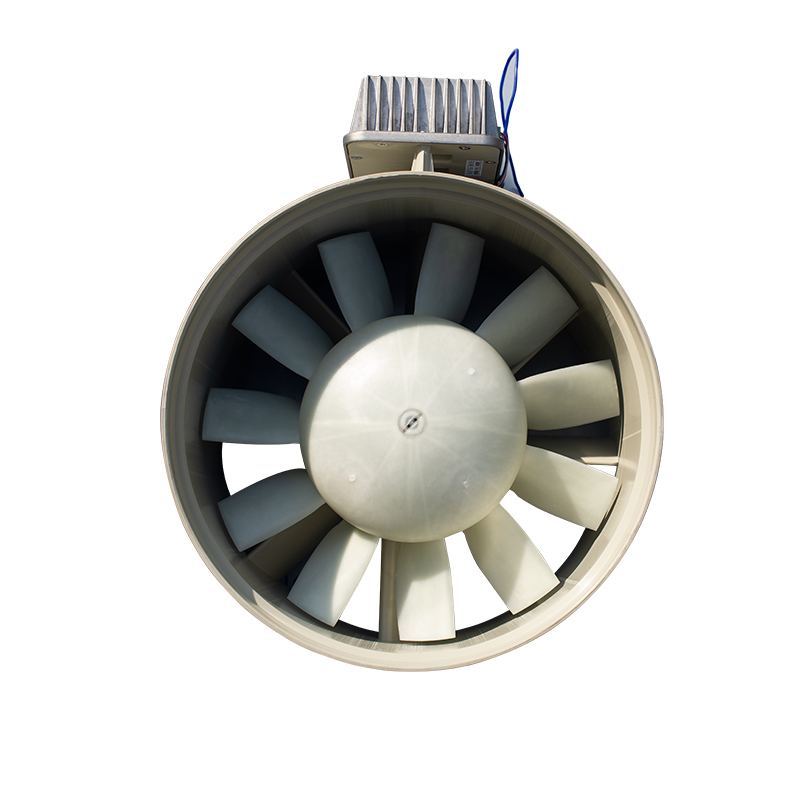
PP/FRP axial flow fan for high-volume, low-pressure ventilation in corrosive environments — moving large air quantities (up to 50,000+ m³/h) against low system resistance (typically 50-300 Pa). Unlike centrifugal fans that take air in axially and discharge it radially (90-degree turn), an axial fan moves air straight through — inlet and outlet are on the same axis, making it the correct choice for wall-mounted ventilation, duct booster applications, cooling air circulation, and any installation where the duct layout favors straight-through airflow without a 90-degree direction change. PP or FRP construction throughout the casing, impeller, and guide vanes for full corrosion resistance. The impeller hub and blades are injection-molded as a single rotating assembly — no individual blade attachments, no balancing after assembly.
| Application | High-volume general ventilation, wall-mounted exhaust, cooling air circulation, duct booster fans, tank ventilation, process area air change in corrosive environments |
| Material | PP casing + PP impeller (≤60degC); FRP casing + FRP impeller (≤80degC); anti-corrosion coated motor housing |
| Air volume | 1,000-50,000+ m³/h depending on diameter and speed |
| Pressure | 50-300 Pa — low pressure, high volume machine |
| Diameter range | DN200-DN1000 standard; larger custom |
| Impeller | One-piece injection-molded PP hub + blades; aerofoil profile; G6.3 balanced |
| Motor | Direct drive — motor in airstream (PP-shrouded) or external (belt-driven); 1,440 or 2,900 RPM |
| Lead time | 10-20 days |
Axial vs Centrifugal: The Application Decides
An axial fan and a centrifugal fan are fundamentally different machines optimized for different regions of the pressure-volume map. Specifying the wrong type means either inadequate airflow, excessive energy consumption, or both:
| Characteristic | Axial Fan | Centrifugal Fan |
|---|---|---|
| Airflow path | Straight through — inlet and outlet on same axis | 90-degree turn — axial inlet, radial outlet |
| Pressure range | Low: 50-300 Pa | Moderate to high: 500-2,500+ Pa |
| Volume range | Very high: up to 50,000+ m³/h per unit | Moderate to high: 2,000-80,000 m³/h |
| Best for | Wall exhaust, cooling air, duct booster, tank vent, open-area ventilation with minimal duct resistance | Ducted exhaust, scrubber systems, filter banks, any application with significant system resistance |
| Space requirement | Compact — in-line with duct, no volute | Larger — volute adds width perpendicular to duct axis |
| Noise | Higher at pressure — blade tip vortex noise | Lower — volute contains blade-pass noise |
The simple rule: if your system has more than 50 meters of duct or passes through a scrubber, filter, or treatment device, you need a centrifugal fan — the axial fan cannot develop enough pressure. If you need to move large air volumes through a short duct or directly through a wall with minimal resistance, an axial fan is the efficient choice. For ducted exhaust systems, see our PP Centrifugal Fan.
Axial Fan Applications in Corrosive Environments
| Application | Why Axial | Typical Size |
|---|---|---|
| Electroplating shop wall exhaust | High air change rate, low duct resistance, straight-through wall penetration. PP corrosion resistance for acid mist environment. | DN400-DN800, 5,000-20,000 m³/h |
| Chemical storage tank ventilation | Continuous low-rate ventilation to prevent fume accumulation. Axial fan runs 24/7 at low speed, low power consumption. | DN200-DN400, 1,000-5,000 m³/h |
| Process area cooling air | High volume, no ductwork — fan moves ambient air through the workspace. PP construction resists ambient corrosive atmosphere. | DN500-DN1000, 10,000-30,000 m³/h |
| Duct booster fan | Installed in-line to overcome friction losses in a long duct run where the main centrifugal fan’s pressure is insufficient at the far end. | Matched to duct diameter; provides 50-200 Pa boost |
| Cooling tower fan (small) | PP construction resists chlorinated water mist. Aerofoil blades for efficient air movement through the tower fill. | DN400-DN800, 5,000-15,000 m³/h |
Why Xicheng
16 years, 2600+ systems shipped worldwide. An axial fan in corrosive service has one vulnerability that steel fans do not face: the motor is typically in the airstream, directly exposed to corrosive gases that attack motor windings, bearings, and electrical connections:
- Motor protection for in-airstream installation. In direct-drive axial fans, the motor sits in the hub, directly in the gas stream. Our standard motor for corrosive service has: anti-corrosion epoxy-coated housing, sealed bearings with corrosion-resistant grease, encapsulated windings (epoxy-impregnated for moisture and chemical resistance), and a PP shroud that deflects the main airflow around (not through) the motor body. For severe service, the motor can be mounted externally with a belt drive or long shaft — the motor sits outside the duct entirely.
- One-piece injection-molded impeller — blades and hub as a single unit. Metal axial fan impellers typically have individual blades bolted or clamped to a hub — each blade attachment is a crevice for corrosion and a potential failure point if a fastener loosens. Our PP impeller is injection-molded as a single piece: hub, blades, and blade roots are continuous material. The aerofoil blade profile — optimized for efficiency and low noise — is mold-controlled for consistency across every blade on every fan.
- Guide vanes for efficiency recovery. Axial fans impart a swirl component to the outlet airflow — the air leaves the impeller rotating around the axis. This rotational kinetic energy is wasted unless recovered. Our axial fans include stationary guide vanes downstream of the impeller that straighten the airflow — recovering the swirl energy as additional static pressure and improving fan efficiency by 5-10%. For duct-mounted installations where the downstream ductwork would otherwise straighten the flow over several diameters (with friction loss), guide vanes recover the energy in a much shorter distance.
Send your airflow and application details to xicheng023@outlook.com. We’ll confirm whether axial or centrifugal is correct and provide a fan selection. WhatsApp: +86 18927456906.
Core Advantages
- Straight-Through Airflow — No Direction Change: Inlet and outlet on the same axis simplifies duct layout for wall exhaust, booster, and in-line applications.
- One-Piece Injection-Molded Impeller: Hub + aerofoil blades as a single unit — no individual blade fasteners, no crevice corrosion, G6.3 balanced.
- Guide Vanes for Swirl Recovery: Stationary downstream vanes convert rotational kinetic energy to static pressure — 5-10% efficiency improvement.
- Motor Protection for Corrosive Airstream: Epoxy-coated, sealed bearings, encapsulated windings, PP shroud — or external motor for severe service.
- Compact In-Line Installation: No volute, no 90-degree transition — fan fits directly into the duct run or wall opening.
Key Specifications
| Model No. | XC-5A |
| Material | PP casing + PP impeller (≤60degC); FRP casing + FRP impeller (≤80degC) |
| Type | Axial flow — in-line, straight-through airflow |
| Diameter Range | DN200-DN1000 standard; larger custom |
| Air Volume | 1,000-50,000+ m³/h |
| Pressure | 50-300 Pa |
| Impeller | One-piece injection-molded PP, aerofoil blades, G6.3 balanced |
| Guide Vanes | Stationary downstream vanes — swirl recovery |
| Motor | Direct drive in-airstream (PP-shrouded) or external belt-drive |
| Motor Speed | 1,440 or 2,900 RPM |
| Gas Temperature | PP: ≤60degC; FRP: ≤80degC |
| Service Life | 8-10 Years |
| Brand / Origin | Xicheng / China |
Certifications and Compliance
- CE Certified – Axial Flow Fan
- RoHS Compliant – PP and FRP materials
- ISO 9001 – Quality Management System
- ISO 14001 – Environmental Management System
- SGS Tested – PP impeller, FRP mechanical properties, G6.3 balance, motor enclosure rating
- Design Compliance – Fan designed to meet EU Industrial Emissions Directive (2010/75/EU); impeller per ISO 1940 G6.3
How to Order
- You send – Air volume, system resistance (or describe duct layout), duct diameter, gas composition and temperature, motor position preference (in-airstream or external)
- We confirm – Axial vs centrifugal suitability for your application; material compatibility with gas chemistry
- We select – Fan diameter, impeller configuration, motor specification, guide vane arrangement
- You approve – Fan curve, motor specification, and pricing
- We build – 10-20 days. Impeller balanced, fan assembled and run-tested
Contact xicheng023@outlook.com or WhatsApp +86 18927456906 — fan selection within 24 hours.
Complete Your System
- PP Centrifugal Fan – For ducted exhaust with system resistance beyond axial capability
- PP/FRP Centrifugal Blower – For high-pressure blower applications
- PP/FRP Diagonal Flow Fan – Hybrid axial-centrifugal for intermediate pressure
- PP Round Duct – Matching duct for fan installation
FAQ
Axial or centrifugal — which is right for my application?
If your system has significant duct resistance (long runs, multiple elbows, scrubber, filters), you need a centrifugal fan — an axial fan cannot develop enough pressure. If you’re moving large air volumes through a short duct, wall opening, or open area with minimal resistance (under 200 Pa), an axial fan is more efficient and more compact. The borderline is around 200-300 Pa system resistance: below this, consider axial; above this, centrifugal is required. Send us your system details for a definitive recommendation.
Can an axial fan handle corrosive gases?
Yes — the PP or FRP casing and impeller are inherently corrosion-resistant. The vulnerability is the motor: in a direct-drive axial fan, the motor sits in the airstream. Our standard motor protection (epoxy coating, sealed bearings, encapsulated windings, PP shroud) is adequate for most industrial corrosive environments at moderate concentration. For high-concentration acid gases, condensing moisture, or high-temperature exhaust, specify external motor mounting — the motor sits outside the duct, connected by a shaft or belt drive, and never contacts the airstream.
Why are axial fans louder than centrifugal fans at the same airflow?
Axial fan noise is dominated by blade-tip vortex interaction with the casing wall — the pressure difference between the blade’s pressure and suction sides creates a vortex at the tip that slaps against the casing as each blade passes. Centrifugal fans contain this noise within the volute; axial fans radiate it directly into the duct. Our aerofoil blade profile and tight tip clearance (2-3 mm) minimize tip vortex strength, and downstream guide vanes reduce swirl-generated noise. For noise-sensitive installations, inlet and outlet silencers are available.