
Product Overview
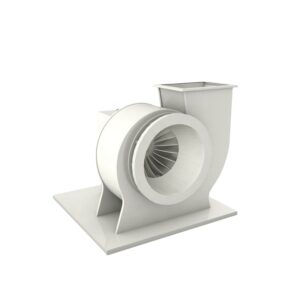
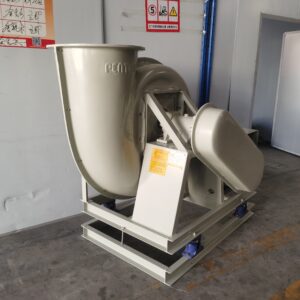
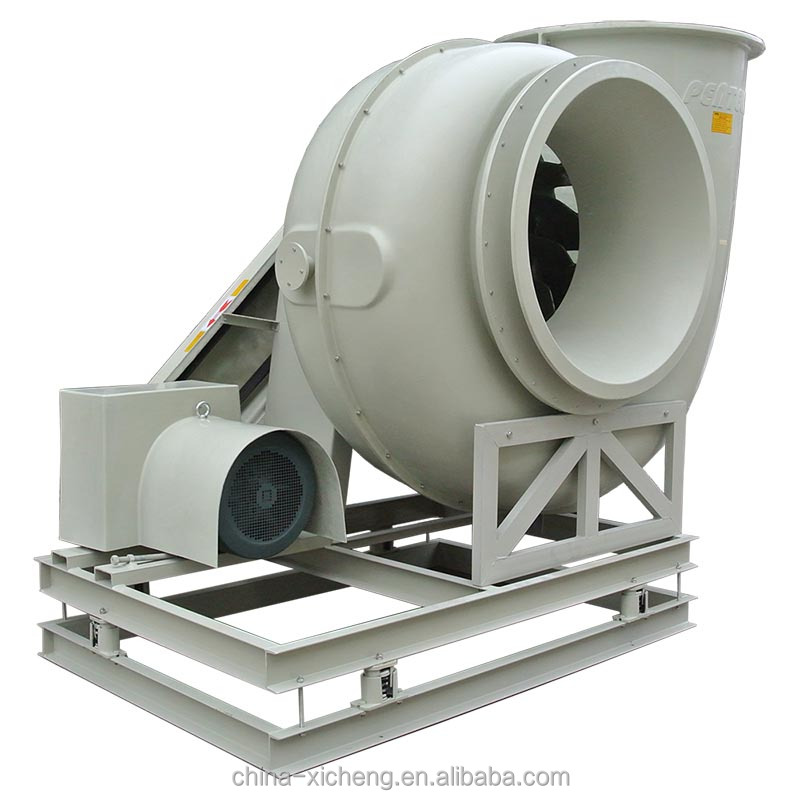
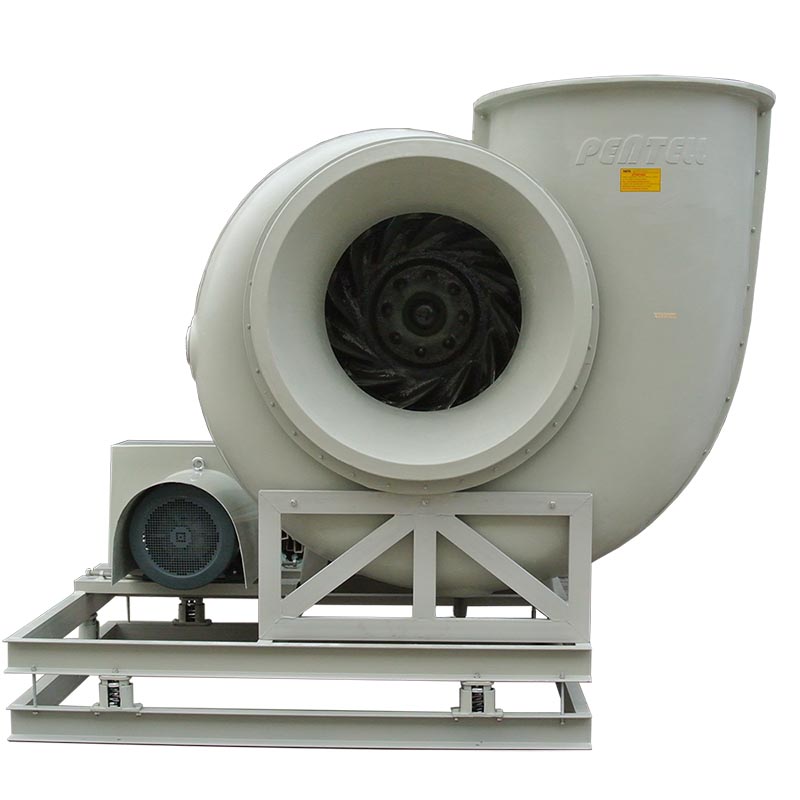
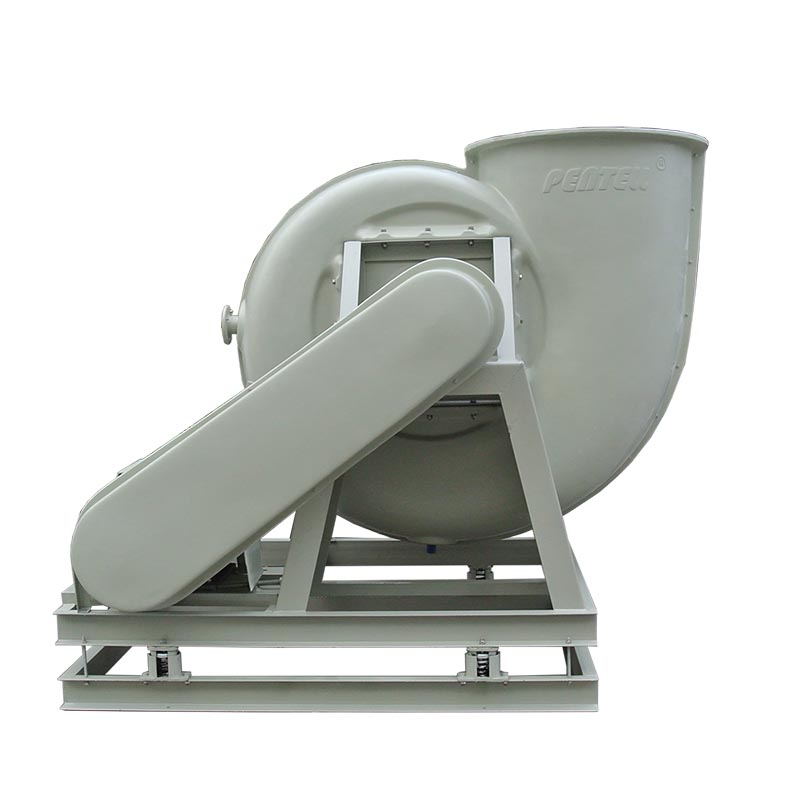
PP/FRP centrifugal fan for corrosive industrial exhaust — the volute and impeller are manufactured from PP (polypropylene) or FRP (fiberglass-reinforced plastic), providing full-wall-thickness corrosion resistance without the coating degradation that limits the service life of coated steel fans in chemical service. The impeller is injection-molded from modified reinforced PP in a single piece — no blade-to-hub welds or fasteners, uniform material properties throughout the rotating assembly. Designed to the F4-72 aerodynamic profile for high efficiency across a wide operating range, the fan moves 2,000 to 8,000 m³/h against system pressures up to 1,150 Pa in standard configurations, with larger custom sizes available.
| Application | Corrosive gas exhaust — hydrochloric acid mist, sulfuric acid mist, nitric acid mist, and general acid fume ventilation in chemical, electroplating, pharmaceutical, and laboratory facilities |
| Material | PP volute + reinforced PP injection-molded impeller (standard, ≤60degC gas); FRP volute + FRP impeller (≤80degC gas, higher mechanical strength) |
| Drive type | A-type direct drive — motor directly coupled to impeller shaft; 1,440 or 2,900 RPM |
| Motor power | 0.75 kW to 11 kW standard; custom motors available |
| Air volume | 2,000-8,000 m³/h standard models; larger custom up to 80,000 m³/h |
| Pressure | 1,000-1,150 Pa at design point |
| Gas temperature | PP: ≤60degC; FRP: ≤80degC |
| Lead time | 15-25 days |
Why the Fan Material Must Match the Gas Stream
A centrifugal fan handling corrosive gas cannot rely on protective coatings — the impeller rotates at 1,440-2,900 RPM, generating centrifugal forces that stress every surface. A coating that delaminates even slightly at one point creates a corrosion initiation site that propagates rapidly under the combined effects of chemical attack and mechanical stress. Within months, an apparently intact coated steel impeller can develop through-thickness corrosion at the blade roots — the highest-stress location — leading to impeller failure with potentially catastrophic consequences for personnel and equipment downstream:
- PP — full-wall-thickness acid resistance, no coating. The entire volute, impeller, and inlet cone are solid PP — not coated, not lined. If the surface is scratched during installation or maintenance, the exposed material is chemically identical to the surface. No coating holiday leads to rapid substrate corrosion because there is no substrate to corrode. PP handles most mineral acids (HCl, H2SO4, HNO3 at moderate concentrations), alkalis, and salt-laden air. Temperature limit: 60degC continuous.
- FRP — higher temperature, higher strength. FRP (fiberglass-reinforced plastic) extends the operating envelope: temperature to 80degC, bending strength ≥196 MPa, and better resistance to abrasive particulate (up to 150 mg/m³ vs PP’s 100 mg/m³). FRP is the correct choice when the gas stream temperature or mechanical loads exceed PP’s limits. The glass fiber reinforcement provides structural stiffness that PP alone cannot achieve at elevated temperature.
- What PP/FRP fans CANNOT handle. PP and FRP are not universal. They are chemically attacked by: aromatic compounds (benzene, toluene, xylene), halogen derivatives of aliphatic and aromatic hydrocarbons (chlorinated solvents, fluorinated compounds), and ketones (acetone, MEK, MIBK) at elevated concentrations and temperatures. These chemicals can cause swelling, softening, or stress cracking of the polymer matrix. If your gas stream contains these compounds, contact us for a material compatibility review — in some cases, PPS or a different fan configuration may be required. This material limitation is inherent to all PP/FRP fans regardless of manufacturer and is essential for safe specification. The fan’s compliance with EU Industrial Emissions Directive requirements depends on correct material selection for the specific gas composition.
Why Xicheng
16 years, 2600+ systems shipped worldwide. A centrifugal fan is the heart of any exhaust system — if the fan fails, the entire system stops. Our manufacturing approach prioritizes impeller integrity, balance quality, and material consistency:
- One-piece injection-molded impeller — no blade attachments. Metal fan impellers typically have blades welded or riveted to a hub — each attachment point is a stress concentration and a potential failure initiation site. Our PP impeller is injection-molded as a single piece: blades, hub, and backplate are formed in one mold cycle. No welds, no fasteners, no joints. The material is uniform throughout, and the blade geometry is mold-controlled for consistent aerodynamic performance across every fan produced.
- G6.3 balance grade — smooth operation, long bearing life. Every impeller is static-balanced to ISO 1940 G6.3 grade before assembly. An unbalanced impeller at 2,900 RPM generates vibration that destroys bearings, cracks the volute, and loosens mounting bolts. The G6.3 standard — with a permissible residual unbalance of 6.3 mm/s — ensures vibration levels that support the fan’s 8-10 year design life without bearing replacement.
- F4-72 aerodynamic profile — proven efficiency. The F4-72 is the most widely used centrifugal fan profile in industrial ventilation — its backward-curved blade design provides high efficiency (typically 80-85% static) across a broad flow range with non-overloading power characteristic. This means the motor cannot be overloaded regardless of where the fan operates on its curve — important for systems where dampers may be adjusted and the operating point shifts. The aerodynamic design has been refined over decades of industrial service, and our PP/FRP adaptation matches the metal F4-72 performance while adding full corrosion resistance.
- Complete fan + scrubber + duct systems. The fan is one component. We supply the complete system: hood/capture → duct → damper → fan → scrubber → stack. All components are sized as a matched system, all are corrosion-resistant, and all are covered by a single warranty. See our Wet Scrubber and PP Round Duct pages.
Send your gas composition, air volume, and system pressure drop to xicheng023@outlook.com. We’ll select the fan, verify material compatibility, and provide a performance curve with the proposal. WhatsApp: +86 18927456906.
Core Advantages
- Full-Wall-Thickness Corrosion Resistance: Solid PP or FRP — not coated steel. A scratch doesn’t initiate corrosion because there’s no metal substrate to corrode.
- One-Piece Injection-Molded Impeller: Blades, hub, and backplate in a single mold cycle — no welds, no fasteners, no stress concentrations.
- G6.3 Balance Grade to ISO 1940: Static-balanced impeller for smooth operation and 8-10 year bearing life at 1,440-2,900 RPM.
- F4-72 Aerodynamic Profile: Proven backward-curved blade design — 80-85% efficiency, non-overloading power characteristic, broad operating range.
- A-Type Direct Drive, No Belt Losses: Motor directly coupled to impeller — no belt slippage, no belt maintenance, 100% power transmission.
Key Specifications
| Model No. | XC-5 |
| Material | PP volute + PP impeller (≤60degC); FRP volute + FRP impeller (≤80degC) |
| Drive Type | A-type direct drive — motor directly coupled |
| Motor Speed | 1,440 RPM or 2,900 RPM |
| Motor Power | 0.75 kW to 11 kW standard |
| Max Gas Temperature | PP: 60degC | FRP: 80degC |
| Max Particulate | PP: ≤100 mg/m³ | FRP: ≤150 mg/m³ |
| Impeller Balance | ISO 1940 G6.3 |
| Volute Design | F4-72 aerodynamic profile — backward-curved blades |
| Service Life | 8-10 Years |
| Brand / Origin | Xicheng / China |
Model Selection Table
| Model | Motor (kW) | Air Volume (m³/h) | Pressure (Pa) |
|---|---|---|---|
| XC-FJ-3 | 1.5 | 2,000 | 1,145 |
| XC-FJ-3.6 | 2.2 | 4,000 | 1,150 |
| XC-FJ-5.5 | 4.0 | 6,000 | 1,000 |
| XC-FJ-6 | 5.5 | 8,000 | 1,100 |
Custom sizes: Up to 80,000 m³/h. Contact xicheng023@outlook.com for fan selection.
Certifications and Compliance
- CE Certified – Centrifugal Fan
- RoHS Compliant – PP and FRP materials
- ISO 9001 – Quality Management System
- ISO 14001 – Environmental Management System
- SGS Tested – PP sheet mechanical properties, FRP bending strength (≥196 MPa), impeller balance certification
- Design Compliance – Fans designed to meet EU Industrial Emissions Directive (2010/75/EU) exhaust system requirements; impeller balance per ISO 1940 G6.3 grade
How to Order
- You send – Air volume (m³/h), system pressure drop (Pa), gas composition and temperature, particulate loading, material preference (PP or FRP)
- We select – Fan model from the XC-FJ range or custom sizing; verify material compatibility with your gas composition
- You approve – Fan performance curve, motor specification, material confirmation, and pricing
- We build – 15-25 days. Impeller balanced, fan assembled, run-tested before shipment
Contact xicheng023@outlook.com or WhatsApp +86 18927456906 — fan selection and quotation within 24 hours.
Complete Your System
- Anti-Corrosion Centrifugal Fan – Enhanced chemical resistance for aggressive environments
- PP/FRP Centrifugal Blower – Higher pressure blower for demanding applications
- Wet Scrubber System – Complete exhaust treatment with matched fan
- PP Round Duct – Corrosion-resistant duct for fan connections
FAQ
PP or FRP — which material should I choose for my fan?
Choose PP when: gas temperature ≤60degC, particulate ≤100 mg/m³, and the gas is primarily mineral acids (HCl, H2SO4, HNO3). PP is lower cost and injection-molded impeller quality is excellent. Choose FRP when: gas temperature is 60-80degC, particulate is 100-150 mg/m³, the gas contains abrasive particles, or higher mechanical strength is needed (FRP bending strength ≥196 MPa). FRP costs more but extends the operating envelope. For temperatures above 80degC, neither PP nor FRP is suitable — contact us for alternative materials.
What chemicals can a PP centrifugal fan NOT handle?
PP and FRP fans cannot handle gases containing: aromatic compounds (benzene, toluene, xylene, styrene), halogenated hydrocarbons (dichloromethane, chloroform, trichloroethylene, fluorinated solvents), and ketones (acetone, MEK, MIBK, cyclohexanone). These chemicals can cause swelling, softening, or environmental stress cracking of PP and FRP. This is not a manufacturing defect — it is a fundamental material compatibility limitation. Send us your complete gas composition and we’ll verify compatibility before specifying the fan material.
What does G6.3 balance grade mean in practice?
ISO 1940 G6.3 limits the permissible residual unbalance to 6.3 mm/s at the fan’s operating speed. For a 2,900 RPM fan, this means the impeller’s center of mass is within approximately 20 microns (0.02 mm) of the rotational axis. Achieving this requires precision mold design (balance is designed into the mold, not corrected after molding) and verification on a balancing machine before assembly. An impeller balanced to G6.3 at the factory will typically maintain acceptable vibration levels for 8-10 years in normal service.