
Key Takeaways
- Wet scrubber maintenance is a scheduled program of checks, readings, calibration, and corrective actions that keeps the packed-bed system within its design operating window — and there is no single universal calendar; the OEM manual, your permit, and the site baseline set the real intervals.
- Daily readings catch failures while they are cheap. pH or conductivity, sump level, pressure drop, and pump flow form a five-minute round that prevents most alarms.
- Pressure-drop trend, not one number, drives packing decisions. Compare against the clean-bed baseline read over time, not a snapshot.
- Any internal work starts with lockout/tagout and entry safeguards. Never enter a scrubber to inspect it without energy isolation in place.
- The record is the audit trail. Tie reading, unit, baseline, exception, work mode, owner, corrective action, and closure verification into one loop an auditor can follow.
A wet scrubber that runs inside its design window for a decade is the product of a written maintenance plan, not of luck. Maintenance frequency is a decision your team makes with the OEM manual, the permit, and the site baseline in hand, because no universal wet scrubber maintenance calendar fits every service. The program this guide lays out has five layers: daily operator rounds, weekly and monthly subsystem checks, quarterly and semiannual shutdown-gated inspections, and the annual overhaul — plus the lockout/tagout rules that gate internal work and the record fields that close every finding. Read it once, then hand the layered table to the crew that owns the round.
What Wet Scrubber Maintenance Covers (Direct Answer)
Wet scrubber maintenance is a scheduled program of checks, readings, calibration, and corrective actions that keeps the packed-bed system within its design operating window. It is not a reaction to a failing machine; it is the routine that prevents the failing machine. The scope is the whole system, not just the tower: the recirculation loop (pump, strainer, nozzles), the packed bed, the mist eliminator, the housing and connections, and the instruments that report pH, level, flow, and pressure drop.
A defined team runs it. Operators take the daily or shift round and compare readings to the approved baseline. Maintenance crafts handle the weekly and monthly subsystem checks, cleaning, and calibrations. Engineering owns the shutdown-gated inspections and the clean-or-replace decision on packing. Outside service appears when OEM expertise is needed or when a finding keeps recurring after the obvious fix. Frequency is layered, daily through annual, and the real intervals come from the OEM manual, the permit, and the site baseline — not from a generic calendar, and not by averaging conflicting manufacturer advice (the next section shows the conflict honestly).
The decision in this module is short and practical: assign the daily round owner this week, pull the OEM manual and the permit, and publish the baseline bands your crew will check against. Without those three, the checklist below has nothing to compare readings to.
The Maintenance Layers: Daily, Weekly, Quarterly, Semiannual, Annual

A wet scrubber maintenance plan layers tasks by frequency because no single interval fits every subsystem. Daily work is non-intrusive monitoring. Weekly and monthly work asks a maintenance craft to open strainers, read header pressures, and inspect the mist eliminator. Quarterly and semiannual work is shutdown-gated: the tower is isolated from energy before anyone enters. The annual shutdown is the full internal inspection and overhaul. Each layer has a different owner, a different record, and a different risk profile.
Manufacturers disagree on the frequency, and this guide does not average the conflict away. Torch states that daily maintenance is generally not necessary and that weekly monitoring with recorded results is sufficient; MACH schedules daily checks of make-up, airflow, pressure drop, pH, pump flow and pressure, and sump level; Viron runs daily or every-shift checks of pH, conductivity, and sump level. The EPA inspection manual recommends chevron and mesh-pad demisters be inspected at least weekly, and a Tri-Mer OEM template puts internal mist-pad checks on a semiannual cadence. These are guidance with different scopes, not a single legal calendar. Set each interval from your OEM manual, permit, and site baseline, tuned to duty — intermittent odor control is not continuous acid service.
| Frequency | Subsystem focus | Typical tasks | Records |
|---|---|---|---|
| Daily / shift | Recirculation loop, instruments, stack | pH or conductivity vs setpoint; sump level; pressure drop; pump flow and pressure; visible emissions | Reading vs approved band; exception flag |
| Weekly | Nozzles, strainer, sump, mist eliminator | Header pressures (pluggage vs erosion); strainer clean; sump drain per permit; demister check | Finding and corrective action |
| Monthly | Fasteners, motor, taps, fan | Motor current vs nameplate; pressure taps; sight gauge; fan bearings and belts | Trend readings |
| Quarterly | Packing, pump, automation | Leak walk-down; spray test under operating modes; packing bed check; pump rated flow | Decision log |
| Semiannual | Internals | Corrosion and erosion; nozzle condition; solids in bed and eliminator; mist pads or filter packs | Internal inspection record |
| Annual | Whole system | Full shutdown inspection; thickness survey; calibration; overhaul | Overhaul record with closure |
Decision: before the next scheduled window, write the frequency for each row from your OEM manual and permit — not the other way around. Where a source is missing, such as your device’s set-up form, the permit boundary, or the site baseline, leave that interval unset until the document is found.
Daily Checks: Readings, Baseline, and Action Thresholds
The daily round is monitoring, and monitoring is only useful against a written baseline. In roughly five minutes an operator checks pH or conductivity against the chemistry setpoint, sump level, pressure drop across the packed bed, pump flow and pressure, and the stack for visible emissions or droplet re-entrainment. MACH adds make-up, blowdown, and sump temperature to the same list; EPA guidance puts instrument readings on a daily cadence and notes that a hand pH check should be taken near the probe location because pH varies across the system.
The baseline is yours to define. Set three bands for every reading — normal, caution, action — and publish them to the shift before the next round runs. MACH is explicit that each facility should define its own normal pressure-drop range, and EPA builds its evaluation on comparing readings with a site baseline at a verified operating point. Treat a crossed band as a finding with an owner, not a datum to log and ignore. Corrections are chemistry-specific: where dosing is required, adjust slowly and confirm the reading, because a wrong pH drives crystal formation on packing surfaces.
When a reading crosses its action band, enter the diagnostic path instead of re-reading: rising pressure drop can mean fouling, flooding, a plugged nozzle, or channeling, and our symptom-to-root-cause diagnostic guide walks those causes in order. The round is complete only when the reading, the unit, and the band are in the log — that log becomes the audit trail in the records module.
Decision this shift: never clear an alarm by adjusting the alarm. Escalate a reading outside the band to the assigned owner before end of shift, and keep the corrective action visible in the record.
Weekly and Monthly Checks: Nozzles, Strainer, Sump, Mist Eliminator
The weekly and monthly layer turns readings into physical checks, and the strainer is the highest-yield item on it. Viron calls the basket or Y-strainer protecting the recirculation pump the most common single maintenance item on any wet scrubber: a clogged strainer starves the spray headers, and the pressure drop climbs before anyone sees why. Clean or backflush it on the cadence your duty demands, weekly to monthly.
Header pressure tells the nozzle story before you open anything. MACH reads the liquid pressure gauges on the supply headers: higher-than-normal pressure points to pluggage, lower-than-normal pressure points to nozzle erosion. Each week, per MACH guidance, the sump is drained, cleaned, and refilled — subject to your effluent permit, because blowdown and drain water travel through a permitted waste path, not a floor drain. Where an OEM template sets the monthly list, it adds fasteners, motor current compared with the nameplate, pressure taps, sight gauge and level-control passages, and fan bearings and belts.
The EPA Wet Scrubber Inspection and Evaluation Manual, a 1983 evaluation guide rather than a current regulation, is the authority on the demister family: chevron and mesh-pad demisters should be inspected at least weekly to prevent solids buildup, using a high-intensity explosion-proof flashlight, with the flush nozzles evaluated at the same time and deposits removed through the spray system or an external hose. Gradual scaling raises local gas velocity and ends in entrainment — the visible plume or droplet fallout the daily round is watching for.
Decision: every finding from this layer goes on the corrective-action list with an owner and a due date. A strainer that needs weekly cleaning is routine maintenance; a finding that keeps returning after the obvious fix points upstream, and that is the moment to move from checklist to engineering.
Quarterly and Semiannual Checks: Packing, Leaks, Instruments
Quarterly and semiannual checks are shutdown-gated: the scrubber is stopped, isolated, and opened under the lockout/tagout rules in the safety module, so the crew can inspect what running monitoring cannot see. Once a quarter, per MACH guidance, the whole system is walked down for leaks; per Torch guidance, the circulation and spray circuit is tested under different operating modes while the recirculation tank is checked for sludge and the automation components for correct operation. Viron adds looking at the packing bed for channeling or fouling and confirming the recirculation pump holds its rated flow, not just that it runs.
The semiannual stop is the internal inspection. MACH’s list covers corrosion and erosion inside the tower, plugged or eroded spray nozzles, solids deposits in tray orifices and packed beds, and solids accumulation in the mist eliminator, with mist pads or filter packs checked and cleaned or replaced per the OEM template. This is the natural point for service-specific depth: for acid-service corrosion and scaling work, the acid scrubber maintenance guide carries the specialized checks.
Instruments get their own clock. pH probes drift in chemical service, and calibration frequency is set by the chemistry, the OEM manual, and the permit — some programs calibrate monthly, and acid service can demand a two-week cadence; do not adopt a generic number, and never let an annual calibration override a stricter OEM or permit requirement. On the same stop, verify pressure taps and transmitters, because a blocked tap produces a confident wrong reading.
Decision: schedule the quarterly and semiannual stops into the next turnaround window with lockout/tagout planned in, and treat the semiannual finding list as the input to the annual overhaul scope.
Annual Shutdown Inspection and Overhaul
The annual shutdown is where the maintenance loop closes: the tower is drained, flushed, and ventilated, personnel enter through the manway with full PPE — including a supplied-air respirator where residual acid gas, caustic mist, or an oxygen-deficient atmosphere is possible — and every wear system gets an owner with a written finding. Entry follows the site’s confined-space program and OSHA 1910.134 respiratory protections. This is also where the lockout/tagout procedure for this scrubber gets exercised in real work, not in a drill.
Seven areas make a defensible annual scope. (1) Packing: compare the pressure-drop trend against the clean-bed baseline; the Tri-Mer template says clean the packing before it runs more than 50 percent above the clean-pack pressure drop, or when visual inspection calls for it — that figure is the OEM template’s example, not an obligation threshold for your equipment; your own OEM manual and set-up form govern. (2) Shell: for FRP or PP vessels, an ultrasonic thickness survey at fixed shell locations compared with the as-built thickness catches corrosion before it reaches the structure. (3) Nozzles: full inspection, replacing any orifice worn beyond its original dimension. (4) Mist eliminator: media checked for solids buildup, corrosion, and tearing. (5) Pump: mechanical seal, bearings, and impeller erosion. (6) Fan: impeller and bearings. (7) Instruments: pH probe, pressure-drop transmitter, flow meter, and level transmitters removed, cleaned, and recalibrated.
Industry examples size a typical annual stop at one to two days with thickness readings at ten to twenty shell locations, and treat packing life and budget as site-specific estimates, not fixed promises. For your device, the authoritative scope is the OEM manual and the set-up form. Where those documents are missing, mark the thresholds for packing, shell thickness, and seal replacement as unresolved and obtain them before the stop — do not import a template number as an obligation.
Decision: in the quarter before the stop, freeze the scope list, assign an owner to each of the seven areas, and confirm the OEM documents and the lockout/tagout procedure are on site. The stop is complete when every finding has a corrective action and a closure verification.
Lockout/Tagout and Entry Safety Before Any Internal Work
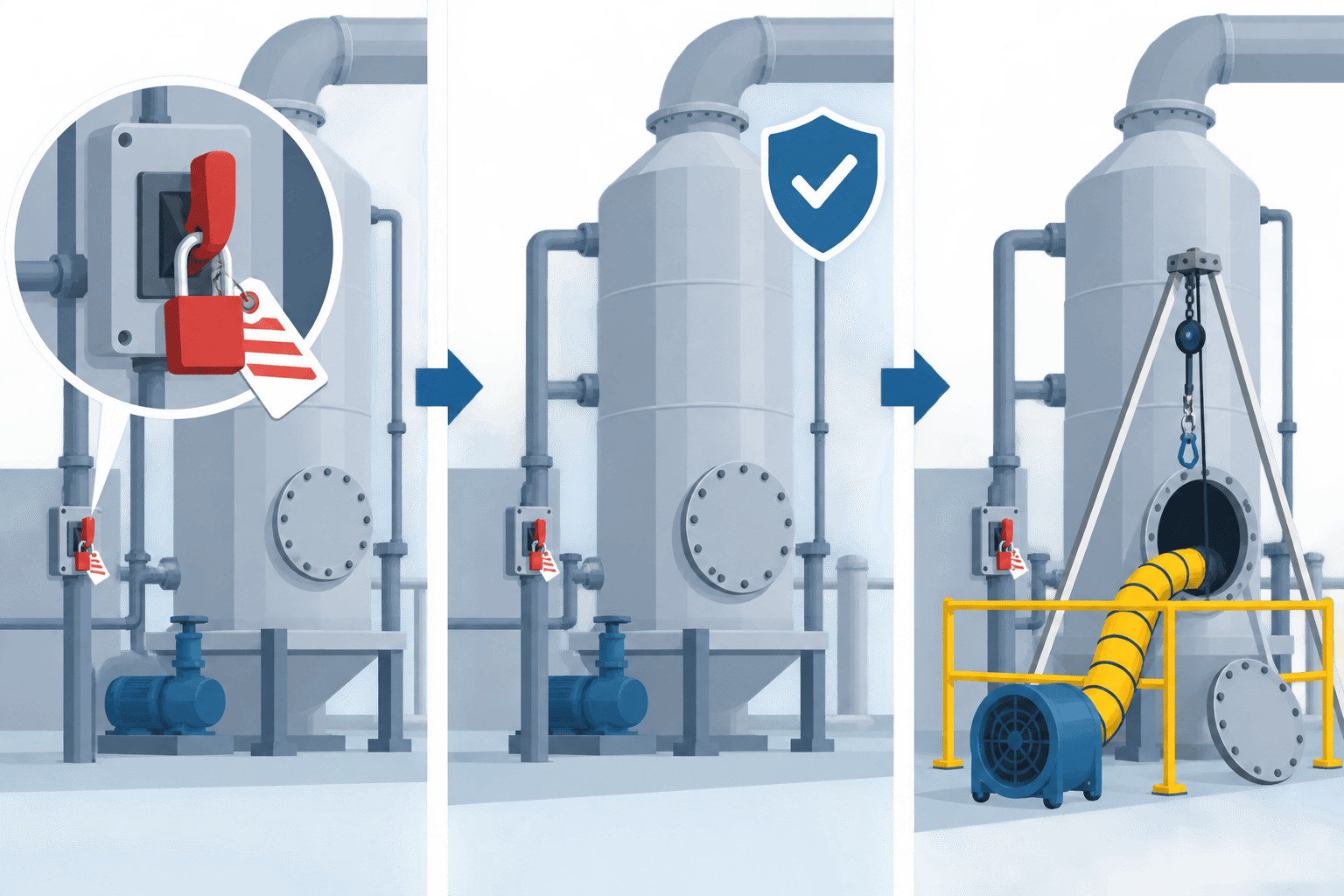
Before any internal work on a wet scrubber, the machine must be isolated from all energy sources and rendered inoperative — that is the baseline requirement of OSHA 1910.147, the control of hazardous energy (lockout/tagout) standard, and it applies to servicing and maintenance where unexpected energization or release of stored energy could injure someone. Energy means more than electricity: the standard’s scope covers electrical, mechanical, hydraulic, pneumatic, chemical, and thermal sources, so shutting off the motor alone is not isolation.
Only authorized employees apply and remove lockout devices, and before work starts they verify that isolation is real by attempting normal start controls and by testing after stored energy is relieved. Reaccumulation matters in a scrubber: pumps and dosing skids can hold residual pressure or charge again, so verification continues through the job. Group work and shift changes follow a documented procedure so protection never has a gap, and the employer must run a periodic inspection of the energy control procedure at least annually.
Entry is a separate decision. Inside the tower, atmosphere and residue decide the PPE: ventilation first, then supplied-air or other respiratory protection under OSHA 1910.134 and the site’s confined-space program, because an oxygen-deficient or residual-gas atmosphere is possible even after flushing. Wash water and sump contents leave through the permitted waste path, not a floor drain.
Decision: audit your energy control procedure for this scrubber against the manufacturer’s shutdown sequence before the next internal stop, and never perform inspection through an open hatch on a running unit — running checks are monitoring, not maintenance.
Maintenance Records: The Check-Action-Close Loop

The maintenance record ties each reading, its unit, the approved baseline, any exception, the work mode, the owner, the corrective action, and the closure verification into one audit-ready loop. There is no upgrade path around that loop: a reading without a unit is noise, an exception without an owner is a rumor, and an action without closure verification is unfinished work. EPA’s manual builds a model record system on daily, routine recording, so that an inspector or a plant manager can reconstruct how the system actually ran.
Log the minimum fields per row: date and time, reading, unit, baseline band, exception flag, work mode (running round, shutdown-gated, lockout/tagout), owner, corrective action, and closure verification with date. Viron notes that many air permits require documented operating parameters — pH, flow, pressure drop — as evidence the equipment ran in permitted conditions, so confirm the fields your own permit lists before designing the sheet. One row per check in a spreadsheet costs nothing to maintain and turns readings into trends.
Trend, not snapshots, drives decisions. A pressure drop that creeps upward over weeks tells a different story — gradual fouling — than one that spikes overnight, which usually means a plugged nozzle or a moved valve; without the log both look identical. Use the trend to decide when a threshold is approaching, and confirm threshold and verification methods against our performance-testing guide.
Decision: design the log sheet this week with the eight fields above, and close every finding in the same sheet — open items with a due date are a maintenance plan; open items without one are wishful thinking.
Who Does What: Role Responsibility for the Maintenance Plan
A maintenance plan without owners is a suggestion, so assign every task to one of four roles before the plan goes live. Operators own the daily and shift round: readings, bands, and the immediate escalation of a crossed band. Maintenance crafts own the weekly and monthly layer: strainer, header pressures, sump events, and calibration work. Engineering owns shutdown-gated inspections, the clean-or-replace decision on packing, and any change to chemistry or duty that moves the design basis.
| Task | Owner | Escalates to |
|---|---|---|
| Daily readings, bands, stack check | Operator | Maintenance, same day |
| Strainer, headers, sump events | Maintenance | Engineering if it repeats |
| Nozzle and packing inspection | Engineering | OEM for findings |
| Calibration and trend review | Maintenance / Engineering | OEM for unresolved drift |
| Overhaul scope and closure | Engineering | Outside service for specialist work |
| Permit-record reviews | EHS / Engineering | Permit authority as required |
Where does routine end and engineering begin? Viron’s line is practical: a strainer needing weekly cleaning is routine maintenance; the same failure recurring after the obvious fix, a chemistry mismatch with the design basis, or an inlet load that has doubled since installation is an engineering conversation. Outside service earns its slot for OEM-specific work on controls or materials, and for the specialist checks an internal team is not trained to certify.
Decision: write a one-page RACI-style sheet naming an individual for each row of the layered table — a named person is reachable; a role title is a meeting.
Spare Parts and Budget Planning (Example Scope)
Spare planning works best as rotating stock sized to the real failure pattern, and the wear items repeat across packed-bed scrubbers: spray nozzles, the recirculation pump mechanical seal, instrument probes, mist eliminator media, and packing. One published example keeps the scale honest: a 20,000 CFM chemical scrubber plan carries an annual parts cost of roughly $1,400 to $3,500 and a total annualized budget of about $6,000 to $16,000, roughly 3 to 5 percent of installed cost. Treat those figures as planning estimates, not pricing, and re-size them from your own baseline.
| Wear item | Example stock logic |
|---|---|
| Spray nozzles | ~20% of installed per year; replace orifice worn beyond design |
| Recirculation pump seal | One per year in chemical service |
| pH probe + buffer stock | 1–2 probes per year; drift is chemistry-dependent |
| Mist eliminator media | Life counted in years; inspect at every annual stop |
| Packing | Clean first; replace on the pressure-drop trend — no universal life figure |
Budgeting rule of thumb: planned labor plus parts is cheaper than the unplanned failure it prevents, and when the plan shows pump service parts, spec them to your pump’s duty and materials — our PP centrifugal chemical pump page covers construction and sizing basics.
Decision: build a twelve-month stock list next quarter, tie quantities to the annual overhaul scope, and mark every cost line as an estimate until you quote it — the wet scrubber maintenance budget is a planning number, not a price.
Wet Scrubber Maintenance FAQ
Is the annual LOTO inspection the same as the annual scrubber cleaning?
No. OSHA 1910.147 requires employers to perform a periodic inspection of the energy control procedure at least once a year — that is an audit of your lockout/tagout program, not a frequency for cleaning or inspecting the scrubber itself. The two can share a calendar, but they are different obligations: one protects people working on the machine, and the other is a maintenance event on the machine. Keep both on your schedule, separately dated and separately recorded.
Where can I find the schedule for my specific scrubber?
At the source that governs your equipment: the OEM operating and maintenance manual, the set-up form for your process chemistry, the air permit that defines the operating envelope, and the site baseline your facility has established. If those documents are missing, request them from the manufacturer and leave the affected intervals unset in the meantime — a generic calendar is a starting point for the wet scrubber maintenance plan, not permission to skip the actual requirement.
Your Next Step: Build the Plan and Start the Audit Trail
Start with the documents, not the calendar. Pull the OEM manual and set-up form, the permit, and your site baseline; set the bands; assign the named owners; and put the eight-field log sheet into service this week. Then run the daily round as the first real row of the audit trail, and book the shutdown-gated stops into the next turnaround window before the year fills up.
The plan is complete when a new finding travels the full loop: reading, exception, owner, corrective action, closure verification. That is wet scrubber maintenance in practice — a closed loop your crew can run and an auditor can follow, with the frequency set by your equipment’s own documents rather than by a generic calendar.
When the plan shows worn internals — packing, nozzles, mist eliminator — or a service decision, spec the replacement against your duty on the packed-bed scrubber product page, and match recirculation-loop parts to the pump page when the plan calls for them. Hand your maintenance manager the printable checklist below; the next step is the first row of the log.
#### Wet Scrubber Preventive Maintenance Checklist (printable table)
| Frequency | What to check | Record it as | Exit action if abnormal |
|---|---|---|---|
| Daily / shift | pH or conductivity vs setpoint; sump level; pressure drop; pump flow and pressure; stack for visible emissions | Reading, unit, band, exception | Assign owner; escalate before end of shift |
| Weekly | Nozzle header pressures; strainer clean or backflush; sump drain and refill per permit; mist eliminator check | Finding, corrective action | Add to corrective-action list with due date |
| Monthly | Motor current vs nameplate; pressure taps; sight gauge; fan bearings and belts | Trend readings | Investigate drift; calibrate or repair |
| Quarterly | Leak walk-down; spray test under operating modes; packing bed; pump rated flow; automation | Decision log | Shutdown-gated; schedule fix in next window |
| Semiannual | Internal: corrosion, erosion, nozzles, solids in bed and eliminator; mist pads or filter packs | Internal inspection record | Feed findings into annual overhaul scope |
| Annual | Full shutdown inspection; thickness survey; instrument calibration; pump and fan overhaul; LOTO procedure exercised | Overhaul record with closure | Owner assigned to every finding; verify closure |
Before any shutdown-gated or entry work: apply the documented lockout/tagout per OSHA 1910.147, complete the confined-space assessment, and route wash water and sump contents through the permitted waste path, recorded in the wet scrubber maintenance log.


