
Why Round Duct Delivers the Lowest Ventilation System Cost
The shape of a duct determines two things that compound over the system’s operating life: how hard the fan works and how long the duct lasts. Round duct wins on both counts — and the reason is geometry, not opinion. A circle encloses the most cross-sectional area for the least perimeter of any shape. Less perimeter means less wall surface area in contact with the airflow. Less surface area means less friction. Less friction means lower fan power consumption, every hour the system runs, for the entire life of the building. For a typical industrial ventilation system operating 6,000 hours per year, a 10-20% difference in pressure drop between round and rectangular duct translates to thousands of dollars in electricity cost — compounded annually for 10-15 years.
The specific engineering advantage: for a given cross-sectional area A, a circle has perimeter 3.54×√A. A square of equal area has perimeter 4.00×√A — 13% more. A 2:1 aspect ratio rectangle has perimeter 4.24×√A — 20% more. The duct friction loss (Darcy-Weisbach) is directly proportional to the perimeter (via hydraulic diameter), so the energy penalty maps almost 1:1 to the perimeter increase. For full product specifications, dimensions, and manufacturing details, see our PP Round Duct main product page.
Round vs Rectangular: Beyond Pressure Drop
Pressure drop is the largest but not the only difference. Three other factors influence the decision:
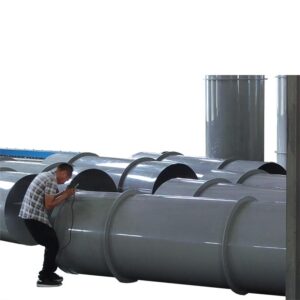
- Structural performance under negative pressure. Exhaust systems pull air — creating vacuum inside the duct. A round cross-section distributes this external pressure evenly as pure compression around the circumference. The material works in its strongest mode. A rectangular duct under the same vacuum experiences bending stress on the flat walls — the walls want to bow inward. Rectangular duct needs thicker walls or external stiffening ribs to resist the same negative pressure that round duct handles with its basic wall thickness. This structural advantage matters most in systems operating at -500 Pa or deeper — precisely the conditions in chemical plant and laboratory fume hood exhaust.
- Air leakage. Round duct has one longitudinal joint (if fabricated) or zero (if injection-molded). A fabricated rectangular duct has four corner welds per section — four potential leak paths. Every joint is a maintenance liability. In a negative-pressure exhaust system, leaks pull unfiltered air into the duct rather than pushing contaminated air out — but both are problems: inward leaks dilute the exhaust stream and increase the total air volume the fan and downstream treatment equipment must handle. Meeting EU Industrial Emissions Directive ductwork leakage standards is easier with round construction.
- Cleanability. Round duct has no corners for debris to accumulate. For pharmaceutical, food processing, and electronics cleanroom ventilation, this matters — smooth circular walls with no internal crevices are easier to clean and verify as clean. Rectangular duct corners trap dust and provide harborage for microbial growth in humid environments.
When Rectangular Duct Is the Right Choice
Round duct is the engineering default — but real installations sometimes demand rectangular. A rectangular duct can be the better choice when:
- Space height is constrained. A ceiling plenum with 400 mm clearance cannot fit a 500 mm round duct — but a rectangular duct of equal cross-sectional area at 800 mm wide × 245 mm high fits with room to spare. The energy penalty of the higher aspect ratio is the price of physical fit.
- Exposed ductwork must look intentional. Architectural exposed duct in laboratories and commercial spaces often specifies rectangular for clean lines that integrate with the building structure. Round duct works for industrial; rectangular reads as designed.
- Stacking multiple services. Rectangular ducts stack efficiently against flat surfaces — tight to the ceiling, against a wall, in a corner. Multiple rectangular ducts can be arranged side-by-side or stacked vertically, using space that would be wasted with round duct gaps.
For space-constrained installations where round duct won’t fit, see our PP Square Duct page covering rectangular duct options.
Sizing a Round Duct System
Duct diameter is determined by airflow (m3/h) and target velocity (m/s). Industrial exhaust systems typically design for 8-15 m/s — fast enough to prevent particulate settling, slow enough to keep pressure drop manageable:
| Air Volume (m3/h) | Duct Diameter at 10 m/s | Duct Diameter at 14 m/s |
|---|---|---|
| 1,000 | DN200 | DN160 |
| 3,000 | DN315 | DN250 |
| 5,000 | DN400 | DN355 |
| 10,000 | DN600 | DN500 |
| 20,000 | DN800 | DN700 |
| 40,000 | DN1200 | DN1000 |
These are starting points. Actual diameter depends on total system pressure drop including elbows, tees, reducers, dampers, and the downstream scrubber or filter. We calculate the full system curve. For diameter-specific product pages, see our DN15-DN200, DN250-DN600, DN600-DN1000, and DN1000-DN1500 round duct pages.
Material Selection for Round Duct
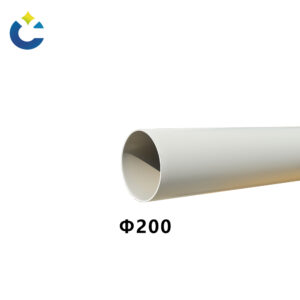
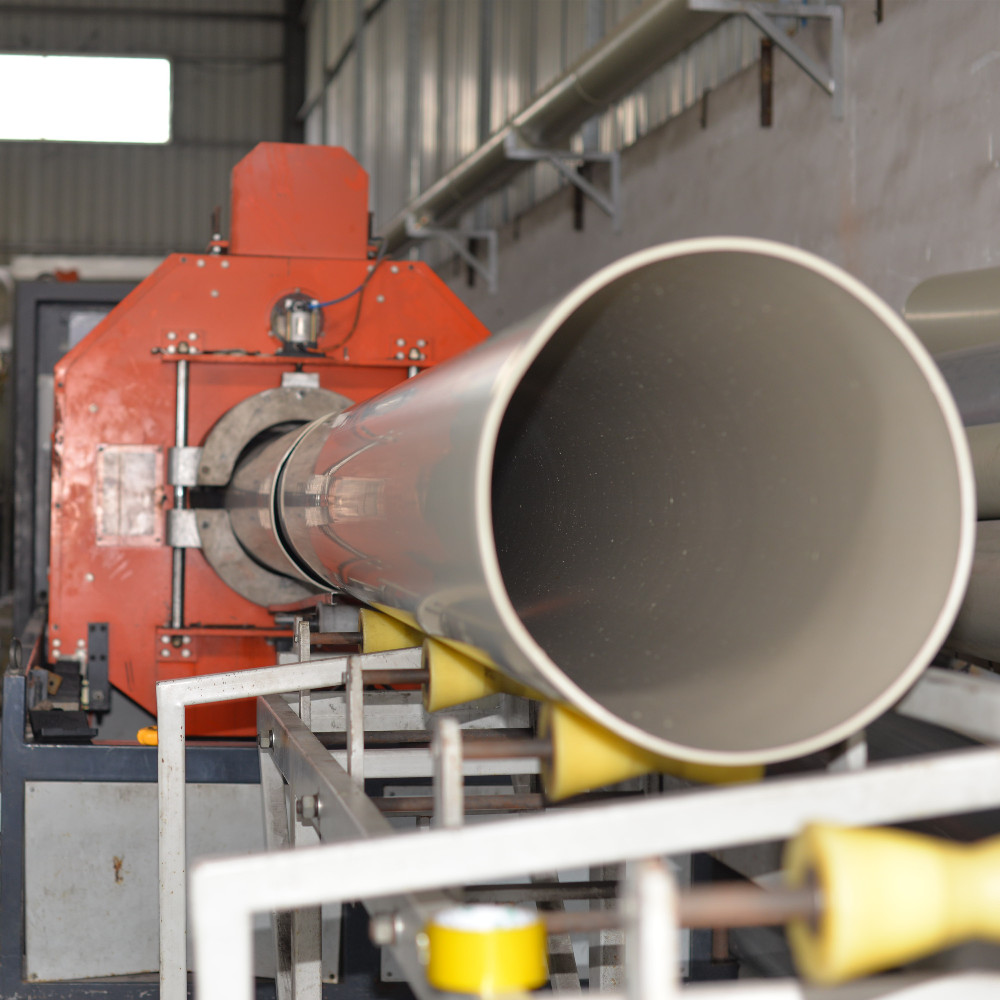
PP (polypropylene) is the standard for industrial ventilation — corrosion resistant, -10 to 80degC, injection molded to DN1000 seamless. PVC provides higher rigidity and UV stability for outdoor installations where appearance matters. FR-PP handles high-temperature exhaust (80-60 °C) and fire-rated applications per NFPA 90A. The material decision depends on what’s in your air stream and at what temperature. Full material specifications are on our PP Round Duct main page.
Send your system airflow, layout, and chemical exposure to xicheng023@outlook.com. We’ll calculate pressure drop, size the ductwork, and provide a complete quotation. WhatsApp: +86 18927456906.