Small-Diameter Duct: Where Precision Matters More Than Size
Large-diameter duct dominates the engineering discussion — main trunks, scrubber connections, high-airflow headers. But every large system terminates in small-diameter runs: the individual fume hood drop, the lab bench exhaust connection, the instrument vent line, the chemical storage cabinet extract. These DN15-DN200 lines are where the system interfaces with the user — and where undersized, poorly connected, or chemically incompatible duct creates daily problems.
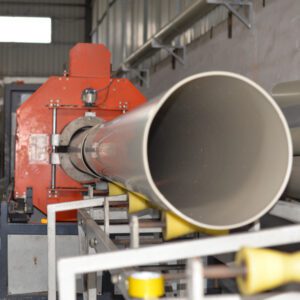
PP round duct in DN15-DN200 diameters is injection-molded as one seamless piece — no longitudinal weld, no spiral seam, no joint to fail. At these small diameters, the manufacturing quality difference between injection-molded and extruded pipe is most significant because wall thickness as a percentage of diameter is higher — making any wall thickness variation from extrusion more consequential for flow area and pressure drop. Our PP Round Duct main page covers the full diameter range and manufacturing specifications.
Applications for DN15-DN200 Duct
| DN Size | Typical Application | Airflow Range at 10 m/s |
|---|---|---|
| DN15-DN50 | Instrument vent lines, chemical storage cabinet extraction, single-point source capture, compressed air condensate drain | 6-70 m3/h |
| DN65-DN100 | Individual fume hood drops, lab bench extraction arms, welding fume extraction points, dust collector branch lines | 120-280 m3/h |
| DN125-DN150 | Multiple-hood zone laterals, small process equipment exhaust, tank vent lines, battery charging room extraction | 440-630 m3/h |
| DN175-DN200 | Laboratory zone headers (3-5 hoods), medium process exhaust, paint booth extraction, solvent storage room ventilation | 860-1,130 m3/h |
Why Injection Molding Matters Most at Small Diameters
Small-diameter pipe and duct is typically produced by extrusion — a continuous process where molten polymer is pushed through an annular die. Extrusion is efficient for high-volume production, but it has inherent limitations that become more significant as diameter decreases:
- Wall thickness consistency. Extruded pipe wall thickness can vary ±10-15% around the circumference due to die centering drift during production. In a DN200 pipe with 3 mm nominal wall, a 15% under-thickness means 2.55 mm at some points — a 15% reduction in pressure-containing capability. In a DN50 pipe with the same 3 mm wall, the percentage is the same but the absolute margin is smaller. Injection-molded pipe wall thickness is controlled by the mold cavity — consistent to ±2-3% around the full circumference.
- Internal surface finish. Extruded pipe internal surface roughness depends on die wear and polymer processing conditions. Injection-molded internal surfaces replicate the polished mold surface — consistently smoother. For small-diameter duct where wall friction dominates pressure drop (higher surface-to-volume ratio than large diameters), internal smoothness directly affects system pressure drop.
- Out-of-round tolerance. Extruded pipe can develop ovality as it cools — the pipe is not perfectly circular. This matters for socket-fit connections and flange alignment. Injection-molded pipe cools in a rigid mold that maintains circularity to tight tolerances.
Connection Options for Small-Diameter Duct
Small diameters enable connection methods that are impractical at large sizes:
- Socket coupling. For DN15-DN100 at low pressure. Pipe end slips into a socket fitting with integral EPDM or FKM sealing ring. Fast assembly, no welding, no bolts. Ideal for laboratory bench connections that may be reconfigured as experiments change. Not suitable for pressure above 2 bar or hazardous chemical exhaust where a leak at the coupling would create a personnel exposure risk.
- Butt welding. Standard for permanent connections at all diameters. Hot-gas extrusion welding produces a joint as strong as the parent pipe. Recommended for exhaust duct carrying hazardous or odorous compounds where joint leakage is unacceptable — and for any system operating under negative pressure.
- Compression fittings. For DN15-DN50 instrumentation and chemical dosing lines. PP compression fittings with EPDM or PTFE ferrules provide demountable, leak-tight connections without welding. Suitable for low-pressure liquid and gas service.
For connection accessories, see our Air Duct Connections & Flanges page.
Small-Diameter Duct in Laboratory Ventilation
Laboratory fume hood exhaust is the most demanding small-diameter duct application. Each hood typically requires 500-1,500 m3/h exhaust flow (depending on sash opening and face velocity target), which for a single-hood drop at 10 m/s corresponds to DN150-DN200. These individual drops connect to a zone header (DN250-DN400) which connects to the main building exhaust riser (DN500-DN1000+). The small-diameter drops are the most accessible part of the system — and the most likely to be modified during lab renovations. Socket-coupled or flanged connections at the hood interface allow reconfiguration without cutting welded ductwork.
For laboratory exhaust treatment, see our Laboratory Fume Hood Scrubber page. Laboratory exhaust duct design follows OSHA 29 CFR 1910.94 and OSHA Laboratory Safety Standard 29 CFR 1910.1450 requirements for chemical fume hood exhaust system integrity and chemical-resistant construction.
Send your duct schedule to xicheng023@outlook.com for a quotation including all diameters and fittings. WhatsApp: +86 18927456906.