
Product Overview
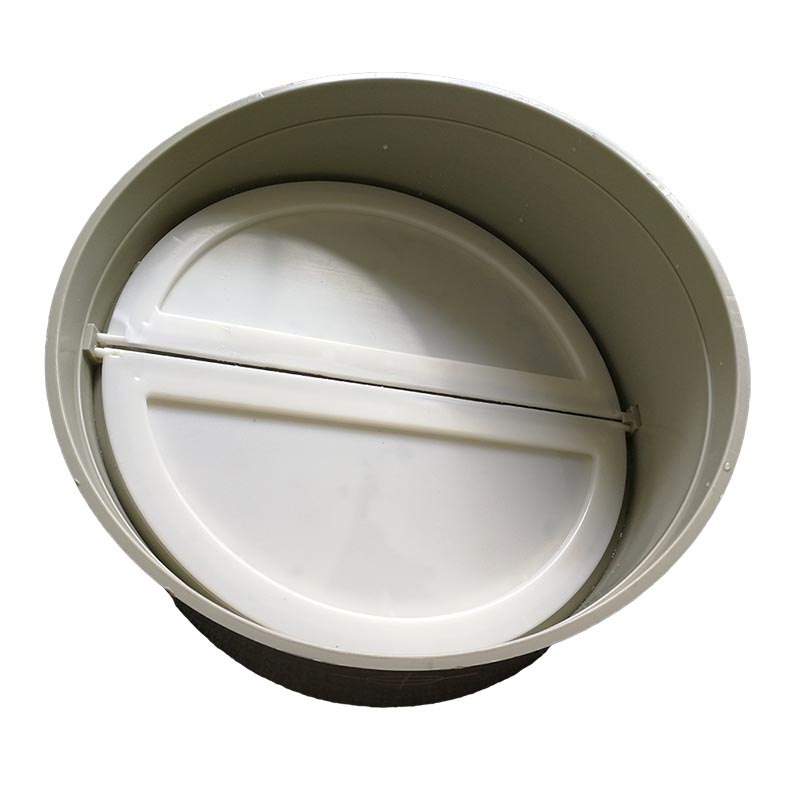
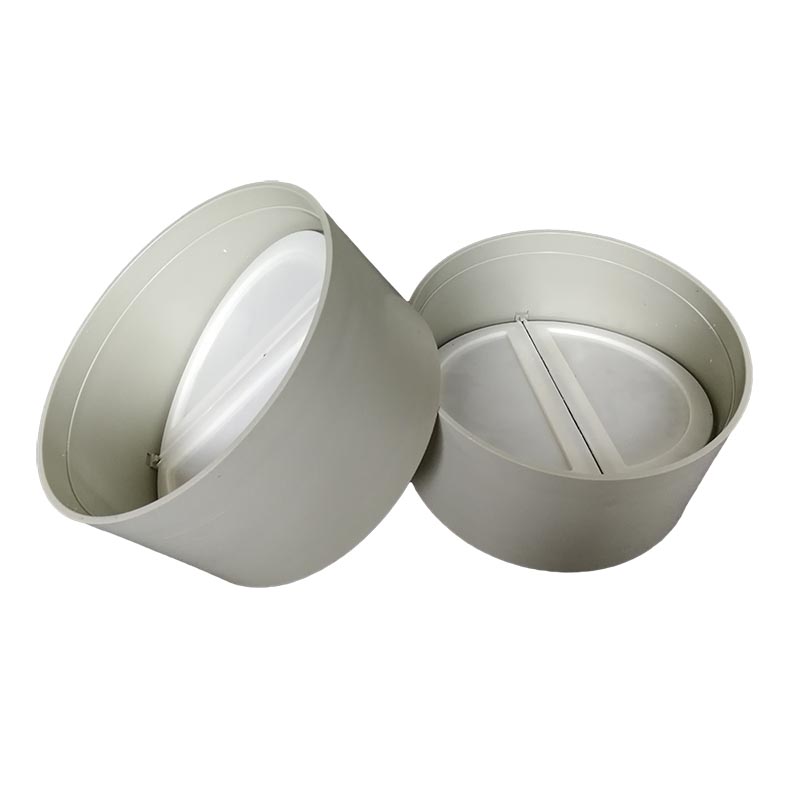
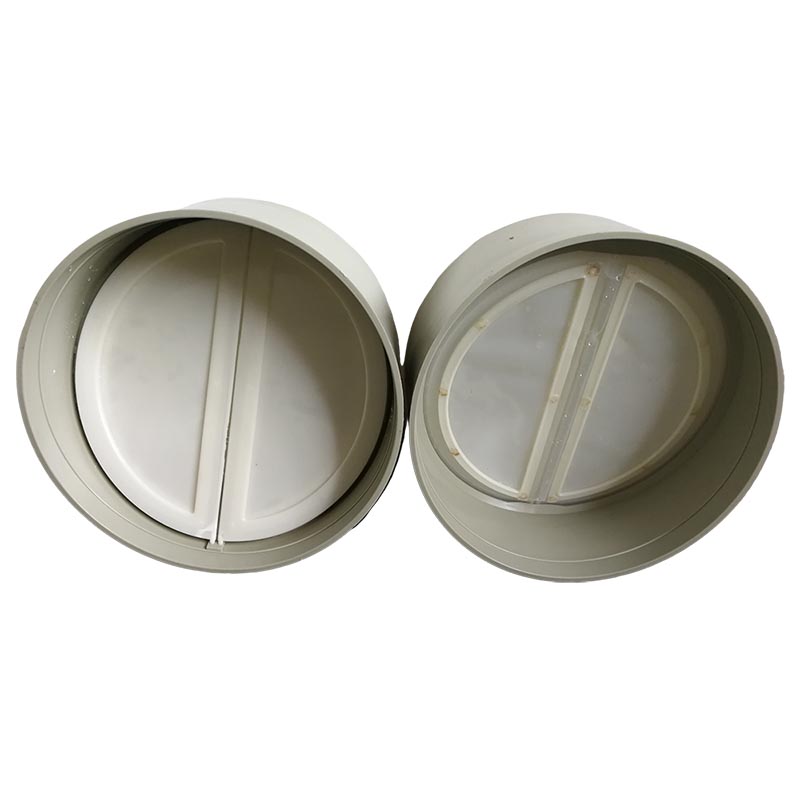
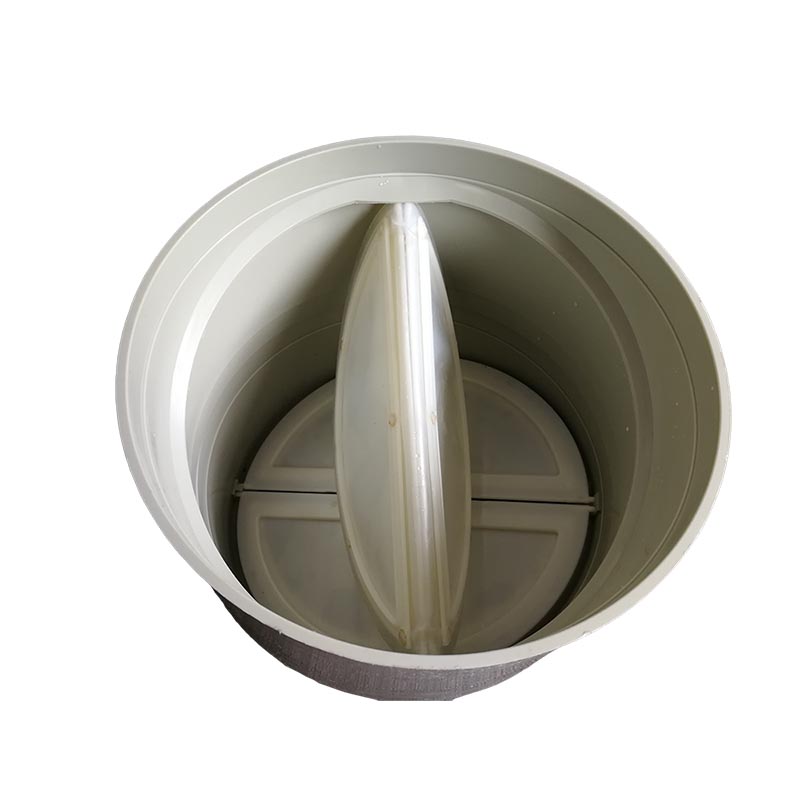
PP check valve for one-way airflow — allowing forward flow while automatically preventing reverse flow when downstream pressure exceeds upstream pressure or when the upstream fan stops. Used wherever backflow would cause contamination, damage, or safety risk: fan discharge to prevent reverse rotation from stack downdraft, multiple fans on a common header to prevent recirculation through a stopped fan, fresh air intake to prevent exhaust re-entrainment, and scrubber bypass lines where reverse flow would short-circuit the treatment system. The valve opens passively under forward flow pressure and closes under gravity or spring assist when flow stops or reverses — no external power, no control signal, no operator intervention.
| Application | Backflow prevention — fan discharge, common header isolation, fresh air intake protection, scrubber bypass prevention, stack downdraft blocking |
| Material | PP (standard), PVC (rigid), FR-PP (high-temp / flame retardant) — injection molded body and disc |
| Operation | Passive — opens under forward flow pressure, closes under gravity/spring when flow stops or reverses |
| Cracking pressure | 50-150 Pa — the minimum forward pressure to begin opening |
| Standard diameters | DN63 to DN315 (injection molded); larger custom fabricated |
| Connection | Flanged (standard) or butt-weld |
| Color | Beige / Dark Grey |
| Lead time | 5-15 days |
Where Check Valves Prevent System Failures
A check valve costs a fraction of the equipment it protects — but its failure can cause damage far exceeding its cost. Specifying the right check valve for each location is inexpensive insurance:
- Fan discharge — preventing reverse rotation. When a fan stops (power loss, maintenance shutdown, VFD at zero speed), the stack or downstream duct still contains a column of air. If that air is warmer than ambient (typical for process exhaust), natural draft can pull air backward through the stopped fan, spinning it in reverse. On restart, the motor must overcome this reverse rotation — drawing 6-8× full-load current and potentially tripping overload protection or damaging the motor. A check valve at the fan discharge closes when forward flow stops, preventing reverse rotation and protecting the fan motor.
- Common header — preventing recirculation through stopped fans. Multiple fans discharging into a common header (typical for multi-fan scrubber systems or parallel exhaust arrangements) create a risk: when one fan stops, the operating fans pressurize the common header, and that pressure can drive reverse flow through the stopped fan — short-circuiting exhaust back into the building through the idle branch. A check valve at each fan discharge isolates the stopped fan from the pressurized header. This is mandatory for parallel fan arrangements and supports EU Industrial Emissions Directive requirements for reliable exhaust system operation.
- Fresh air intake — preventing exhaust re-entrainment. Fresh air intakes and exhaust stacks on the same building can interact: under certain wind conditions, exhaust can be drawn into the fresh air intake. A check valve on the fresh air intake prevents reverse flow during these conditions — closing when the intake sees negative pressure relative to ambient. This is particularly important for laboratory and hospital ventilation where exhaust re-entrainment into the fresh air supply is a health risk.
Why Xicheng
16 years, 2600+ systems shipped worldwide. A check valve seems like the simplest valve in a ventilation system — no lever, no actuator, no control signal. But its reliability depends entirely on manufacturing quality — there is no operator to notice that it’s not sealing properly:
- Injection-molded disc and seat — precise alignment. The disc-to-seat contact determines how well the check valve seals against reverse flow. An injection-molded disc and integral seat provide consistent geometry and surface finish — the disc seats concentrically on the molded seat every time. Fabricated check valves with cut-and-welded seats have inherent dimensional variation that compromises sealing repeatability.
- Low cracking pressure — opens with minimal flow resistance. The cracking pressure (50-150 Pa) is the minimum forward pressure at which the check valve begins to open. Below this, the disc remains seated. A check valve with too high a cracking pressure restricts flow at low air volumes — effectively acting as an unintended throttle in the system. Our disc weight and spring assist (if equipped) are calibrated to provide the lowest cracking pressure consistent with reliable closure on flow reversal.
- Horizontal or vertical installation. Check valves are orientation-sensitive — gravity-assisted closure works with gravity, not against it. Horizontal installation (disc swings on horizontal spindle): works in any orientation, relies on spring assist for closure. Vertical installation with upward flow: gravity assists closure when flow stops. Vertical installation with downward flow: requires spring assist — gravity works against closure. Specify your installation orientation when ordering so we configure the spring assist correctly.
Send your check valve requirements to xicheng023@outlook.com. We’ll specify diameter, cracking pressure, and spring configuration. WhatsApp: +86 18927456906.
Core Advantages
- Passive Operation, No External Power: Opens under forward flow, closes under gravity/spring — no wiring, no control signal, no actuator. Operates automatically, every time.
- Injection-Molded Disc and Seat: Molded precision provides consistent sealing geometry — better repeatability than fabricated cut-and-welded seats.
- Low Cracking Pressure: 50-150 Pa opening threshold — minimal flow restriction, no unintended system throttling.
- Orientation-Configured Spring Assist: Spring calibrated for your installation orientation — horizontal, vertical up, or vertical down. Correct spring force for reliable closure regardless of gravity direction.
- Three Materials: PP for general corrosion, PVC for rigid UV-stable, FR-PP for fire-rated and high-temp to 60 °C.
Key Specifications
| Model No. | XC-11C |
| Material | PP / PVC / FR-PP — injection molded body and disc |
| Type | Swing check valve — passive, gravity/spring-assisted closure |
| Cracking Pressure | 50-150 Pa (spring-adjustable) |
| Standard Diameters | DN63 to DN315 (injection molded); larger custom fabricated |
| Installation Orientation | Horizontal, vertical up, or vertical down — spring configured per orientation |
| Connection Type | Flanged (standard) or butt-weld |
| Operating Temperature | PP: -10 to 80degC | PVC: 0 to 60degC | FR-PP: up to 60 °C |
| Service Life | 8-10 Years |
| Brand / Origin | Xicheng / China |
Certifications and Compliance
- CE Certified – Check Valve
- RoHS Compliant – All materials
- ISO 9001 – Quality Management System
- ISO 14001 – Environmental Management System
- SGS Tested – PP materials, disc seating leakage test, cracking pressure verification
- Design Compliance – Valves designed to meet EU Industrial Emissions Directive (2010/75/EU) exhaust system reliability requirements
How to Order
- You send – Duct diameter, material, installation orientation, maximum reverse pressure, connection type
- We confirm – Disc configuration, spring assist (if required), lead time, pricing
- We produce – 5-15 days. Disc seating verified, cracking pressure checked
Contact xicheng023@outlook.com or WhatsApp +86 18927456906 — quotation within 24 hours.
Complete Your System
- Manual Butterfly Damper – Manual flow control upstream of check valve
- Electric Motorized Damper – Automated damper for system isolation
- Solenoid Valve – Fast-acting on/off valve for safety interlocks
- PP Round Duct – Matching duct for check valve installation
FAQ
Do I need a spring-assist check valve or will gravity closure work?
Gravity closure is sufficient for: horizontal installation (disc swings on horizontal spindle, gravity provides closing force) and vertical installation with upward flow (gravity assists closure when flow stops). Spring assist is required for: vertical installation with downward flow (gravity works against closure), low-density gas where gravity force on the disc is inadequate, and any installation where closure speed matters (spring closes the disc faster than gravity alone, reducing the volume of reverse flow before the disc seats). When in doubt, specify spring assist — it adds minimal cost and works in all orientations.
How much reverse leakage is acceptable?
A properly seated injection-molded check valve allows 1-3% of forward flow capacity as reverse leakage at the closed position — sufficient for most industrial ventilation backflow prevention. For applications requiring zero reverse leakage (bubble-tight shutoff), a check valve alone is not sufficient — specify a check valve in series with a solenoid valve or motorized damper that closes positively when the fan stops. The check valve prevents immediate reverse flow; the positive shutoff device provides the final seal.
Can I use one check valve for multiple fans on a common header?
No — each fan needs its own dedicated check valve at its individual discharge, before the connection to the common header. A single check valve on the common header would prevent reverse flow from the stack but would not prevent recirculation between fans on the header — an operating fan would still backflow through a stopped fan if each fan doesn’t have its own check valve.