

Product Overview
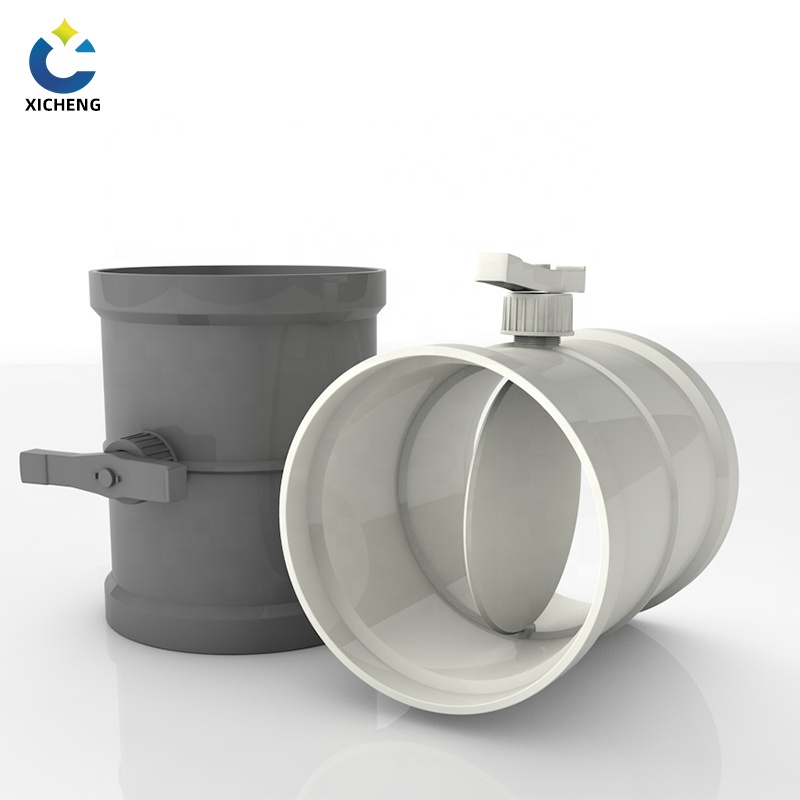
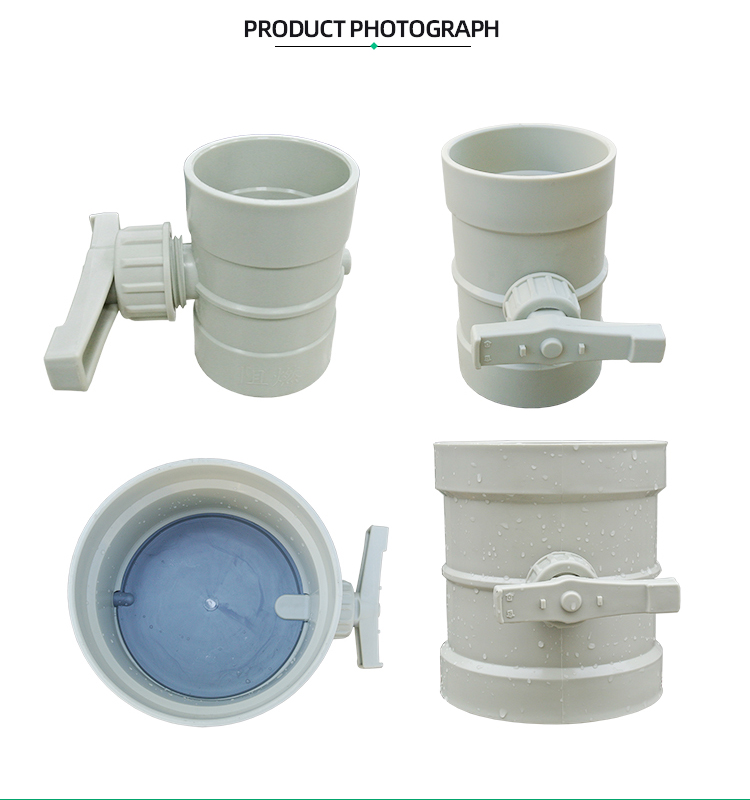
PP manual butterfly damper for industrial ventilation airflow control — injection molded one-piece body with integrated disc and spindle for precise manual adjustment of air volume in duct systems. Unlike conventional butterfly dampers assembled from multiple components with mechanical fasteners, our injection-molded design produces the valve body, disc, and seat as a single continuous piece in PP, PVC, or FR-PP. This eliminates leakage paths at component joints, reduces the number of corrosion-vulnerable parts, and provides a smooth internal flow path with minimal pressure drop when fully open.
| Application | Manual air volume control in ventilation ductwork, exhaust balancing, zone isolation, fresh air modulation |
| Material | PP (standard corrosion), PVC (rigid/UV-stable), FR-PP (flame retardant / 60 °C) — injection molded body and disc |
| Operation | Manual lever or hand-wheel; disc position adjustable from fully closed to fully open with position locking |
| Standard diameters | DN63, DN75, DN90, DN110, DN160, DN200, DN250, DN315 — injection molded; DN355+ custom fabricated |
| Pressure range | Working pressure drop 150-750 Pa; maximum duct pressure ±2,000 Pa |
| Color | Beige / Dark Grey |
| Lead time | 5-15 days standard diameters; 15-20 days custom |
Why Injection-Molded Damper Bodies Outperform Assembled
A butterfly damper has three critical seal points: the body-to-duct connection, the spindle penetration through the body, and the disc-to-seat contact when closed. In an assembled damper, each of these is a separate component with its own tolerance and assembly quality. An injection-molded damper integrates all three into one production cycle:
- Body and seat are one continuous piece. Assembled dampers bolt or weld a separate seat ring into the body — creating a joint that can leak, loosen under vibration, or corrode at the interface. Injection molding forms the body and seat as a single piece with identical material properties throughout — no joint to leak, no interface to corrode.
- Spindle penetration is molded, not drilled. Drilling a hole through the body for the spindle creates a raw PP surface with micro-cracks that can propagate under cyclic loading. The injection mold forms the spindle bore directly — smooth internal surface, no micro-cracks, and precise clearance control for minimum leakage around the spindle.
- Disc profile optimized for flow, not fabrication convenience. Fabricated damper discs are typically flat plates — simple to cut but aerodynamically poor, creating separation and turbulence when partially open. An injection-molded disc can incorporate a profiled cross-section that reduces pressure drop in the open position and provides more linear flow modulation as the disc angle changes. This supports accurate airflow balancing per ASHRAE ventilation system commissioning standards.
Why Xicheng
16 years, 2600+ systems shipped worldwide. A manual damper seems simple — a disc on a spindle in a body. But the difference between a damper that adjusts smoothly for 10 years and one that sticks, leaks, or corrodes within 2 years is in the manufacturing quality and material selection:
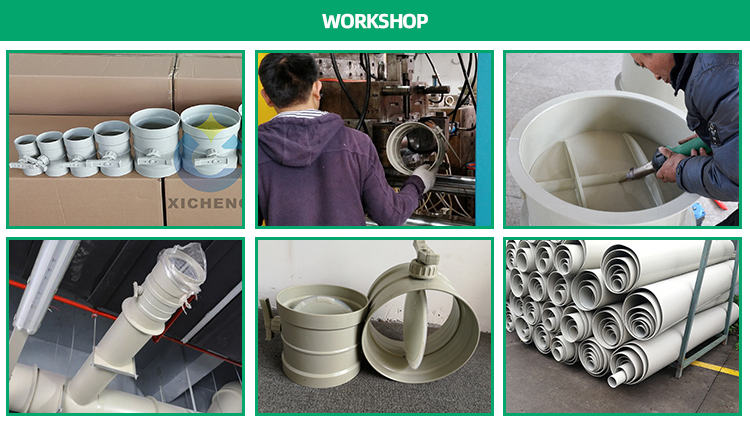
- Injection-molded in eight standard diameters. DN63 through DN315 are produced as injection-molded one-piece bodies — the disc, body, seat, and spindle bore all formed in a single mold cycle. Consistent quality across every unit, every diameter. Diameters above DN355 are custom-fabricated from PP/PVC/FR-PP sheet.
- Material matched to your duct. PP damper body with PP duct for chemical exhaust systems. PVC for rigid, UV-stable outdoor installations. FR-PP for high-temperature exhaust (up to 60 °C) and fire-rated ductwork. The damper material must match the duct material — mixed materials create thermal expansion mismatch and chemical compatibility problems at the connection flanges.
- Position locking that stays locked. The manual lever or hand-wheel mechanism includes a positive position lock that prevents the disc from drifting under airflow pressure pulsation — a common problem with friction-only manual dampers where the disc slowly migrates toward the closed position under continuous airflow, gradually strangling the system. Our lock mechanism uses a toothed engagement, not friction, to hold position.
- Installed in demanding ventilation systems. Chemical plant exhaust balancing (corrosive, negative pressure), laboratory fume hood zone dampers (frequent adjustment, chemical exposure), pharmaceutical HVAC (cleanroom pressurization control), and general industrial ventilation (duct isolation, fresh air modulation). Each application tests a different aspect of damper durability — corrosion, cycle life, or both.
Send your duct diameter and material to xicheng023@outlook.com. We’ll specify the right damper and provide a quotation. WhatsApp: +86 18927456906.
Core Advantages
- One-Piece Injection-Molded Body: No separate seat ring, no body-to-seat joint, no spindle penetration drilled after molding — all critical seal points formed in one mold cycle.
- Eight Standard Diameters In-Stock: DN63, 75, 90, 110, 160, 200, 250, 315 — injection molded. DN355+ custom fabricated to order.
- Profiled Disc for Smooth Modulation: Injection-molded disc with aerodynamic profile reduces pressure drop when open and provides linear flow control vs disc angle.
- Material-Matched to Your Duct: PP, PVC, and FR-PP options — same material as your duct system, same thermal expansion, same chemical resistance.
- Positive Position Lock: Toothed locking mechanism holds disc position under airflow pressure pulsation — no friction-only drift.
Key Specifications
| Model No. | XC-11 |
| Material | PP / PVC / FR-PP — injection molded body and disc |
| Type | Manual butterfly damper — lever or hand-wheel operation |
| Standard Diameters | DN63, DN75, DN90, DN110, DN160, DN200, DN250, DN315 |
| Custom Diameters | DN355+ — fabricated from PP/PVC/FR-PP sheet |
| Pressure Range | 150-750 Pa operating pressure drop |
| Air Volume Range | 50-1,100 m3/h per damper (diameter-dependent) |
| Control Accuracy | ±5% air volume |
| Operating Temperature | PP: -10 to 80degC | PVC: 0 to 60degC | FR-PP: up to 60 °C |
| Service Life | 8-10 Years |
| Brand / Origin | Xicheng / China |
Certifications and Compliance
- CE Certified – Manual Damper, Electric Damper, Air Valve
- RoHS Compliant – All damper materials
- ISO 9001 – Quality Management System
- ISO 14001 – Environmental Management System
- SGS Tested – PP material properties, disc torque testing, leakage rate at closed position
- Design Compliance – Dampers designed for ASHRAE ventilation system balancing standards and EU Industrial Emissions Directive exhaust system control requirements
How to Order
- You send – Duct diameter, material (PP/PVC/FR-PP), airflow range, operating pressure, damper quantity
- We confirm – Diameter within standard range or custom, material availability, lead time, pricing
- We produce – 5-15 days for standard diameters; 15-20 for custom
Contact xicheng023@outlook.com or WhatsApp +86 18927456906 — quotation within 24 hours.
Complete Your System
- Manual Rectangular Damper – Rectangular duct manual airflow control
- Manual Air Control Valve – Multi-turn precision flow control valve
- Electric Motorized Damper – Motorized version for automated control
- PP Round Duct – Matching round duct for damper installation
FAQ
Butterfly damper or opposed-blade damper — which should I specify?
Butterfly damper: single disc rotating on a central spindle. Best for on/off isolation and general flow modulation in round duct. Simpler mechanism, fewer parts, lower cost. Opposed-blade damper: multiple linked blades rotating in opposite directions. Provides more linear flow control and better modulation at partial-open positions. Typically used in rectangular duct or where precise flow control across the full range is required. For most industrial ventilation round duct applications, a butterfly damper is the appropriate choice.
What is the leakage rate when the damper is fully closed?
An injection-molded butterfly damper with integral seat achieves approximately 2-5% of full-open flow at the closed position — sufficient for isolation in non-critical applications. For applications requiring bubble-tight shutoff (zero leakage), an inflatable-seal damper or guillotine damper is required — contact us for custom damper solutions beyond the standard butterfly range.
Can the manual damper be upgraded to electric actuation later?
Yes. The spindle and mounting flange are designed to accept both manual lever and electric actuator attachment. If you start with manual operation and later want to automate, the actuator can be retrofitted without replacing the damper body. See our Electric Motorized Damper page for actuator options.

