
Product Overview
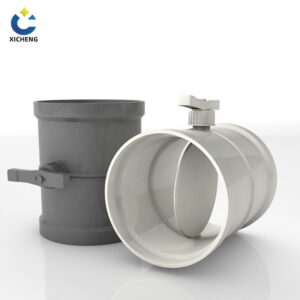
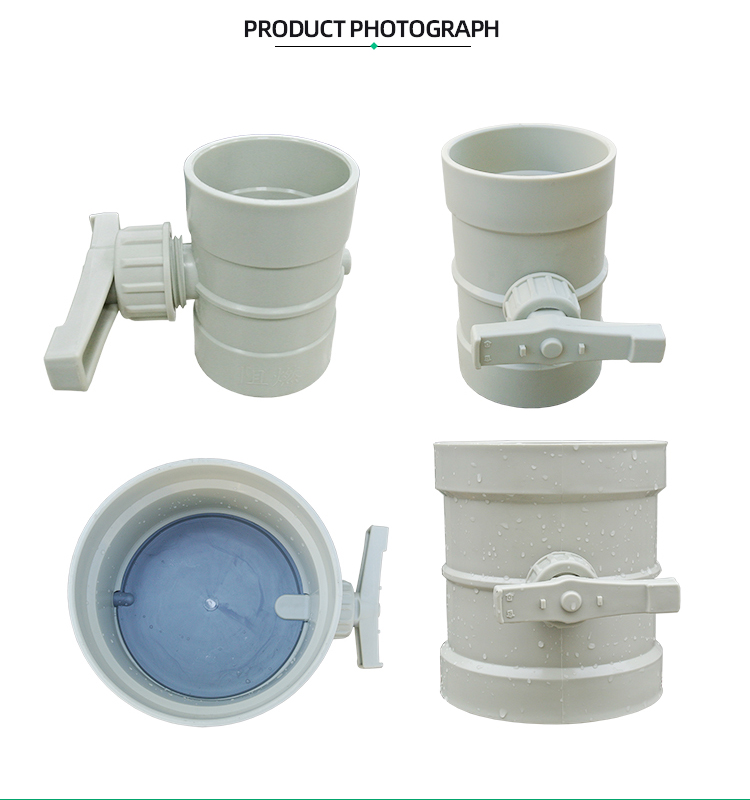
PP manual air control valve for general-purpose airflow regulation in ventilation piping, process air lines, and duct branch connections — distinct from butterfly dampers in being designed for inline pipe installation rather than in-duct mounting. The valve body connects directly to pipe flanges or via socket/weld ends, making it the correct choice for individual branch line flow control, equipment isolation, and applications where a damper’s in-duct disc would obstruct access or create unacceptable turbulence upstream of sensitive equipment. Available in PP, PVC, and FR-PP for pipe diameters from DN63 to DN315 as standard injection-molded bodies, with larger diameters fabricated to order.
| Application | Inline pipe air volume regulation, branch line isolation, process air flow control, tank vent modulation, instrument air pressure relief |
| Material | PP (standard corrosion), PVC (rigid/UV-stable), FR-PP (flame retardant / 60 °C) — injection molded body |
| Operation | Manual lever or multi-turn hand-wheel; precise flow adjustment with positive position locking |
| Standard diameters | DN63, DN75, DN90, DN110, DN160, DN200, DN250, DN315 — injection molded; DN355+ custom |
| Connection type | Flanged (standard), butt-weld, or socket — matched to your pipe specification |
| Pressure range | 150-750 Pa operating; 2,000 Pa max static |
| Color | Beige / Dark Grey |
| Lead time | 5-15 days standard; 15-20 days custom |
Valve vs Damper: Which Goes Where
The distinction between an air control valve and a butterfly damper is not just terminology — it’s about installation location, flow characteristic, and maintenance access:
- Valve = inline pipe-mounted. An air control valve connects directly to pipe flanges or socket/weld ends — it’s part of the pipe run, supported by the pipe, and removed by unbolting flanges. The flow passes through the valve body with minimal disturbance to the velocity profile because the throttling element is contained within a cylindrical passage matching the pipe diameter. This is the correct choice for individual branch line control where each branch needs independent flow adjustment without affecting adjacent lines.
- Damper = in-duct mounted. A butterfly damper fits between duct flanges inside the duct cross-section — it’s a duct component, not a pipe component. The disc sits in the airflow path, creating turbulence downstream that equalizes over several duct diameters. This is correct for main duct flow control where the downstream turbulence is acceptable and the damper’s lower cost per unit diameter is advantageous.
- When the distinction blurs. In small-diameter duct systems (under DN315), the same injection-molded body can serve as either a valve or a damper depending on connection type — flanged ends make it a valve; weld-in installation makes it a damper. The functional difference is in how it’s installed, not how it’s manufactured. This overlap is why many small-system designers specify air control valves for all flow control points — consistency simplifies spare parts and maintenance procedures. For duct-specific applications, see our Manual Butterfly Damper page. For rectangular ductwork, see Manual Rectangular Damper.
Flow Control Characteristics
How the valve modulates flow — the relationship between lever position and resulting airflow — determines whether system balancing is straightforward or frustrating:
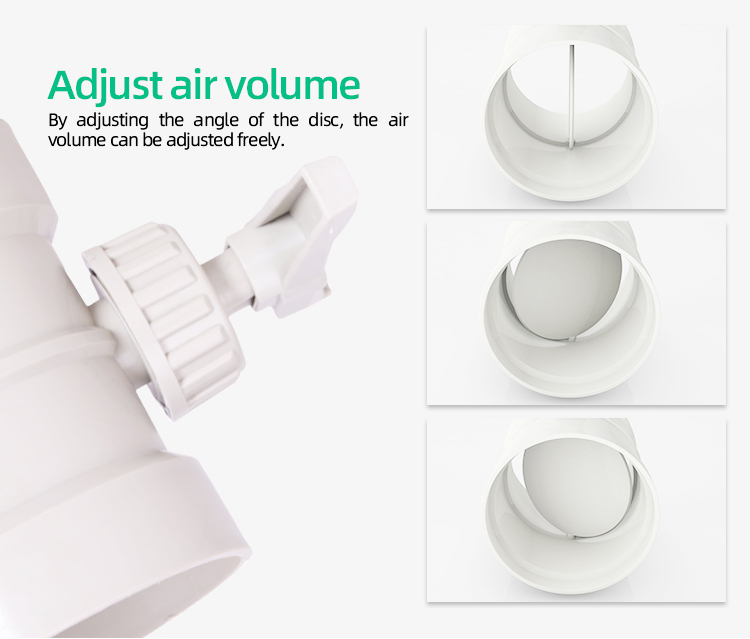
- Pressure-independent control. Mechanical pressure compensation components in the valve body automatically adjust the throttling position in response to inlet/outlet pressure changes — maintaining a constant set airflow even as duct static pressure varies from 150 to 750 Pa. This is the defining advantage of an air control valve over a simple damper: set it once, and it holds flow regardless of upstream pressure fluctuations from other branches opening or closing. For multi-branch exhaust systems where branches interact, pressure-independent valves eliminate the iterative rebalancing that simple dampers require after each adjustment.
- ±5% air volume accuracy. Airflow is set via calibrated lever position or multi-turn hand-wheel with position scale. Once set, the mechanical compensation maintains flow within ±5% of setpoint across the operating pressure range. This accuracy supports ASHRAE ventilation system balancing tolerances without requiring in-line airflow measurement at each branch.
- Fast response to pressure changes. The mechanical pressure compensation responds to static pressure changes in under 1 second — fast enough to maintain flow stability during normal system operation (filter loading, damper adjustments elsewhere, fan speed changes). This eliminates the flow hunting that simple dampers exhibit when upstream pressure changes.
Why Xicheng
16 years, 2600+ systems shipped worldwide. An air control valve with pressure-independent flow regulation is more complex than a simple damper — the pressure compensation mechanism must operate reliably for years in corrosive, dusty, or humid duct environments without maintenance access:
- Injection-molded valve body with integral compensation chamber. The pressure compensation components — mechanical springs, diaphragms, and linkages — are housed within the injection-molded PP body. Unlike assembled valves where the compensation mechanism is a bolted-on external module (creating additional leak paths and corrosion-vulnerable fasteners), our integrated design protects the mechanism within the valve body. The only penetrations are the operating lever spindle and the flange connections — both sealed at the mold level, not at the assembly level.
- Dust-tolerant, maintenance-free design. Conventional air control valves use airflow sensors (pitot tubes, thermal anemometers, or differential pressure taps) to measure flow for closed-loop control. In industrial exhaust carrying particulate, these sensors clog — the control signal drifts, the valve position hunts, and eventually the system faults. Our pressure-independent valve uses mechanical compensation that requires no airflow sensor — no sensor to clog, no signal to drift, no maintenance call for sensor cleaning. This is the single most important reliability advantage in industrial service.
- Installed where reliability matters most. Chemical plant fume extraction branches (corrosive, inaccessible, cannot shut down for valve maintenance), pharmaceutical lab exhaust (precise face velocity control at each hood requires stable branch flow), wastewater treatment odour control (H2S-laden air, high humidity, limited maintenance access), electronics factory process tool exhaust (production cannot stop for HVAC maintenance). In all these applications, a valve failure is not just an HVAC problem — it’s a production problem.
- Control mode flexibility. Standard manual operation with lever or hand-wheel. PLC-compatible position feedback available for integration into building management systems — the valve reports its position without the BMS controlling it. This hybrid approach gives operators manual authority at the valve while providing remote visibility to the control room.
Send your airflow requirements and pipe diameters to xicheng023@outlook.com. We’ll specify the right valve configuration and provide a complete quotation. WhatsApp: +86 18927456906.
Core Advantages
- Pressure-Independent Flow Control: Mechanical compensation maintains set airflow ±5% as duct pressure varies from 150-750 Pa — no rebalancing after system changes, no airflow sensor to clog.
- One-Piece Injection-Molded Body: Valve body, compensation chamber, and spindle bore formed in a single mold cycle — no bolted-on external modules creating leak paths.
- Dust-Tolerant, Maintenance-Free: No airflow sensor, no differential pressure taps, no electronics — purely mechanical operation that tolerates particulate-laden industrial exhaust.
- Sub-1-Second Pressure Response: Mechanical compensation responds faster than electronic actuator-driven dampers — maintaining flow stability during system pressure transients.
- Flanged, Weld, or Socket Connection: Connection type matched to your pipe specification — flanged for serviceable installations, welded for permanent, socket for quick-fit small diameters.
Key Specifications
| Model No. | XC-11V |
| Material | PP / PVC / FR-PP — injection molded valve body |
| Type | Manual air control valve with mechanical pressure compensation |
| Standard Diameters | DN63, DN75, DN90, DN110, DN160, DN200, DN250, DN315 |
| Custom Diameters | DN355+ — fabricated to order |
| Air Volume Range | 50-1,100 m3/h (diameter-dependent) |
| Control Accuracy | ±5% of set airflow across 150-750 Pa |
| Response Time | <1 second to static pressure change |
| Operating Temperature | PP: -10 to 80degC | PVC: 0 to 60degC | FR-PP: up to 60 °C |
| Connection Type | Flanged, butt-weld, or socket |
| Service Life | 8-10 Years |
| Brand / Origin | Xicheng / China |
Certifications and Compliance
- CE Certified – Air Control Valve
- RoHS Compliant – All valve materials
- ISO 9001 – Quality Management System
- ISO 14001 – Environmental Management System
- SGS Tested – PP material properties, pressure compensation calibration, leakage testing
- Design Compliance – Valves designed to meet ASHRAE air balancing standards and EU Industrial Emissions Directive (2010/75/EU) exhaust system airflow control requirements
How to Order
- You send – Pipe diameter, material (PP/PVC/FR-PP), airflow range, connection type, operating pressure range
- We confirm – Diameter within standard range or custom, pressure compensation calibration range, lead time, pricing
- We produce – 5-15 days standard; 15-20 days custom
Contact xicheng023@outlook.com or WhatsApp +86 18927456906 — quotation within 24 hours.
Complete Your System
- Manual Butterfly Damper – In-duct damper for main duct flow control
- Manual Rectangular Damper – Rectangular duct airflow control
- Electric Motorized Damper – Motorized automated airflow control
- PP Industrial Pipe – Matching pipe for valve installation
FAQ
What is pressure-independent control and why does it matter?
In a multi-branch exhaust system, closing a damper on one branch increases static pressure in the main header — which changes the flow through every other branch unless each branch’s flow control device compensates. A pressure-independent valve mechanically adjusts its internal throttling position to maintain constant flow as upstream or downstream pressure changes — eliminating the interaction between branches that makes multi-branch systems difficult to balance. Without pressure-independent control, adjusting one branch means rebalancing all branches. With it, each branch holds its set flow regardless of what other branches do.
How is this different from a motorized VAV box?
A motorized VAV (Variable Air Volume) box uses an electronic actuator, airflow sensor, and controller to modulate a damper in response to a control signal — it provides closed-loop electronic flow control. Our manual air control valve provides mechanical pressure-independent flow regulation without electronics, sensors, or power. The VAV box is more flexible (variable setpoint from BMS, programmable control sequences) but more complex (sensors to calibrate and maintain, actuators to fail, controllers to program). The manual valve is simpler, more robust in industrial environments, and does not require power or communication wiring at the installation point.
Can the manual valve be upgraded to electric actuation?
Yes — the spindle and mounting interface are compatible with both manual lever and electric actuator attachment. The pressure-independent mechanical compensation continues to function regardless of actuation method. If you start with manual operation and later automate, the actuator can be field-retrofitted. See our Electric Motorized Damper page for actuator options.