
Product Overview
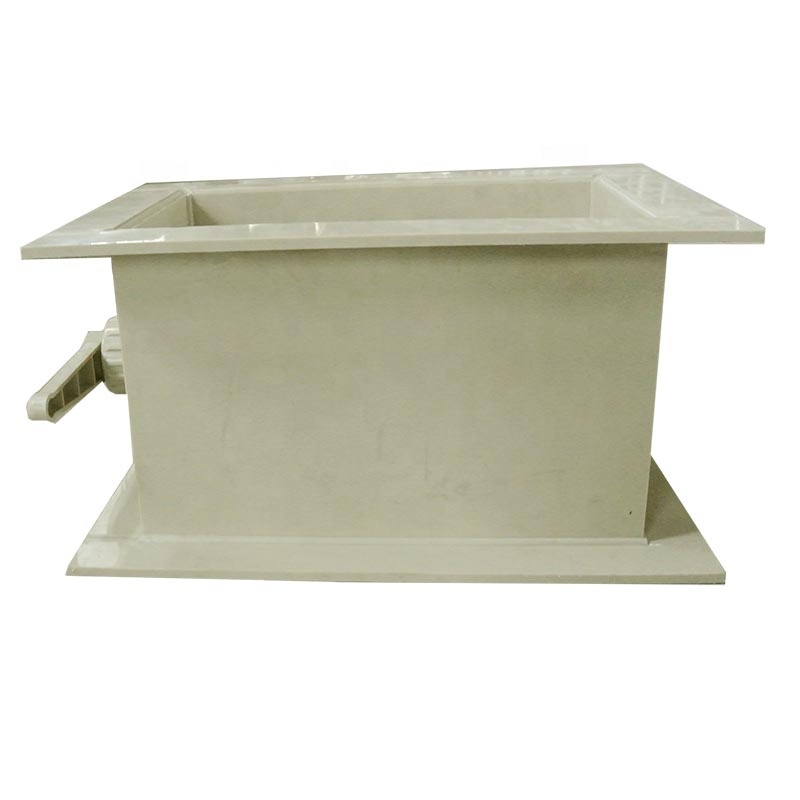
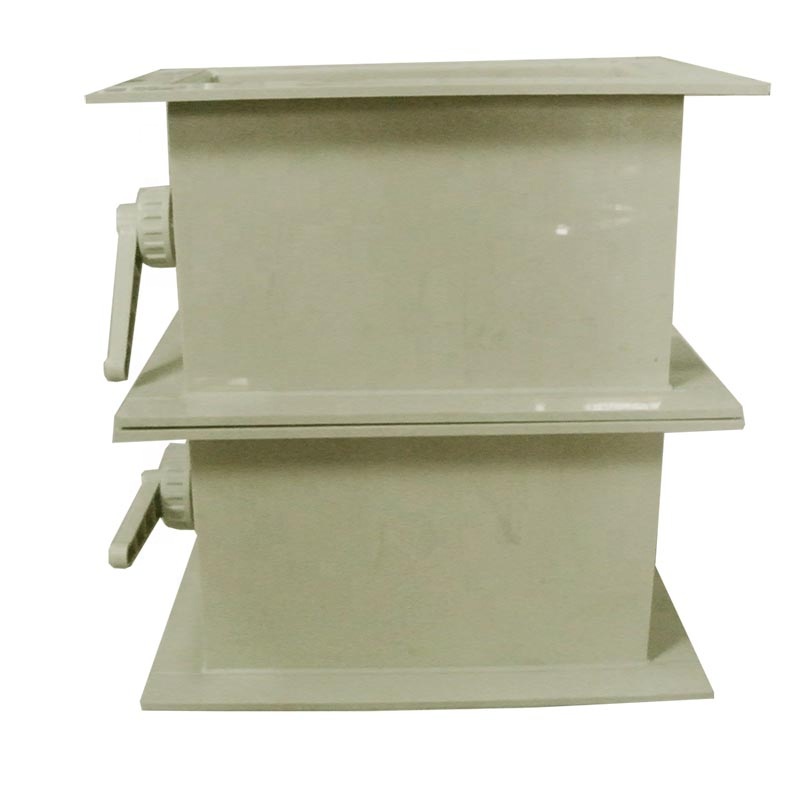
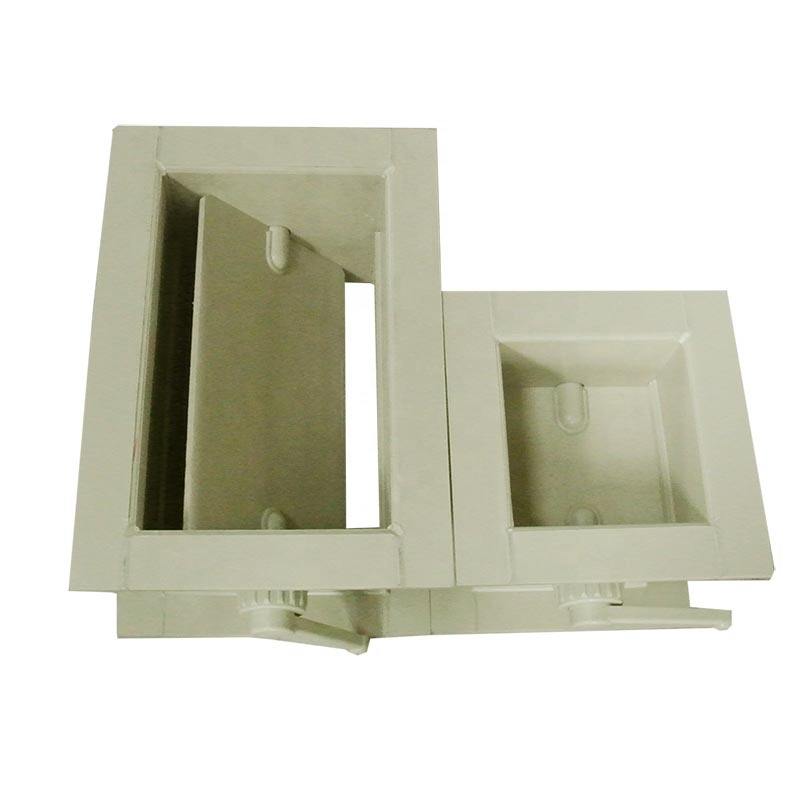
PP manual rectangular damper for airflow control in square and rectangular ventilation ductwork — custom-fabricated to your duct’s exact internal cross-section in PP, PVC, or FR-PP. Unlike round butterfly dampers that use a single rotating disc, rectangular dampers employ multiple linked opposed-blade or parallel-blade configurations spanning the short dimension. Each blade is individually supported with intermediate bearings for spans exceeding 300 mm. The welded PP frame includes external rib reinforcement engineered for the full duct static pressure — preventing frame deflection that would cause blade binding or uncontrolled leakage at partial-open positions.
| Application | Manual airflow modulation and isolation in rectangular ventilation ductwork — zone balancing, exhaust isolation, fresh air control, laboratory fume hood branch dampers |
| Material | PP (standard corrosion), PVC (rigid/UV-stable), FR-PP (flame retardant / 60 °C) — welded frame with injection-molded or fabricated blades |
| Blade configuration | Opposed-blade (linear modulation, recommended) or parallel-blade (two-position isolation) |
| Custom sizing | Fabricated to your duct’s exact width × height; blade span, count, and bearing spacing engineered per order |
| Operation | Manual lever or hand-wheel with positive position lock; blade angle adjustable from fully closed to fully open |
| Pressure range | Operating pressure drop 150-750 Pa; frame reinforced for full duct static pressure at closed position |
| Color | Beige / Dark Grey |
| Lead time | 15-20 days custom fabrication |
Why Rectangular Dampers Are Completely Different Engineering
A round butterfly damper uses one disc on one spindle — simple mechanics, well-understood flow characteristic. A rectangular damper cannot use this design because a circle cannot seal against four flat walls. The engineering challenge shifts from single-disc dynamics to multi-blade coordination, frame rigidity over long flat spans, and blade tip sealing along straight edges:
- Multi-blade linked motion. Each blade is an independent aerodynamic surface rotating on its own spindle. All blades are connected by a common linkage bar — when the operator moves the lever, every blade must rotate to the same angle simultaneously. If one blade binds (from frame deflection, corrosion at the bearing, or particulate accumulation), the entire damper loses calibrated flow control. Our blade bearings are PP-on-PP with calculated clearance for thermal expansion — no metal bushings to corrode, no lubricant to attract duct dust.
- Frame rigidity is the limiting design factor. The long sides of a rectangular damper frame act as simply supported beams under the full duct static pressure when the damper is closed. A 1,000 mm × 400 mm frame at 1,000 Pa closed pressure experiences approximately 400 N of distributed load on each 1,000 mm side — enough to deflect a 10 mm PP frame by 2-3 mm at mid-span. That 2-3 mm of frame bow creates a gap between the blade tips and the frame in the center — exactly where you need the seal. External rib stiffeners welded to the frame divide the unsupported span and reduce deflection to under 0.5 mm. This level of frame engineering is not optional — it’s the difference between a damper that controls flow predictably and one that leaks unpredictably. For systems requiring ASHRAE commissioning standards, damper leakage at closed position directly affects system balance.
- Blade tip sealing along straight edges. Round butterfly dampers seal disc-to-body on a continuous circular seat. Rectangular dampers seal blade tips to four separate flat frame surfaces — the two short sides and the two long sides. The blade tip-to-frame gap must be consistent along the full blade length. Frame deflection makes the gap wider in the center. Blade deflection under pressure makes it wider still. Our blade thickness and bearing spacing are calculated to limit combined blade + frame deflection to under 1% of blade span — maintaining effective sealing contact along the full blade length.
Opposed-Blade vs Parallel-Blade: The Control Characteristic
Blade rotation direction fundamentally changes how the damper modulates flow:
| Characteristic | Opposed-Blade | Parallel-Blade |
|---|---|---|
| Blade motion | Adjacent blades rotate in opposite directions | All blades rotate in the same direction |
| Flow vs angle | Near-linear — 50% open ≈ 50% flow | Non-linear — 50% open delivers 70-80% of full flow |
| Downstream profile | Uniform — converging streams from adjacent gaps mix rapidly | Stratified — airflow directed in blade angle direction |
| Actuator torque | Lower — adjacent blade forces partially cancel | Higher — all blades see same aerodynamic load |
| Best for | Flow modulation, zone balancing, VAV, partial-open operation | Open/close isolation, two-position service |
Why Xicheng
16 years, 2600+ systems shipped worldwide. Rectangular damper fabrication is custom engineering per order — no two ducts have exactly the same internal dimensions. The quality of the fabrication determines whether the damper controls flow for 10 years or binds, leaks, and gets replaced in 3:
- Engineered per order, not adapted from a standard size. We start with your duct’s actual internal width and height, static pressure, and control requirement (modulation or isolation). From this we calculate: blade count (short dimension ÷ optimal blade span), blade thickness (for deflection limit at closed pressure), bearing spacing (intermediate bearings where span exceeds 300 mm), frame thickness and reinforcement rib count (for frame deflection limit), and linkage bar design (for simultaneous blade rotation without binding). The output is a fabrication drawing unique to your order.
- PP hot-gas welding by qualified technicians. The frame is welded from PP sheet — four sides, corner joints, and external rib stiffeners. Unlike mechanical assembly with fasteners that loosen under vibration, hot-gas extrusion welding creates joints with strength equal to the parent PP material. Corner welds are full-penetration — no partial welds that can crack under frame deflection cycling.
- Installed in demanding rectangular duct systems. Laboratory building fume hood zone dampers (daily adjustment, chemical exposure, access-limited ceiling plenums), pharmaceutical cleanroom return air dampers (precise pressurization control, low leakage requirement), chemical plant rectangular exhaust mains (corrosive, negative pressure, large cross-section), electronics factory process exhaust (frequent production tool reconfiguration requiring damper repositioning).
Send your duct internal dimensions, static pressure, and control requirement to xicheng023@outlook.com. We’ll engineer the damper to your exact conditions and provide a complete proposal with fabrication drawings. WhatsApp: +86 18927456906.
Core Advantages
- Custom-Fabricated to Your Duct Dimensions: Not adapted from standard sizes — frame, blade count, and reinforcement calculated from your actual width, height, and pressure.
- Frame Deflection Engineered: External rib stiffeners calculated for your static pressure — limiting frame bow to under 0.5 mm for consistent blade tip sealing across the full span.
- Opposed-Blade for Predictable Modulation: Near-linear flow vs opening angle — 50% open delivers ~50% flow. Critical for multi-branch exhaust balancing where damper positions interact.
- PP-on-PP Bearings, No Lubrication: Blade spindle bearings use PP-on-PP contact surfaces with thermal expansion clearance — no metal corrosion, no lubricant attracting duct particulate.
- Material-Matched to Your Rectangular Duct: PP, PVC, or FR-PP damper frame and blades matching your duct material — same thermal expansion, same chemical resistance, no mixed-material joint problems.
Key Specifications
| Model No. | XC-11R |
| Material | PP / PVC / FR-PP — welded frame, injection-molded or fabricated blades |
| Type | Manual rectangular damper — opposed-blade or parallel-blade |
| Custom Sizing | Fabricated to your duct internal width × height |
| Blade Span | Up to 300 mm per unsupported segment; intermediate bearings for wider ducts |
| Frame Reinforcement | External PP ribs at calculated spacing; mandatory on frame sides ≥600 mm |
| Pressure Range | 150-750 Pa operating; frame rated for full duct static pressure at closed position |
| Operating Temperature | PP: -10 to 80degC | PVC: 0 to 60degC | FR-PP: up to 60 °C |
| Service Life | 8-10 Years |
| Brand / Origin | Xicheng / China |
Certifications and Compliance
- CE Certified – Manual Rectangular Damper
- RoHS Compliant – All damper materials
- ISO 9001 – Quality Management System
- ISO 14001 – Environmental Management System
- SGS Tested – PP sheet mechanical properties, weld integrity, blade deflection testing
- Design Compliance – Dampers designed to meet ASHRAE ventilation system balancing and commissioning standards and EU Industrial Emissions Directive (2010/75/EU) exhaust system control requirements
How to Order
- You send – Duct internal width × height, duct material, static pressure at damper location, control requirement (modulation or isolation)
- We design – Blade count, blade thickness, bearing spacing, frame thickness, external rib reinforcement, linkage configuration
- You approve – Fabrication drawing with dimensions, blade configuration, reinforcement details, and pricing
- We fabricate – 15-20 days. Frame welded, blades installed, linkage adjusted, blade travel verified before shipment
Contact xicheng023@outlook.com or WhatsApp +86 18927456906 — design proposal within 24 hours.
Complete Your System
- Manual Butterfly Damper – Round duct manual airflow control damper
- PP Square Duct – Rectangular ventilation duct
- Square Duct with Flange – Flange-reinforced rectangular duct
- Electric Motorized Damper – Automated damper for remote control systems
FAQ
Opposed-blade or parallel-blade — which should I choose?
Choose opposed-blade if the damper will operate at partial-open positions — for flow modulation, zone balancing, and VAV control. The near-linear flow characteristic makes system commissioning predictable. Choose parallel-blade if the damper serves as a two-position isolation device — fully open or fully closed. The simpler linkage is adequate for isolation and costs slightly less, but the non-linear flow characteristic makes it unsuitable for modulation.
How much leakage should I expect at fully closed?
A well-fabricated rectangular opposed-blade damper with engineered frame rigidity achieves approximately 3-8% of full-open flow at the closed position. Achieving below 3% requires blade edge seals (flexible PP or EPDM lips on the blade tips) and tighter frame deflection tolerances. For applications requiring bubble-tight shutoff, contact us for custom damper solutions with inflatable seals or guillotine-type isolation dampers.
Can you match an existing damper’s dimensions for replacement?
Yes — this is a common request. Send us the existing damper’s external frame dimensions and the duct’s internal cross-section (they may differ if the old damper had an adapter frame). We’ll fabricate a direct replacement that fits the existing duct and flange bolt pattern. Include photos of the existing installation if possible — they help identify any field modifications that affect fit.