When the Environment Chooses the Duct Material
Commercial HVAC duct handles clean air at moderate temperature in dry ceiling plenums — galvanized steel is fine. Laboratory and industrial duct handles a different reality: acid fumes from fume hoods, solvent vapors from process equipment, high humidity from wet scrubbers, and temperature swings from intermittent process operation. In these environments, the duct material is not a choice — it’s dictated by what flows through it. PP and PVC square duct survive conditions that destroy galvanized steel within 2-3 years.
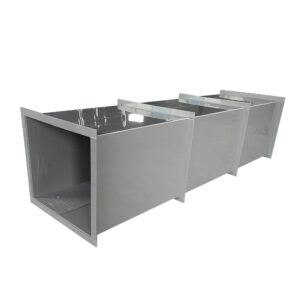
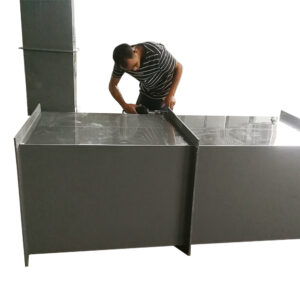
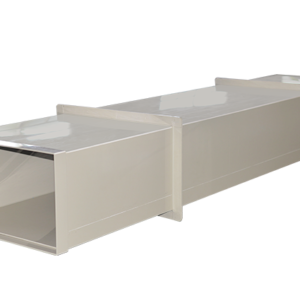
Laboratory buildings and industrial plants share a common constraint: space. Fume hood exhaust ductwork competes with cable trays, plumbing, fire sprinkler lines, medical gas piping, and structural steel — all in the same ceiling plenum. Square and rectangular duct earns its place here because it stacks efficiently against flat surfaces, fitting into spaces that round duct cannot. See our PP Square Duct main product page for standard product data.
Laboratory Duct: Not Just Another Ventilation System
Laboratory exhaust duct has requirements that commercial ventilation does not. Understanding these differences prevents specifying duct that meets the airflow requirement but fails the chemical, safety, or regulatory requirement:
- Chemical diversity. A university chemistry building may have 50 fume hoods used by different research groups with different chemical inventories that change semester by semester. The duct system must handle the worst-case combination of chemicals, not a fixed process recipe. PP’s broad chemical resistance — acids, alkalis, and most organic solvents at ambient temperature — makes it the default laboratory exhaust duct material. For perchloric acid hoods or other special chemistry, see our Acid & Alkali Resistant Fume Hood page for duct material compatibility guidance.
- Negative pressure for containment. Laboratory exhaust operates under negative pressure to ensure that any duct leak draws room air in rather than releasing chemical fumes out. This is a safety requirement per OSHA 29 CFR 1910.1450 Occupational Exposure to Hazardous Chemicals in Laboratories, which mandates that laboratory ventilation systems maintain containment under all operating conditions. The duct must maintain structural integrity under continuous negative pressure — typically -200 to -500 Pa at the fan inlet, deeper at the far end of long duct runs. Square duct on laboratory systems almost always requires external reinforcement. Our Square Duct with Flange page covers reinforcement options.
- Fire and smoke containment. Duct penetrating fire-rated walls or floors requires fire dampers and may require the duct material itself to meet flame spread and smoke development limits. Where local code requires non-combustible or limited-combustible duct material, FR-PP (UL 94 V-2 (V-0 on request), ASTM E84 Class A) may be required in place of PP. See our FR-PP Flame Retardant Pipe page.
- Exhaust treatment integration. Laboratory exhaust rarely discharges directly to atmosphere — it passes through a scrubber or carbon filter first. The duct must be sized for the total airflow including the treatment equipment pressure drop, and the connection to the scrubber must be leak-tight. Our Laboratory Fume Hood Scrubber provides complete lab exhaust treatment.
Industrial Duct: Corrosive, Hot, and Unforgiving
Industrial exhaust duct carries whatever the process produces — acid mist from electroplating, solvent vapor from coating lines, HCl gas from chemical reactors, hot particulate-laden air from furnaces. The duct material must resist the specific chemical at the specific temperature for the specific duration of exposure:
| Industry | Exhaust Challenge | Recommended Material |
|---|---|---|
| Electroplating / surface finishing | Acid mist (HCl, H2SO4, HNO3, HF), high humidity, chemical splash | PP — broad acid resistance, humidity immunity |
| Chemical processing | Mixed acid and solvent, temperature up to 80degC (PP) or 60 °C (FR-PP) | PP for ambient; FR-PP for hot or fire-rated |
| Semiconductor / electronics | HF, HCl, silanes, high-temperature process exhaust | FR-PP for hot exhaust; PP for ambient corrosive |
| Pharmaceutical | Solvent vapors, trace API, cleanroom requirements | PP — smooth internal surface, no particle shedding |
| Food and beverage | Wash-down humidity, cleaning chemicals, condensation | PP — corrosion-free, no rust contamination |
| Wastewater treatment | H2S, humidity, biological activity | PP — H2S and moisture resistant |
Designing for Maintenance Access
Industrial and laboratory duct systems require more maintenance access than commercial HVAC — the duct carries corrosive or fouling exhaust that may need internal inspection, cleaning, or media replacement (for in-line carbon filters). Design for access from the start:
- Flanged connections at equipment. Every piece of in-line equipment (damper, sensor, sampling port, carbon filter housing) should have flanged connections on both sides for removal without cutting duct.
- Clean-out access every 15-20 meters. Flanged tee with blind flange on the branch port provides a full-diameter access opening for internal inspection and cleaning. Much more effective than a small inspection port.
- Slope for drainage. Exhaust carrying condensing vapors should slope 1-2% toward a low-point drain to prevent liquid accumulation. Horizontal rectangular duct with eccentric reducers (flat bottom) maintains slope through diameter changes.
For connection and access fittings, see our Air Duct Connections & Flanges page.
Send your laboratory or industrial exhaust requirements to xicheng023@outlook.com. We’ll specify material, size the ductwork, and provide a complete system quotation. WhatsApp: +86 18927456906.