Square Duct: The Space-Saving Trade-Off
Every ventilation designer starts with round duct — lowest pressure drop, best structural performance, simplest to manufacture. Then reality intervenes: the ceiling plenum has only 350 mm of clearance, the mechanical shaft is already packed with services, the architect wants the duct to lay flat against the beam. Square and rectangular duct exists for one reason: it fits where round duct does not. Understanding the trade-off — how much pressure drop you accept for how much space you save — is the core engineering decision behind every rectangular duct specification.
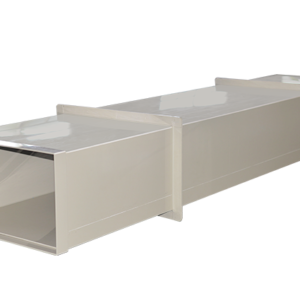
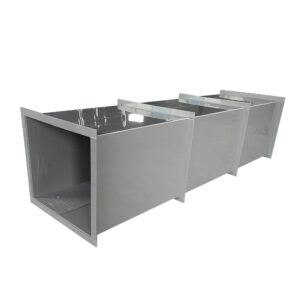
For a given cross-sectional area, a rectangle has 13-40% more perimeter than an equivalent circle — meaning 13-40% more wall surface area causing friction, and 13-40% more fan power to move the same air. The aspect ratio (width ÷ height) determines exactly how much. A square duct at 1:1 aspect ratio has the lowest penalty — about 13% higher pressure drop than round. A 4:1 rectangle — 400 mm wide, 100 mm high — has about 40% higher. The question is whether the space saved is worth the fan energy premium. See our PP Square Duct main product page for full specifications and manufacturing details.
Aspect Ratio and Pressure Drop
The relationship between aspect ratio and pressure drop is not linear — it gets worse faster as the duct gets flatter:
| Aspect Ratio (W:H) | Example Dimensions (equal area to DN400 round) | Perimeter Increase vs Round | Pressure Drop Penalty |
|---|---|---|---|
| 1:1 (Square) | 355 × 355 mm | 13% | ~13% |
| 2:1 | 500 × 250 mm | 20% | ~22% |
| 3:1 | 615 × 205 mm | 30% | ~34% |
| 4:1 | 710 × 178 mm | 40% | ~48% |
| 5:1 | 795 × 159 mm | 50% | ~62% |
The energy penalty compounds annually. A 4:1 rectangular duct requiring an extra 500 Pa of fan pressure costs approximately USD 300-500 per year in additional electricity (for a 10,000 m3/h system operating 6,000 hours) compared to the equivalent round duct. Over a 10-year duct life, that’s USD 3,000-5,000 in avoidable energy cost — often more than the duct itself. The space constraint must be genuine to justify this.
Where Square Duct Earns Its Keep
- Ceiling plenums with limited height. The most common reason for rectangular duct. A commercial building with 400 mm above the false ceiling cannot fit a DN500 round duct — the round duct would protrude through the ceiling. A 800 × 200 mm rectangular duct carries the same airflow while fitting comfortably in the available space. The 30% energy penalty is the price of physical feasibility.
- Wall cavities and service risers. Mechanical shafts between structural columns or inside wall cavities are often rectangular by building design. Rectangular duct fills the available cross-section efficiently; round duct wastes the corners of a rectangular shaft.
- Exposed architectural ductwork. When duct is visible and part of the building’s aesthetic, rectangular profile aligns with the rectilinear architecture — beams, columns, ceiling grids are all orthogonal. Round duct works in industrial settings; rectangular looks designed.
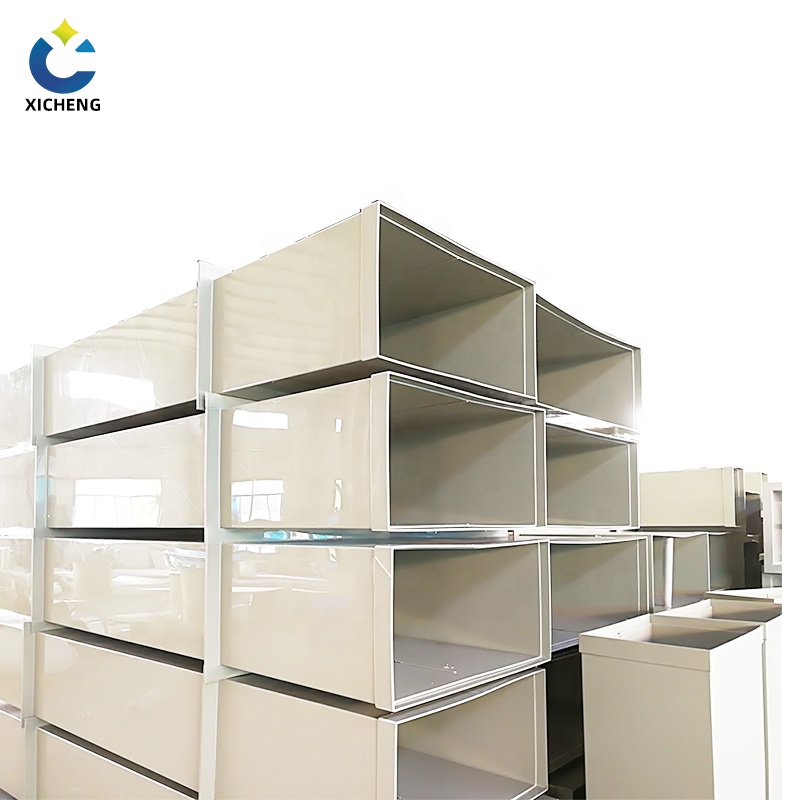
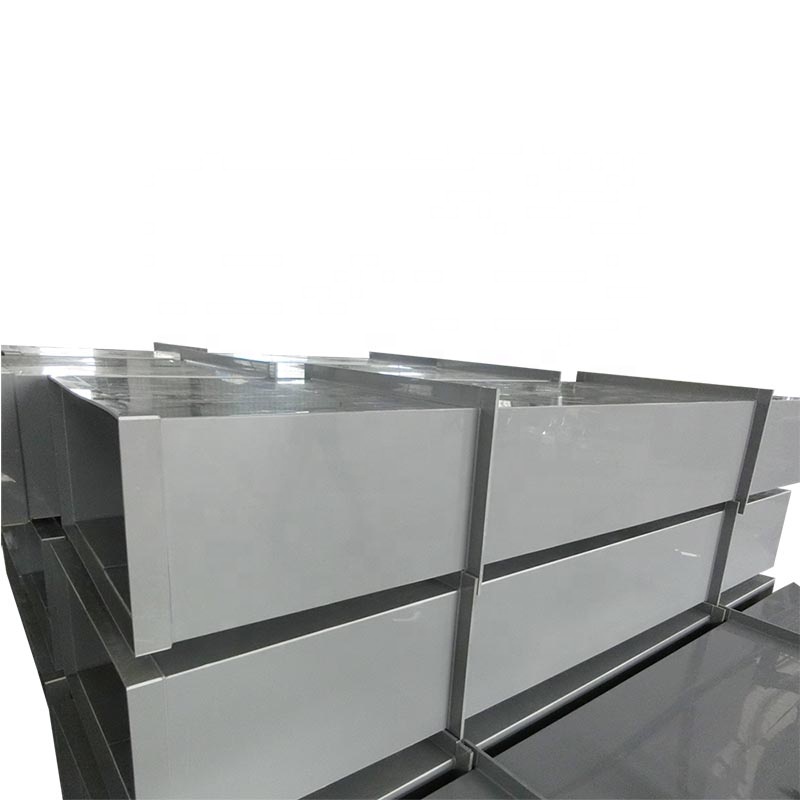
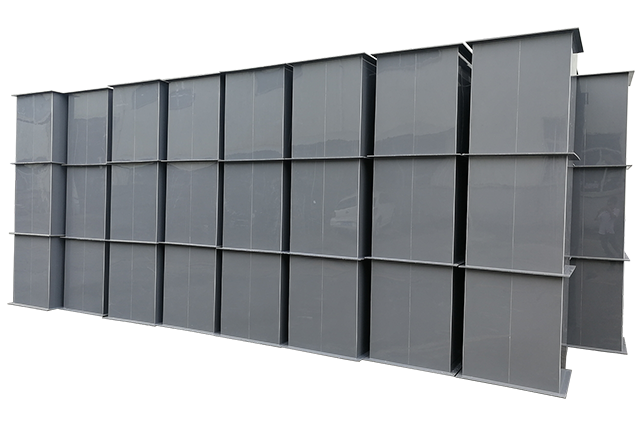
- Multi-service stacking. Rectangular ducts stack vertically with flat surfaces touching — no wasted triangular gaps between round ducts. In a tight mechanical room, three stacked 800 × 250 rectangular ducts use the full vertical clearance that three DN400 round ducts (requiring 400 mm diameter + clearance each) cannot.
Structural Reinforcement for Rectangular Duct
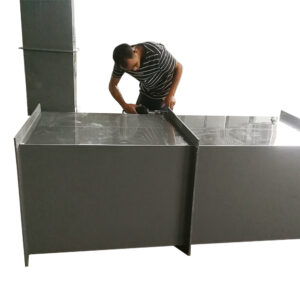
The flat walls of a rectangular duct are structurally the opposite of round: external pressure (vacuum inside the duct) creates bending stress rather than uniform compression. Without reinforcement, a flat PP wall under vacuum bows inward — reducing cross-sectional area, increasing pressure drop, and eventually buckling:
- External rib stiffeners. Welded PP ribs on the exterior of each flat face divide the unsupported panel into smaller sections. A 800 × 250 mm face divided into four 200 mm panels by three ribs can handle 2-3× the vacuum of the un-reinforced face. Rib spacing is engineered for your specific negative pressure, not a generic standard.
- Flange-reinforced edges. The longest edges of a rectangular duct section can be stiffened by the connection flanges themselves — the flange provides a rigid edge that prevents wall deflection at the ends. Intermediate ribs handle the mid-span.
- Corner integrity. The four corners of a fabricated rectangular duct are welded seams. At each corner, the flat wall transitions through a 90deg bend. This is where stress concentrates under vacuum — the corner weld must have full penetration and a smooth internal radius. Injection-molded rectangular profiles eliminate corner welds entirely: the entire cross-section is molded as one piece, corners included. See our PP Square Duct page for injection-molded rectangular options.
Square Duct Fittings: A Complete System
Rectangular duct requires rectangular fittings — round elbows and tees won’t work:
- Square elbows. 90deg and 45deg fabricated elbows with turning vanes recommended for aspect ratios above 2:1 to reduce pressure drop through the turn. See PP Duct Elbow.
- Square-to-round transitions. Connecting rectangular branch duct to round main duct or round fan inlet/outlet. The transition piece must be long enough to manage flow acceleration or deceleration without separation.
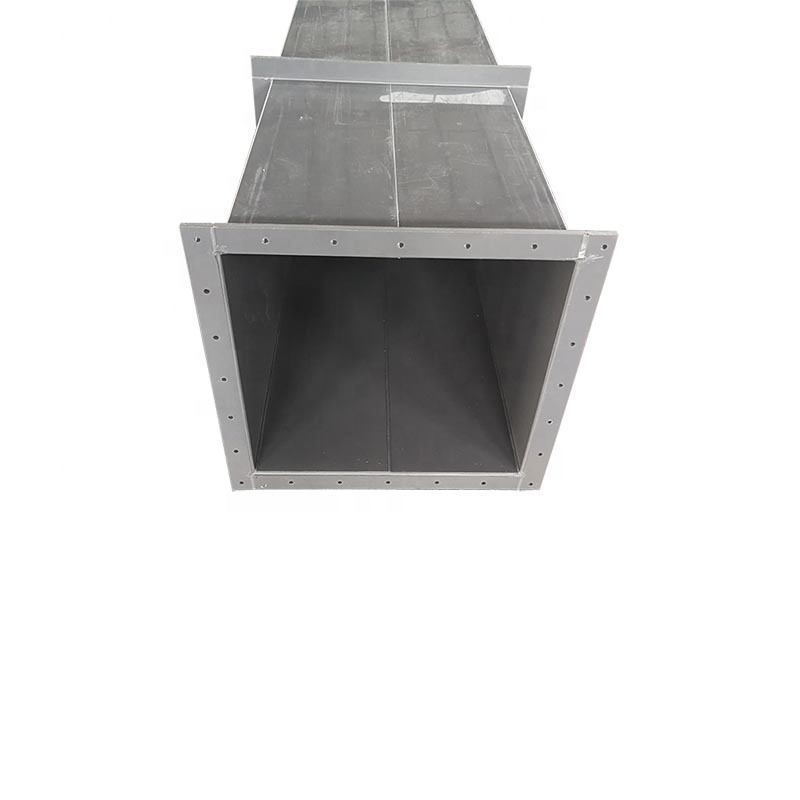
- Square flanges. Rectangular flange frames with gaskets for bolted connections at equipment interfaces and access points. Rectangular flanges are easier to align than large-diameter round flanges. See Air Duct Connections & Flanges.
Send your duct layout showing space constraints to xicheng023@outlook.com. We’ll recommend aspect ratios, calculate pressure drop, and provide a complete quotation. Industrial exhaust duct design follows OSHA 29 CFR 1910.94 Ventilation requirements for system integrity under negative pressure. WhatsApp: +86 18927456906.