

Product Overview
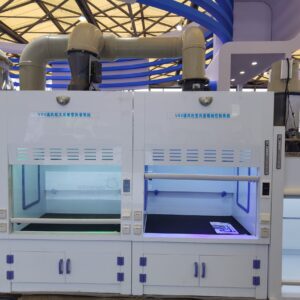
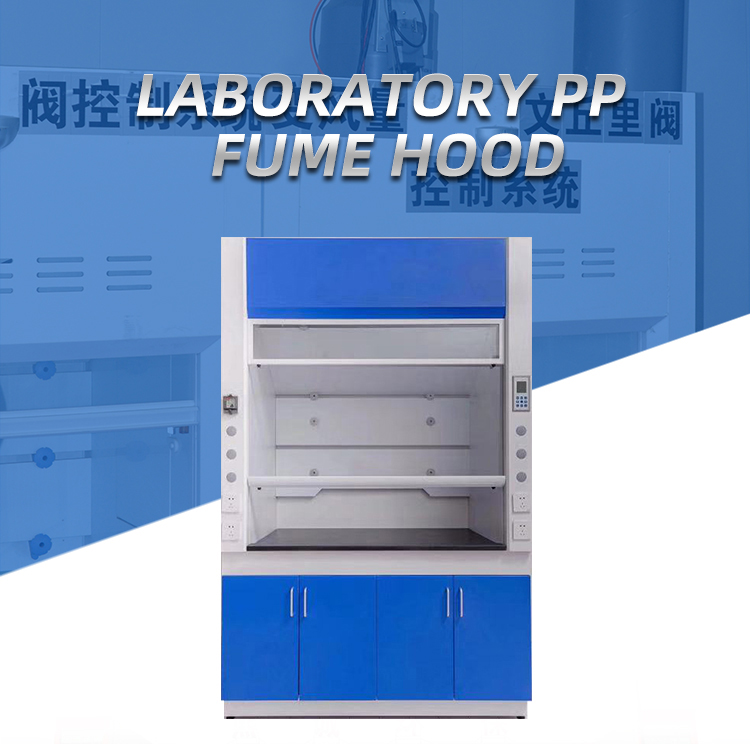
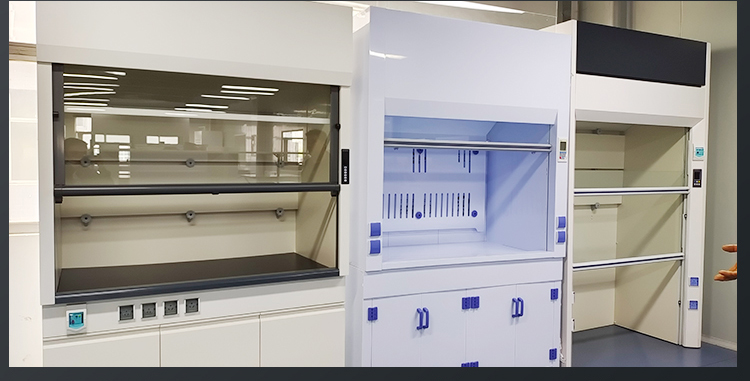
Acid and alkali resistant laboratory fume hood with mixed-material construction — combining PP polypropylene, stainless steel (SS304/316L), and FRP elements to handle aggressive chemical environments where a single-material hood is insufficient. Standard PP hoods excel against most acids and alkalis, but strong oxidizing agents, concentrated acids at elevated temperature, and certain solvents require the additional protection of SS316L internals, FRP panels, or hybrid construction. Designed for industrial quality control labs, chemical R&D facilities, metallurgical testing labs, and pharmaceutical synthesis operations handling perchloric acid, hydrofluoric acid, fuming sulfuric acid, and other highly aggressive reagents.
| Application | Aggressive acid digestion, strong alkali handling, oxidizing agent work, high-concentration corrosive chemical operations |
| Material | PP body + SS316L work surface and internals (standard); PP + FRP (alternative); full FRP (maximum corrosion resistance) |
| Sash | Tempered glass with chemical-resistant gaskets; polycarbonate sash for HF applications |
| Face velocity | 0.3-0.5 m/s across sash opening |
| Standard sizes | 1,200/1,500/1,800 x 800 x 2,350 mm (W x D x H); custom sizes available |
| Lead time | 15-25 days |
| Warranty | 12 months structure; material-specific chemical compatibility warranted per specification |
When Standard PP Is Not Enough
PP fume hoods handle the vast majority of laboratory chemicals, but certain chemical environments exceed PP’s capabilities. Knowing when to upgrade to a mixed-material or special-construction hood prevents premature equipment failure and protects laboratory personnel:
- Oxidizing acids. Concentrated nitric acid (above 60%), perchloric acid, and fuming sulfuric acid attack PP over time, causing embrittlement and eventual structural failure. SS316L internals or FRP construction withstand these conditions. Perchloric acid use additionally requires wash-down capability to prevent explosive perchlorate salt accumulation — a feature standard in our acid-resistant hoods.
- Hydrofluoric acid (HF). HF attacks glass — standard tempered glass sashes degrade rapidly in HF environments. Our HF-configured hoods use polycarbonate sashes with HF-resistant gaskets, PP body construction, and SS316L work surfaces. These configurations meet OSHA hydrogen fluoride exposure limits for laboratory worker protection.
- High-temperature acid work. Hot acid digestions (above 80degC) reduce PP’s mechanical strength. SS316L work surfaces and internal baffles handle the thermal load while the PP body provides overall corrosion resistance at lower cost than an all-stainless hood.
- Mixed solvent and acid environments. Laboratories performing sequential acid and solvent work need compatibility across a wide chemical range. FRP (fiberglass-reinforced plastic) provides excellent acid resistance plus better solvent tolerance than PP alone, particularly with chlorinated solvents.
Why Xicheng
16 years, 2600+ systems shipped worldwide. Mixed-material fume hoods require engineering judgment — which material goes where, what’s compatible with what, and how to join dissimilar materials without creating corrosion-prone interfaces:
- Chemical-first material selection. We don’t offer a generic “chemical-resistant” hood. We map your specific chemical list — including concentrations and temperatures — against material compatibility databases to specify which components should be PP, SS316L, FRP, or polycarbonate. A hood handling 70% HNO3 at 100degC has fundamentally different requirements than one handling 37% HCl at ambient temperature.
- In-house PP and FRP fabrication. Both PP and FRP are fabricated in our own facility. Hot-gas extrusion welding for PP, wet lay-up and hand lamination for FRP — our technicians handle both materials. For steel components (SS304/316L), we work with qualified metal fabrication partners and verify material certs on every component.
- Installations in demanding laboratory settings. Metallurgical assay labs (hot acid digestions with HCl, HNO3, HF, HClO4), pharmaceutical R&D (mixed solvent-acid synthesis), petrochemical quality labs (high-temperature sample preparation), university chemistry departments (undergraduate teaching labs with unpredictable chemical usage), and environmental testing facilities (aqua regia digestions for heavy metals analysis).
Send your chemical list and operating conditions to xicheng023@outlook.com. We’ll verify material compatibility and specify the right hood configuration.
Core Advantages
- Chemical-Specific Material Selection: PP, SS316L, FRP, and polycarbonate configured per your chemical list — not a one-material-fits-all approach.
- Oxidizer-Ready: SS316L internals and wash-down capability for perchloric acid and fuming nitric acid applications.
- HF-Compatible Configurations: Polycarbonate sash and HF-resistant gaskets for hydrofluoric acid laboratories.
- In-House Multi-Material Fabrication: PP welding and FRP lamination under one roof for quality-controlled hybrid construction.
- Custom Configuration: Size, materials, sash type, work surface, and service fixtures all specified to your chemical environment.
Key Specifications
| Model No. | XC-24 |
| Material | PP + SS316L (standard); PP + FRP; Full FRP — configured per chemical profile |
| Function | Aggressive Chemical Containment and Exhaust |
| Ventilation Type | Variable Air Volume (VAV) or Constant Air Volume (CAV) |
| Face Velocity | 0.3-0.5 m/s |
| Standard Sizes | 1,200/1,500/1,800 x 800 x 2,350 mm (custom sizes available) |
| Color | White (PP) / Metallic (SS) / Grey (FRP) |
| Service Life | 10-15 Years (with chemical-compatible material selection) |
| Brand / Origin | Xicheng / China |
Certifications and Compliance
- CE Certified – Laboratory Fume Hood
- RoHS Compliant – All materials
- ISO 9001 – Quality Management System
- ISO 14001 – Environmental Management System
- SGS Tested – PP Sheet, FRP panel, SS316L material certification
- Design Compliance – Systems designed to meet OSHA Laboratory Standard (29 CFR 1910.1450) and OSHA HF exposure limits for hazardous chemical laboratory operations
How to Order
- You send – Complete chemical list (reagents, concentrations, temperatures), hood dimensions, laboratory type, exhaust system details
- We analyze – Chemical compatibility against PP, SS316L, FRP, and elastomer databases; identify any chemicals requiring special material selection
- We specify – Material configuration per component (body, work surface, baffle, sash, gaskets, fasteners), VAV or CAV recommendation, exhaust treatment if required
- You approve – Material specification report, hood drawings, pricing, and delivery schedule
- We build – 15-25 days. Multi-material fabrication with material certs, face velocity verification before shipment
- We ship – Installation drawings, chemical compatibility documentation, material certs, and maintenance manual included.
Contact xicheng023@outlook.com or WhatsApp +86 18927456906 — material compatibility analysis and proposal within 24 hours.
Complete Your System
- PP Laboratory Fume Hood – Standard PP hood for routine chemical work
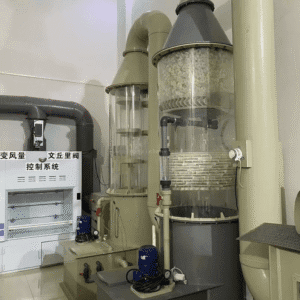
- Laboratory Exhaust Purification System – Scrubber + carbon filter for lab exhaust treatment
- PP Exhaust Duct – Corrosion-resistant ductwork for lab ventilation
- PP/FRP Centrifugal Fan – Corrosion-resistant exhaust fan
Global Shipping
We ship acid-resistant fume hoods worldwide across Southeast Asia, South Asia, Middle East, Africa, Europe, Americas, and Oceania. Standard sea freight; PP and FRP’s light weight vs all-stainless hoods reduces freight cost. Export documentation included.
FAQ
When do I need an acid-resistant hood instead of a standard PP hood?
Standard PP hoods handle most common laboratory chemicals at ambient to moderate temperatures. You need an acid-resistant mixed-material hood when: you work with oxidizing acids (concentrated HNO3, HClO4, fuming H2SO4), use HF (which attacks glass and many metals), perform hot acid digestions (above 80degC), or handle chemicals that attack PP specifically (certain chlorinated solvents, strong oxidizers). Send us your chemical list for a compatibility assessment.
What is perchloric acid and why does it require special hood features?
Perchloric acid (HClO4) is a strong oxidizer used in analytical chemistry for sample digestion. When perchloric acid fumes condense and dry inside ductwork, they form explosive perchlorate salts that can detonate from mechanical shock or vibration. Perchloric acid hoods require: water wash-down systems to flush condensate before salts form, SS316L or FRP construction (PP is not rated for concentrated HClO4), and dedicated exhaust ductwork not shared with other hoods. Our XC-24 configured for perchloric acid includes all these features.
Can I use one hood for both acids and solvents?
It depends on which acids and which solvents, at what concentrations and temperatures. PP handles most acids well but is attacked by certain chlorinated solvents (dichloromethane, chloroform) and strong oxidizers. FRP provides better solvent tolerance. For labs alternating between acids and solvents, we typically recommend FRP construction or PP with SS316L for the most-exposed surfaces. The safest approach is to send your complete chemical inventory for a material compatibility check.