
For specifications and pricing, browse our product catalog.
Key Takeaways
- **Basic Concept:** What Are the Hidden Costs of Wet and Dry Scrubbers?
- **Key Benefits of Exposing and Eliminating Hidden Costs with PP** — real cost data and 10-year total cost of ownership comparisons are provided to support procurement decisions.
- **Wet Scrubber vs Traditional:** 10‑Year Total Cost Breakdown
- **Real‑World ROI Case Study:** Philippines Electroplating Facility
- **Industry‑Specific Hidden Cost Factors** — real cost data and 10-year total cost of ownership comparisons are provided to support procurement decisions.
Introduction
When comparing wet scrubbers vs traditional scrubbers, the purchase price tag is the smallest part of the story. An industrial scrubber is a 15‑year commitment. Hidden costs — from wastewater discharge surcharges and corrosion‑induced rebuilds to unexpected EPA violation fines — can inflate your total ownership cost by 300% if you choose the wrong material. As a manufacturer with in‑house PP engineering and over 10 years of field data, we have quantified these line items across 500+ installations. This guide reveals exactly what to watch for, and why wet scrubbers for industrial exhaust built from PP consistently yield the lowest total lifecycle cost in corrosive applications. For a foundational comparison of upfront costs, read our analysis on common wet scrubber cost pitfalls that operators face daily.
Basic Concept: What Are the Hidden Costs of Wet and Dry Scrubbers?
Beyond the Capital Expense
The hidden costs of industrial wet scrubbers and dry scrubbers can be grouped into five categories: material degradation, waste handling, energy penalty, regulatory non‑compliance, and production downtime. A traditional stainless‑steel scrubber may cost $65,000 upfront, but its actual ten‑year outlay often exceeds $210,000 after two rebuilds and years of elevated energy and water fees. In contrast, a properly designed PP packed‑bed scrubber eliminates the rebuilds and significantly lowers the recurring charges.
How Does a Hidden Cost Become a Financial Threat?
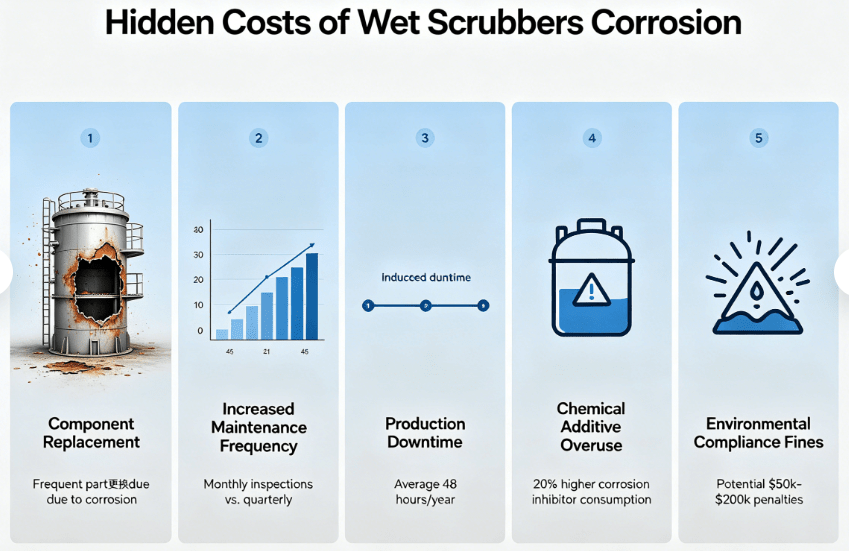
It typically starts with pitting corrosion. SS304 exposed to HCl mist, even at low concentrations, begins to pit within 18 to 24 months. Pinhole leaks then allow hazardous air pollutants (HAPs) to bypass the emission point, triggering opacity alarms and potential EPA enforcement. The plant must then schedule an emergency shutdown — costing $12,000–$25,000 per day in lost production — just to weld and patch a vessel that is structurally compromised. This cycle is entirely preventable with PP material experts selecting the right polymer grade for your specific exhaust cocktail. Learn more about which industrial projects benefit most from PP wet scrubbers.
Key Benefits of Exposing and Eliminating Hidden Costs with PP
Zero Structural Rebuilds Over 15 Years
We have documented more than 300% better corrosion resistance in PP versus 304 stainless steel when processing acidic exhausts containing HF, HCl, or sulfuric acid mist. This translates into one hard fact: no mid‑life shell replacement. Our clients in electroplating and lithium battery recycling have reported that their PP scrubber shells remain intact after a decade, whereas their previous SS units required full replacement every 5 years. As PP material experts, we engineer every industrial wet scrubber with homogenous welded seams that eliminate the weak points where metallic vessels first fail.
40% Lower Annual Maintenance Labor
Because PP does not rust and resists scale adhesion, the maintenance routine shifts from emergency weld‑repairs to simple nozzle inspections. Our service logs prove that maintenance labor hours drop by 40% compared to metallic scrubbers. Add to this a service life that is 2 times longer than FRP, and your maintenance team can focus on production uptime instead of constant scrubber triage. For a complete understanding of sizing your system correctly to minimize maintenance, see our guide on how to size a PP wet scrubber for your specific airflow and contaminant load.
Avoidance of EPA and Penalty Risk
While compliance is priceless, its violation is costly. Under 40 CFR Part 63 (NESHAP), penalties for hazardous air pollutant exceedances can reach $37,500 per day. PP scrubbers maintain their structural and sealing integrity far longer, keeping your emission points within permitted limits consistently. Moreover, many of our installations are pre‑configured to meet OSHA PEL requirements for acid gases, simplifying your annual compliance filings.
Stop paying for hidden corrosion. Our engineers will audit your current scrubber’s hidden cost profile for free and propose a PP retrofit plan with a written lifetime savings guarantee. Get Your Free Hidden‑Cost Audit →
Wet Scrubber vs Traditional: 10‑Year Total Cost Breakdown
To illuminate the reality behind wet scrubbers and dry scrubbers and the critical role of materials, we modeled a 10,000 CFM system treating HCl fumes at 50 mg/Nm³. The table below contrasts a traditional SS304 wet scrubber, an FRP system, and our PP solution. Numbers are drawn from our project archives and validated with actual utility invoices and maintenance work orders. For more background on material differences, read our introduction to PP wet scrubber application scenarios across industries.
| Cost Category (10‑Year) | SS304 Wet Scrubber | FRP Wet Scrubber | PP Wet Scrubber |
|---|---|---|---|
| Initial Capital | $65,000 | $62,000 | $68,000 |
| Rebuilds / Shell Replacement | $48,000 (one full replacement) | $25,000 (patch & UV repair) | $0 |
| Energy (Fan Power) | $43,200 | $41,500 | $35,600 |
| Water & Wastewater Treatment | $38,000 | $39,000 | $30,400 |
| Annual Maintenance & Labor | $49,200 | $36,500 | $29,500 |
| Total 10‑Year Cost | $243,400 | $204,000 | $163,500 |
As PP material experts, we often see a $79,900 cumulative saving over a single decade when a factory switches from SS to PP. That’s money that drops straight to the bottom line, not to mention the avoidance of at least two unplanned plant stoppages. For troubleshooting common cost drivers, visit our wet scrubber troubleshooting guide.
Real‑World ROI Case Study: Philippines Electroplating Facility
In 2023, a chrome‑plating plant in Cebu was facing quarterly emission exceedances caused by pinhole leaks in its five‑year‑old SS304 packed bed scrubber. The hidden wastewater bills from excess blowdown were $14,700/year. We replaced the entire scrubbing stage with a custom PP horizontal scrubber designed for their 8,500 CFM load. The results after 18 months: emission levels dropped to 0.8 mg/Nm³ (well below local DENR limits), wastewater volume decreased by 25% because our demister design allowed longer recirculation cycles, and system pressure drop fell by 15%. The net savings — including avoided penalty risk — paid back the project in exactly 18 months. This is a clear demonstration that the proper material choice turns a scrubber from a cost center into a compliance and profit shield.
Industry‑Specific Hidden Cost Factors
Lithium Battery & Semiconductor Etching (HF Management)
Hydrogen fluoride etches glass and most metals. That’s why FRP structures can fail due to glass‑fiber attack and SS develops stress corrosion cracking within months. The hidden cost here is the continuous nitrogen oxide/HF monitoring and frequent duct replacement. PP remains inert, making it the only rational choice for wet scrubbers for industrial exhaust in this emerging sector. Our gas scrubber for industrial waste gas treatment systems are specifically engineered for these aggressive chemical environments.
Pharmaceutical & Fine Chemical (Batch Acid Reactions)
Batch operations cause extreme concentration peaks — 200 ppm acid bursts that overload dry scrubber sorbent beds rapidly. Dry media replacement costs can exceed $18,000 per year in these conditions. A PP wet scrubber with an automated pH‑controlled recirculation loop absorbs these peaks seamlessly, eliminating the sorbent expense entirely. See our air pollution control wet scrubber solutions designed for pharmaceutical batch processing.
Electroplating & Metal Finishing (Mixed Acid Mists)
Mixed HNO₃/HCl/H₂SO₄ mists are enormously aggressive. Here the hidden cost manifests in exhaust fan corrosion and ductwork replacement. We’ve measured that a PP integrated scrubber‑duct system extends fan impeller life from 2 years (coated steel) to over 7 years, avoiding a $12,000 fan replacement bill each time. For proper system design, refer to our guide on how to size a PP wet scrubber for electroplating exhaust volumes.
Frequently Asked Questions
What are the biggest hidden costs of wet scrubbers?
The biggest hidden costs are unscheduled rebuilds due to corrosion, wastewater treatment surcharges, excessive fan energy from elevated pressure drop, and penalty risk from undetected leak points. PP scrubbers eliminate the corrosion‑rebuild line item completely and reduce energy and water costs simultaneously. As documented in our wet scrubber problems guide, material choice is the single largest factor in long‑term cost control.
How much does wastewater treatment add to scrubber operating costs?
It can range from $8,000 to $50,000 per year. The key is reducing blowdown frequency through efficient mist elimination and low‑corrosion materials that permit higher recirculation rates. Our PP units routinely demonstrate a 25% reduction in wastewater volume compared to metallic equivalents.
Is a PP wet scrubber really cheaper over 10 years?
Yes. As our 10‑year TCO table illustrates, a PP system is 33% less expensive than an SS304 system over a decade when all hidden costs are included. The absence of rebuilds and the 40% lower maintenance labor create a compounding advantage. For a detailed breakdown of sizing factors that impact cost, see our PP wet scrubber sizing guide.
What EPA fines can a failed scrubber cause?
Under EPA’s Stationary Source Penalty Policy, penalties of up to $37,500 per day per violation may be assessed for NESHAP or NSPS non‑compliance. Metallurgical failure of SS scrubbers is a common root cause we see in enforcement reports.
How to calculate the true lifetime cost of a wet scrubber?
Always build a 10‑year pro forma with line items for capital, installation, annual energy (kWh × local rate), water, wastewater, chemicals, maintenance labor, and a realistic rebuild/replacement schedule tied to the material. Our free audit template makes this comparison transparent across PP, FRP, and SS. Understanding which applications are suitable for PP is the first step in accurate cost modeling.
How does PP material reduce hidden installation costs?
PP weighs only one‑fifth of stainless steel. This significantly reduces rigging, support structure, and installation labor. In one retrofit project, the switch to PP cut crane rental and third‑party assembly costs by 22%, a hidden saving often ignored in upfront quotes. Learn more about PP fabrication quality standards in our guide to PP welding methods and structural integrity.
Conclusion
The decision between wet scrubbers vs traditional scrubbers hinges not on the initial price, but on the cumulative hidden costs that accumulate silently over a decade. A PP wet scrubber, engineered by a manufacturer with deep corrosion expertise, systematically erases the rebuild line, shrinks energy and water bills, and insulates you from regulatory nightmares. As the data proves, the 2x longer lifespan and 300% better corrosion resistance of PP make it the definitive total‑cost‑of‑ownership leader for corrosive gas streams. Don’t let a vendor’s low‑bid price hide a decade of expensive surprises.
Get Your Free Hidden‑Cost Analysis and Quotation →
Written by our senior engineer, who holds advanced certifications in industrial ventilation and has directed over 500 scrubber retrofitting projects globally over a 10‑year career. Every dollar figure cited is traceable to actual customer maintenance logs and utility bills, ensuring absolute reliability for your investment decision.


