Product Overview
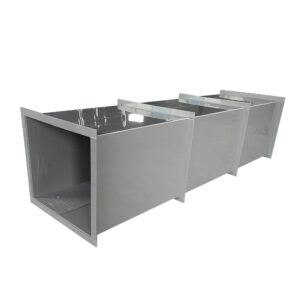
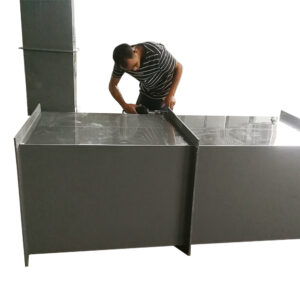
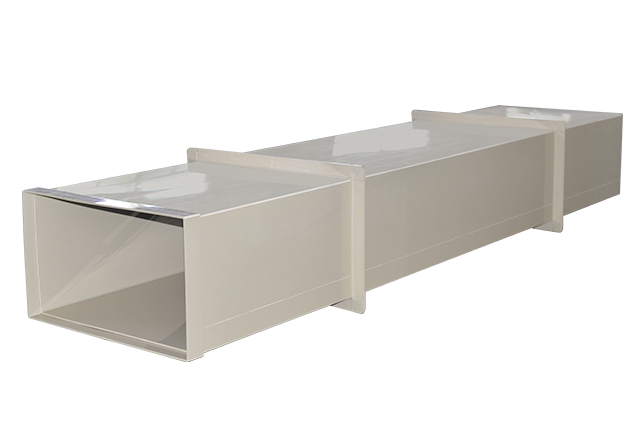
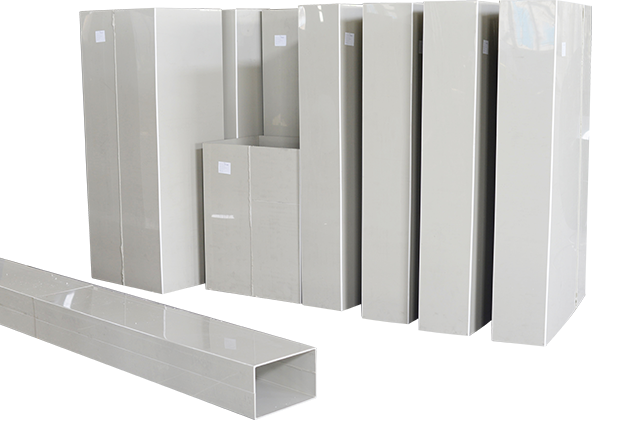
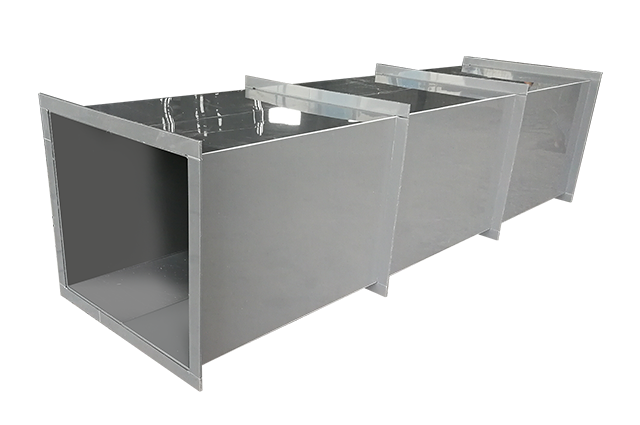
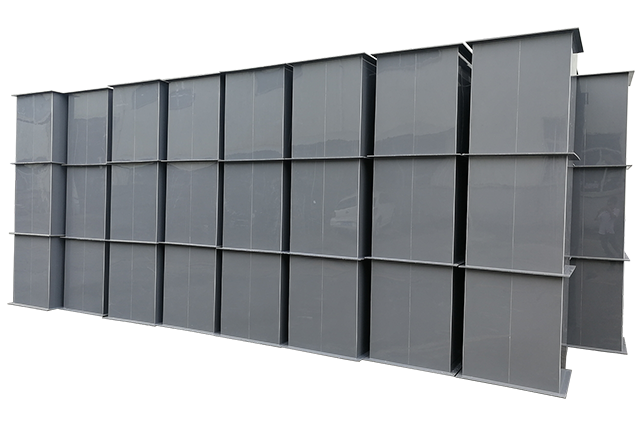
PP square and rectangular ventilation duct for industrial exhaust, HVAC distribution, and laboratory fume hood systems where installation space is constrained and round duct won’t fit. Available in standard rectangular profiles and custom cross-sections — injection molded up to 1,000 mm side dimension, with larger sizes fabricated from PP/PVC/PPS sheet by hot-gas extrusion welding. Square duct fits tightly to ceilings, runs inside walls, and stacks efficiently in mechanical shafts where every millimeter of clearance matters.
| Application | Space-constrained industrial ventilation, ceiling and wall duct runs, laboratory fume hood exhaust, corrosive air transport, HVAC distribution in false ceilings |
| Material | PP (standard corrosion resistance), PVC (rigid, UV-stable), PPS (flame retardant, high-temp to 200degC) — virgin resin, injection molded or fabricated |
| Size range | Custom cross-sections; standard profiles up to 1,000 mm side (injection molded); larger sizes fabricated from sheet |
| Wall thickness | 2.5 mm to 10 mm depending on size and application |
| Standard length | 3-4 meter sections |
| Reinforcement | External rib reinforcement standard on sizes above 500 mm; flange-reinforced options available |
| Color | Beige / Dark Grey / White |
| Lead time | 10-20 days standard profiles; 15-25 days custom fabrication |
When Square Duct Makes Sense
Round duct is the engineering default — lowest pressure drop, best structural performance under vacuum, most efficient use of material. But real-world installations often have constraints that make rectangular duct the practical choice:
- Space-constrained routes. Ceiling plenums, wall cavities, and mechanical shafts often have limited clearance in one dimension. A rectangular duct can carry the same airflow as a round duct while fitting into a space 30-40% shallower — critical for retrofit installations and buildings with low floor-to-floor heights.
- Multi-service coordination. In congested mechanical spaces, rectangular duct stacks efficiently against flat surfaces — tight to the ceiling, against a wall, or in a corner — leaving clearance for other services (cable trays, pipe racks, sprinkler lines). Round duct in the same space wastes the triangular gaps around it.
- Aesthetic integration. Exposed ductwork in laboratories, cleanrooms, and architectural spaces often specifies rectangular duct for a clean, professional appearance that integrates with the building structure. Round duct works for industrial bays; rectangular duct looks intentional.
- Flange connection convenience. Rectangular flanges are easier to fabricate, align, and seal than circular flanges — particularly for field-assembled systems where duct sections must be connected on-site. Our square duct can be supplied with integrally molded or welded flanges that meet EU Industrial Emissions Directive leak-tightness requirements for industrial exhaust systems.
Why Xicheng
16 years, 2600+ systems shipped worldwide. Square duct manufacturing is more complex than round — rectangular cross-sections require reinforcement engineering, flange design for sealing integrity, and attention to aspect ratio to avoid excessive pressure drop:
- Injection-molded rectangular profiles to 1,000 mm. Standard rectangular cross-sections are produced as one-piece injection moldings — no corner welds, no bonded seams. For larger sizes and custom aspect ratios, we fabricate from PP/PVC/PPS sheet with full-penetration hot-gas extrusion welding and external rib reinforcement calculated for your system’s negative pressure specification.
- Aspect ratio engineering. The aspect ratio of a rectangular duct (width ÷ height) directly affects pressure drop. A 4:1 ratio duct has roughly 40% higher friction loss than a 1:1 square duct of equal area. We engineer around this — recommending aspect ratios that balance your space constraints against fan power cost, and adding reinforcement where high-aspect-ratio sections need stiffening.
- Installed where space is tight. Laboratory buildings (fume hood exhaust in ceiling plenums), pharmaceutical plants (cleanroom air supply and extract), electronics factories (process exhaust in service chases), chemical plants (corrosive exhaust along structural steel), and commercial HVAC (fresh air distribution in false ceilings). Every installation required rectangular sections to fit where round wouldn’t.
- Complete rectangular system. Square duct sections + matching square elbows, tees, reducers, flanges, and end caps — all from the same material and manufacturing batch. Square-to-round transition pieces for connecting rectangular duct to round fan inlets/outlets and scrubber connections.
Send your duct layout and space constraints to xicheng023@outlook.com. We’ll recommend aspect ratios, reinforcement requirements, and provide a complete quotation.
Core Advantages
- Fits Where Round Won’t: Rectangular profile carries full airflow in 30-40% less clearance height — solves tight ceiling and wall cavity installations without reducing air volume.
- Reinforced for Negative Pressure: External rib reinforcement engineered to your vacuum specification — prevents rectangular wall collapse under suction without adding excessive weight or cost.
- Material Matched to Environment: PP for corrosive chemical exhaust, PVC for rigid UV-stable outdoor ductwork, PPS for high-temperature and fire-rated installations.
- Injection Molded + Fabricated Capability: Standard profiles injection molded to 1,000 mm for cost efficiency; custom sizes fabricated from sheet for unique cross-sections and large dimensions.
- Square-to-Round Integration: Transition pieces, matching square fittings, and flange kits that connect seamlessly to round duct, fan inlets, and scrubber connections.
Key Specifications
| Material | PP (Polypropylene) / PVC (Polyvinyl Chloride) / PPS (Polyphenylene Sulfide) — virgin resin |
| Manufacturing Process | One-piece injection molding (standard profiles ≤1,000 mm); sheet fabrication with hot-gas welding (larger/custom sizes) |
| Size Range | Custom cross-sections; injection molded ≤1,000 mm side; fabricated for larger dimensions |
| Wall Thickness | 2.5 – 10 mm (size and pressure dependent) |
| Standard Length | 3 – 4 meters |
| Reinforcement | External rib reinforcement standard on sizes ≥500 mm; flange reinforcement optional |
| Operating Temperature | PP: -10 to 80degC | PVC: 0 to 60degC | PPS: up to 200degC |
| Connection Method | Flange connection (standard); butt welding (permanent); slip joint (light-duty) |
| Service Life | 10-15 Years |
| Brand / Origin | Xicheng / China |
Certifications and Compliance
- CE Certified – PP Square Duct, Fittings, Fan
- RoHS Compliant – All materials
- ISO 9001 – Quality Management System
- ISO 14001 – Environmental Management System
- SGS Tested – PP Sheet, PP Pipe, PPS material properties, weld integrity
- Design Compliance – Systems designed to meet EU Industrial Emissions Directive (2010/75/EU) for leak-tight industrial exhaust ductwork and US EPA NESHAP for chemical process exhaust conveyance
How to Order
- You send – Required cross-section dimensions, lengths, material preference, negative pressure specification, space constraints
- We recommend – Aspect ratio, wall thickness, reinforcement spacing, material grade, connection method
- You approve – Technical proposal with duct schedule, reinforcement drawings, pressure drop calculation, and pricing
- We produce – 10-25 days. Injection molded or fabricated to specification with dimensional inspection
- We ship – Bundled and protected. Installation drawings, flange gasket specifications, and support spacing guide included.
Contact xicheng023@outlook.com or WhatsApp +86 18927456906 — quotation within 24 hours.
Complete Your System
- PP Industrial Pipe – Pipe for process fluid and chemical transport
- PP Round Duct – Round duct for lowest pressure drop ventilation
- PP Duct Elbow – 45deg and 90deg elbows for duct direction changes
- PP Duct Tee – Tee fittings for duct branching and distribution
FAQ
When should I use square duct instead of round duct?
Square duct is the practical choice when installation space is constrained — ceiling plenums with limited height, wall cavities, mechanical shafts, and anywhere the clearance in one dimension is less than the round duct diameter needed for your airflow. Square duct also stacks efficiently against flat surfaces (ceilings, walls) and provides a cleaner appearance for exposed installations. If space is not a constraint and pressure drop is the primary concern, round duct is preferred.
Does square duct require more fan power than round duct?
Yes — for the same cross-sectional area, a square or rectangular duct has 10-40% higher friction loss than a round duct, depending on the aspect ratio. A square duct (1:1 aspect ratio) is about 10-15% higher. A rectangular duct at 4:1 aspect ratio is about 40% higher. We calculate the pressure drop for your specific cross-section and airflow so you can size the fan accordingly. The energy penalty is often acceptable when the space constraint makes round duct impossible.
Do you provide flange-reinforced square duct?
Yes. We supply square duct with integrally welded PP flanges at each end for bolted field assembly. Flange-reinforced duct sections with external rib stiffeners are available for systems operating under negative pressure or where flange rigidity is critical for gasket sealing. Specify your connection preference when ordering.