Description
Who Needs This High-Efficiency PP Spray Tower?
If your industrial facility generates water‑soluble exhaust gases — acid mists, alkaline fumes, or odorous organic vapors — and you need a cost‑effective, low‑maintenance treatment solution, this PP spray tower is engineered for you.
Spray towers use atomized liquid droplets to capture and neutralize pollutants through absorption. According to the U.S. EPA Air Pollution Control Technology Fact Sheet, spray towers are the simplest wet scrubber used for gas and particulate control. This counter‑current design maximizes pollutant contact within a compact vertical footprint, making it a practical choice for facilities where floor space is limited. For a deeper understanding of different scrubbing technologies, see our guide on gas scrubber types (H₂S, Acid & Fuel Gas).
Typical operating scenarios:
- Electroplating and metal finishing lines producing chromic acid (CrO₃), HCN, and HCl mists.
- Chemical processing plants with mixed acid gas streams (HNO₃, HF).
- Pharmaceutical factories with solvent vapors and acid exhaust.
- Printing and painting workshops generating VOC‑laden odors.
- Fertilizer production and waste treatment facilities with ammonia (NH₃) emissions.
This spray tower is optimized for medium‑volume exhaust treatment, offering a wide operating range to suit various industrial scales. The open spray chamber design resists fouling, making it suitable for streams containing sticky or crystallizing substances that would clog packed beds. Regarding material limits, PP resists most dilute mineral acids, alkalis, and organic solvents. However, it is not designed for exhaust temperatures exceeding 70°C, or for strong oxidizing acids like concentrated nitric acid (>50%) and fuming sulfuric acid. For more aggressive environments, alternative materials like FRP or PVC may be considered, as we lay out these boundaries transparently for informed decision‑making. If your facility has ceiling height restrictions, our horizontal wet scrubber offers a space‑saving alternative.
Why Engineers Choose Our PP Spray Tower
1. PP Polypropylene Construction = Reliable, Cost‑Effective Corrosion Resistance
The entire tower shell, liquid distribution system, and mist eliminator are fabricated from virgin PP sheet — specifically chosen for its excellent resistance to HCl, H₂SO₄, and most alkaline solutions. PP offers a strong and cost‑effective alternative to metallic or FRP alternatives. For dilute acid and alkali streams under 60°C, PP is often the most economical choice with an expected service life of over 8 years under normal operating conditions. Research on scrubber materials indicates that PP components demonstrate very low moisture absorption (<0.01% after 24‑hour immersion) and maintain dimensional stability, with thermal expansion being linear and predictable up to 100°C, translating to a mere 0.04 mm per meter length increase at typical scrubber operating temperatures.
2. High‑Efficiency Packing Layer for Maximum Neutralization
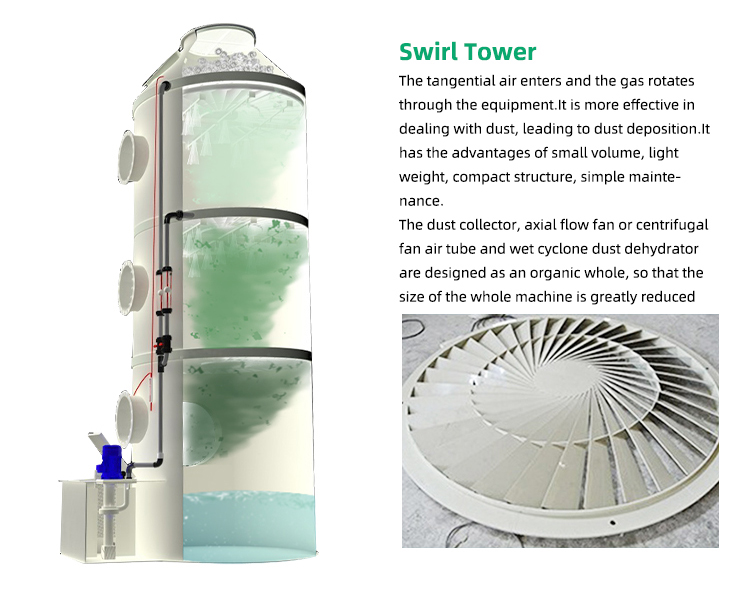
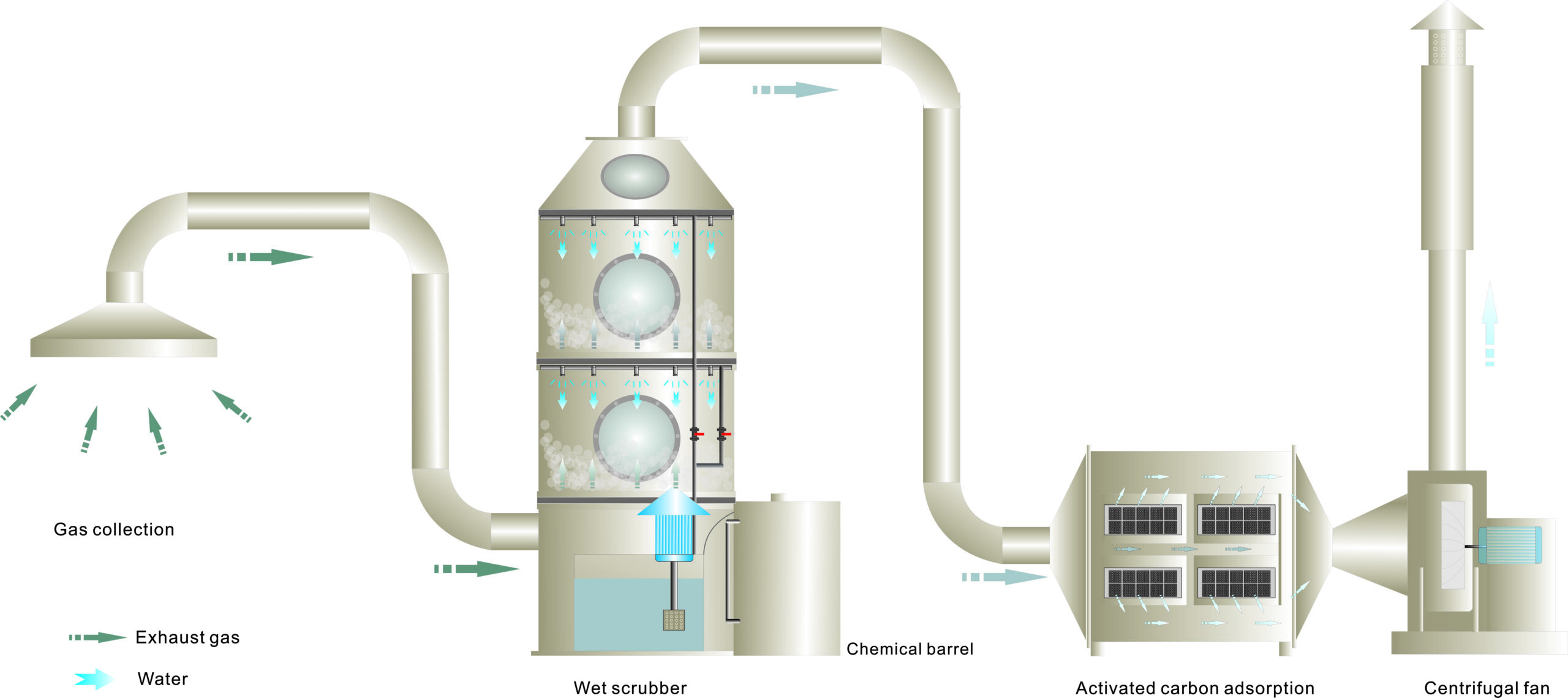
The spray tower features a dedicated packing layer that acts as a gas‑liquid contact reaction medium. As exhaust gas flows upward through the packing, it comes into full contact with the scrubbing liquid flowing downward over the packing surface. This creates extensive wetted surface area that significantly increases residence time and contact efficiency compared to open spray designs alone. The packing layer is specifically designed to handle the gas‑liquid neutralization reactions required for acid and alkali waste gas treatment, with the packing media selected based on your specific pollutant type and concentration.
3. Integrated Water Tank with Level Control = Simplified Operation
Each spray tower includes an integrated recirculation water tank with a built‑in water level control device. Positioned directly beneath the tower, the tank collects spent scrubbing liquid, where it can be recirculated or drained to your wastewater treatment system. The single‑unit design reduces on‑site plumbing complexity and footprint compared to systems requiring separate external sumps.
4. Inspection Window & Maintenance Access Port = Reduced Downtime
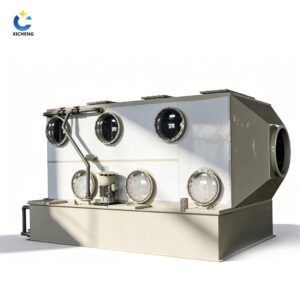
The tower body incorporates a transparent inspection window and a dedicated maintenance access port, allowing operators to visually monitor spray patterns and packing condition during operation. Routine inspection of the packing layer and spray nozzles can be performed through the access port without requiring full system disassembly — a practical feature that reduces annual maintenance hours compared to sealed tower designs.
5. Complete System‑Ready Configuration
The standard supply includes the tower body with spray system, packing layer, integrated water tank, inspection window, maintenance access port, water level control device, and pressure gauge. This complete configuration means you receive a ready‑to‑install unit that simply requires connection to your exhaust ducting, recirculation pump, and fan system — reducing on‑site assembly time and commissioning complexity.
Technical Specifications: Standard Model Range
All values taken directly from the original product specification.
| Air Volume (m³/h) | Tower Diameter (mm) | Shell THK (mm) | Drain Outlet | Water Tank Size (mm) | Inlet/Outlet Dia. (mm) | Pump (kW) | Wind Resist. (Pa) |
|---|---|---|---|---|---|---|---|
| 3,000 | 800 | 8 | DN32 | 600×700×H700 | 315 | 0.75 | 500 |
| 5,000 | 1,000 | 8 | DN40 | 600×800×H700 | 400 | 1.5 | 500 |
| 8,000 | 1,200 | 8 | DN40 | 600×1000×H700 | 500 | 2.2 | 500 |
| 10,000 | 1,500 | 10 | DN40 | 700×1000×H700 | 550 | 2.2 | 500 |
| 12,000 | 1,600 | 10 | DN50 | 700×1000×H700 | 600 | 3.75 | 500 |
| 15,000 | 1,800 | 10 | DN50 | 700×1200×H700 | 650 | 3.75 | 500 |
| 20,000 | 2,000 | 10 | DN50 | 700×1200×H700 | 750 | 5.5 | 500 |
| 25,000 | 2,200 | 10 | DN50 | 700×1200×H700 | 950 | 5.5 | 600 |
| 30,000 | 2,500 | 12 | DN65 | 700×1200×H700 | 1,000 | 5.5 | 600 |
| 35,000 | 2,700 | 12 | DN65 | 1000×700×H700 | 1,100 | 7.5 | 600 |
| 40,000 | 2,900 | 12 | DN65 | 1000×700×H700 | 1,200 | 7.5 | 600 |
| 45,000 | 3,000 | 12 | DN65 | 1000×700×H700 | 1,250 | 7.5 | 600 |
Standard Configuration: Vertical PP tower body, spray system with packing layer, integrated water tank with level control device, inspection window, maintenance access port, and pressure gauge. Custom sizes and multi‑stage configurations are available upon request. For step‑by‑step sizing methodology with real‑world engineering examples, see our guide on scrubber sizing calculation: design & optimization.
Industry Performance Context
As performance engineering context for your purchase decision, industry data indicates that spray tower scrubbers can attain removal rates above 99% under properly sized conditions, with leading scrubbing products reaching up to 99.99% efficiency[reference:11][reference:12]. The U.S. EPA classifies spray towers as low‑energy scrubbers that are capable of efficiently removing particles greater than about 5‑10 µm in diameter[reference:13]. A Dürr CTS high‑end spray tower achieves superior removal efficiency through a fine atomization system with low pressure drop and minimal fouling[reference:14]. These independent findings validate the fundamental scrubbing principle our equipment shares.
Frequently Asked Questions
Q1: How does a PP spray tower compare to packed bed scrubbers?
Spray towers use atomized droplets in an open chamber for gas‑liquid contact, while packed bed scrubbers add structured media to extend contact time. As noted by Tecpro Australia, packed bed scrubbers incorporate a porous bed of media which the liquid reagent flows over and the gas passes up through, increasing surface area and extending contact time[reference:15]. The fundamental difference makes spray towers generally lower cost and more tolerant of solids — making them ideal as a first‑stage or general‑purpose device — while packed beds achieve higher absorption efficiency per unit volume for soluble gases. For installations with headroom constraints, our packed bed scrubber or the vertical vs horizontal wet scrubber selection guide can help you evaluate design trade‑offs.
Q2: What removal efficiency can I expect?
Under properly designed operating conditions with matched scrubbing chemistry, this counter‑current PP spray tower can consistently achieve removal efficiencies above 90% for highly soluble acid gases (e.g., HCl, NH₃). The overall efficiency depends on gas solubility, liquid‑to‑gas ratio, nozzle performance, and packing depth. According to the U.S. EPA, most wet scrubbing systems operate with particulate collection efficiencies over 95%[reference:16].
Q3: What pollutants can this spray tower treat?
This system is capable of treating H₂S, SOₓ, NOₓ, HCl, NH₃, Cl₂, and other water‑soluble gases. According to the U.S. EPA, spray tower scrubbers can remove gaseous pollutants by absorption and are also effective for particulate matter[reference:17]. We match the scrubbing liquid chemistry during quotation: NaOH solution for acid gases, dilute H₂SO₄ for ammonia, and water with additives for VOCs.
Q4: How does PP compare to FRP or stainless steel for scrubber construction?
PP (Polypropylene) excels in acid and alkali resistance at a relatively low cost. It is the material of choice for low to medium‑temperature corrosive environments (typically <60–70°C) due to its price‑performance ratio[reference:18]. FRP offers a higher strength‑to‑weight ratio and slightly better temperature tolerance but at a higher cost. 316L stainless steel provides high‑temperature strength but is susceptible to chloride‑induced pitting corrosion. Polypropylene remains the preferred choice when cost‑effectiveness and chemical resistance in moderate temperatures are the driving design constraints.
Q5: Is this equipment compliant with EPA or OSHA regulations?
While our scrubbers are designed to help you meet local emission standards, they do not carry EPA certification as a complete system (no such product‑level certification exists for air pollution control equipment). The EPA identifies wet scrubbers as a viable control technology for gaseous emissions and particulate matter[reference:19]. For workplace safety, OSHA sets permissible exposure limits (PELs) for specific pollutants — for example, HCl has a ceiling limit of 5 ppm (7 mg/m³), as published in the OSHA Chemical Hazards database[reference:20]. Achievable outlet concentration depends on inlet conditions and scrubbing liquid chemistry, which our engineering team will help optimize during specification.
Q6: What regular maintenance is required?
Regular maintenance of your spray tower will ensure optimum performance and service life. As the U.S. EPA notes, wet scrubbing systems are susceptible to several operating problems including inadequate liquid flow, liquid re‑entrainment, poor gas‑liquid contact, corrosion, and plugged nozzles, beds, or mist eliminators[reference:21]. We recommend a tiered maintenance schedule to preempt these issues:
Weekly: Check spray nozzle patterns and recirculation liquid pH. Verify pump pressure.
Monthly: Inspect packing layer through the inspection window for fouling or scaling.
Quarterly: Clean the mist eliminator and check drain outlets for blockages.
Annually: Full packing media inspection; replace if channeling or degradation is observed. For a complete tiered inspection schedule with chemical management strategies, see our Acid Scrubber Maintenance Guide.
Q7: What are the installation requirements?
The spray tower should be installed on a level, corrosion‑resistant foundation pad — if indoors, on an acid‑proof concrete plinth; if outdoors, with an FRP or coated steel containment curb. Maintain at least 1 meter clearance around the tower for maintenance access, particularly at the inspection window and access port. Recirculation pump should be placed on a separate anti‑corrosion base. Inlet/outlet ducting must match the flange dimensions specified in the technical table. We also endorse the practice of constructing a bund wall around the base to contain accidental spills, which is particularly recommended for facilities handling concentrated acid streams where secondary containment is required.
Q8: What are the typical operating problems and how can I solve them?
Low removal efficiency is typically caused by insufficient scrubbing liquid flow or depleted reagent concentration. High pressure drop usually indicates scale buildup on the mist eliminator. Liquid carryover into downstream ducting points to a saturated mist eliminator or operation above the maximum design gas velocity. Regular inspection of the spray nozzles and packing layer through the integrated inspection window and maintenance access port will enable early detection of these issues before they impact compliance.
Q9: What is the expected service life?
PP tower shell: 8–12 years under normal corrosive conditions with routine maintenance. PP material demonstrates excellent long‑term durability in dilute acid service — unlike metallic alternatives that can fail within 2–4 years from pitting or stress corrosion cracking. Packing media replacement cycle: 3–5 years depending on gas composition and operating temperature. Pump mechanical seals: inspect annually; replace every 2–3 years.
Q10: How long does shipping take?
Standard models from the above table typically ship within 15–25 working days from our factory in China. Custom configurations require additional engineering and fabrication time. We deliver FOB/CIF to major ports worldwide.
Q11: Can this PP spray tower handle a mix of acid fumes and dust simultaneously?
Yes, this is one of the fundamental advantages of the spray tower design. The U.S. EPA notes that spray tower scrubbers can remove gaseous pollutants while also capturing particulates[reference:22]. The open structure without restrictive packed beds means particulate loading is less likely to cause blockages, making it an excellent choice for processes where dust and acid mists are co‑generated, such as metal grinding or fertilizer granulation.
Q12: Is this PP spray tower resistant to UV damage for outdoor installation?
Standard PP resin is susceptible to UV degradation when exposed to direct sunlight over extended periods. UV exposure can cause surface chalking, discoloration, and a gradual reduction in impact strength. For outdoor installations, we recommend either: (a) a simple weather shelter or canopy to block direct sunlight, or (b) our UV‑stabilized PP formulation that incorporates carbon black or chemical UV absorbers at a modest additional cost. This ensures the 8+ year service life projection remains valid for outdoor conditions.
About the Author & Our Expertise
Product specifications reviewed by: Corbin Deng, Process Engineer, XICHENG EP LTD — 12+ years in industrial spray tower design and wet air pollution control systems.
About XICHENG EP LTD
XICHENG EP LTD is a specialist manufacturer of PP polypropylene air pollution control equipment, including spray towers, packed bed scrubbers, and integrated treatment systems. We have supplied over 800 installations across 30+ countries, serving the electroplating, chemical, pharmaceutical, and metal finishing industries. Our factory is ISO 9001:2015 and ISO 14001 certified, and all products are supported by material certificates and performance data.
Verified Installations
- Electroplating facility, Vietnam — 15,000 m³/h spray tower treating CrO₃ & H₂SO₄ mist, operational since 2019 with zero unplanned downtime.
- Chemical processing plant, Thailand — 25,000 m³/h multi‑stage spray tower for mixed acid gas exhaust, compliant with local emission regulations since 2021.
- Pharmaceutical factory, Singapore — 8,000 m³/h spray tower with packing layer for solvent vapor treatment, validated by third‑party stack test.
Certifications: ISO 9001:2015 (Quality Management) | ISO 14001 (Environmental Management). Material certificates and inspection reports available upon request.
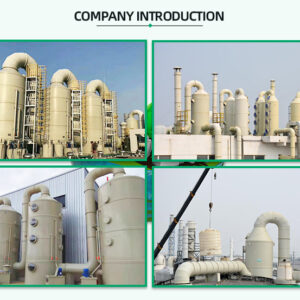
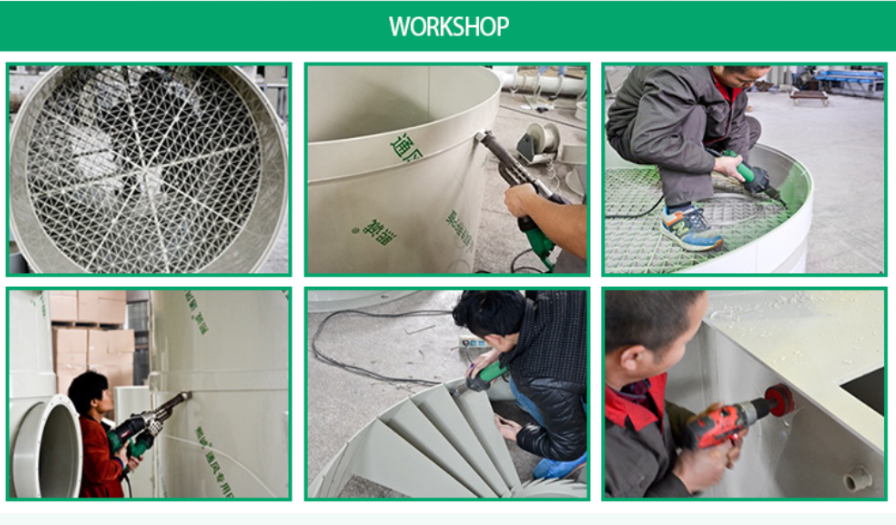
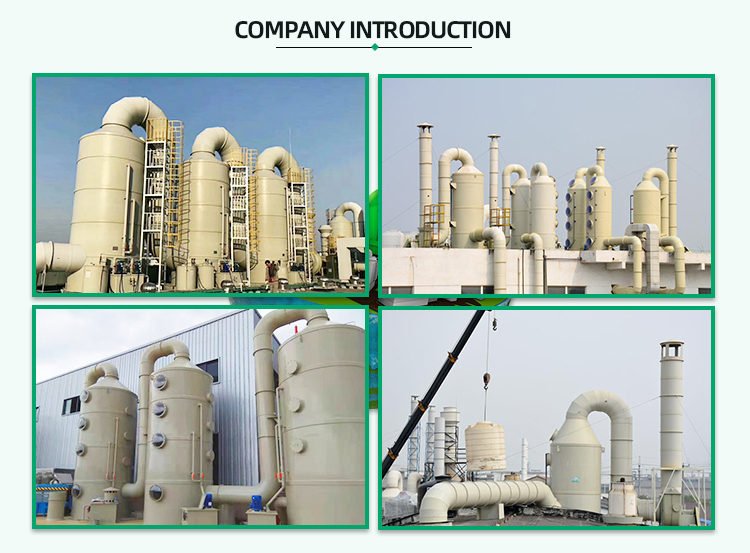
All photos on this page are of actual XICHENG manufacturing, packing, and installation sites, taken in 2024–2025.