
Introduction: Sizing Is the Difference Between Compliance and Costly Retrofits
A scrubber that is too small will fail emission limits the moment your process runs at full load. A scrubber that is oversized wastes energy, chemicals, and capital. Getting scrubber sizing right is the single most important engineering decision when specifying a vent gas scrubber—whether you are controlling acid fumes from a storage tank vent, removing H₂S from a biogas stream, or eliminating odors from a food processing exhaust. Most guides describe scrubber types but avoid the actual numbers. This article gives you the parameters that matter: gas flow rate, residence time, liquid-to-gas ratio, packing depth, and pressure drop—and explains why PP packed bed scrubbers deliver the sizing flexibility and chemical resistance that other materials cannot match. If you are evaluating an odor scrubber for nuisance gases or a high-efficiency system for corrosive vent gas, this guide provides the design logic and cost context to make a confident decision.
What Is a Vent Gas Scrubber—And Why Sizing Starts with the Source
A vent gas scrubber treats exhaust from tank vents, reactor vents, pressure relief devices, and other intermittent or continuous low-flow sources. Unlike main process scrubbers that handle large, steady-state gas volumes, vent scrubbers must accommodate variable flow rates and pollutant concentrations. A scrubber sized for average conditions will fail during peak venting events. A properly sized vent system considers the maximum possible vent rate (often calculated per API 2000 for storage tanks) and the peak pollutant concentration—not the daily average.
The starting point for accurate scrubber sizing is the inlet gas characterization: flow rate (CFM or m³/h), temperature, pollutant species and concentration (ppm or mg/Nm³), and the required outlet emission limit. These four inputs determine every downstream design parameter. Our PP packed bed scrubber handles vent gas flows from 500 CFM to over 50,000 CFM, with turndown ratios of up to 10:1 when equipped with variable-speed chemical dosing. For applications where vent gas contains both particulate and acid gases, our gas scrubber for industrial waste gas treatment integrates multiple stages in a compact PP package.
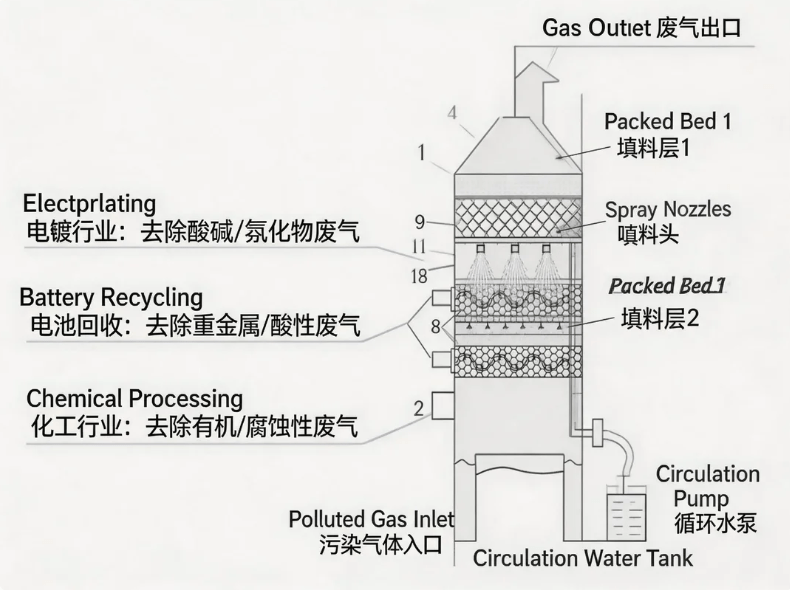
Scrubber Sizing: The Six Parameters That Determine Success
Every scrubber sizing calculation builds from six interconnected parameters. Get these right, and the scrubber will meet its emission target with minimum operating cost. Get one wrong, and you either fail compliance or overspend.
1. Gas Flow Rate and Turndown
The scrubber cross-sectional area and diameter are sized for the maximum expected gas flow. Superficial gas velocity through a packed bed typically ranges from 1.5 to 3.0 m/s for PP random packing. Exceeding this range causes flooding; operating far below it reduces mass transfer efficiency. Variable-speed fans or multiple parallel units handle wide turndown ratios. For vent gas scrubber applications where flow varies with tank levels and ambient temperature, a design flow range of 60–110% of maximum is common.
2. Liquid-to-Gas Ratio (L/G)
The L/G ratio—gallons of scrubbing liquid per 1,000 cubic feet of gas—determines the wetting rate of the packing and the available reactive chemical for pollutant capture. For HCl absorption with caustic, an L/G of 3–7 gpm/1,000 CFM is typical. HF requires higher ratios (5–10) due to its weak-acid behavior. Packed bed scrubbers using PP structured packing can operate at the lower end of these ranges while maintaining 99%+ removal because the smooth PP surface promotes uniform liquid film formation.
3. Packing Depth and Residence Time
Removal efficiency correlates directly with packing depth. A 2-meter PP packed bed achieves approximately 95% HCl removal at standard L/G; 3 meters delivers 99%; 4 meters reaches 99.9%. The correct depth depends on your target emission limit. Design for the tightest standard your permit could require over the system’s 15-year life—adding packing depth at the factory costs far less than extending a column later. Our industrial PP wet scrubber systems are engineered with modular packing sections that allow depth adjustment without vessel modification.
4. Pressure Drop and Fan Energy
Pressure drop across the packed bed is a function of gas velocity, packing type, and bed depth. For PP pall rings at 2.0 m/s superficial velocity and 3-meter bed depth, expect 250–400 Pa. Structured PP packing reduces this by 20–30% compared to random packing, translating directly into fan energy savings. Over 15 years, a pressure drop reduction of 100 Pa on a 10,000 CFM system saves approximately $5,000 in electricity—one reason why our PP systems show 40% lower total maintenance than SS304 equivalents. The EPA wet scrubber monitoring guidance recommends continuous differential pressure monitoring as a best practice for tracking packing condition and energy efficiency.
5. Chemical Consumption and pH Control
Chemical feed rate is sized based on the stoichiometric requirement plus 10–20% excess to ensure complete reaction. For a vent gas stream containing 50 ppm HCl at 10,000 CFM, caustic (NaOH) consumption is approximately 18 kg/day. Automated pH control with a setpoint of 7–9 minimizes chemical waste. PP’s chemical inertness means the scrubbing liquid chemistry is determined solely by the pollutant, not by corrosion byproducts from the vessel itself—a hidden advantage when sizing chemical feed systems.
6. Mist Elimination and Carryover
A properly sized mist eliminator prevents liquid droplet carryover, which would otherwise send captured pollutants out the stack. PP chevron-style demisters operate at face velocities of 2.5–4.0 m/s and achieve droplet removal down to 10 microns. For odor scrubber applications where even faint visible plume is unacceptable, a secondary mesh pad or coalescing filter may be added.
Packed Bed Scrubbers: Why They Dominate Corrosive Vent Gas Service
Packed bed scrubbers are the most widely used configuration for vent gas treatment because they offer the highest mass transfer efficiency per unit volume, handle a wide range of gas flows, and can be built entirely from PP for zero-corrosion operation. The packing media—random pall rings, saddles, or structured sheets—provides the surface area for gas-liquid contact. PP packing resists acid attack indefinitely and retains its geometric shape, maintaining design efficiency year after year. Metal packing, in contrast, corrodes, loses surface area, and introduces metal ions into the scrubbing liquid.
For an odor scrubber treating hydrogen sulfide, mercaptans, or ammonia, packed bed systems can be configured with a chemical scrubbing stage (oxidation with sodium hypochlorite or acid absorption for ammonia) or with a biological stage that uses bacteria to oxidize odor compounds. The vessel material must be compatible with both the incoming odorous gas and the scrubbing chemistry—PP satisfies this requirement across the full range. For a broader look at configurations, see our gas scrubber type comparison guide.
Odor Scrubber Sizing: Special Considerations for Nuisance Gases
An odor scrubber must achieve removal efficiencies that go beyond what emission permits require—because the human nose detects certain compounds at parts-per-billion levels. H₂S has an odor threshold of 0.5 ppb, mercaptans as low as 0.02 ppb. Sizing for odor control therefore requires higher packing depths, longer contact times, and often a polishing stage (activated carbon or biological filter) downstream of the primary packed bed.
Chemical odor scrubbers typically use sodium hypochlorite or hydrogen peroxide to oxidize H₂S and organic sulfides to odorless sulfate. The chemical consumption is proportionally higher than for simple acid gas neutralization. PP is fully compatible with these oxidizing environments—unlike stainless steel, which can suffer accelerated corrosion in the presence of hypochlorite. Our air pollution control wet scrubber systems can be configured with integrated carbon polishing for odor applications with the most stringent requirements.
The Material Factor: How PP Affects Sizing and Lifecycle Cost
Material choice is not separate from scrubber sizing—it directly influences the sizing parameters and the total cost of ownership. PP’s smooth surface allows lower L/G ratios and lower pressure drop. Its chemical inertness eliminates the corrosion allowance that must be factored into stainless steel wall thickness calculations. A PP scrubber wall thickness is determined by structural requirements, not by expected corrosion rate, so the vessel remains as strong in year 15 as in year one.
The 10-year cost comparison below is drawn from our project database for a 10,000 CFM packed bed scrubber treating mixed acid vent gas.
| Cost Category (10 Years) | PP Packed Bed Scrubber | SS304 Packed Bed Scrubber |
|---|---|---|
| Initial Capital (including installation) | $68,000 | $65,000 |
| Vessel Rebuilds / Replacement | $0 | $48,000 (year 5 replacement) |
| Fan Energy (10-year cumulative) | $35,600 | $43,200 |
| Chemical Consumption (NaOH, 10yr) | $28,000 | $31,000 (higher due to corrosion byproducts) |
| Maintenance Labor | $29,500 | $49,200 |
| Total 10-Year Cost | $161,100 | $236,400 |
The PP system saves over $75,000 across a decade—a return that begins within the first 18 months of operation. For a breakdown of all cost factors and the mechanics of saving, see our hidden scrubber costs analysis.
Get a custom sizing calculation for your vent gas stream. Provide your flow rate, pollutant data, and target emission limit—our engineers will return a complete design with pressure drop, chemical consumption, and 10-year cost projection. Request Your Free Sizing Calculation →
Frequently Asked Questions
How do I size a vent gas scrubber for my storage tank?
Start with the maximum venting rate per API 2000 (in-breathing and out-breathing) plus any process-generated flow. Provide the pollutant type and concentration. A scrubber sizing calculation then determines column diameter, packing depth, and liquid recirculation rate based on these inputs and your target outlet limit.
What is the correct L/G ratio for a packed bed odor scrubber?
For chemical odor scrubbers treating H₂S with hypochlorite, an L/G of 5–8 gpm/1,000 CFM is typical. For ammonia removal with sulfuric acid, 3–6 gpm/1,000 CFM. PP packing operates efficiently at the lower end, reducing pump energy.
Why choose a packed bed scrubber over a Venturi for vent gas?
Packed bed scrubbers achieve higher removal efficiency (99%+) for gases and fine aerosols at lower pressure drop than Venturis. Venturis are better for particulate-laden streams. If your vent gas contains both, a multi-stage system with a Venturi first stage is recommended.
Does scrubber sizing change for HF compared to HCl?
Yes. HF requires higher pH (10–12 vs. 7–9 for HCl), deeper packing, and higher L/G ratios because it is a weak acid. PP is mandatory for HF service; FRP and glass internals are chemically attacked.
How much does an undersized scrubber cost over its lifetime?
An undersized vent gas scrubber will exceed emission limits during peak flow or high concentration events, risking fines of up to $37,500 per day under NESHAP. The cost of a properly sized system is a fraction of a single major violation.
Can I get a sizing calculation before purchasing?
Yes. As a factory-direct manufacturer, we provide detailed sizing calculations with your quotation, including column diameter, packing depth, pressure drop, chemical consumption, and performance guarantee—at no cost. Visit our contact page to start.
Conclusion
Scrubber sizing is an engineering discipline, not a guess. A properly sized vent gas scrubber—with the correct packing depth, L/G ratio, and mist elimination for your specific pollutant and flow profile—delivers consistent compliance and the lowest total cost of ownership. PP packed bed scrubbers with 300% better corrosion resistance than SS304, a 2x longer service life than FRP, and 40% lower maintenance provide the most reliable and cost-effective platform for vent gas, odor control, and corrosive exhaust applications. Contact our engineering team with your gas data, and we will return a complete sizing calculation and quotation with a written performance guarantee.
Request Your Free Sizing Calculation →
Written by our senior process engineer, who has over a decade of experience sizing, designing, and commissioning packed bed scrubbers for vent gas, odor control, and corrosive exhaust applications across Asia, the Middle East, and Latin America. All sizing parameters, cost figures, and performance data are drawn from the documented outcomes of our 500+ installations.


