
For specifications and pricing, browse our product catalog.
Key Takeaways
- **Multi-Stage Gas Scrubber Design:** When One Stage Isn’t Enough
- **H₂S Scrubber Media Comparison:** Chemical vs. Biological vs. Hybrid
- **2026 Compliance Trends Shaping Gas Scrubber Selection** — this comparison helps you select the right technology and configuration for your specific application.
- **Real-World Selection Case:** Philippines Electroplating Plant
- **Material Selection:** The Decision Most Buyers Get Wrong
Introduction
Most guides tell you what a gas scrubber is and list the common types — packed bed, Venturi, spray tower. But when your exhaust contains both heavy particulate and corrosive acid gases, none of those single-stage answers work. You need a gas scrubber selection methodology that accounts for multi-pollutant loads, varying inlet conditions, and the hidden compliance risks that emerge three years into operation. This guide fills the gap left by generic overviews. We cover multi-stage design logic, H₂S media comparison across chemical and biological options, 2026 regulatory trends that impact your equipment choices, and the material selection framework that determines whether your system lasts 5 years or 20. For the foundational operating principles behind these systems, read our companion article on gas scrubber types for H2S, acid, and fuel gas.
Multi-Stage Gas Scrubber Design: When One Stage Isn’t Enough
Single-stage scrubbers dominate online guides, but real industrial exhaust rarely fits a textbook. A foundry emits fine silica dust alongside SO₂ from core binders. A lithium battery recycling line produces HF gas mixed with carbon black particulates. In both cases, a single packed bed or Venturi will underperform — and your compliance will suffer. Multi-stage gas scrubber selection solves this by pairing complementary technologies in series.
Stage 1: Particulate Knockdown (Venturi or Jet Scrubber)
The first stage removes coarse and fine particulates that would clog downstream packing. A Venturi scrubber uses a high-velocity throat to atomize scrubbing liquid into microscopic droplets, capturing submicron particles through inertial impaction. For explosive or heavily dust-laden streams, a jet scrubber — where pressurized liquid creates the draft — eliminates the need for a fan in the dirty gas stream. After this stage, the gas is saturated, cooled, and largely free of solids — ideal conditions for stage two.
Stage 2: Chemical Absorption (Packed Bed Scrubber)
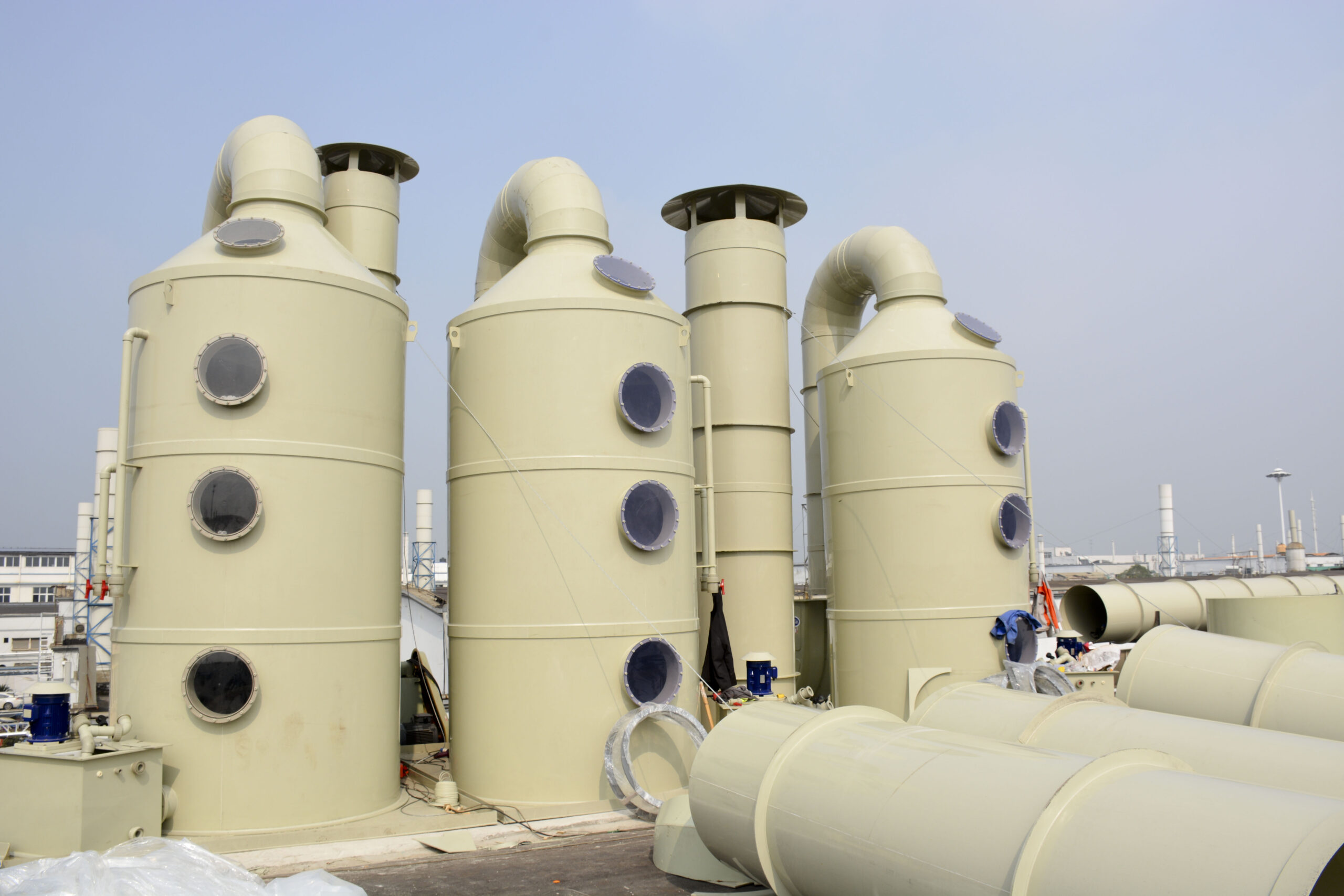
The now clean, saturated gas enters a counter-flow packed bed where caustic or amine solution neutralizes acid gases or absorbs H₂S. Without the particulate burden, packing stays clean for years, maintaining the design contact area that generic single-stage scrubbers lose to clogging within months. Our PP packed bed scrubber is purpose-built for this exact role — the EPA wet scrubber monitoring protocol validates this multi-stage approach, emphasizing that consistent outlet readings depend on stable contact geometry — something only PP can maintain long-term.
Stage 3 (Optional): Polishing and Odor Control
For applications with strict odor limits — municipal biogas upgrading, pharmaceutical solvent recovery — a third polishing stage can be added. This might be an activated carbon bed for trace VOC removal or a biological trickling filter that converts residual H₂S to sulfate. The key design insight is that each stage reduces the pollutant load entering the next, making the overall system more compact and reliable than a single oversized unit.
Glass furnace exhaust is a common multi-stage case: particulate, SOx, and NOx loads vary with furnace type and firing practice, so the route decision starts with wet scrubber selection for glass furnace exhaust rather than a one-size-fits-all unit.
Decision Matrix: When to Go Multi-Stage
| Exhaust Profile | Recommended Configuration | Why |
|---|---|---|
| Acid gas only (no dust) | Single PP packed bed | No particulate to clog packing |
| Heavy dust + acid gas | Venturi → PP packed bed | Dust removed first, extends packing life 5x |
| H₂S + CO₂ (biogas) | PP packed bed with amine → activated carbon polish | Amine for H₂S/CO₂ bulk removal, carbon for final polishing |
| Mixed acid + alkali exhaust | Separate acid scrubber → alkali scrubber in series | Sequential columns prevent neutralization in a single vessel |
| Explosive dust + corrosive gas | PP jet scrubber → PP packed bed | Jet eliminates spark risk; PP handles corrosives |
As PP material experts, we’ve engineered multi-stage systems for electroplating shops across Southeast Asia where single-stage SS units had failed within two years. The multi-stage approach kept packing clean and compliance stable, while PP construction ensured the entire train remained corrosion-free. For an overview of equipment options across the full pollution control spectrum, see our 2026 guide to air pollution control systems.
H₂S Scrubber Media Comparison: Chemical vs. Biological vs. Hybrid
The gas scrubber selection challenge for hydrogen sulfide is unique because H₂S can be removed by fundamentally different mechanisms — chemical absorption, biological oxidation, or solid-phase adsorption. The wrong choice leads to excessive chemical costs or inadequate removal at peak loads.
| Media Type | Mechanism | Removal Efficiency | OPEX Profile | Best Application |
|---|---|---|---|---|
| NaOH (Caustic) | Chemical neutralization: H₂S + 2NaOH → Na₂S + 2H₂O | >99% | High — continuous chemical purchase and waste disposal | Small-to-medium biogas plants, variable loads |
| Amine (MEA/DEA) | Reversible chemical absorption with thermal regeneration | >99% | Moderate — regeneration reduces chemical consumption | Large biogas upgrading, natural gas processing |
| Biological (Bio-Trickling Filter) | Bacterial oxidation: H₂S → H₂SO₄ by Thiobacillus species | 90–95% | Low — no chemical cost once established | Wastewater treatment, steady gas flow |
| Activated Carbon | Physical adsorption + catalytic oxidation on carbon surface | 95–99% (polishing) | Moderate — media replacement every 6–18 months | Low-flow polishing, final stage after bulk removal |
| Hybrid (Chemical + Biological) | Chemical absorption followed by biological regeneration of caustic | >99% | Low-to-moderate — regenerated alkali, low waste | Medium-to-large biogas, high uptime requirement |
The vessel material is just as critical as the media choice. H₂S in moist environments forms weak sulfurous acid, which attacks carbon steel and 304 stainless steel through stress corrosion cracking. PP is chemically inert to both H₂S and the caustic or amine solutions used, so your gas scrubber selection can focus on the right media without worrying about shell degradation. Our gas scrubber for industrial waste gas treatment handles H₂S across all media types with zero material compatibility concerns. The OSHA permissible exposure limits for H₂S (10 ppm TWA) demand consistent removal — and consistent removal demands a vessel that doesn’t degrade.
2026 Compliance Trends Shaping Gas Scrubber Selection
Emission regulations are moving targets. Your gas scrubber selection today must account for where standards will be in 2030, not where they were in 2020. Three trends are reshaping scrubber design requirements globally.
Carbon Capture Integration: From Pollution Control to Resource Recovery
The most significant shift in industrial gas cleaning is the convergence of emission control and carbon capture. Scrubbers originally designed solely for acid gas removal are being reimagined as dual-function units: removing SO₂ and HCl while also capturing CO₂ for reuse (e.g., in greenhouses, soft drinks, or chemical synthesis). This requires higher packing efficiency, different scrubbing chemistries, and materials compatible with both acidic and CO₂-rich environments.
Regional Standards Tightening
| Region | 2024 HCl Limit | 2026/2027 Trend | Impact on Scrubber Design |
|---|---|---|---|
| EU (BREF/BAT) | 1–10 mg/Nm³ | BAT-AEL range narrowing — upper limits decreasing | Need for higher packing depth and finer mist elimination |
| India (CPCB) | 20 mg/Nm³ | Alignment with WHO interim targets; likely decrease to 10 mg/Nm³ by 2027 | Existing single-stage scrubbers may become non-compliant |
| Southeast Asia (DENR/PCD) | 10–30 mg/Nm³ | Gradual harmonization with BREF standards | New installations should design for BREF compliance from day one |
| U.S. (EPA NESHAP) | 0.5–2.0 kg/hr (varies by source) | Stable, but enforcement increasing with continuous monitoring requirements | CEMS-ready design with dedicated tapping points now standard |
The practical consequence: if you’re installing a scrubber today in India or Southeast Asia, designing to current local limits alone risks a costly retrofit within 3 years. Design to the tighter incoming standard and future-proof your compliance. This is where PP construction delivers an unspoken advantage — unlike SS or FRP scrubbers that may need rebuilds within 5 years, PP vessels last 15+ and can be retrofitted with higher-efficiency internals without shell replacement.
Continuous Monitoring Becomes Standard
Regulators worldwide are moving from periodic stack testing to CEMS requirements. Your scrubber must have dedicated tapping points for SO₂, HCl, and flow monitors — and the vessel must maintain gas-tight integrity so that monitoring data remains accurate over the full service life. A pinhole leak upstream of the CEMS probe produces false readings and potential penalties. Our air pollution control wet scrubber systems include CEMS-ready ports as standard, ensuring your monitoring setup is audit-ready from day one.
Real-World Selection Case: Philippines Electroplating Plant
In 2024, a chrome and nickel plating facility in Cebu was facing quarterly DENR exceedances. Their existing SS304 packed bed scrubber — a single-stage unit treating mixed HCl, H₂SO₄, and chromic acid mist — had developed multiple pinhole leaks at the 3-year mark. Worse, they discovered that liquid maldistribution from a warped SS distributor was causing only 60% of the packing to receive scrubbing liquid.
Our gas scrubber selection was a complete replacement with a PP packed bed unit, sized for current and anticipated future limits. The homogeneous PP shell eliminated the corrosion risk. PP internal distributors, dimensionally stable at the scrubber’s 70°C operating temperature, restored full packing utilization. Within 18 months, the investment paid back through avoided penalty risk and reduced chemical consumption — the plant’s NaOH usage dropped 25% because uniform distribution meant less chemical waste. For guidance on sizing such systems precisely, see our PP wet scrubber sizing guide.
Not sure which scrubber configuration matches your exhaust? Send us your gas composition, flow rate, and target emission limits. Our engineers will provide a multi-stage design recommendation with ROI projection — free. Get Your Free Selection Consultation →
Material Selection: The Decision Most Buyers Get Wrong
The single most expensive mistake in gas scrubber selection is choosing the vessel material based on purchase price alone. Stainless steel looks cheaper on the quote. PP looks like a premium. But the 10-year picture reverses completely.
- SS304 in acid service: Replacement within 3–5 years. One mid-life rebuild. Pinhole leaks compromise compliance. Total 10-year cost: 2–3x the initial purchase price.
- FRP in acid service: 7–10 year service life. Delamination risk at joints. UV degradation requires external coating. Maintenance costs moderate but unpredictable.
- PP (solid polypropylene): 15–20 year service life. 300% better corrosion resistance than SS304. 40% lower maintenance. 2x longer than FRP. Homogeneous welds — no interfaces, no leak paths. Total 10-year cost: the lowest of all three options, verified across our 500+ installations.
As this independent review on Pollution Engineering confirms, polymer-based scrubbers are now the standard specification for corrosive industrial applications where maintenance access is limited. To understand the full cost picture, read our analysis of hidden scrubber costs that most vendor quotes omit.
Frequently Asked Questions
When is a multi-stage gas scrubber necessary?
When your exhaust contains both particulates and acid gases, a single-stage scrubber will underperform. A Venturi or jet scrubber first removes dust, then a packed bed handles the gas-phase pollutants. Multi-stage selection prevents packing clogging and extends the system’s effective life by 5x compared to a single-stage unit handling mixed loads.
Which H₂S removal media gives the lowest operating cost?
Biological scrubbers offer the lowest OPEX once established, with almost zero chemical input. For variable or high-H₂S streams, hybrid chemical-biological systems regenerate caustic in situ, combining >99% removal with low waste. The vessel must be PP to handle both H₂S acidity and the caustic/biological environment without degradation.
How do 2026 emission trends affect my scrubber purchase today?
Regulations are tightening in India, Southeast Asia, and globally. A scrubber designed only to current local limits may need a costly retrofit within 3 years. Design to EU BREF BAT-AEL levels from day one, and choose PP so the shell can accommodate future internals upgrades without replacement.
Why does PP outperform SS and FRP in gas scrubber applications?
PP demonstrates 300% better corrosion resistance than SS304, lasts 2x longer than FRP, and reduces maintenance by 40%. It is chemically inert to HCl, H₂S, HF, and caustic solutions — the complete range of scrubbing chemistries — with homogeneous welds that eliminate the interfacial leak paths where failure begins in metal or composite vessels.
How do I select the right scrubber for mixed acid and alkali exhaust?
Mixed acid-alkali streams — common in semiconductor etching and battery testing — require separate, sequential columns: one for acids, one for alkalis. Treating both in a single vessel causes neutralization that fouls packing. Our industrial PP wet scrubbers can be configured in series for this exact requirement.
What ROI can I expect from a properly selected PP gas scrubber?
A Philippine electroplating plant recovered its PP scrubber investment in 18 months through avoided penalty risk, 25% lower chemical consumption from uniform liquid distribution, and eliminated rebuild costs that SS scrubbers incur every 3–5 years. For more detail on lifecycle economics, see our hidden scrubber costs breakdown.
Conclusion
Effective gas scrubber selection is never about finding the cheapest upfront quote. It’s about matching the right combination of stages, media, and — most critically — vessel material to your actual exhaust composition and your region’s regulatory trajectory. Multi-stage design handles complex exhaust that single-stage scrubbers cannot. The right H₂S media choice cuts operating costs by 50% or more. And PP construction — with 300% better corrosion resistance, 40% lower maintenance, and a 2x longer lifespan — ensures that whatever selection you make today keeps performing through 2040 and beyond. Contact our engineering team to configure the right system for your specific gas stream, backed by factory-direct pricing and proven results across 500+ global installations.
Get Your Free Gas Scrubber Selection Consultation →
Written by our senior process engineer with 10+ years of experience designing and commissioning multi-stage gas scrubbing systems for electroplating, biogas, chemical processing, and semiconductor facilities across Asia, the Middle East, and Latin America. Every selection recommendation is backed by actual project data from our 500+ installations.


