
Introduction: Beyond the Definition—Real Industrial Applications
If you arrived here asking “what are scrubbers,” you’ve probably already seen the textbook answer: they are devices that wash pollutants out of exhaust gas. But the practical question every plant manager and EHS engineer actually needs answered is “what are scrubbers used for in my specific process, and how do I select one that won’t become a maintenance nightmare in three years?” This guide answers that question. We move beyond definitions and generic type lists into the real industrial scenarios where scrubbers earn their keep—electroplating lines, lithium battery recycling, chemical batch reactors, and more. For each application, we provide the pollutant chemistry, the correct scrubber type, the material that survives longest, and the ten-year cost data that procurement teams need but almost never receive. Our companion article covers what scrubbers are and how they work; here we focus entirely on where they go and what they cost.
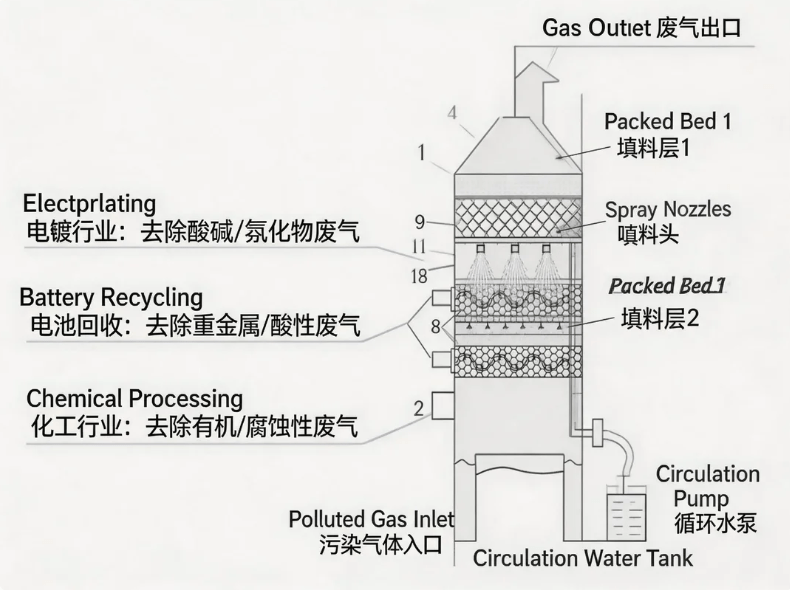
Electroplating & Metal Finishing: The Acid Mist Challenge
Chrome, nickel, and zinc plating lines produce exhaust that is deceptively simple in composition but punishing in effect. Hydrochloric acid from pickling tanks, chromic acid mist from chrome baths, and sulfuric acid from anodizing lines often travel through the same ductwork. A single-material scrubber must handle all three simultaneously—and survive. Stainless steel 304, the default choice for many general fabricators, develops chloride pitting from HCl within 18 months and through-wall pinholes within 24 months under continuous exposure at scrubber temperatures (50–80°C).
The correct specification for this application is a PP packed bed scrubber with structured packing rated for mixed acid service and a scrubbing liquid maintained at pH 7–9 using automated caustic dosing. Polypropylene is chemically inert to HCl, H₂SO₄, and chromic acid at scrubber operating temperatures—there is no passive oxide layer to breach because there is no metal. Our PP packed bed scrubber is built specifically for this duty, with every seam homogeneously welded from parent PP stock so there are no interfaces for acid to attack. A chrome-plating plant we supplied in Thailand replaced a leaking SS304 unit with a PP system sized for 10,000 CFM; the payback arrived in 18 months through eliminated rebuild costs and reduced chemical consumption. For a complete breakdown of the numbers behind such projects, see our hidden scrubber costs analysis.
Lithium Battery Recycling: Hydrogen Fluoride and Mixed Particulate
Lithium battery recycling is the fastest-growing source of HF-laden exhaust in industry today. When batteries are shredded and thermally processed, the electrolyte decomposes, releasing hydrogen fluoride along with carbon black particulate and volatile organic compounds. HF is a weak acid—it does not fully dissociate in water—so capturing it demands a scrubbing liquid maintained at pH 10–12, significantly higher than the pH 7–9 that handles HCl. More critically, HF attacks silicon dioxide, which means it dissolves the glass fibers inside FRP scrubbers and etches ceramic packing. A fiberglass scrubber on HF duty will suffer structural delamination within 24–36 months.
The correct specification is a multi-stage wet scrubber: a Venturi pre-stage or jet scrubber to knock down carbon black particulate, followed by a PP packed bed column with independent pH control for HF absorption. PP throughout the entire train—from inlet duct to recirculation tank—is mandatory; there is no material transition point where HF can find a vulnerable interface. Our gas scrubber for industrial waste gas treatment systems are engineered for exactly this demanding application, with integrated fluoride-laden blowdown treatment via calcium precipitation. The EPA wet scrubber monitoring framework provides useful guidance on instrumentation and sampling protocols for HF service.
Chemical Batch Processing: Concentration Spikes and Thermal Load
Unlike continuous processes that emit a steady gas concentration, batch reactors produce exhaust that swings from near-zero to 200 ppm acid gas in minutes, then back to zero. A scrubber sized for the average load will fail during peaks; one sized for the peak will be oversized and inefficient for 90% of the cycle. The solution is a packed column scrubber with automated pH-controlled chemical dosing and a recirculation tank large enough to buffer concentration changes. Our industrial PP wet scrubber systems include variable-speed chemical metering pumps that respond to real-time pH readings, maintaining the target setpoint regardless of gas load fluctuation.
The material requirement is equally specific. Batch reactions often generate exotherms that can push gas temperatures to 80°C. PP handles this without softening or distortion. Stainless steel, already vulnerable to the acid being produced, faces accelerated corrosion at elevated temperatures. FRP can creep under sustained load when hot. For a broader overview of scrubber configurations that handle these variable conditions, see our guide to gas scrubber types.
What Scrubbers Cost: 10-Year TCO by Material
Most guides describe what scrubbers are used for but avoid what they actually cost to own. The table below models a 10,000 CFM system treating mixed HCl/H₂SO₄ exhaust—numbers drawn from our project database rather than theoretical estimates.
| Cost Category (10 Years) | PP Scrubber | SS304 Scrubber | FRP Scrubber |
|---|---|---|---|
| Initial Capital | $68,000 | $65,000 | $62,000 |
| Vessel Rebuilds / Replacement | $0 | $48,000 (one full replacement) | $25,000 (patch & UV repair) |
| Energy (Fan Power, 10-year cumulative) | $35,600 | $43,200 | $41,500 |
| Water & Wastewater Disposal | $30,400 | $38,000 | $39,000 |
| Maintenance Labor & Materials | $29,500 | $49,200 | $36,500 |
| Total 10-Year Cost | $163,500 | $243,400 | $204,000 |
A PP system saves nearly $80,000 over a decade compared to stainless steel. The payback on the slightly higher upfront cost is 18 months. To size a system for your specific airflow and pollutant load, use our PP scrubber sizing guide. The OSHA air contaminant limits provide additional context on the workplace exposure thresholds these systems are designed to meet.
Global Emission Limits Your Scrubber Must Meet
Selecting a scrubber without knowing the specific emission limits for your region is a mistake that forces expensive retrofits. The table below compares current limits across four major regulatory frameworks.
| Region / Standard | HCl Limit | SO₂ Limit | HF Limit |
|---|---|---|---|
| U.S. EPA (NESHAP 40 CFR 63) | 0.5–2.0 kg/hr or 20 ppmv | Varies by NSPS category | 0.15–0.5 kg/hr |
| EU BREF / BAT-AEL | 1–10 mg/Nm³ | 50–150 mg/Nm³ | 0.1–1 mg/Nm³ |
| India CPCB | 20 mg/Nm³ | 100 mg/Nm³ | 5 mg/Nm³ |
| Philippines DENR / Thailand PCD | 10–30 mg/Nm³ | 50–200 mg/Nm³ | 2–5 mg/Nm³ |
Designing to EU BREF BAT-AEL from day one avoids a costly rebuild when your local limits inevitably tighten. PP’s 15-year service life makes this forward-looking approach practical—the shell will still be intact when your permit requirements become stricter.
Installation Checklist: Five Steps That Prevent Startup Failure
Even a perfectly engineered scrubber can fail to meet its design efficiency if installed incorrectly. Based on our commissioning experience across 500+ projects, these five points are the most frequent sources of startup problems:
- Duct slope and drainage: Inlet ducts must slope toward the scrubber at a minimum 2% grade. Flat or back-sloped ducts collect corrosive condensate.
- Fan placement: Position the exhaust fan on the clean-gas side (induced draft) to keep the impeller out of the corrosive stream.
- Liquid distributor leveling: Level distributors to within ±1 mm across their span. An out-of-level distributor creates dry channels from day one.
- Recirculation tank sealing: Cover the tank and vent it back to the scrubber inlet. Open tanks allow VOC re-entrainment.
- Instrument calibration: Calibrate pH probes, differential pressure transmitters, and level switches on-site with actual process liquids. A 10% offset can hide developing failures for months, especially in scrubber water treatment loops. For a detailed guide on managing the liquid side of your system, see our scrubber water treatment design guide.
Tell us your exhaust parameters. Our engineers will recommend the correct scrubber type and material for your specific application, with a 10-year cost projection and written performance guarantee. Get Your Free Application Assessment →
Frequently Asked Questions
What are scrubbers used for in electroplating?
In electroplating, scrubbers capture acid mists—HCl from pickling, chromic acid from chrome baths, and H₂SO₄ from anodizing lines. A PP packed bed scrubber with automated caustic dosing is the standard solution, resistant to all three acids simultaneously.
Can one scrubber handle both dust and acid gases?
Yes, through a multi-stage configuration. A Venturi pre-stage removes particulate, and a downstream packed bed column handles acid gases. This is essential for applications like lithium battery recycling, where HF gas and carbon black dust coexist.
How do emission limits affect my scrubber choice?
Your target emission limit determines packing depth, liquid chemistry, and mist elimination efficiency. Design to the tightest standard applicable to your region. PP systems are upgradeable with deeper packing without replacing the vessel itself.
What is the single biggest driver of scrubber lifetime cost?
Mid-life vessel replacement. SS304 scrubbers require a new shell within 5 years in acid service, costing 70% of the original purchase price. PP eliminates this event entirely, which is why the 10-year TCO is approximately 33% lower.
How do I know which scrubber type fits my application?
The answer depends on your pollutant chemistry, gas flow rate, temperature, and target emission limit. Provide these four parameters to a qualified manufacturer for a specific recommendation with a performance guarantee.
Do you provide international installation support?
Yes. We ship complete PP scrubber systems to over 30 countries, with detailed installation manuals, remote commissioning support, and optional supervised startup. Factory-direct pricing applies regardless of destination.
Conclusion
Understanding what scrubbers are used for is the first step. Selecting the right scrubber type, material, and configuration for your specific application—electroplating, battery recycling, chemical batch processing, or any other corrosive exhaust duty—is what determines whether your system delivers 15 years of trouble-free compliance or becomes a recurring capital expense. PP construction, with 300% better corrosion resistance than SS304, a 2x longer service life than FRP, and 40% lower maintenance, provides the material foundation for the lowest total cost of ownership across all the applications described above. Contact our engineering team with your exhaust parameters for a complete system recommendation backed by factory-direct pricing and a written performance guarantee.
Request Your Free Application Assessment →
Written by our senior process engineer, who has spent over a decade specifying, installing, and commissioning industrial scrubber systems for electroplating, battery recycling, and chemical processing facilities across Asia, the Middle East, and Latin America. All application data, cost figures, and material comparisons are drawn from the documented outcomes of our 500+ completed installations.


