
Introduction: The Simple Answer First
What are scrubbers? At their core, scrubbers are pollution control devices that use liquid or dry media to remove harmful gases, particulates, and chemical fumes from industrial exhaust. If your plant produces emissions — whether acid mist from electroplating, hydrogen sulfide from biogas, or fine dust from metal grinding — a scrubber is what stands between that exhaust and the outside air. This guide answers what are scrubbers used for, breaks down all major scrubber types, and explains why wet scrubbers built from polypropylene have become the standard for corrosive applications. We are a factory-direct manufacturer with over 500 installations worldwide, and the recommendations here are based on real systems operating under real permits.
What Are Scrubbers? A Clear Definition
The question what are scrubbers comes up most often from plant managers and engineers who are new to air pollution control or upgrading an old system. A scrubber is essentially a washing device for dirty air. Contaminated gas enters a vessel, comes into contact with a scrubbing medium — usually water, a chemical solution, or a dry sorbent — and pollutants transfer from the gas into that medium. Cleaned gas then exits through a stack or ductwork. The captured pollutants end up in a liquid blowdown stream or spent dry media, both of which require proper handling.
Scrubbers handle three broad categories of pollutants: acid gases (HCl, HF, H₂SO₄, SO₂), particulates (metal fumes, silica dust, carbon black), and odors or volatile organics. A single scrubber can often handle all three when properly designed. This versatility is what makes scrubbers the backbone of industrial emission control in sectors ranging from chemical processing to battery recycling. For a deeper dive into how the scrubbing process actually works, see our guide on how scrubber work solves industrial compliance.
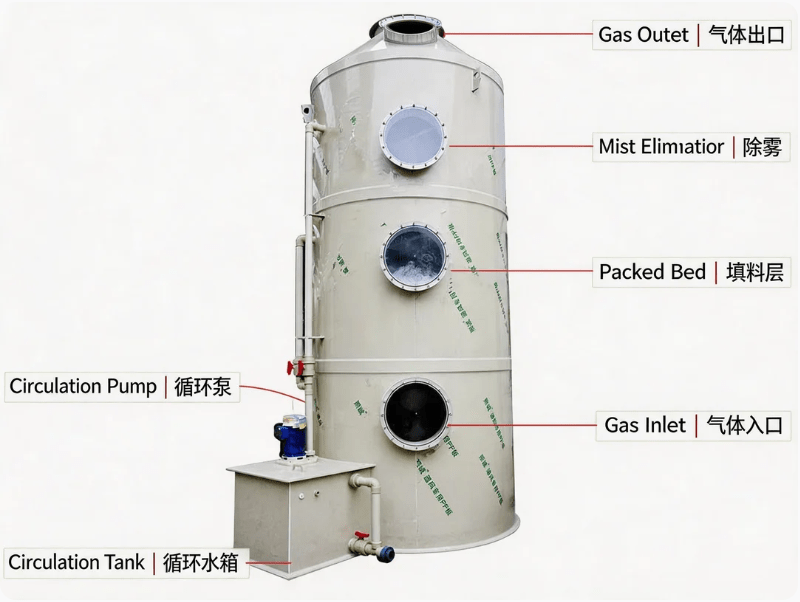
What Are Scrubbers Used For? The Industries That Depend on Them
What are scrubbers used for across different industries? The answer covers almost every sector that generates corrosive or hazardous exhaust. Below are the most common applications we have supplied systems for.
| Industry | Typical Pollutants | Recommended Scrubber Type |
|---|---|---|
| Electroplating & Metal Finishing | HCl, H₂SO₄, chromic acid mist, NOₓ | PP packed bed wet scrubber |
| Lithium Battery Recycling | HF, HCl, heavy metal particulates | Multi-stage PP wet scrubber |
| Chemical Processing | SO₂, HCl, VOCs, organic sulfides | Chemical scrubbers with pH control |
| Biogas & Landfill Gas | H₂S, siloxanes, moisture | Packed bed with amine or biological stage |
| Pharmaceutical Manufacturing | Solvent vapors, acid gases, odors | Combination wet scrubber + carbon adsorption |
| Semiconductor Fabrication | HF, HCl, SiH₄, ammonia | PP packed bed with emergency gas abatement |
In each of these applications, the scrubber is not optional — it is the difference between operating with a valid environmental permit and facing fines of up to $37,500 per day under regulations like the EPA NESHAP framework. The OSHA permissible exposure limits for the airborne forms of these pollutants are equally strict, requiring reliable scrubbing to keep workplace air safe.
Scrubber Types: Choosing the Right Configuration
When evaluating scrubber types, the first decision is between wet and dry systems. Within wet systems, there are further choices based on gas flow, pollutant chemistry, and available space.
Wet Scrubbers: The Workhorse of Industrial Gas Cleaning
A wet scrubber uses liquid — almost always water with a chemical additive — to absorb and neutralize pollutants. The gas-liquid contact can happen in several ways, giving rise to the main wet scrubber subtypes:
- Packed bed scrubber: Gas flows upward through a column filled with structured packing, while liquid flows downward. This creates the highest contact surface area and achieves 99%+ removal for acid gases. Our PP packed bed scrubber is the most widely used configuration in corrosive exhaust service.
- Venturi scrubber: Gas is accelerated through a narrow throat, atomizing the scrubbing liquid into microscopic droplets that capture fine particulates. Ideal for foundries, smelters, and applications with heavy dust loads.
- Cyclone spray chamber: Gas enters tangentially, creating a centrifugal flow that forces liquid droplets into contact with the vessel wall. Suitable for moderate removal requirements and water-soluble gases.
- Horizontal crossflow scrubber: Gas moves horizontally through a spray curtain. It requires less height than vertical columns and is often used in retrofit projects with ceiling constraints. See our guide to PP scrubber applications for examples.
Dry Scrubbers: For Water-Sensitive Environments
Dry scrubber types use a powdered sorbent — typically hydrated lime or sodium bicarbonate — injected into the gas stream. The sorbent reacts with acid gases to form solid salts, which are then collected in a downstream baghouse or electrostatic precipitator. Dry scrubbers avoid liquid waste but are generally less efficient than wet systems for highly soluble gases like HCl and cannot handle the high humidity found in many industrial exhaust streams.
Semi-Dry and Other Configurations
Spray dryer absorbers spray a lime slurry into hot gas; the water evaporates, leaving dry reaction products. These systems occupy a middle ground between wet and dry, commonly used in larger waste-to-energy plants where minimizing visible plume is important. For a complete comparison of all system types, see our overview of gas scrubber types.
Why Wet Scrubbers — and Why PP — for Corrosive Exhaust
If your exhaust contains acid gases, the wet scrubber is almost always the correct choice. Water absorbs HCl and HF far more efficiently than any dry sorbent, and the chemical reaction with caustic converts pollutants into harmless salts that stay dissolved in the liquid phase. But the vessel material is what determines whether the system survives its full design life. Stainless steel 304 in HCl service develops pinhole leaks within 18–24 months. FRP degrades under HF attack and UV exposure. PP — solid, homogeneously welded polypropylene — is chemically inert to the full spectrum of mineral acids and caustic solutions at scrubber temperatures. That is why our industrial PP wet scrubber systems deliver 300% better corrosion resistance than SS304, a 2x longer service life than FRP, and 40% lower maintenance over their operational lifetime. For the cost data behind those numbers, see our hidden scrubber costs analysis.
Frequently Asked Questions
What are scrubbers, in the simplest terms?
Scrubbers are industrial air cleaners. They wash pollutants out of exhaust gas using water, chemicals, or dry powder. The cleaned air meets emission limits, and the captured pollutants are managed safely.
What are scrubbers used for in electroplating?
In electroplating, scrubbers capture acid mists — HCl from pickling tanks, chromic acid from chrome plating, and sulfuric acid from anodizing lines. A PP packed bed scrubber is the standard solution because it resists corrosion from all three acids simultaneously.
Which scrubber type is best for acid gases?
A packed bed wet scrubber offers the highest removal efficiency for HCl, HF, and SO₂ — routinely exceeding 99%. If the gas stream also contains heavy dust, a Venturi pre-stage is added before the packed bed.
How long does a wet scrubber last?
A PP wet scrubber lasts 15–20 years with routine visual inspections and occasional nozzle cleaning. Stainless steel scrubbers in the same acid service typically need replacement within 5 years.
Do dry scrubbers work better than wet scrubbers?
Not for corrosive, high-humidity exhaust. Dry scrubbers avoid liquid waste but cannot match the removal efficiency of a wet scrubber for highly soluble gases like HCl. The right choice depends entirely on your pollutant chemistry.
Can one scrubber handle multiple pollutants at once?
Yes. A properly designed wet scrubber can simultaneously remove acid gases, particulates, and odors when the scrubbing chemistry is correctly formulated and the packing depth is sufficient.
Conclusion
If you came here asking what are scrubbers, the answer is now complete: they are the most reliable industrial air pollution control devices available, with wet scrubbers leading the field for corrosive exhaust. The right scrubber type — chosen for your specific gas composition, flow rate, and emission limits — combined with PP construction that eliminates the corrosion failures of steel and FRP, gives you a system that meets its permit requirements year after year, with the lowest documented total cost of ownership. Contact our engineering team with your exhaust parameters, and we will recommend the correct scrubber configuration for your facility, backed by a written performance guarantee and factory-direct pricing.
Get Your Free Scrubber Recommendation →
Written by our senior process engineer with over ten years of experience specifying, installing, and commissioning industrial scrubbers for facilities across Asia, the Middle East, and Latin America. The application data, material comparisons, and performance figures in this article are based on documented results from our 500+ completed installations.


