
The introduction of wet scrubber system
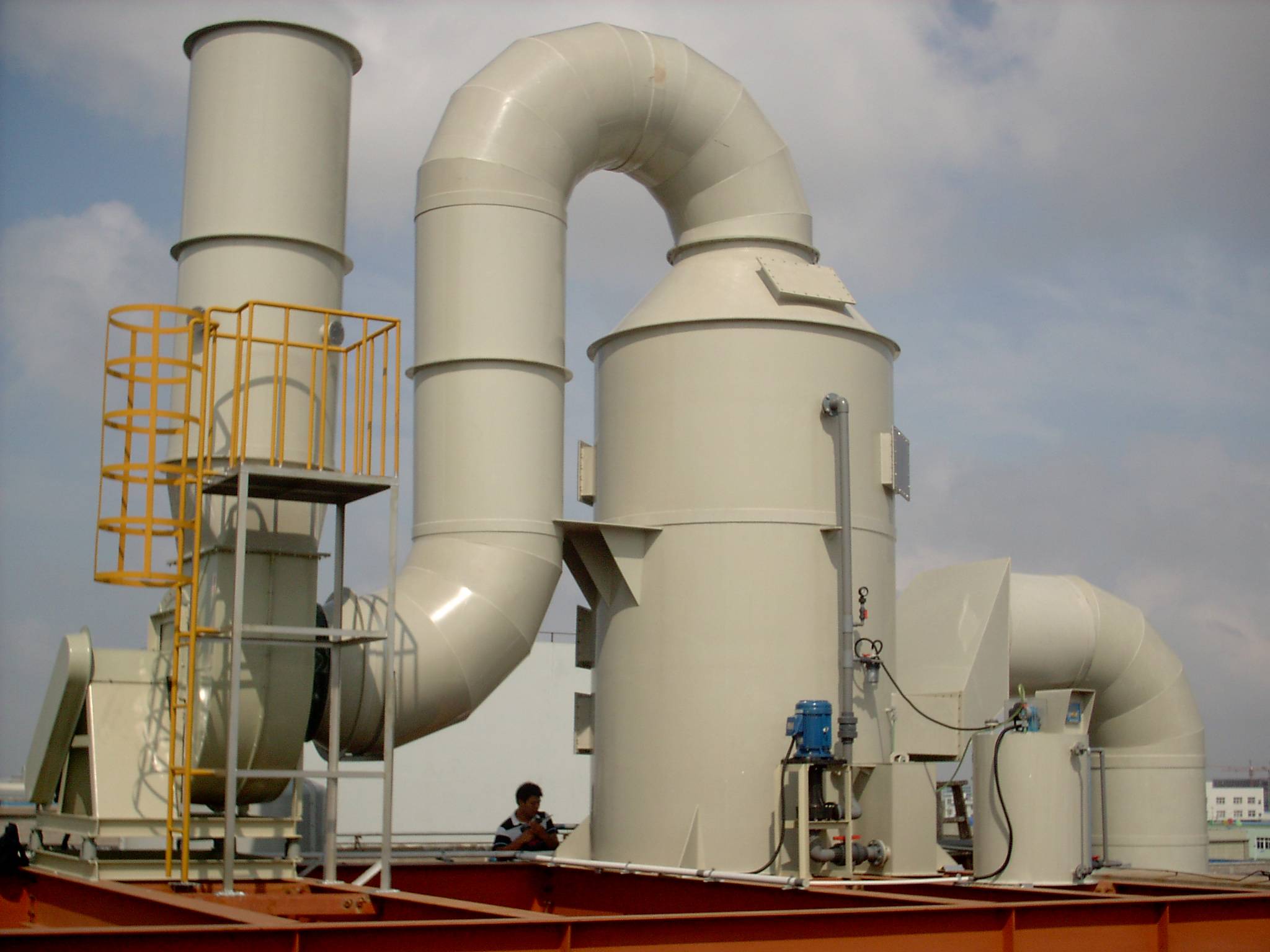
It is an efficient purification equipment that removes pollutants through the contact between liquid and gas: dust-containing gas or waste gas enters the scrubber under the negative pressure of the fan, passes through the packing layer or fully contacts with the sprayed cleaning liquid. The scrubbing liquid absorbs and captures pollutants in the air flow, and uses centrifugal force inside the scrubber or devices such as demister plates to separate the scrubbing liquid containing pollutants from the purified gas. The muddy sediment captured by the water settles to the bottom of the tower together with the water, and the purified gas is discharged through the fan.

The structural composition of wet scrubber system
- Scrubber body: made of corrosion-resistant materials, such as PP (polypropylene), FRP (fiberglass reinforced plastic), etc., with a support structure inside to carry fillers and other components;
- Nozzle system: spray the washing liquid evenly throughout the tower to ensure that the exhaust gas can fully contact the washing liquid;
- Filling layer: filled with fillers of different shapes and sizes, such as polyhedral balls, Pall rings, etc., to increase the contact area between the gas and liquid phases and improve purification efficiency;
- Air flow distribution plate: ensures that the air flow entering the tower is evenly distributed to avoid short circuits;
- Mist eliminator: located at the top of the tower, it is used to separate and remove the fine droplets rising with the air flow to prevent secondary pollution;
- Circulation pump and pipeline system: realize the circulation of washing liquid and maintain appropriate liquid level and pressure;
- Activated carbon adsorption tower, has a good adsorption effect on VOC waste gas;
- FRP centrifugal fan, puts the entire equipment under negative pressure, pumps the waste gas to the inside of the wet scrubber for purification, and then discharges it;
- The automatic dosing system can set and detect the pH value of the liquid to achieve timely & automatic addition of chemicals and save labor costs;
- electric control cabinet, control the operation of the entire wet scrubber system.

The applications of wet scrubber system
1. Power Generation Industry
Power plants (especially coal-fired, biomass, or waste-to-energy plants) generate large volumes of exhaust containing sulfur dioxide (SO₂), nitrogen oxides (NOₓ), and fly ash (fine particulates). Wet scrubbers are critical here for:
- Flue Gas Desulfurization (FGD): The most common application—using alkaline solutions (e.g., limestone slurry, ammonia) to absorb SO₂, converting it into harmless byproducts (e.g., gypsum, which can be recycled for building materials).
- Particulate Removal: Spraying water or chemical solutions to capture fly ash, which is then separated as sludge and disposed of or treated.
- NOₓ Control: Some advanced wet scrubbers (e.g., wet electrostatic precipitators combined with scrubbing) help reduce NOₓ emissions when paired with reducing agents.
2. Chemical & Petrochemical Industry
Chemical manufacturing, refineries, and petrochemical plants produce complex exhaust streams with acidic gases (HCl, HF, H₂SO₄ vapor), volatile organic compounds (VOCs), solvents (e.g., benzene, toluene), and toxic fumes. Wet scrubbers are used to:
- Neutralize acidic gases: Using caustic solutions (e.g., sodium hydroxide) to neutralize corrosive acids, preventing damage to equipment and acid rain.
- Capture VOCs and solvents: For water-soluble VOCs (e.g., alcohols, ketones), water-based scrubbers trap these compounds; for insoluble VOCs, modified scrubbers with oil-based or chemical absorbents are used.
- Control toxic emissions: Remove hazardous gases like hydrogen sulfide (H₂S) from refinery “sour gas” using amine-based solutions.
3. Metallurgical & Mining Industry
Mining (e.g., coal, metal ore) and metal processing (smelting, casting, galvanizing) release metal fumes (lead, zinc, copper), sulfur oxides, and dust (silica, coal dust). Wet scrubbers address these by:
- Scrubbing smelter exhaust: Removing SO₂ from copper, lead, or zinc smelting (similar to power plant FGD) and capturing heavy metal particulates via water or chemical sprays.
- Controlling mining dust: At coal mines or ore processing facilities, wet scrubbers (often “venturi scrubbers” for high efficiency) capture airborne dust from crushing, screening, or conveyor operations, improving air quality for workers.
- Treating galvanizing fumes: Removing hydrochloric acid (HCl) fumes from zinc galvanizing processes using alkaline scrubbing solutions.
4. Manufacturing & Industrial Processes
A wide range of manufacturing sectors rely on wet scrubbers to manage process-specific emissions:
- Electronics & Semiconductor Manufacturing: Produces acidic gases (HF, HCl, NOₓ) from wafer etching and cleaning. Wet scrubber systems (often with recirculating fluoride-neutralizing solutions) protect cleanrooms and prevent equipment corrosion.
- Printing & Coating: Uses solvents (e.g., mineral spirits, acetone) in ink or paint application. Wet scrubber systems (sometimes paired with activated carbon for enhanced VOC removal) capture solvent vapors to meet air quality standards.
- Pharmaceutical Manufacturing: Removes dust, chemical vapors (e.g., from drug synthesis), and odors from drying or granulation processes, ensuring compliance with strict health and safety regulations.
- Food & Beverage Processing: Controls odors (e.g., from fermentation, rendering) and particulate matter (e.g., flour dust in bakeries, sugar dust in refineries) using water-based scrubbers, which are safe for food-contact environments.
5. Waste Management & Municipal Sector
Waste handling facilities generate odorous and toxic emissions that require mitigation:
- Landfills & Waste Transfer Stations: Capture methane (CH₄), hydrogen sulfide (H₂S), and ammonia (NH₃)—major sources of landfill odor. Wet scrubbers use chemical oxidizers (e.g., sodium hypochlorite) to break down these compounds.
- Waste Incineration Plants: Treat exhaust from burning municipal solid waste (MSW), removing dioxins, furans, heavy metals (mercury, cadmium), and acid gases via multi-stage wet scrubbing systems.
6. Marine & Shipping Industry
To comply with international maritime regulations (e.g., IMO MARPOL Annex VI), ships burning high-sulfur fuel oil (HSFO) use marine wet scrubbers (e.g., “SeaSOx” systems) to:
- Remove sulfur oxides (SOₓ) from ship exhaust: Operate in “open loop” (using seawater as the scrubbing liquid, which naturally neutralizes SOₓ) or “closed loop” (using freshwater with alkaline additives) to meet global SOₓ emission limits (0.5% sulfur content in fuel, or lower in Emission Control Areas).
7. Aerospace & Automotive Industry
- Aerospace Manufacturing: Removes metal dust (from aluminum or titanium machining) and chemical vapors (from paint stripping or composite curing) using high-efficiency wet scrubbers.
- Automotive Painting: Captures overspray (paint particles) and solvent vapors (from automotive coatings) in “wet booths”—a type of wet scrubber that uses water to trap paint droplets, preventing them from entering the air.
Company profiles
XICHENG EP LTD, is located in Shenzhen, China. It is an environmental protection equipment manufacturer which has been focusing on the environmental protection industry for many years and specializing in the production and sales of environmental protection equipment and various accessories.
With the aims of “Quality First, Mutual Benefit, Cooperation and Win-Win”, our company is directed by market demand and has independently developed new varieties to satisfy different industries’ needs for the differences and diversification of plastics.
Our main products are: exhaust gas scrubbers, activated carbon towers, ventilation pipes, and a series of plastic injection molded parts and processing parts, like ventilation accessories, plastic sheet, and tank, laboratory furnitures, VAV ventilation system, HVAC ventilation system, etc.
Contact:
- Sales manager: Lora Wu
- Email: lora@china-xicheng.com
- Tel & WhatsApp: +0086 13378669672


Related Posts
Air pollution control wet scrubber
Air pollution control wet scrubber description An air pollution control…
Polypropylene solid sheet
Polypropylene solid sheet introduction Polypropylene solid sheets are versatile and…
Case Study: How Water Scrubber Helped Our Client Reduce Maintenance Cost by 60% in 2026
Case Study: How Water Scrubber Helped Our Client Reduce Maintenance…