
Introduction
If you run a mid‑market factory and your local emission rules are tightening, understanding how does a scrubber work is the fastest path to affordable compliance. The concept is straightforward: a wet scrubber forces dirty exhaust through a scrubbing liquid that traps pollutants before they escape into the air. But beyond the basic idea, reliable long‑term scrubber work depends on details that many guides overlook — especially material selection. As a factory‑direct PP manufacturer with 10+ years of global project experience and over 500 installations, we build polypropylene wet scrubbers that deliver efficient, uninterrupted operation for over a decade, even with corrosive exhaust. This guide explains the technology behind how does a wet scrubber work, why consistent performance is critical for meeting international standards, and how PP makes the difference in both reliability and total cost.
What Is a Scrubber and How Does It Work?
What Is an Industrial Scrubber?
An industrial scrubber is a pollution control device that uses liquid to wash harmful gases and dust from exhaust air. Unlike dry filters, this equipment actively absorbs and neutralises pollutants — making it the go‑to solution for corrosive, humid, and hot gas streams in metal finishing, battery recycling, chemical mixing, and pharmaceutical processing. For a broader look at how these systems fit into industrial air treatment, read our introduction to wet scrubber systems and their applications.
How Does a Wet Scrubber Work?
Here is the process in four clear stages:
- 1. Gas enters the vessel at the bottom or side. PP handles temperatures up to 80°C without softening, so performance stays consistent under thermal load.
- 2. It moves into the contact zone — a packed bed or spray chamber — where scrubbing liquid flows downward. Pollutants dissolve or react instantly. For example, NaOH converts HCl gas into harmless salt and water. This mass transfer is the core of wet scrubber work.
- 3. Cleaned gas passes through a mist eliminator that captures liquid droplets before they exit the stack.
- 4. The scrubbing liquid collects in a tank, gets pH‑adjusted, and recirculates. A small bleed stream goes to treatment, but overall water use stays low.
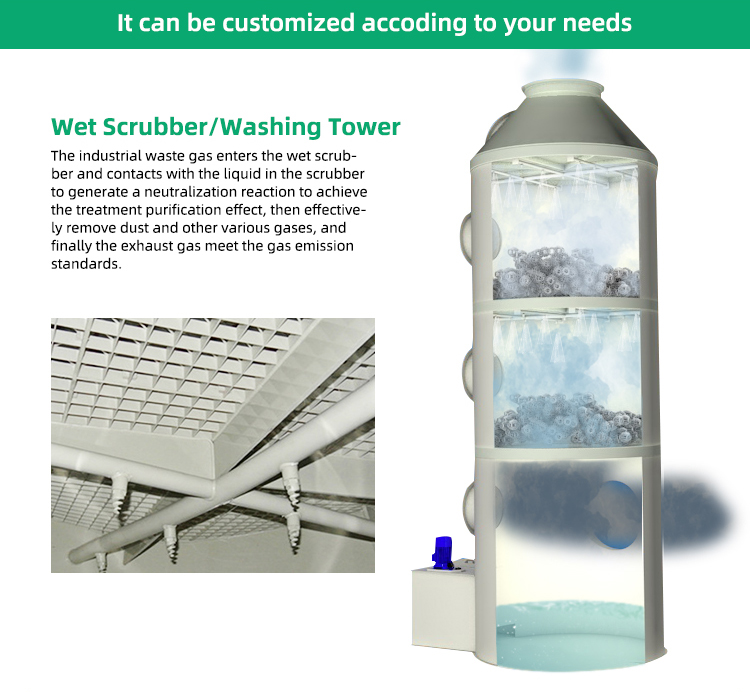
The secret to lasting performance is keeping gas and liquid distribution even over the full service life. In our all‑PP scrubbers, every internal support, distributor, and weld is made from the same corrosion‑proof material. This is why our units demonstrate stable scrubber work for over a decade without degradation. See this engineering in practice by examining our PP packed bed scrubber, built for high‑efficiency acid gas removal.
Key Benefits of PP Scrubbing Systems for Global Compliance
Meets Regional Emission Standards Worldwide
We design scrubbers for factories around the globe. Whether your permit aligns with India’s CPCB limits, the EU BREF/BAT conclusions, Thailand’s PCD, South Africa’s NEM:AQA, or the U.S. EPA wet scrubber monitoring requirements, effective scrubber work is what makes compliance possible. A properly sized PP system delivers consistent outlet concentrations year after year — and we provide emission guarantee data to support your local permit application.
300% Better Corrosion Resistance Protects Long‑Term Operation
As PP material experts, we measure what matters. PP demonstrates 300% better corrosion resistance than 304 stainless steel when exposed to HCl or H₂SO₄ mists. This directly impacts equipment longevity: steel vessels develop pinhole leaks within 18–24 months, allowing untreated gas to bypass the entire treatment process. In contrast, PP stays leak‑free and seamless for over 15 years, ensuring dependable scrubber work throughout its service life. Our industrial wet scrubber shells are homogeneously welded — providing a perfect environment for reliable gas cleaning decade after decade. This also simplifies meeting OSHA permissible exposure limits (PELs) for acid gases, which are far easier to maintain when your equipment is free from hidden leaks.
Lower Maintenance, Longer Life, Fewer Headaches
For plants without large maintenance teams, the numbers tell the story. Our PP scrubbers cut annual maintenance labour by 40% compared to stainless steel, and last 2 times longer than FRP in acid service. No welding repairs, no recoating, no crack sealing — just steady operation with a visual check every 6 months. This independent review on Pollution Engineering confirms polymer‑based scrubbers are preferred for corrosive applications where trouble‑free running is a priority. You can also read our own hidden scrubber costs analysis.
Tell us your exhaust parameters. We will recommend the correct PP scrubber, demonstrate how it delivers dependable scrubber work for your specific gas stream, and quote factory‑direct. Get a Free Technical Proposal →
PP vs SS vs FRP: How Material Choice Affects Equipment Longevity
While the basic operating principle is the same, the vessel’s ability to survive corrosive service determines whether your system keeps running. The table below is built from field data across hundreds of installations.
| Performance Factor | PP Wet Scrubber | SS304 Wet Scrubber | FRP Wet Scrubber |
|---|---|---|---|
| Acid Corrosion Resistance | Excellent — 300% better than SS | Poor — pitting starts in 2 years | Moderate — blistering risk |
| Operational Consistency | Stable for 15‑20 years | Frequent bypass once leaks start | Degradation affects efficiency |
| Yearly Maintenance | 40% lower than SS | High | Moderate |
| Leak Risk Over Time | Minimal — seamless welds | High — pinhole leaks common | Medium |
| 10‑Year Total Cost | Lowest | 2–3x higher | 1.5x higher |
As PP material experts, we often replace failed SS and FRP units across Southeast Asia and the Middle East — not because the underlying scrubber work design was wrong, but because the housing failed.
Types of Wet Scrubbers to Match Your Process
Packed Bed Scrubber — Best for Acid Gases
Gas flows up, liquid flows down over structured packing, and over 99% of HCl, HF, SO₂, or ammonia is absorbed. This configuration is the standard for electroplating and battery plants. Our PP packed bed scrubber uses advanced media to maximise efficiency while keeping pressure drop low.
Venturi Scrubber — Best for Dust and Fumes
High‑speed gas atomises the scrubbing liquid into a fine mist that captures submicron particles. This method is ideal for foundries and metal grinding. We reinforce the PP throat to ensure reliable operation even with abrasive dust.
Horizontal Crossflow Scrubber — Space‑Saving Design
Gas travels horizontally against a vertical spray curtain — same operating principle, much lower height. See our guide to PP scrubber applications for examples of efficient gas cleaning in compact spaces.
How Much Can a PP Scrubber Save?
For a typical electroplating plant moving 10,000 CFM of mixed acid exhaust, a PP wet scrubber costs slightly more upfront than SS, but the payback period is just 18 months. After that, you save through zero vessel rebuilds, 40% lower maintenance, and smoother internal surfaces that cut fan energy by roughly 15%. Over the full 15‑year life, total savings often top $80,000 compared to stainless steel. And you avoid the production downtime that stops all scrubber work until expensive repairs are complete. To size your system precisely, use our PP wet scrubber sizing guide.
Frequently Asked Questions
How does a wet scrubber work step by step?
Dirty gas enters, contacts liquid in a packed bed or spray zone, pollutants transfer to the liquid, clean gas exits through a mist eliminator, and the liquid recirculates. PP construction keeps the process stable for over 15 years.
What pollutants can a wet scrubber remove?
HCl, H₂SO₄, HF, HNO₃, SO₂, NH₃, and particulates. Well‑designed scrubber work guarantees 95–99% removal for the design contaminant.
Does this only work for EPA regulations?
No. Effective gas cleaning meets emission limits globally — from EU BREF to Indian CPCB to Philippine DENR. We provide performance data tailored to your permit.
Why choose PP over cheaper stainless steel or FRP?
PP’s 300% better corrosion resistance and 2x longer life mean lower lifetime cost. PP ensures reliable scrubber work without mid‑life rebuilds.
How do I know which scrubber type fits my plant?
It depends on your pollutant, airflow, space, and budget. Contact our engineers to specify the right type for your needs. Start on our contact page.
Do you support international projects?
Yes. We ship PP scrubbers to over 30 countries, with detailed manuals and remote support — all factory‑direct pricing.
Conclusion
A PP wet scrubber — with 300% better corrosion resistance, a 2x longer lifespan, and 40% lower maintenance — gives you the sustained scrubber work your facility needs without the hidden costs of steel or FRP. Contact our team today to configure the right system for your exhaust.
Get Your Free PP Scrubber Quotation →
Written by our senior process engineer with 10+ years of experience designing wet scrubbers for factories across Asia, the Middle East, and Latin America. Over 500 units commissioned, each designed to meet local emission standards on a practical maintenance budget.


