
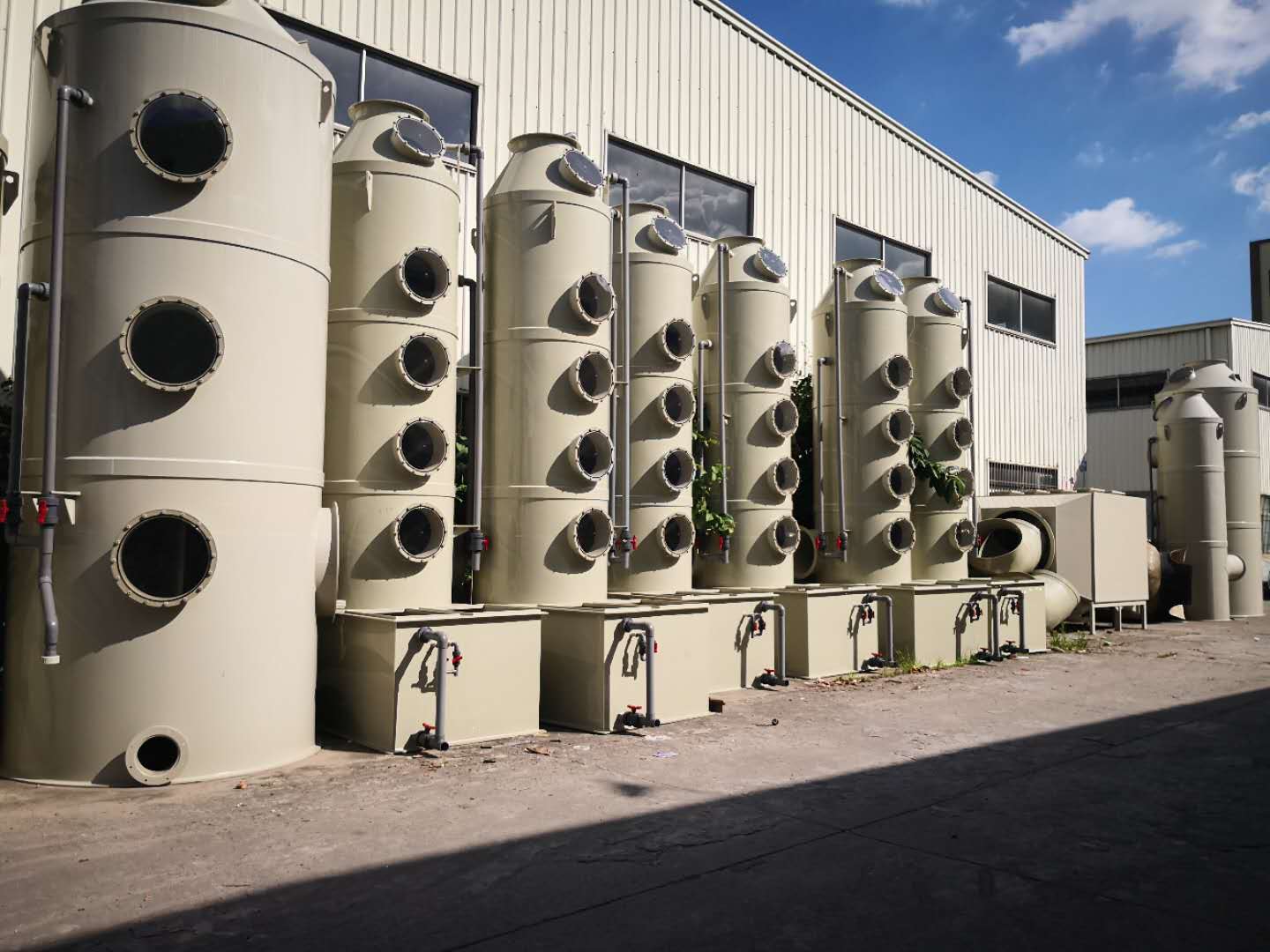
Learning how to size a PP wet scrubber correctly is the foundation of compliant, efficient, and long-lasting industrial waste gas treatment for corrosive, high-pollutant exhaust streams.
Incorrect sizing leads to substandard pollutant removal, non-compliance with 2026 global industrial emission standards, premature PP material degradation, and costly system retrofits.
This guide delivers end-to-end sizing formulas, standard model selection, and compliance best practices for how to size a PP wet scrubber, covering the full 3000-45000m³/h industrial airflow range.

The first key step in sizing a PP wet scrubber is to calculate the design air volume and flow rate.This data sets the main dimensions of the scrubber tower.
Core Design Airflow Formula:
Q_design = Q_actual × 1.15
Where Q_design = design airflow (m³/h), Q_actual = measured maximum exhaust airflow from the production line, and 1.15 = 15% safety factor for industrial variable load conditions.
For the 3000-45000m³/h range, the formula also accounts for duct leakage loss, with an additional 5% margin added for systems with duct runs over 50 meters.
Empty Tower Gas Velocity Formula:
v = Q_design / (3600 × A)
Where v = empty tower velocity (m/s, optimal 1.2-2.0 m/s for PP wet scrubbers), A = cross-sectional area of the scrubber tower (m²).
Accurate pollutant load calculation is non-negotiable when you size a PP wet scrubber to meet 2026 emission standards.
Pollutant Load Formula:
G = Cinlet × Qdesign × 10^-6
Where G = pollutant mass flow rate (kg/h), Cinlet = inlet pollutant concentration (mg/m³).
Required Removal Efficiency Formula:
ηrequired = [(Cinlet – Cemission_limit) / Cinlet] × 100%
Where η_required = minimum removal efficiency (%), Cemission_limit = 2026 local regulatory emission limit for the target pollutant.
Liquid-Gas (L/G) Ratio Calculation:
L/G ratio is set based on required removal efficiency, with 1.5-3.0 L/m³ for acid gas removal, and 2.5-4.0 L/m³ for high-solubility or high-concentration pollutants.
Pollutant solubility and chemical reactivity directly impact how to size a PP wet scrubber for corrosive industrial exhaust.
For water-soluble acid gases (H₂SO₄, HCl, HNO₃): Use the standard L/G ratio and 1.2m packing height per 95% removal efficiency, with PP material selected for full acid and alkali corrosion resistance.
For low-solubility acid gases (SO₂, NO₂): Increase L/G ratio by 30%, add a two-stage packing layer, and size the scrubber tower with a 10% larger diameter to extend gas-liquid contact time.
For alkaline and odorous gases (NH₃, H₂S): Use acidic circulating liquid, set L/G ratio to 2.0-3.5 L/m³, and include a mist eliminator sizing calculation to prevent carryover of corrosive liquid.
The table below delivers standard PP wet scrubber model matching for the 3000-45000m³/h range, aligned with industrial manufacturing standards and 2026 emission requirements.
| Standard Model | Design Airflow Range (m³/h) | Tower Diameter (mm) | Optimal Empty Tower Velocity (m/s) | Recommended Packing Height (m) |
|---|---|---|---|---|
| XC-PP-3000 | 2500-3500 | 800 | 1.2-1.8 | 2.0-3.0 |
| XC-PP-10000 | 8000-12000 | 1400 | 1.3-1.9 | 3.0-4.0 |
| XC-PP-20000 | 18000-22000 | 2000 | 1.4-2.0 | 4.0-5.0 |
| XC-PP-30000 | 28000-32000 | 2400 | 1.4-1.9 | 5.0-6.0 |
| XC-PP-45000 | 40000-45000 | 3000 | 1.3-1.8 | 6.0-8.0 |
Special working conditions require targeted adjustments when you size a PP wet scrubber, to maintain efficiency and PP material reliability.
For inlet pollutant concentration over 2000mg/m³: Increase tower diameter by 10%, add a second packing stage, and increase L/G ratio by 40% to ensure full pollutant absorption.
For inlet gas temperature over 60°C: Add a pre-cooling section to the scrubber design, select UV-stabilized heat-resistant PP material, and increase the safety factor to 20% for airflow sizing.
For explosive or dust-laden exhaust: Add a pre-filter section, size the scrubber with a lower empty tower velocity (1.0-1.5 m/s), and include explosion-proof pressure relief ports in the tower design.
Compliance validation is the final critical step when you size a PP wet scrubber, to ensure alignment with the latest 2026 global industrial emission standards.
All standard models in the selection chart meet the EU Industrial Emissions Directive (IED) 2026 update, US EPA NESHAP standards, and China’s GB37822-2019 volatile organic compound emission control requirements.
For each model, validate that the calculated removal efficiency meets the local emission limit, with documented test reports for inlet and outlet pollutant concentrations required for regulatory inspections.
Additional compliance requirements apply for pharmaceutical, electronics, and chemical manufacturing industries, with stricter emission limits for hazardous air pollutants (HAPs) in 2026.
There are 3 core sizing mistakes that are the leading cause of non-compliance when companies size a PP wet scrubber for industrial use.
The most common mistake is undersizing the design airflow, with no safety factor for variable production loads, leading to excessive empty tower velocity, liquid carryover, and reduced pollutant removal efficiency.
The second critical mistake is using a generic L/G ratio without accounting for specific pollutant solubility, leading to insufficient absorption and failure to meet 2026 emission limits.
The third high-risk mistake is oversizing the scrubber tower, which leads to low empty tower velocity, poor gas-liquid contact, and wasted energy from oversized circulating pumps and fans.
PP material properties directly impact how to size a PP wet scrubber, with specific pitfalls that can lead to premature tower failure.
A common pitfall is ignoring PP material thickness sizing, with insufficient wall thickness for large-diameter towers over 2000mm, leading to structural deformation under negative pressure.
For corrosive high-temperature exhaust, a critical pitfall is using standard PP material instead of reinforced heat-resistant PP, leading to material softening, cracking, and corrosive liquid leakage.
Another common pitfall is undersizing the mist eliminator section, leading to corrosive liquid carryover into the downstream duct and fan, causing premature equipment failure.
Scenario-specific best practices ensure accurate results when you size a PP wet scrubber for different industrial applications.
For chemical plant acid mist exhaust: Use a two-stage scrubber design, size for a minimum 99% removal efficiency, and select full corrosion-resistant PP material for all wetted components.
For electronics manufacturing exhaust: Include a pre-filter for particulate matter, size the scrubber for low-noise operation, and validate compliance with strict local semiconductor industry emission standards.
For pharmaceutical laboratory exhaust: Size the scrubber for variable airflow conditions, include a backup circulating pump, and ensure full compliance with OSHA occupational exposure limits for hazardous chemicals .
Mastering how to size a PP wet scrubber correctly is critical to delivering a compliant, efficient, and long-lasting industrial waste gas treatment system.
By following the standardized calculation formulas, selecting the correct model from the 3000-45000m³/h range, and avoiding common sizing pitfalls, you can ensure your system meets 2026 global emission standards and delivers reliable performance for decades.
Partner with an experienced environmental equipment manufacturer to access custom PP wet scrubber design, full system sizing support, and compliance validation for your specific industrial application.


You must be logged in to post a comment.